TL;DR: Apply minoxidil twice daily to a dry scalp, using 1 mL of liquid (with the dropper) or half a capful of foam. Part your hair, apply directly to the thinning area, spread gently with fingertips, then wash your hands. Wait at least four hours before washing your hair. Most people see meaningful results after three to six months of consistent use.
What is minoxidil and how does it actually work?
Minoxidil is a topical vasodilator originally developed as a blood-pressure pill in the 1970s. Doctors noticed patients growing unexpected hair, researchers ran trials, and the FDA approved a 2% topical solution for androgenetic alopecia in 1988. The 5% solution followed in 1991 for men, and a 5% foam was approved in 2006 [1].
The honest mechanism is still not fully pinned down. The working theory is that minoxidil (or its active metabolite minoxidil sulfate, produced in the follicle by the enzyme sulfotransferase) widens blood vessels around hair follicles, extending the anagen (growth) phase and enlarging miniaturized follicles. How much sulfotransferase activity you have in your scalp predicts how well minoxidil will work for you, which is partly why results vary so much between people [2].
Minoxidil does not block DHT. It does not fix the underlying hormonal cause of male- or female-pattern hair loss. Think of it as a follicle-support drug: it keeps weakened follicles producing hair as long as you keep using it. Stop, and the hair you gained typically sheds within three to four months.
If you want to understand the full picture of what drives hair loss in the first place, what causes hair loss is a good place to start.
What do you need before you start applying?
You need the product, clean dry hair, and a plan for twice-daily consistency. That's basically it. Here's the short shopping list:
Topical liquid (solution): Comes in 2% and 5% concentrations. The dropper delivers exactly 1 mL per dose. The vehicle is usually propylene glycol, which causes scalp irritation in some people.
Topical foam: Comes in 5% concentration. Half a capful (about 1 g) is one dose. The foam vehicle skips propylene glycol, so it's gentler for people with sensitive scalps. This is the format most dermatologists reach for when patients report irritation on the solution [3].
Optional: a fine-tooth comb or parting tool to expose the scalp, mild sulfate-free shampoo for wash days, and a timer or phone alarm to build the twice-daily habit.
You do not need a prescription for any OTC minoxidil concentration (2% or 5% liquid or foam) in the United States. Higher concentrations (like 10% compounded solutions) require a prescription and sit outside FDA-approved labeling.
Keep the product away from eyes and mucous membranes. The FDA label warns specifically against inhaling the foam spray and getting the solution on the face [1].
How to apply minoxidil liquid: step-by-step
The dropper bottle is the classic format and still the cheapest. Here's the exact sequence:
-
Start with a dry scalp. Wet hair dilutes the solution and causes it to run off the scalp instead of sitting on the skin. Wash in the morning if you want, then wait until your scalp is completely dry before applying.
-
Fill the dropper to the 1 mL line. That is one full dose. Do not guess. The FDA-approved dose for men is 1 mL twice daily [1]. Some people use more thinking it'll work faster. It won't. It just wastes product and increases absorption into the bloodstream.
-
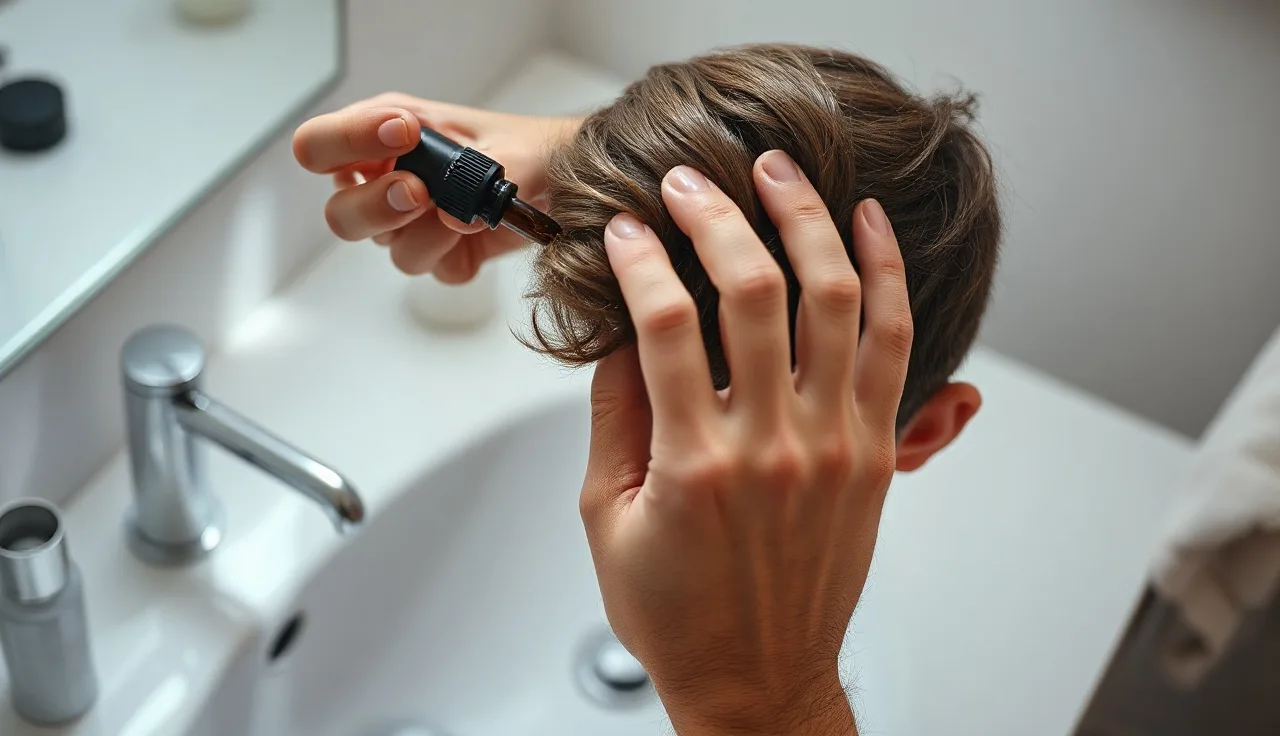
Part your hair to expose the thinning zone. On a receding hairline or diffuse thinning crown, create two or three parts so you can get the dropper tip close to skin. If you're dealing with a receding hairline, focus application on that frontal zone.
-
Apply the solution directly to the scalp in small drops, not to the hair shaft. The active ingredient has to reach the follicle. Dumping it on top of your hair and hoping it trickles down does not work well.
-
Spread gently with your fingertips. Don't rub aggressively. Light spreading helps distribution without pushing the product away from the skin.
-
Wash your hands immediately. Minoxidil absorbed through the palms can cause unwanted facial hair in women and temporary blood-pressure dips in sensitive individuals. Soap and water, not a quick rinse.
-
Let it dry completely. This takes 2 to 4 hours. Do not apply styling products, hats, or helmets on top of wet minoxidil. Do not lie down on fabric you care about. Plan your schedule accordingly.
-
Repeat in the evening. Twice daily is the FDA-approved regimen. Once daily gives partial results for some people but there are no large head-to-head trials comparing the two with statistical rigor.
A 60 mL bottle at standard dosing (1 mL twice daily) lasts exactly 30 days. Budget accordingly.
How to apply minoxidil foam correctly
The foam format is a bit different in technique but the principles are the same. One dose is half a capful, roughly 1 gram of foam [3].
-
Rinse the cap with cold water first. Foam activates with heat. If the cap is warm from your bathroom, the foam starts dissolving before you use it. Run cold water over the outside of the can and cap for a few seconds.
-
Hold the can upside down and dispense onto the cap or your fingertips. Do not spray it directly onto your scalp. It disperses too widely and wastes product.
-
Part your hair to expose the scalp. Same as with the liquid: the foam has to touch skin, not hair.
-
Dab and press the foam into the scalp. Use your fingertips to gently work it into the parted area. The foam melts quickly at skin temperature, which helps absorption.
-
Wash your hands. Not optional.
-
Give it time to absorb. The foam tends to dry faster than the liquid (often 20 to 30 minutes for most people versus 2 to 4 hours), which is a real quality-of-life advantage, especially for morning routines.
Foam costs a bit more than generic liquid solutions, but if you've been skipping doses because the liquid feels heavy or greasy, the foam's faster drying time is worth paying for. Adherence is everything with minoxidil. A product you actually use twice a day beats a cheaper one you use erratically.
How much minoxidil should you use per application?
Stick to the labeled dose. For men, that's 1 mL of liquid or half a capful (1 g) of foam, twice daily. For women, the FDA-approved dose is 1 mL of 2% solution twice daily, or 1 g of 5% foam once daily [1][3].
More is not better. A study published in the Journal of the American Academy of Dermatology noted that systemic absorption increases with dose without proportional scalp benefit, raising the risk of side effects like low blood pressure and scalp irritation [2]. The follicles can only absorb so much.
If you want to see more about how dosing and formulations differ for men specifically, minoxidil for men covers the clinical trial data in detail.
For a look at what happens when things go wrong, minoxidil side effects runs through the full risk profile including the less common cardiac and blood pressure concerns.
When should you apply minoxidil during the day?
Timing matters less than consistency, but the standard recommendation is morning and evening, roughly 8 to 12 hours apart.
Most people find these two windows work: right after the morning shower once the scalp is dry, and again before bed. The "before bed" application has one practical downside: wet minoxidil on a pillow spreads to your forehead and face overnight, which is how some men grow forehead fuzz they did not want. Applying 30 to 60 minutes before sleep and using a satin pillowcase reduces transfer.
Do not apply minoxidil immediately after a hot shower. Hot water opens capillaries and increases systemic absorption. Wait 15 to 20 minutes after the shower, or apply to a completely cooled scalp.
If you miss a dose, skip it and resume your normal schedule. Doubling up at the next application does not compensate and increases irritation risk.
What mistakes ruin minoxidil results?
The most common failure is stopping too early. Minoxidil typically causes an initial shed (telogen effluvium) in the first 4 to 8 weeks as dormant follicles enter a new growth cycle [4]. This shed alarms people and they quit, right before the regrowth would have started. If you want to understand why this shed happens physiologically, telogen effluvium explains the mechanism.
The second most common mistake is applying to wet hair. The solution runs off and never contacts the follicle.
The third is applying to the hair shaft rather than the scalp. Minoxidil does nothing coating your hair strands. The action is at the follicle, which lives under the skin.
Fourth: inconsistency. Missing several doses per week is one of the strongest predictors of poor response. A 2004 study in the Journal of the American Academy of Dermatology found that adherence to the twice-daily regimen was significantly associated with hair count outcomes [5]. Treating minoxidil like a vitamin you take when you remember is a way to spend money on nothing.
Fifth: expecting results in six weeks. The FDA label for Rogaine explicitly states that hair regrowth may take 4 months or longer, and that 4 months of twice-daily use are required before you can fairly evaluate the response [1].
Sixth: using it on a sunburned, broken, or irritated scalp. Damaged skin absorbs dramatically more drug into the bloodstream.
Can you apply minoxidil to a wet or damp scalp?
No. This is one of the clearest instructions on the FDA label and one of the most ignored.
A wet scalp means the solution dilutes and runs. It also means the drug contacts the hair shaft (useless) rather than absorbing into the skin. The FDA label for minoxidil solution states the scalp must be completely dry before application [1].
Foam is slightly more forgiving because its consistency holds it in place longer, but the same principle applies: drier is better. Wait until you can press your fingertip to your scalp and feel no moisture.
How long until you see results from minoxidil?
The honest answer: three to six months for meaningful change, up to twelve months for your full response.
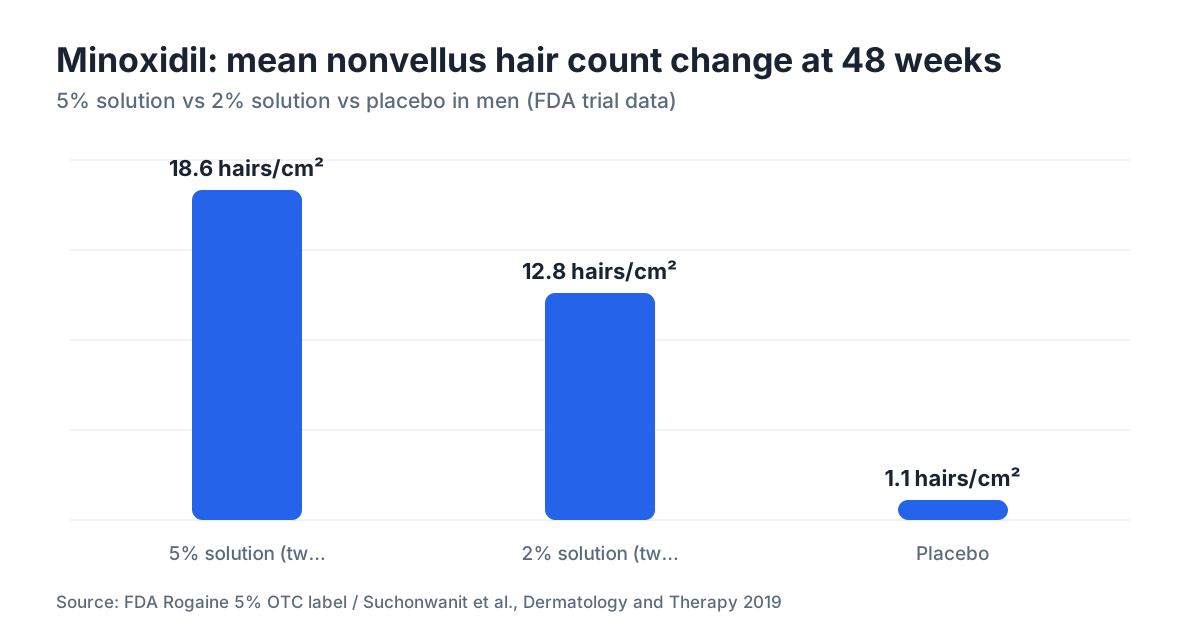
In the 12-month clinical trials submitted to the FDA for 5% minoxidil, men using 5% topical solution showed statistically significant increases in hair count compared to placebo starting at 8 to 16 weeks, with peak response measured at 48 weeks [1]. The 5% solution outperformed the 2% solution with a 45% greater increase in nonvellus hair count at 48 weeks in those trials.
Foam studies show similar timelines. A randomized controlled trial found that 5% minoxidil foam used once daily for 24 weeks produced hair count increases comparable to the twice-daily 2% solution [3].
If you have seen zero change after 12 months of consistent twice-daily use, you are likely a poor sulfotransferase converter, and your dermatologist might consider adding finasteride or discussing other options. The combination of both drugs is sometimes more effective than either alone, and finasteride and minoxidil covers that evidence.
At the 6-month mark, if you're unsure whether what you're seeing is regrowth or wishful thinking, a free AI hair analysis at MyHairline can compare photos over time and give you an objective picture before you make any decisions about your regimen.
Should you wash your hair before or after applying minoxidil?
Before, always. Apply to a clean, dry scalp whenever possible.
Buildup of sebum, styling product, and dry minoxidil residue from earlier applications can form a coating that reduces how much fresh minoxidil reaches the skin. Washing clears that. You do not need to wash before every single application, but the morning application after a shower is ideal, and washing two to three times per week before application is reasonable for most people.
After applying minoxidil, wait at least 4 hours before washing your hair (or before swimming, heavy sweating, or anything that could rinse it off). Four hours is the absorption window cited in the FDA labeling [1]. Some dermatologists suggest waiting overnight for maximum absorption if your schedule allows it.
Is minoxidil safe to use long term?
The available long-term data is generally reassuring for topical use at labeled doses. Minoxidil has been on the market since 1988, and the most common long-term adverse event reported in post-marketing surveillance is scalp irritation and contact dermatitis, not systemic effects [1].
That said, topical minoxidil does have measurable systemic absorption. The FDA label notes that 1.4% to 2% of an applied topical dose is absorbed systemically [1]. For healthy adults using OTC doses, this is not clinically significant. For people with cardiovascular disease or who are pregnant, it is a conversation to have with a doctor first.
The American Academy of Dermatology's guidelines for androgenetic alopecia list topical minoxidil as a first-line treatment for both men and women, with the evidence rated as Grade A (strong) [6].
Oral low-dose minoxidil (0.25 to 5 mg daily) is a newer off-label approach that some dermatologists prescribe. If you're curious about how the oral version compares, oral minoxidil runs through what the current data shows.
Minoxidil is not a cure. Stopping use leads to loss of the hair maintained or regrown by the drug, typically within three to four months. Plan for this being a long-term commitment before you start.
Does minoxidil work better with other hair loss treatments?
For androgenetic alopecia, the combination of minoxidil plus finasteride (a DHT blocker) outperforms either drug alone in most trials. A randomized study published in Dermatology and Therapy found that men using both 5% topical minoxidil and 1 mg oral finasteride had significantly higher hair counts at 12 months than those using finasteride alone [7].
The logic is complementary: minoxidil supports follicle function and extends the growth phase; finasteride reduces DHT and slows the hormone-driven miniaturization. Together they address two separate pathways.
Minoxidil plus microneedling is another combination getting real trial support. A randomized controlled trial in the Journal of the American Academy of Dermatology found that combining 5% minoxidil with microneedling produced significantly greater hair count increases than minoxidil alone at 12 weeks [8].
If you're interested in DHT blockers more broadly or want to understand how supplements fit into an overall strategy, hair loss supplements covers what has evidence and what doesn't.
For men who have progressed beyond what medication can reverse, a hair transplant consultation might also be worth considering. Minoxidil is often used after transplant to support donor and recipient area health.
What should you do if minoxidil irritates your scalp?
Some irritation in the first one to two weeks is common, especially with the liquid solution's propylene glycol vehicle. Mild redness, flaking, or itching often settles on its own.
If irritation persists past two weeks, try switching to the foam version, which does not contain propylene glycol [3]. Many people who cannot tolerate the liquid do fine on foam.
If the foam also causes persistent irritation, redness, or swelling, stop use and see a dermatologist. True contact allergy to minoxidil itself (rather than the vehicle) is less common but real.
Do not apply hydrocortisone cream to the irritated area and then keep using minoxidil on top of it. Steroids thin the skin and increase drug absorption. If you need a steroid for scalp dermatitis, take a break from minoxidil while treating it.
And if you notice any chest pain, rapid heartbeat, sudden weight gain, or swelling of the hands and feet after starting minoxidil, stop and contact a doctor. These are signs of systemic absorption causing cardiovascular effects and require medical evaluation [1].
A full breakdown of side effects, how common each is, and what to watch for is at minoxidil side effects.
If you've been wondering whether your hair loss pattern is the right kind for minoxidil to help, the free AI hair scan at MyHairline can give you a Norwood or Ludwig stage estimate in minutes, which helps you set realistic expectations before committing to a regimen.
Sources
- FDA, Rogaine (minoxidil) 5% topical solution prescribing information / OTC label
- Shorter K et al., British Journal of Dermatology 2008 - minoxidil sulfotransferase activity and response prediction
- Olsen EA et al., Journal of the American Academy of Dermatology 2007 - 5% minoxidil foam once-daily vs 2% solution twice-daily in women
- American Academy of Dermatology Association - Hair loss: diagnosis and treatment overview
- Messenger AG, Rundegren J, British Journal of Dermatology 2004 - minoxidil review of mechanism and clinical evidence
- American Academy of Dermatology, Clinical guidelines for androgenetic alopecia
- Hu R et al., Dermatology and Therapy 2015 - combination minoxidil and finasteride vs finasteride alone in men
- Dhurat R et al., Journal of Cutaneous and Aesthetic Surgery 2013 - microneedling with minoxidil RCT
- Suchonwanit P, Thammarucha S, Leerunyakul K, Dermatology and Therapy 2019 - minoxidil review for men and women
- FDA, Drug approvals and databases - minoxidil approval history