
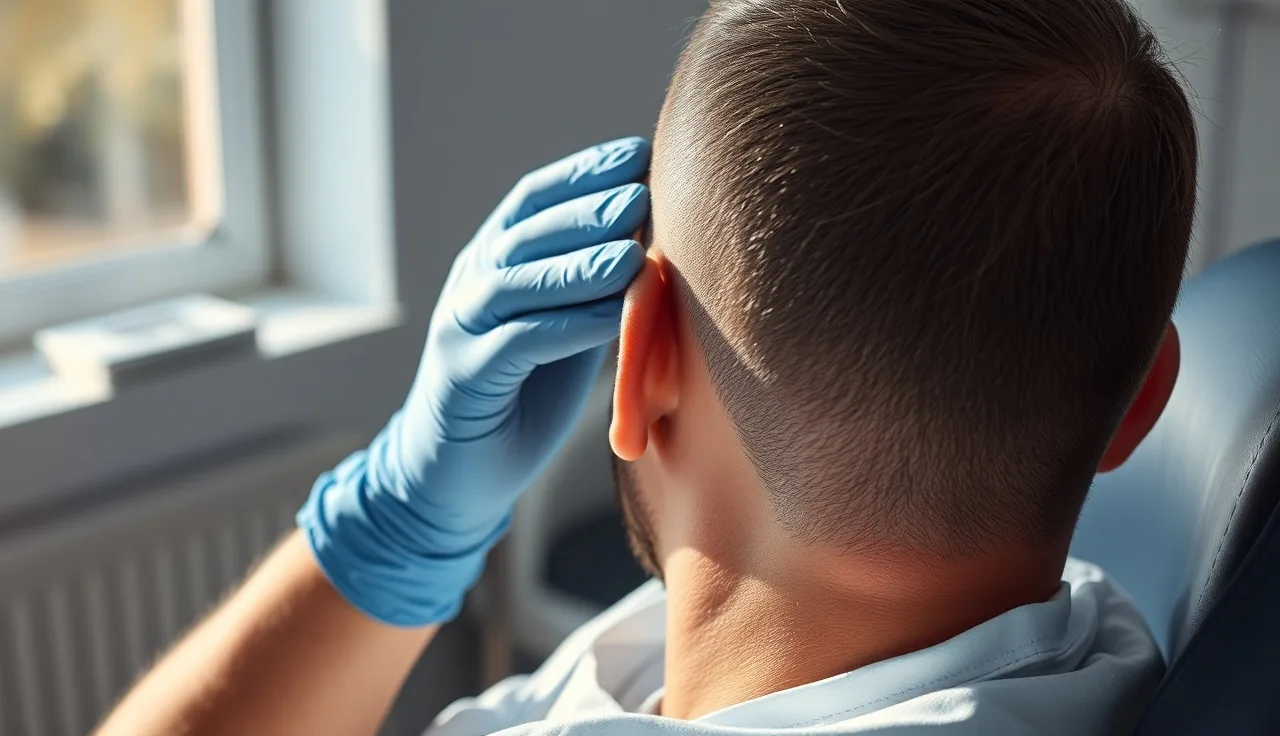
TL;DR: After FUT strip surgery, moderate tightness across the back and sides of your scalp is normal for roughly 2 to 6 weeks. It comes from the skin being sutured together after the donor strip is removed. The feeling peaks in the first 48 to 72 hours, then eases. Severe pain, tightness that worsens after day 3, or numbness that hasn't improved by 3 months means you call your surgeon.
What causes the tightness after FUT surgery?
The tightness is mechanical. FUT removes a strip of scalp, usually from the mid-occipital region between the ears, then closes the wound by suturing the two skin edges together [1]. That closure pulls the surrounding tissue inward, and the scalp does not stretch much, so you feel the tension right away.
Three things decide how tight it gets: how wide the strip was, how naturally lax your scalp is before surgery, and how your surgeon closes the wound. A wider strip means a tighter closure. Surgeons doing a large harvest (often 2,000 to 3,500 grafts in one session) typically remove a strip 1 to 1.5 cm wide and 20 to 30 cm long, which puts real tension on the closure even in patients with good laxity [2].
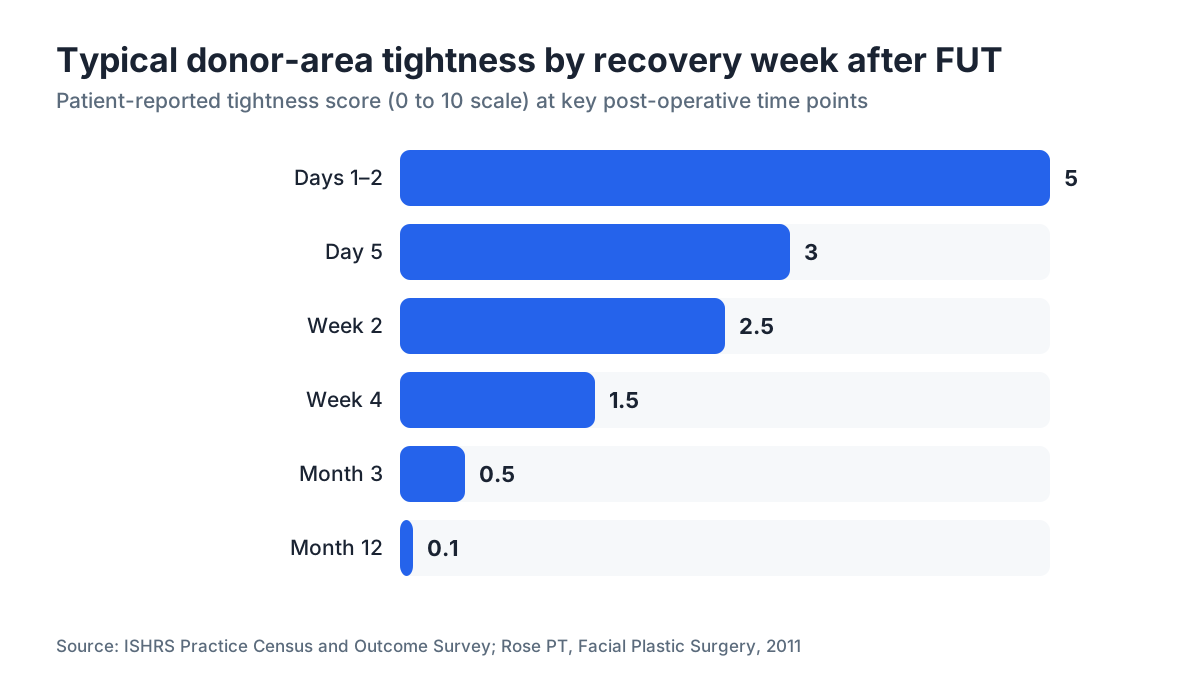
Swelling from the inflammatory response piles on in the first few days. Once that settles, usually by day 5 to 7, most patients describe what's left as a pulled or compressed feeling rather than actual pain.
What level of tightness is normal in the first week?
Moderate tightness in the first 72 hours is expected. It is the most common complaint after FUT, outranking pain in most patient surveys [3]. On a 0 to 10 scale, most patients rate donor-area tightness around 4 to 6 during the first two days, dropping to 2 to 4 by day five.
Standard painkillers should handle it. Most surgeons prescribe a short course of oral pain relief, usually ibuprofen or acetaminophen, and some add a brief muscle relaxant because the occipital muscles can go into mild spasm under the tension.
Here's what is not normal in week one. Tightness that gets worse each day instead of slowly improving. Tightness with a fever above 38.5°C (101.3°F). Tightness so severe you can't sleep even on medication. Those patterns point to wound-edge separation, a hematoma, or early infection, and they need same-day contact with your clinic.
How long does scalp tightness last after FUT?
Two to six weeks for most people. The sensation peaks in the first 48 to 72 hours, then trends down [3]. By week three, the majority of patients rate it 1 to 2 out of 10.
A smaller group, roughly 15 to 20% in published series, reports a residual tight or numb-tight feeling at the donor scar for 3 to 6 months [4]. That one is usually nerve regeneration, not mechanical skin tension. The occipital nerves running through the donor zone get stretched or briefly disrupted during the excision and take months to remodel.
By 12 months, lingering tightness is uncommon. If you still feel a lot at that point, ask your surgeon whether hypertrophic scarring or a stretched scar is the cause, because scar tissue behaves differently from normal skin.
Does scalp laxity before surgery affect how tight you feel afterward?
Yes, and more than any other single factor. Scalp laxity is the biggest mechanical predictor of post-FUT donor tension. Surgeons check it by hand before the procedure, pressing and sliding the scalp to judge how far it will move when pulled together.
Patients with tight scalps (low laxity) feel more tension after closure and carry a higher risk of a widened or raised scar. Some clinics use a scalp relaxer device or a program of scalp exercises for 4 to 8 weeks before surgery to loosen the tissue and cut post-op tension [2]. If your surgeon told you to do pre-op scalp massage and you skipped it, this is the reason it mattered.
With naturally generous laxity, a 2,000-graft session might feel mildly tight for a week or two. The same strip width in a low-laxity patient can drag out to 6 to 8 weeks of tightness and a scar that spreads wide.
What does a normal healing timeline look like week by week?
The table below reflects recovery patterns reported in the clinical literature and standard post-operative guidance from hair restoration societies [3][5].
| Week | Expected tightness level | Other typical symptoms |
|---|---|---|
| 1 | Moderate to high (4 to 6/10) | Swelling, suture discomfort, possible itching |
| 2 | Mild to moderate (2 to 4/10) | Sutures removed (if non-absorbable), less swelling |
| 3 to 4 | Mild (1 to 3/10) | Scar visible but softening, most normal activity resumed |
| 6 to 8 | Minimal (0 to 2/10) | Scar matures, hair shedding from recipient zone common |
| 3 to 6 months | Near zero in most cases | Numbness possible, scar may still be pink |
| 12 months | Should be absent | Scar at final width, new hair growing in |
This is a general guide. Individual variation is real. Someone at a desk all week feels less than someone who went back to manual labor in week two, because physical strain pulls the wound edges apart and drags out the tension.
What are the warning signs that the tightness is not normal?
Most tightness is harmless. A few patterns are not, and they mean you call your surgeon the same day.
One: tightness that is clearly worse on day 3 or later than it was on day 1. Wound tension should trend down, not up. A sudden jump usually means a hematoma (blood pooling under the skin) or early wound dehiscence (the edges separating).
Two: tightness with a visible ridge, lump, or pocket of swelling right at the suture line, as opposed to the diffuse puffiness that's normal in the first 48 hours. That can signal a hematoma, and an expanding hematoma is a surgical emergency.
Three: tightness with fever, pus, or warmth localized to the scar line. Infection after FUT is uncommon, around 1% in most series [3], but it happens, and it changes how the scar heals. Early antibiotics matter.
Four: numbness that is total and stays unchanged past 6 months. Some numbness is normal while cut nerves regrow. Complete permanent numbness of the occipital scalp is not.
Can you do anything to reduce tightness during recovery?
Some things help. Some are neutral. Some make it worse.
What helps: keeping your head elevated at 30 to 45 degrees for the first five days limits fluid pooling and keeps swelling from adding to the mechanical tension [5]. Gentle neck stretches, once your surgeon clears you around the 2-week mark, help the occipital muscles relax. Staying hydrated and skipping alcohol for the first two weeks keeps inflammation from running hotter than it has to.
Neutral or unproven: vitamin E oil on the scar, silicone sheets before the wound is fully closed, oral collagen supplements. None have strong controlled-trial evidence specifically for FUT donor scars, though silicone sheeting has decent evidence for hypertrophic scarring in general dermatology [6].
What makes it worse: strenuous exercise too early (anything pushing your heart rate above 100 bpm in the first two weeks), scratching or picking at the suture line, and sun exposure on the uncovered scar, which drives up inflammation and pigment changes.
If you're weighing medical options for your overall hair loss alongside recovery, finasteride and minoxidil for men are commonly continued or started around the time of a transplant, since shock loss is common after any transplant procedure. The shedding risk is covered at telogen effluvium.
Will the donor scar stretch, and does that affect tightness?
Scar widening is the most discussed long-term cosmetic concern with FUT, and it ties directly to how much tension the closure was under [2][4].
When the wound edges are pulled together under high tension, the body lays down extra collagen to handle the load. That extra collagen can produce a wide, sometimes raised scar. Here's the twist: once the scar matures, usually by 12 months, patients with wide scars often report less ongoing tightness than patients with narrow ones, because a wide scar has spread out to absorb the tension rather than keeping the surrounding skin pulled taut.
Hypertrophic scarring (raised, red, firm) tends to be more painful and feel tighter long-term than a flat wide scar. Keloids in the scalp are rare, under 1% of FUT cases in fair-skinned patients, but the rate climbs in patients with darker skin tones or a personal or family history of keloids [6]. If either applies to you, tell your surgeon before the procedure.
If your scar does stretch or raise, the options are triamcinolone (steroid) injections, laser therapy, or scar revision. Each is a separate procedure you'd discuss at your 12-month follow-up.
How does FUT tightness compare to FUE recovery?
FUT and FUE feel different after surgery, and the honest answer is they aren't really comparable sensations.
FUE (follicular unit extraction) has no linear incision and no suture line. Individual follicles are punched out in a scattered pattern [8]. Most FUE patients call their donor area sore and tender for 5 to 10 days, but the tight, pulled feeling that defines FUT recovery is mostly gone.
The trade-off is real. FUT can deliver more grafts per session for many patients, causes less follicle transection in skilled hands, and leaves a linear scar that hides if you keep your hair a reasonable length [11]. FUE leaves scattered small circular scars that are usually invisible unless you shave to the skin. Neither wins outright. Your choice comes down to how many grafts you need, how you wear your hair, and your surgeon's read on your scalp. A broader overview is at hair transplant.
Still deciding, and want to understand your loss pattern before you commit? The free AI scan at MyHairline gives you a baseline read on your Norwood stage ahead of your consultation.
When should you call your surgeon versus wait it out?
Surgeons want to hear from you when something's wrong. But most post-FUT clinics also field a lot of anxious calls about sensations that are completely normal. Knowing which camp you're in saves everyone time.
Call the same day if: tightness is acutely worsening after day 2, you have a fever above 38.5°C (101.3°F), there's visible swelling or a growing lump along the suture line, you can see the wound edges separating, or you have pus or foul-smelling drainage.
Wait and monitor, then raise it at your next scheduled visit, if: tightness is slowly improving but still there at week 3 or 4, you have mild itching along the scar line (that's healing), or you notice a numb or tingly patch that is shrinking rather than growing.
Log it and mention it at your 3-month follow-up if: you still feel a band of tightness or numbness at 3 months, or the scar looks wider than your surgeon described. Both are manageable, but your surgeon needs to see them in person.
What questions should you ask your surgeon before FUT about expected tightness?
The pre-op conversation is where expectations get set. Get it right and you'll make far fewer panicked calls in week two.
Ask directly: How many grafts are you planning to harvest, and what strip width does that need? What's your read on my scalp laxity? For patients with similar laxity and strip size, how long do yours usually report tightness lasting? What closure technique do you use, and do you use a trichophytic closure (it can improve scar visibility)?
Ask about activity restrictions too, because they feed straight into tightness. Most surgeons restrict strenuous exercise for 2 weeks and heavier lifting for 3 to 4 weeks [5]. Knowing that going in beats finding out on day 10 when you want to get back to the gym. Better for your scar, better for your relationship with your surgeon.
If you're also managing ongoing loss with medication, ask about timing. Some surgeons want patients stable on finasteride and minoxidil for at least a year before a transplant so you know what your baseline pattern looks like. Understanding what causes hair loss in your own case also helps you judge whether a transplant alone is enough or whether medical management alongside it makes sense.
Is there anything about FUT recovery that most people don't know going in?
A few things catch patients off guard.
The tightness often feels worst when you look down. Bending your neck stretches the occipital region and pulls on the closure. It's not harmful, just uncomfortable, and most patients start avoiding downward glances in the first week without thinking about it. Keep your phone and reading material at eye level.
You may sleep through the worst of night one. Most clinics send you home with enough medication to get through it, and many patients say the first morning is when they really notice how tight it feels, because the anesthesia and sedation have fully worn off by then.
Tingling or shooting sensations at 6 to 10 weeks are almost always nerve regeneration, not infection or damage. The sensory nerves in the occipital region grow back at roughly 1 mm per day [7]. It feels strange, sometimes pins and needles, sometimes brief electric zaps, and it's a sign healing is going the way it should.
One more. The recipient area at the front and top, where grafts went in, can also feel tight and swollen in the first week, and forehead swelling can be dramatic. That's a separate thing from donor tightness, driven by fluid tracking forward under the scalp, and it clears on its own within 5 to 7 days for most people. Cold compresses on the forehead (never the graft sites) and sleeping elevated help. If you've been reading up on a receding hairline and wondering whether a transplant fits your pattern, that homework also sets realistic expectations about exactly which area is going to swell.
Sources
- Bernstein RM, Rassman WR. Follicular Unit Transplantation. Dermatologic Clinics, 1999
- Pathomvanich D, Imagawa K, eds. Hair Restoration Surgery in Asians. Springer, 2010 (donor-site tension and scalp laxity chapter)
- International Society of Hair Restoration Surgery (ISHRS). Practice Census and Outcome Survey
- Rose PT. The latest innovations in hair transplantation. Facial Plastic Surgery, 2011; 27(4):366-377
- American Academy of Dermatology (AAD). Hair Transplant: Post-Procedure Care
- Gold MH et al. Evidence-based treatment of keloids with intralesional corticosteroids and silicone sheeting. Journal of Drugs in Dermatology, 2014
- Burnett MG, Zager EL. Pathophysiology of peripheral nerve injury. Neurosurgical Focus, 2004; 16(5):E1
- Rassman WR et al. Follicular unit extraction: minimally invasive surgery for hair transplantation. Dermatologic Surgery, 2002; 28(8):720-728
- FDA. Approved Drug Products: Finasteride 1mg (Propecia) Label
- FDA. Approved Drug Products: Minoxidil Topical Solution Label
- ISHRS. FUT vs FUE: Patient Decision Guide