TL;DR: Draw 1 mL of liquid minoxidil into the dropper, part your hair to expose the scalp, release the liquid directly onto skin in small deposits across the thinning area, then spread with your fingertips. Let it dry 3-4 hours before washing. Done right, one dropper-full covers the average vertex or hairline without drips or waste.
Why does applying liquid minoxidil correctly actually matter?
Most people underestimate how much technique affects results. The FDA-approved dose for 5% liquid minoxidil is 1 mL applied twice daily, and that number comes from the clinical trials that got the drug approved [1]. Applying more doesn't speed up regrowth. Applying less, or applying it to your hair shaft instead of your scalp, means the active ingredient never reaches the follicle.
Hair follicles sit in the dermis of the scalp. Minoxidil works by widening blood vessels around the follicle and prolonging the anagen (growth) phase. If the liquid pools on your hair and dries before it touches skin, you've wasted the dose and the money.
The dropper that comes with most liquid minoxidil is a 1 mL graduated dropper. It's simple. But there's a consistent set of mistakes people make, and fixing them takes less than two minutes.
What does 1 mL actually look like in the dropper?
Most dropper applicators shipped with Rogaine and generic equivalents are marked at 0.5 mL and 1.0 mL. The 1 mL line is the maximum fill mark, and it usually sits about two-thirds to three-quarters up the plastic barrel, not completely full.
Draw the liquid slowly by squeezing the rubber bulb before inserting the tip into the bottle, then releasing it once submerged. Squeeze and release while the dropper is above the liquid and you'll pull air into the barrel and have to start again. One clean draw usually fills to 1 mL without overfilling.
If your dropper has no markings, 1 mL is roughly 20 drops from a standard pharmacy dropper. Counting drops is tedious and imprecise. Spend a couple of dollars on a 1 mL graduated dropper from any pharmacy instead. The precision matters more than you'd think over months of twice-daily dosing.
| Dropper marking | What it means | Use case |
|---|---|---|
| 0.5 mL | Half dose | Not studied for efficacy in standard androgenetic alopecia [1] |
| 1.0 mL | Full labeled dose | Standard twice-daily application per FDA labeling [1] |
| No markings | Approximate by drop count (approx. 20 drops = 1 mL) | Buy a graduated dropper for accuracy |
How do you part your hair to expose enough scalp?
This is the step most people skip, and it causes the most waste. Press a full dropper against a thick mat of hair and the liquid spreads across the shafts and evaporates before it touches skin.
Use a fine-tooth comb or the tail of a styling comb to make a part straight through the center of the thinning area. For vertex (crown) loss, make a cross-shaped part so you have four quadrants of scalp exposed. For a receding hairline, make 2-3 parallel parts from front to back, spaced about an inch apart.
You don't need to saturate the whole scalp. The target zone is the area of active thinning plus about half an inch around its border, where follicles are still present but miniaturizing. Applying further back than that does nothing, because the follicles there aren't under androgenetic pressure [2].
Wet or damp hair makes this harder. Apply to dry hair so the parts stay open and the liquid runs toward skin rather than getting soaked up by the shaft.
What is the correct dropper application technique, step by step?
Here is the sequence that keeps waste down and puts the dose on your scalp.
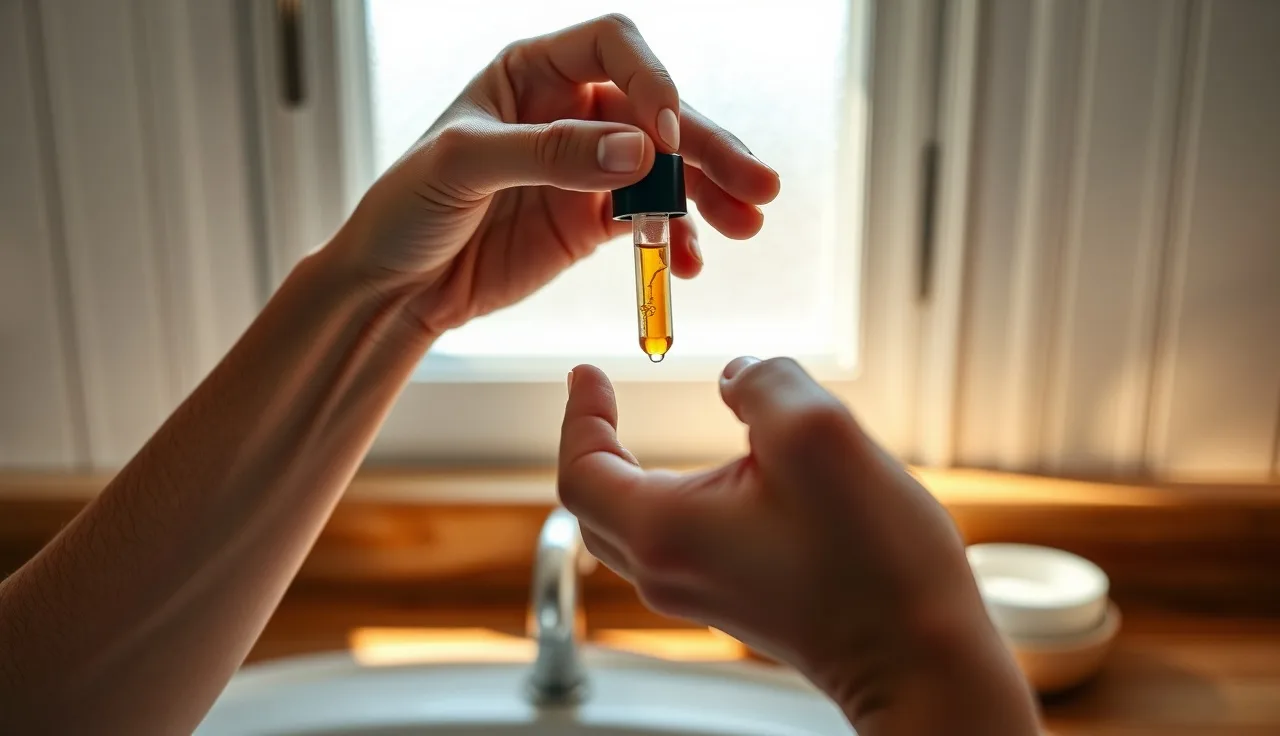
First, fill the dropper to the 1 mL mark as described above. Hold it horizontally or at a slight downward angle to keep liquid from rushing to the tip before you're ready.
Second, position the tip at one end of an exposed part. Touch it gently to the skin, not the hair. Release a small amount, maybe 4-5 drops, into that spot. Move an inch along the part and release another small deposit. Continue until you've run the length of one part.
Third, repeat along each part you've made until the dropper is empty. You should end up with a grid of small liquid dots across the thinning area.
Fourth, use the pads of your fingertips (not nails) to spread the liquid from each dot outward. This moves it across the scalp surface without lifting it off the skin. Some people skip this step, but it cuts the chance of liquid running down your forehead or neck.
Fifth, wash your hands right away. Minoxidil absorbed through the skin of your hands can cause unwanted hair growth on your palms or forearms, and if you touch your face before washing, it can trigger facial hair growth in areas you don't want it [1].
Sixth, let the scalp dry completely before going to bed, putting on a hat, or applying any other product. The FDA label for 5% minoxidil says to allow the scalp to dry before covering it [1]. Lie down too soon and the liquid transfers to your pillow instead of your scalp.
How long does minoxidil take to dry on the scalp?
Liquid 5% minoxidil usually takes 2-4 hours to dry completely under normal indoor conditions. The alcohol base (most liquid formulations use ethanol or propylene glycol as solvents) evaporates within 15-30 minutes to the touch, but the scalp keeps absorbing the active ingredient for several hours afterward [3].
The practical rule: don't wash your hair or shower for at least 4 hours after applying, and don't apply right before bed unless you're certain you won't transfer liquid to a pillow inside that window. If bedtime application is unavoidable, apply at least an hour before lying down, and use a satin pillowcase rather than cotton, which soaks up liquid faster.
Rain and sweat inside the drying window matter too. Heavy exercise right after applying is a common reason people don't see results, because the product gets wiped off before absorption finishes.
How do you avoid getting minoxidil on your face or neck?
This is a real concern, not vanity. Minoxidil promotes hair growth wherever it touches skin consistently [1]. Unwanted facial hair, particularly on the forehead and temples of women, is one of the more reported side effects from topical use [4].
A few things help. Apply with your head tilted slightly forward so gravity pulls liquid toward the crown rather than your hairline and forehead. Keep each deposit small so you're not flooding a part with liquid that runs. Stay an inch away from the hairline edge unless the hairline itself is your target. If it is, apply those deposits last and use the least amount that covers the skin.
Treating a receding hairline with minoxidil? Read up on what's happening at the follicle level first. The article on receding hairline covers what's actually driving recession and whether topical treatment alone is enough.
After applying, take a dry paper towel and lightly blot (don't rub) along your hairline to catch any liquid that has migrated. Blotting removes runoff without pulling the applied dose off your scalp.
Does it matter whether you apply minoxidil morning or night?
Twice daily is what the clinical trials tested and what the FDA label specifies [1]. The exact timing, morning versus night, isn't what drives results. Consistency and spacing are. Roughly 12 hours apart gives the scalp time to absorb each dose fully before the next one lands.
Most people find morning application tricky because the dry time collides with styling or work. Evening application before dinner, rather than right before bed, solves the pillow-transfer problem. The morning dose can go on right after showering, assuming hair is dry, which fixes the styling conflict too: apply first, let it dry, then style.
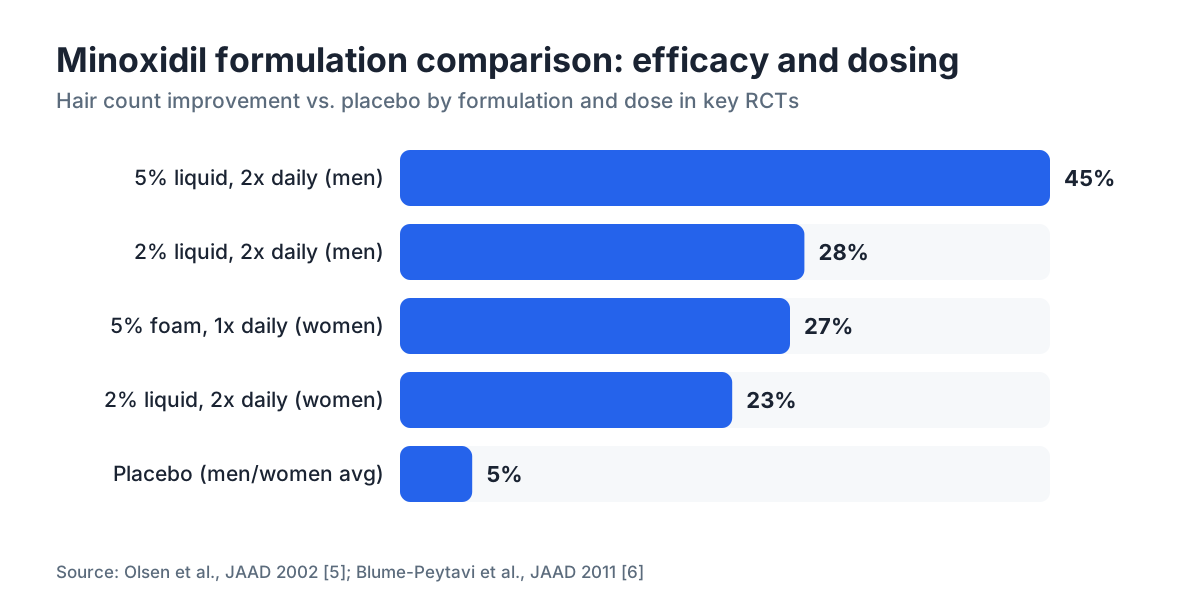
If twice daily genuinely doesn't fit your life, the data on once-daily 5% minoxidil is limited, but some dermatologists use it as a fallback. One study found once-daily 5% solution still produced measurable regrowth, though less than the twice-daily group [5]. This is not the labeled dose, so talk to a doctor before choosing it on purpose.
Why is liquid minoxidil more wasteful than foam, and when is it worth it?
Minoxidil foam was developed partly because liquid formulations kept losing product to hair shafts and running off the scalp. Foam sits where you place it and doesn't flow. A 2011 study in the Journal of the American Academy of Dermatology found that 5% foam applied once daily produced results comparable to 2% solution applied twice daily in women, largely because the foam targeted the scalp better [6].
Liquid is cheaper per milliliter in most markets, it's easier to cover large thinning areas, and it works well for people with very little hair left in the target zone (less hair to block the dropper's path to skin). Foam is better for people with thick or dense hair who struggle to reach the scalp.
If you keep losing product to hair, that's a sign to switch to foam or improve your parting technique. Buying liquid and losing a third of each dose to your hair shaft is not actually cheaper than buying foam.
For more on how liquid minoxidil fits into a full treatment picture for men specifically, the article on minoxidil for men breaks down efficacy data by Norwood stage.
What common mistakes kill your results without you realizing it?
A few patterns show up again and again.
Applying to wet hair is the biggest one. Wet hair soaks up liquid like a sponge, and minoxidil that goes into the hair shaft does nothing for the follicle.
Touching the application site within an hour. Scratching your scalp, adjusting your hair, or putting on a hat all move liquid away from where it needs to be.
Skipping doses and then doubling up the next day. Minoxidil doesn't work like an antibiotic. Doubling a dose doesn't make up for a missed one. It just piles more liquid on your scalp at once, which adds irritation risk without adding benefit [1].
Expecting results in four weeks. Hair growth cycles mean most people don't see measurable changes before three to six months, and the FDA trials that established efficacy ran for 48 weeks [1]. Quitting early because nothing has changed is the most common reason people conclude minoxidil doesn't work for them.
Using expired product. Minoxidil degrades over time. Check the expiration date, and if the liquid has changed color or has sediment, replace the bottle. Generic liquid is cheap enough that stretching an old bottle to save a few dollars makes no sense.
Shedding in the first 4-8 weeks is almost certainly telogen effluvium, a documented and temporary response to minoxidil. It doesn't mean the product is failing.
Is there anything you can do to know if your hair loss type will actually respond to minoxidil?
Minoxidil is FDA-approved for androgenetic alopecia, meaning pattern hair loss driven by genetics and androgens [1]. It has the strongest evidence for crown (vertex) thinning in men and diffuse thinning in women. Evidence for hairline recession is weaker, though it's widely used off-label there.
If your hair loss comes from something else, minoxidil may do nothing or make the picture harder to diagnose. Alopecia areata, scarring alopecias, and nutritional deficiencies all produce hair loss that can look like pattern loss but responds to different treatments [2]. A proper diagnosis before committing to two years of twice-daily application is worth the cost of a dermatology visit.
Want a faster first look at your pattern before seeing a doctor? MyHairline's free AI scan (/scan) lets you photograph your scalp and get an instant Norwood or Ludwig stage classification. It's not a diagnosis, but it tells you whether your pattern is consistent with androgenetic alopecia.
To understand what's driving the loss biologically, the what causes hair loss article covers the DHT pathway, the role of genetics, and why some people respond to minoxidil and others don't.
Should you combine minoxidil with finasteride or other treatments?
The combination of minoxidil and finasteride has a stronger evidence base than either drug alone for androgenetic alopecia in men. A 2015 randomized controlled trial in Dermatology and Therapy found the combination group had significantly greater hair count increases than either monotherapy group over 12 months [7].
Finasteride addresses the androgenic cause (by blocking the enzyme that converts testosterone to DHT), while minoxidil acts on the follicle directly through a separate mechanism. They're not redundant. For men with pattern loss, most dermatologists treat this combination as the current standard of care.
For women, finasteride is used off-label and is not appropriate for women who are pregnant or may become pregnant, because of teratogenicity risk. The finasteride and minoxidil article walks through the specific trial data and who's a good candidate.
Some people also ask about oral minoxidil as an alternative to the dropper entirely. Low-dose oral minoxidil (typically 0.625-2.5 mg/day for women, 2.5-5 mg/day for men) is increasingly prescribed off-label and removes the application-technique problem completely, though it carries different side effect considerations.
How do you store liquid minoxidil to keep it effective?
Store the bottle at room temperature, roughly 59-77°F (15-25°C), away from direct sunlight and heat sources [8]. Bathroom medicine cabinets are fine unless your bathroom gets very humid and hot during showers, in which case a bedroom drawer is better.
Don't refrigerate it. Cold can thicken propylene glycol-based solutions, which makes the dropper harder to fill accurately and changes how the liquid spreads on the scalp.
Keep the cap tightly closed between uses. Ethanol-based solutions evaporate faster than you'd expect, and an uncapped bottle left on a counter loses volume and potentially concentration over days to weeks.
If you've bought in bulk, keep unopened bottles sealed until you need them. Once open, use the bottle within a few months and watch the expiration date.
Sources
- FDA, Rogaine (minoxidil) 5% topical solution prescribing information / OTC label
- American Academy of Dermatology, Hair Loss: Diagnosis and Treatment
- Messenger AG, Rundegren J. Minoxidil: mechanisms of action on hair growth. British Journal of Dermatology. 2004;150(2):186-194.
- American Academy of Dermatology, Minoxidil for Hair Loss: Side Effects
- Olsen EA, et al. A randomized clinical trial of 5% topical minoxidil versus 2% topical minoxidil and placebo in the treatment of androgenetic alopecia in men. Journal of the American Academy of Dermatology. 2002;47(3):377-385.
- Blume-Peytavi U, et al. A randomized, single-blind trial of 5% minoxidil foam once daily versus 2% minoxidil solution twice daily in the treatment of androgenetic alopecia in women. Journal of the American Academy of Dermatology. 2011;65(6):1126-1134.
- Hu R, et al. Combined treatment with oral finasteride and topical minoxidil in male androgenetic alopecia: a randomized and comparative study. Dermatology and Therapy. 2015;5(1):81-87.
- FDA, Drug Storage and Disposal, Consumer Information
- Suchonwanit P, Thammarucha S, Leerunyakul K. Minoxidil and its use in hair disorders: a review. Drug Design, Development and Therapy. 2019;13:2777-2786.
- Rogaine 5% Minoxidil Topical Aerosol (foam) FDA labeling via DailyMed, National Library of Medicine