TL;DR: Apply minoxidil to a dry scalp, then wait at least 4 hours before washing. Let it dry a few minutes before adding any other product. Twice daily is the FDA-approved schedule for most topical formulas. Sequence decides whether it works: minoxidil goes on bare scalp first, everything else after.
What does minoxidil actually do, and why does timing matter so much?
Minoxidil is a vasodilator. It widens blood vessels near the scalp, which increases oxygen and nutrient delivery to shrinking follicles and pushes them from a resting phase back into active growth [7]. The FDA cleared the topical 2% solution for women and the 5% solution for men as over-the-counter treatments for androgenetic alopecia (pattern hair loss) in the 1980s and 1990s [1].
The drug works by direct contact with scalp skin. Sounds obvious. But it carries a big practical consequence: if anything sits between minoxidil and your scalp, absorption drops. Conditioner residue, styling pomade, dry shampoo, heavy oils, all of them build a partial barrier. The order of your routine is almost as important as doing the routine at all.
Timing matters for a second reason. Minoxidil takes roughly 15 to 30 minutes to move through the stratum corneum into the dermis where follicles live [7]. Wash it off too soon and you've thrown the dose away. Apply it to wet hair and you dilute the concentration while stopping the solution from sitting cleanly on skin. Neither is a small slip. They are the two most common reasons people try minoxidil for six months, see nothing, and decide it failed, when the real problem was technique.
Understanding what causes hair loss in the first place helps you set expectations you can actually live up to. Minoxidil doesn't block the hormonal signals that drive pattern loss. It buys time and density. That's genuinely useful. It's not a cure.
Should you apply minoxidil before or after washing your hair?
After. Always after. The FDA-approved labeling for Rogaine and its generics instructs users to apply to a dry scalp [1]. "Dry" means towel-dry at minimum, but fully air-dried is better because the scalp's surface has settled and any leftover shampoo or conditioner has rinsed clear.
Here's the working rule: wash, dry your hair fully, wait 5 to 10 minutes if you can, then apply. After application, wait at least 4 hours before you get it wet again. The FDA label tells you to "allow the solution to dry" and avoid washing the hair for at least four hours after applying [1]. Plenty of people misread this, apply minoxidil, and shower minutes later. That rinses away a real chunk of the dose.
Wash your hair every day? Build the shower into your morning and apply the moment your scalp is dry. Wash every other day or less? The 4-hour window is easy to clear before bed. Both schedules work. Consistency wins, not the clock on the wall.
One exception is worth flagging. The 5% minoxidil foam (the Rogaine Foam line) was tested on dry hair and the label advises the same dry-scalp approach [1]. The foam tends to sit easier on sensitive skin because it contains no propylene glycol, a common irritant in the liquid [2]. If the solution leaves your scalp dry or flaking, the foam is the first thing to try.
How long should you wait after applying minoxidil before styling or adding other products?
Four hours is the conservative answer, and it lines up with manufacturer guidance and most dermatology advice [1]. That's long enough for full absorption under normal conditions. Almost nobody actually waits four hours before getting dressed, so here is what real life allows.
A practical minimum is 2 to 4 minutes for the foam, which dries fast, and about 10 to 15 minutes for the solution, which leaves a tacky film longer. Once the product has dried visibly, you can add a light styling product without wrecking absorption.
The thing that matters most: don't apply minoxidil and then pull on a hat, helmet, or tight headwear. Occlusion while the product is still wet forces it into the fabric instead of your scalp. This is one reason nighttime application is so popular. You apply, it dries while you read, and nothing presses on it.
Keep high-alcohol products off fresh minoxidil too. Many scalp tonics and some dry shampoos are heavy on alcohol, which can dissolve the minoxidil film before absorption finishes. If you use a scalp serum or tonic, put it on before minoxidil, or hours after.
Can you use minoxidil with conditioner and other styling products?
Yes, if you sequence it. Rinse-out conditioner is fine as long as it's washed out fully before minoxidil goes on. Leave-in conditioner is the trickier one. A silicone-heavy leave-in on the scalp before minoxidil acts as a partial barrier. Keep leave-in on the lengths and ends only, off the scalp, and you're clear.
Gels, waxes, and sprays all coexist with minoxidil. The order is simple: minoxidil first on bare scalp, let it dry, then style. Reversing that is the main mistake people make. Load your scalp with product in the morning, then drop minoxidil on top, and you're applying it to a product layer instead of skin.
Dry shampoo is the hardest one here because people spray it straight onto scalp skin between washes. If you use dry shampoo, apply minoxidil to a clean scalp the night before, and save the dry shampoo for the next morning. That beats trying to sort out competing layers of dry shampoo and minoxidil on the same scalp.
For the full picture on minoxidil side effects, including the scalp irritation that product interactions can make worse, that article walks through the dermatology literature in detail.
What's the right application technique to maximize coverage without waste?
The FDA-approved dose for the 5% solution is 1 mL twice daily, so 2 mL total per day [1]. The foam is half a capful twice daily. Both the dropper (solution) and the foam are designed to deliver about that dose per application.
For the solution, part your hair over the thinning area, hold the dropper close to the scalp, and spread the dose across the target zone instead of dumping it in one spot. Use your fingertips to move it gently. Don't rub hard. That works it into hair rather than onto skin. For diffuse crown thinning, start at the center and work outward in a spiral.
For the foam, dispense it onto your fingers while your hands are cold (it dissolves fast in heat), then dab and work through the thinning area section by section.
A few habits quietly cut your results:
- Applying to wet hair (dilutes concentration and runs off)
- Using more than the recommended dose because "more is better" (it isn't, the excess just drips off)
- Coating the hair shaft instead of the scalp skin
- Skipping doses more than once or twice a week on a regular basis
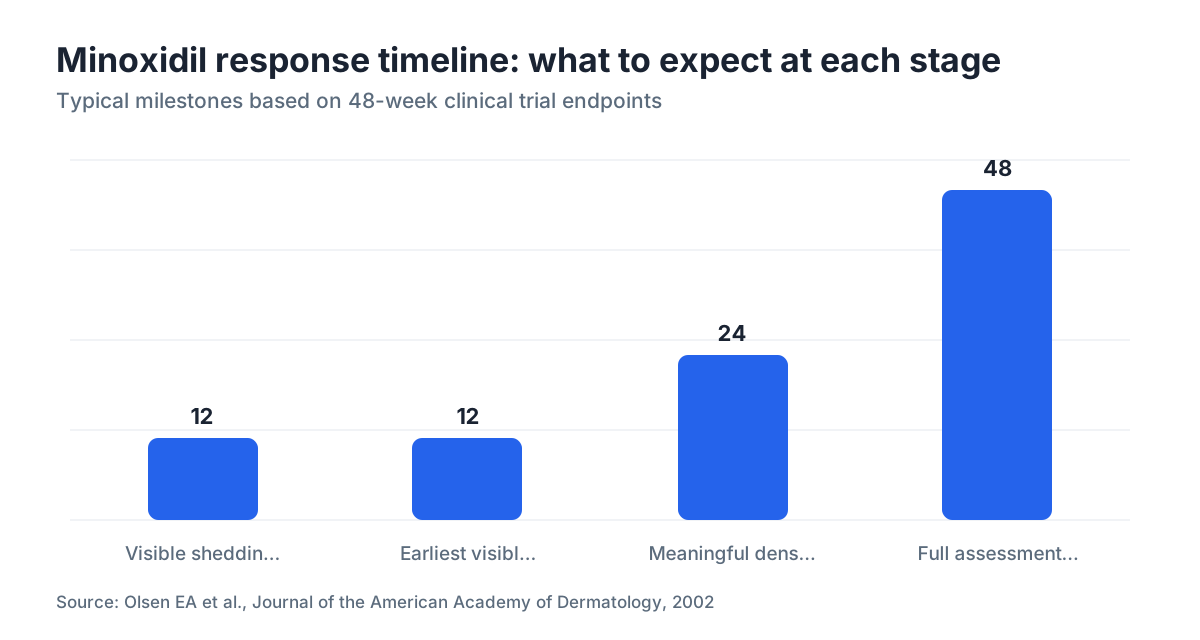
Consistency over 12 months beats any single perfect application. A 48-week randomized controlled trial in the Journal of the American Academy of Dermatology (Olsen et al., 2002) found twice-daily 5% minoxidil solution produced significantly greater hair counts than once-daily application or placebo [3].
How does minoxidil fit into a routine that already includes finasteride or other treatments?
Minoxidil and finasteride work through different mechanisms. Minoxidil supports circulation and stretches the growth phase at the follicle. Finasteride lowers dihydrotestosterone (DHT), the hormone that shrinks follicles in pattern loss. They're commonly used together, and the combination is generally considered more effective than either drug alone [4].
Already on oral finasteride? Adding topical minoxidil is easy. Finasteride is a once-daily pill, usually taken the same time each morning, and it doesn't clash with topical minoxidil on scheduling. Just fold the minoxidil into your post-shower routine.
If you use finasteride and minoxidil together, the main job is keeping each treatment on schedule. Miss a minoxidil dose now and then and you're fine. Missing finasteride has a longer recovery cycle because DHT suppression takes time to rebuild.
Oral minoxidil is showing up more as an alternative to topical, especially for people who find the liquid messy or hard to slot around styling. Low-dose oral minoxidil (0.625 to 5 mg daily for women, 2.5 to 5 mg for men, both off-label) removes the scalp-sequencing problem entirely [10]. The tradeoff is a different side effect profile, including possible fluid retention and hypertrichosis (unwanted body hair). Talk it through with your prescribing doctor.
Using topical DHT blockers like topical finasteride or ketoconazole shampoo? Apply ketoconazole shampoo on wash days, rinse well, then apply minoxidil post-shower as usual. Topical finasteride goes on the scalp directly and should go on after minoxidil has dried, or at a separate time of day, so neither drug interferes with the other's absorption.
What happens to minoxidil if you work out, sweat heavily, or swim?
Sweat and water within the first 4 hours of application cut how much drug absorbs [1]. That's a real problem for morning exercisers.
The simplest fix: apply minoxidil at night after your evening shower. By morning the drug has had 6 to 8 hours to absorb. You can work out, sweat, shower afterward, and none of it touches the dose. Apply your second daily dose after that post-workout shower.
Swimmers, same logic. Apply well before any pool or ocean session, or wait until after. Chlorine doesn't meaningfully degrade minoxidil on the scalp. Rinsing it off before absorption finishes is the actual issue.
If your schedule makes twice-daily timing genuinely hard, once daily at night still produces results, though the clinical evidence is stronger for twice-daily dosing [3]. Don't quit the regimen over logistical friction. Move the timing instead.
Why are you shedding more hair after starting minoxidil, and should you stop?
This is one of the top reasons people quit minoxidil in the first 4 to 12 weeks, and it's almost always the wrong call. The early shedding is well-documented and has a name: telogen effluvium triggered by the treatment itself [5].
Here's the mechanism. Minoxidil speeds up the shift of resting follicles into active growth. To start a new growth cycle, the old telogen (resting) hair has to fall out first. So you get a temporary spike in shedding, usually starting around week 2 to 8 and lasting 4 to 8 weeks. Once that phase clears, new growth begins and density builds.
Not everyone sheds. Roughly 1 in 4 users report it, but it's common enough that you should plan for it [5]. Stop minoxidil during this window and you interrupt the new growth cycle and lose the benefit. You also tend to shed again when you restart.
For the full mechanics, the telogen effluvium article explains the hair cycle and why this shedding is temporary. If shedding runs past 3 months, or comes with scalp inflammation, see a dermatologist. That's not a normal minoxidil response.
How long does it take to see results, and how do you track progress honestly?
Six months minimum before you can fairly judge whether minoxidil is working for you, and most guidelines say 12 months for a full read [1][3].
Hair growth cycles run in phases that span months. Minoxidil stretches the anagen (growth) phase and recruits resting follicles, but those recruited follicles still have to run a full cycle before the new hairs are long enough to see or photograph. The dermatology literature uses 24 to 48 week endpoints for efficacy for exactly this reason [3].
A tracking method that actually works: take a standardized photo every 4 weeks. Same lighting, same angle, same part, same camera distance. Top-down view for crown thinning, a fixed side profile for hairline recession. Don't judge by how your hair looks on a random Tuesday. Humidity, lighting, and styling make day-to-day comparisons worthless.
For an objective baseline before you start, an AI-assisted scalp analysis gives you a documented starting point. The free MyHairline AI scan takes standardized photos and maps density, so you have a real benchmark instead of leaning on memory.
If at 12 months you see no change or ongoing progression, talk options with a dermatologist. You may be a non-responder (roughly 40% of men see modest or no response to minoxidil alone, per Olsen et al. [3]), or your loss pattern may need a different primary treatment.
| Checkpoint | What you're likely to see |
|---|---|
| Week 0-4 | No change, possible early shedding |
| Week 4-12 | Shedding may peak; some fine vellus regrowth possible |
| Month 3-6 | Visible new hair growth for most responders |
| Month 6-12 | Improved density; best window for comparison photos |
| Month 12+ | Maintenance phase; continued use required to hold results |
What if you forget a dose or stop using minoxidil for a while?
Miss one dose now and then and your progress holds. Follicles don't snap back because of a single skipped application. The damage comes from stopping altogether, or from missing doses for weeks at a stretch.
Minoxidil doesn't treat the underlying cause of pattern loss. It manages the follicle environment. Stop, and DHT-driven miniaturization picks back up (if that's your cause), and within 3 to 6 months most of the density you gained is lost [1][3]. This isn't the drug "stopping working." It means the drug needs ongoing use to hold what it built.
Been off it for 2 to 4 weeks and want to restart? Just resume the normal twice-daily schedule. You might get a brief shedding episode again as follicles re-recruit. That's expected. Longer gaps of several months may take more time to rebuild to your previous density.
Frequent travelers find the solution easier to pack (small bottles) but often skip doses when their schedule scrambles. The foam can be harder to travel with in pressurized luggage. A pre-packed travel-size supply removes most of that friction.
Are there any hair care practices that actively interfere with minoxidil working?
A handful are worth flagging.
Heat styling straight over fresh minoxidil is a bad idea. Blow-drying the application area on high heat right after you apply speeds up evaporation before the solution absorbs. If you blow-dry, do it before applying, or on low heat only after.
Heavy scalp exfoliation with strong physical or chemical scrubs on the same day as minoxidil can raise skin permeability enough to push absorption above the intended level. Not dangerous for most people, but if you notice more scalp redness or a systemic effect like headache or lightheadedness, scale back the exfoliation.
Some people pile tretinoin (retin-A) onto the scalp alongside minoxidil to boost penetration. Tretinoin does increase minoxidil absorption, but the combination can cause real irritation and the safety data here is thin. Don't combine them without a dermatologist supervising.
Hair extensions, tight braids, and weaves that pull on the scalp already cause traction alopecia. Minoxidil won't undo damage from ongoing mechanical stress. The traction itself has to be addressed. For loss patterns that aren't purely genetic, the what causes hair loss article covers traction alopecia and other non-androgenetic causes.
For men dealing with a receding hairline, applying minoxidil to the frontal hairline takes a more targeted touch (small amounts along the edge, careful to avoid the face) and, honestly, tends to give more modest results than crown application. The frontal scalp has a denser population of androgen receptors, and minoxidil alone often isn't enough there without a DHT-blocking agent alongside it.
When is minoxidil not enough, and what else should you consider?
Minoxidil works best in early-to-moderate loss. For men at Norwood 5 or above, or women at Ludwig grade 3, the area of loss is usually too large for topical minoxidil to fully cover on its own [3][6].
Stayed consistent for 12 months and still watched progression continue? Have a straight conversation with a dermatologist or hair restoration specialist about adding finasteride (for men), low-level laser therapy, platelet-rich plasma (PRP), or looking into a hair transplant. In most cases these aren't replacements for minoxidil. They're additions to it.
Men with a family history of early, aggressive loss starting in their late teens or early 20s tend to move fast. Minoxidil alone may not keep pace. Starting finasteride early, in your 20s before significant loss, and running minoxidil alongside it, has the strongest evidence base for slowing progression [4].
For women the picture shifts. Finasteride is generally not recommended during reproductive years because of teratogenicity risk. Minoxidil 2% or the 5% foam are the main topical options [8]. If you're a woman with unexplained loss, rule out thyroid disease, iron deficiency, and polycystic ovarian syndrome before you pin it all on pattern loss [8]. Minoxidil won't fix those.
If you want a clearer picture of where you stand before committing, the MyHairline AI scan maps your current density and helps show whether your loss is diffuse or patterned, which changes which treatments are likely to help most.
For men who want minoxidil framed inside male pattern loss specifically, the minoxidil for men article goes deeper on dosing, Norwood staging, and realistic expectations.
Sources
- FDA, Rogaine (minoxidil) OTC Drug Facts Label
- American Academy of Dermatology, Minoxidil overview
- Olsen EA et al., Journal of the American Academy of Dermatology, 2002, 48-week randomized trial of 5% vs 2% minoxidil and placebo
- Kaufman KD et al., Journal of the American Academy of Dermatology, 1998, finasteride and minoxidil combination evidence
- Mounsey AL, Reed SW, American Family Physician, 2009, Hair Loss: Diagnosis and Management
- National Institutes of Health, MedlinePlus, Androgenetic alopecia
- Suchonwanit P et al., Drug Design, Development and Therapy, 2019, Minoxidil and its use in hair disorders
- Dinh QQ, Sinclair R, Clinical Interventions in Aging, 2007, Female pattern hair loss
- Rossi A et al., Dermatologic Therapy, 2012, Minoxidil and ketoconazole combined use
- Sinclair RD, International Journal of Dermatology, 2010, Low-dose oral minoxidil