
TL;DR: A board-certified dermatologist is the best starting point for hair loss in the US. They diagnose, prescribe, order bloodwork, and do biopsies. Trichologists are unregulated in most countries and cannot prescribe anything. See a dermatologist first. If access is limited, a trichologist can help with scalp care and lifestyle triggers, but every treatment plan still needs a licensed prescriber behind it.
What is the difference between a dermatologist and a trichologist?
A dermatologist is a licensed medical doctor. That means four years of medical school, at least one year of internship, and three more years in a dermatology residency. In the US, board certification through the American Board of Dermatology requires passing both a written and an oral exam. Dermatologists diagnose any skin or scalp condition, prescribe drugs, order labs, and perform biopsies. Hair loss sits squarely in their scope. [1]
A trichologist is something else entirely. The word sounds clinical, but it describes someone who completed a course, often privately run, focused on hair and scalp health. In the United States, the United Kingdom, and most other countries, trichology is not a regulated profession. No government licensing body oversees it. The International Association of Trichologists and the Institute of Trichologists are the main credentialing groups, but finishing their programs gives no legal authority to prescribe medication or diagnose medical conditions. [2]
That gap matters. The treatments with the strongest evidence behind them, finasteride, minoxidil for men, and oral minoxidil, all need a prescriber, or at minimum a recommendation built on a real diagnosis.
None of this makes trichologists useless. A good one runs a detailed scalp analysis, talks through nutrition and lifestyle, and sometimes catches patterns a rushed GP misses. The catch is consistency. Trichology training ranges from serious multi-year programs to weekend certificates. A dermatologist's training does not vary like that.
When should you see a dermatologist for hair loss?
Sooner than most people do. People often wait a year or more after noticing hair loss before seeing a specialist, and that wait costs them options, because most treatments work best while follicles are still alive and miniaturized rather than gone for good. [3]
See a dermatologist if any of these apply:
- Your hairline has moved back noticeably, or you see more scalp than you used to.
- You are shedding more than feels normal. Losing 50 to 100 hairs a day is typical; steady shedding well above that deserves a look. [3]
- You have patches of loss rather than diffuse thinning.
- Your scalp itches, burns, or shows scaling, redness, or sores.
- Significant hair loss runs in your family and you want to get ahead of it.
- You are considering a hair transplant and need a baseline evaluation.
Patchy loss needs a dermatologist fast. Alopecia areata, tinea capitis (a fungal infection), and scarring alopecias can all look alike, and can all mimic androgenetic alopecia. Guess wrong and you treat the wrong disease.
Want a rough read on your pattern before the appointment? The free AI scan at MyHairline (myhairline.ai/scan) maps your hairline against Norwood scale stages, so you walk in with something concrete instead of "my hair feels thinner." No photo tool replaces a biopsy or trichoscopy done in a clinic, but it gives your doctor a starting point.
When might a trichologist actually be useful?
There are real scenarios where a trichologist earns their fee.
Access is the big one. In the US, the wait for a new-patient dermatology visit runs anywhere from several weeks to more than six months depending on where you live. [4] If your hair is falling out fast and you cannot get in for months, a trichologist trained in scalp assessment can rule out obvious dietary or lifestyle contributors and flag anything that looks medically urgent so you know to push harder for a doctor.
Second: chronic conditions where the diagnosis is already settled. If a dermatologist has confirmed androgenetic alopecia and you are stable on finasteride, a trichologist who specializes in scalp care can help with dandruff, seborrheic dermatitis, or product buildup, none of which needs a prescriber.
Third: a second set of eyes on unexplained shedding. Telogen effluvium gets missed by generalists constantly. A trichologist who takes a thorough history of recent illness, stress, surgery, diet changes, and thyroid symptoms might spot a trigger a busy GP skipped past. They still cannot order the bloodwork to confirm it, so a physician has to close the loop.
The rule here is simple. Use a trichologist as a supplement, never a substitute.
What credentials should you look for in a hair loss specialist?
For a dermatologist, the floor is board certification through the American Board of Dermatology (ABD). Verify it at certificationmatters.org, run by the American Board of Medical Specialties. [5] Some dermatologists add fellowship training in hair disorders and use the title "hair loss specialist" or "trichology-trained dermatologist." In that context the label means a medical doctor with extra clinical focus, not the non-medical certification.
The American Hair Loss Association keeps a directory of physicians it considers credible for hair loss. [11] The American Academy of Dermatology has a "find a dermatologist" tool that filters by specialty interests, including hair disorders. [3]
For a trichologist, the top credential in North America is the Certified Trichologist (CT) designation from the International Association of Trichologists (IAT), or a Fellowship from the Institute of Trichologists in the UK. Neither confers prescribing rights, but both signal a structured curriculum rather than a weekend seminar. Ask exactly which body issued the certification and how many hours of supervised clinical training it required.
Red flags no matter the title: anyone who leads with selling you a proprietary product line before examining you, anyone who promises to "cure" androgenetic alopecia, and anyone charging hundreds of dollars for a scalp scan before offering any diagnostic framework.
Knowing what causes hair loss, the genetic, hormonal, and nutritional pieces, helps you judge whether a specialist is asking the right questions in the first place.
How do you find a hair loss specialist dermatologist near you?
Start with the AAD's dermatologist finder at aad.org, which filters by location and self-reported focus areas including hair and scalp disorders. [3] Then confirm the physician is actually board certified using the ABMS tool at certificationmatters.org. [5]
Academic medical centers are worth knowing about. Most major university hospital systems run dedicated hair disorder clinics. They see the most complex cases and are usually the best resource for scarring alopecias, alopecia areata, and unclear presentations. Wait times run longer, but the evaluation goes deeper.
Teledermatology has grown a lot and is now a real option for many hair loss cases. Platforms staffed by board-certified dermatologists can get you an evaluation in days rather than months. The limit is physical: trichoscopy (dermoscopy of the scalp) and punch biopsy cannot happen remotely, so a complex case eventually needs an in-person visit.
Call ahead and ask three questions before booking:
- Does this physician treat hair loss as a real part of their practice, or only occasionally?
- Do they perform trichoscopy in the office?
- Can they prescribe finasteride, and have they managed patients on it long-term?
That third question reveals a lot. A dermatologist who has never prescribed a DHT blocker for androgenetic alopecia, or who ships every such case off to an endocrinologist, is a generalist dermatologist with thin hair experience, not a hair specialist.
What does a hair loss specialist appointment actually involve?
A good first visit follows a predictable shape. Expect a detailed history: onset, rate of loss, family history, recent illnesses, medications, supplements, diet changes, stress events. Then a scalp exam, including trichoscopy if the office has it. Trichoscopy uses a handheld dermatoscope that can separate androgenetic alopecia from alopecia areata from scarring conditions by the look of individual follicles and the scalp surface.
Bloodwork is common for new patients, especially women. A standard hair loss panel usually covers complete blood count, thyroid-stimulating hormone (TSH), ferritin (more useful than total iron), vitamin D, and sometimes DHEA-S and testosterone if hormonal alopecia is on the table. Ferritin gets overlooked constantly. Many labs flag a ferritin of 12 as "normal," but hair clinicians often target levels above 40 to 70 ng/mL for good follicle cycling, a position backed by dermatology literature even though the exact threshold is still debated. [6]
A punch biopsy, removing a small core of scalp for histology, comes in when the diagnosis stays uncertain after visual inspection and trichoscopy. It sounds worse than it is. Quick, done under local anesthetic, and it leaves a scar smaller than a pencil eraser.
By the end you should have a diagnosis, a treatment plan with honest expectations, and a timeline for reassessment. If a specialist cannot give you at least a working diagnosis, ask why, and ask what testing would settle it.
How much does seeing a hair loss specialist cost?
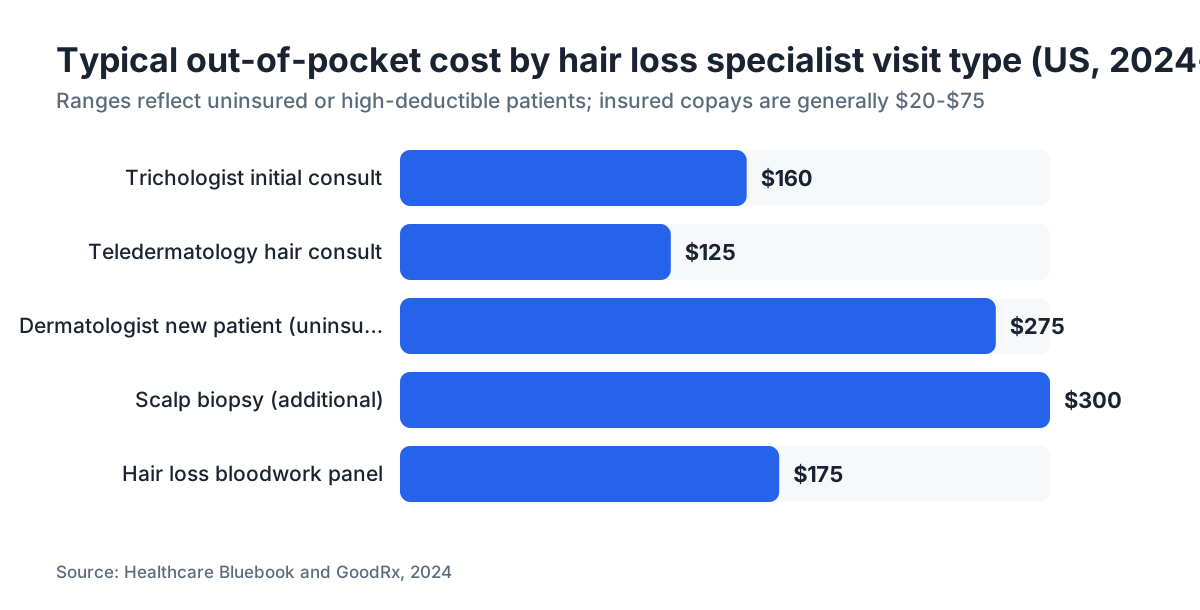
It depends heavily on your insurance and which specialist you see. The table below reflects typical US prices for 2024 to 2025. These are ranges from published cost data and patient surveys; your real number depends on location, plan, and what gets done during the visit. [4][7]
| What you are paying for | Typical out-of-pocket cost (US) |
|---|---|
| Dermatologist new patient visit (insured) | $20 to $75 copay |
| Dermatologist new patient visit (uninsured) | $150 to $400 |
| Scalp biopsy (additional) | $100 to $500+ |
| Hair loss bloodwork panel | $50 to $300 depending on tests |
| Trichologist initial consultation | $75 to $250 (rarely covered) |
| Teledermatology hair consultation | $50 to $200 |
Insurance usually covers a dermatologist visit coded as medically necessary. Androgenetic alopecia is sometimes coded as cosmetic, which changes coverage, but conditions like alopecia areata or scarring alopecias are typically covered. Ask the billing office how the visit will be coded before you show up.
Trichology consultations are almost never covered, because trichology is not a recognized medical profession in the US.
Here is the perspective that matters. Generic finasteride runs roughly $10 to $30 a month at most US pharmacies, so the medication costs far less than the visits over time. [8] Read up on minoxidil side effects and the combined finasteride and minoxidil approach before your appointment so you can hold a real conversation instead of nodding along.
Can a GP or primary care doctor treat hair loss instead?
Yes, technically, with real limits. A primary care physician can prescribe minoxidil and finasteride and can order basic bloodwork. For straightforward male-pattern baldness with no complicating factors, a GP willing to engage with hair loss is a legitimate option, mostly for access reasons.
The problem is time and depth. Most GPs spend 15 minutes or less per patient. Hair loss diagnosis benefits from trichoscopy, which most GP offices do not have. Telling apart the types of loss, especially diffuse shedding that could be telogen effluvium versus female-pattern hair loss versus early alopecia areata, genuinely benefits from dermatology training.
If your GP says "it's probably just stress, come back in six months" without examining your scalp or ordering labs, push back or go straight to a specialist. Six months is a long time to lose hair when something treatable is driving it.
Are there specific specialists for women with hair loss?
Women do best with a dermatologist who has explicit experience in female hair disorders. The pattern, the causes, and the treatment approach all differ from men. Female androgenetic hair loss (female-pattern hair loss, or FPHL) usually shows up as diffuse thinning over the crown rather than a receding hairline, and the workup almost always includes hormonal labs. [9]
For women, endocrinologists and gynecologists sometimes co-manage cases because of the hormonal overlap, particularly with polycystic ovary syndrome (PCOS), thyroid disorders, and perimenopause. A good dermatologist either orders the relevant labs directly or coordinates with another specialist.
Finasteride and dutasteride are not FDA-approved for women and are teratogenic, meaning dangerous in pregnancy. Topical minoxidil at 2% or 5% is the main FDA-approved option for women. [10] Low-level laser therapy and platelet-rich plasma (PRP) also get used, with modest evidence. The treatment picture for women is genuinely more complicated, and a wrong diagnosis carries higher stakes, which is one more reason to find a dermatologist who sees a lot of female hair loss patients.
What questions should you ask at your hair loss consultation?
Walking in prepared changes what you get out of the visit. Ask these:
- What is the most likely diagnosis from what you can see today, and how confident are you?
- What tests (biopsy, bloodwork) would change your diagnosis or plan?
- Is my hair loss progressing, stable, or reversible right now?
- What is a realistic 12-month outcome with treatment?
- What are the side effects of anything you are recommending?
- If I start this, when should I expect results and how will we measure them?
- Any supplements or over-the-counter products worth adding or avoiding? (Reading up on hair loss supplements first helps you judge the answer.)
- What happens if I do nothing?
That last one gets skipped too often. Knowing the natural path of untreated hair loss is how you decide whether a medication's side effect profile is worth it for your situation.
Men focused on their hairline pattern should know their receding hairline Norwood stage going in. The MyHairline free AI scan at myhairline.ai/scan gives you a stage estimate before you book, so the conversation starts with a shared reference point.
Are online hair loss clinics a legitimate alternative to in-person specialists?
For many people, yes. The telehealth wave built a real category of online services staffed by licensed prescribers (NPs, PAs, and MDs) who focus on hair loss. They prescribe finasteride and minoxidil, review photos for pattern assessment, and order labs in most states.
The honest ones are upfront about their limits. No trichoscopy, no biopsy, no evaluation of scalp conditions that need a physical exam. If a service claims it can diagnose every type of hair loss from photos alone, be skeptical.
Where they genuinely help: younger men with obvious androgenetic alopecia who want to start finasteride without a four-month wait for a dermatology appointment. Topical minoxidil needs no prescription at all, so the real value of these services is prescription finasteride plus clinical oversight.
Where they fall short: women with unexplained diffuse shedding, anyone with scalp symptoms beyond simple thinning, and anyone who already tried first-line treatments and got nothing. Those cases need an in-person dermatologist.
Sources
- American Board of Dermatology, Certification and Training Requirements
- International Association of Trichologists, About Trichology
- American Academy of Dermatology, Hair Loss Overview
- Association of American Medical Colleges, Physician Workforce Data
- American Board of Medical Specialties, Certification Matters Verification Tool
- Trost LB et al., Journal of the American Academy of Dermatology, 2006 - The diagnosis and treatment of iron deficiency and its potential relationship to hair loss
- MedlinePlus, US National Library of Medicine, Hair Loss
- GoodRx, Finasteride Price Guide
- Olsen EA, Journal of the American Academy of Dermatology, Female pattern hair loss
- US Food and Drug Administration, Drugs information portal
- American Hair Loss Association, Physician Referral Directory