

TL;DR: Hair loss from Ozempic is almost always telogen effluvium triggered by rapid weight loss and calorie restriction, not the drug itself. It typically peaks around 3-6 months in and resolves on its own within 6-12 months once weight stabilizes. Eating enough protein, staying patient, and talking to a dermatologist about minoxidil are the three most evidence-backed steps.
Why does Ozempic cause hair loss in the first place?
Ozempic (semaglutide) doesn't appear to attack hair follicles directly. The FDA's prescribing label for semaglutide lists alopecia as an adverse reaction reported in clinical trials, but the mechanism is almost certainly indirect [1]. Here's what's actually happening. When you lose weight fast, your body reads the caloric deficit as physiological stress. That stress pushes hair follicles out of the growth phase (anagen) and into the resting phase (telogen), all at once. Two to four months later, they shed together. That's telogen effluvium, and it's the same thing that happens after surgery, childbirth, a high fever, or a crash diet [2].
In the STEP 1 trial of semaglutide, participants lost an average of 14.9% of body weight over 68 weeks [3]. That kind of loss is a well-documented trigger. The shedding isn't telling you something is permanently wrong. It's telling you your body noticed a big change.
There's a smaller second possibility worth knowing about. GLP-1 receptor agonists suppress appetite hard, and some people eating very little end up short on protein, iron, zinc, or biotin. Nutritional gaps can drive shedding on their own, and they're fixable. This is what causes hair loss in the nutritional category, and it stacks on top of the stress-related shedding in a way that makes the total loss feel worse.
How common is hair loss with Ozempic and weight-loss drugs?
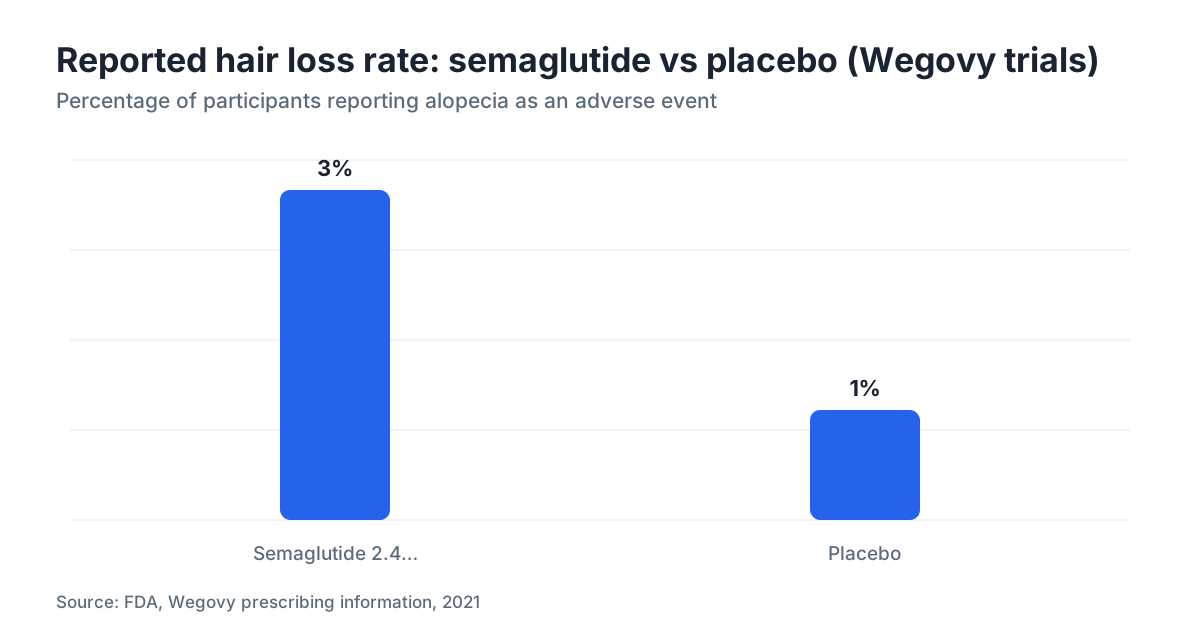
Numbers vary by study design. A 2023 analysis of FDA Adverse Event Reporting System (FAERS) data found hair loss reported at a meaningfully higher rate among GLP-1 receptor agonist users than the background population, with semaglutide and tirzepatide both implicated [4]. In the clinical trial setting, alopecia showed up in roughly 3% of participants on semaglutide 2.4 mg (Wegovy) versus about 1% on placebo [1].
That 3% figure is probably an undercount. Trials capture formally reported adverse events. Real-world surveys of people using these medications put self-reported hair thinning closer to 10-20% among those who lost significant weight quickly. The honest answer is nobody has great population-level data yet. These drugs are too new, and hair shedding is notoriously underreported in trials.
What the data does confirm: people who lose more weight, faster, shed more. The drug dose matters less than the weight-loss rate it produces.
How long does Ozempic hair loss last?
Classic telogen effluvium runs its course in 6 to 12 months after the trigger resolves [2]. Once your weight stabilizes and your nutritional stores recover, follicles cycle back into anagen and new growth appears. You'll often see fine, short hairs regrowing at the scalp surface before the overall density fully returns.
The worst shedding usually peaks around month 3 to 5. If you're losing clumps in the shower and it's month 4 of Ozempic, that's not a sign things are getting permanently worse. That's the peak the biology predicts.
If shedding is still heavy past month 9, or if you're seeing patterned thinning at the crown or temples specifically, book a dermatologist visit. Ozempic can unmask underlying androgenetic alopecia (genetic hair loss) that was already in progress but hadn't become visible yet. Rapid weight loss, by lowering circulating hormones and adding stress, can speed up a genetic trajectory that would have shown up eventually anyway. Those two things need different approaches.
What can you actually do to stop or reduce the hair loss?
No single pill stops telogen effluvium cold. But some things genuinely reduce severity and speed recovery, and some are a waste of money. Here's the honest breakdown.
Get enough protein. This is the single highest-leverage move. Ozempic cuts appetite dramatically, and plenty of users eat 600-900 calories a day without meaning to. At that intake, protein almost always falls short. Hair is mostly keratin, which is a protein. The RDA for protein is 0.8 g per kg of body weight, but people in active weight loss likely need 1.2-1.6 g per kg to hold onto muscle and support hair follicle function [5]. Track it for a week. Most people are shocked how far below target they land.
Check your iron and ferritin. Iron deficiency is one of the most common and most overlooked drivers of shedding, especially in women. Ask your doctor for a full iron panel including ferritin, more than hemoglobin. A ferritin below 30 ng/mL is commonly linked to telogen effluvium, and many clinicians aim for above 70 ng/mL in patients with active shedding [6].
Consider minoxidil. Topical minoxidil (2% or 5%) is FDA-approved and has good evidence for extending the anagen phase and prompting regrowth. It won't stop the telogen effluvium mechanism directly, but it can shorten the recovery window and improve density on the way back. Minoxidil for men has the most trial data, and it's used off-label in women too (2% or 5%, applied carefully). Oral minoxidil at low doses (0.625-2.5 mg daily) has growing evidence and is worth raising with a doctor, especially if topical formulas bother your scalp. Read more on oral minoxidil if you want to understand the difference.
Slow your weight loss rate if you can. This is uncomfortable advice, but it's real. The faster you lose weight, the harder the telogen effluvium hit. If your doctor agrees and your health allows, targeting 0.5-1% of body weight per week rather than 1.5-2% can meaningfully soften the shedding. Talk to your prescribing physician before adjusting your dose.
Don't waste money on biotin megadoses. Biotin deficiency causing hair loss is real but rare. If you're not deficient, supplementing doesn't help, and it actively skews thyroid and cardiac lab results, which matters if you're having other labs drawn [7]. A standard multivitamin is fine. Targeted supplementation based on actual bloodwork is better. For a realistic look at which supplements have evidence behind them, the hair loss supplements guide covers what's worth considering.
Be careful with heat and tension. During a shedding phase, follicles are fragile. Tight hairstyles, aggressive brushing, and heat styling pile mechanical loss on top of the telogen shedding. Low-manipulation styles help.
Does stopping Ozempic stop the hair loss?
Probably not, at least not right away, and not for the reason you'd expect. The shedding is driven by weight-loss stress, not the drug molecule, so quitting Ozempic doesn't flip a switch. If you stop the drug and regain weight quickly, you may actually set off a second wave of telogen effluvium from the fluctuation.
If you stop Ozempic and your weight stabilizes, the shedding should resolve on the usual 6-12 month timeline, counted from whenever the weight settled. The drug stopping isn't the relevant variable. Weight stability is.
Have this conversation with your prescribing doctor before making any medication changes. The cardiovascular and metabolic benefits of semaglutide are substantial, and discontinuing it purely over hair shedding is a tradeoff worth thinking through carefully with a physician who knows your full picture.
Should you see a dermatologist, and when?
Yes, if any of these are true: shedding is still heavy after 9 months; you're seeing clear pattern thinning at the crown or hairline rather than diffuse all-over loss; your scalp is itchy, scaly, or inflamed; or you're a man seeing recession at the temples. Those point to something beyond simple telogen effluvium.
A dermatologist can do a scalp exam, pull test, and dermoscopy in one short visit and tell you whether you're looking at pure telogen effluvium, telogen effluvium plus androgenetic alopecia, or something else. Ask for blood panels at the same time: ferritin, thyroid (TSH, free T4), zinc, vitamin D, and complete blood count.
If androgenetic alopecia is layered on top, the treatment options open up. Finasteride is the most evidence-backed systemic option for men with genetic hair loss (it lowers DHT, the androgen that shrinks follicles). Understanding DHT blockers more broadly helps frame those conversations. For women, finasteride is sometimes used off-label, and spironolactone is another option. A receding hairline that appeared or accelerated during Ozempic use probably has a genetic component that's now worth treating actively.
If you want a read on your shedding pattern before an appointment, a free AI hair analysis at MyHairline can give you a starting picture and show whether the pattern looks diffuse (typical of telogen effluvium) or patterned (more consistent with androgenetic alopecia).
What does the evidence say about minoxidil for drug-related hair loss?
Minoxidil is the most studied topical hair loss treatment there is. The FDA approved it for androgenetic alopecia, but dermatologists reach for it broadly in telogen effluvium because of how it works: it prolongs the anagen (growth) phase and increases blood supply to the follicle [8].
For telogen effluvium specifically, a 2017 systematic review in the Journal of the American Academy of Dermatology concluded that minoxidil "can improve hair density and accelerate regrowth" in patients with non-scarring diffuse hair loss, the category Ozempic-related shedding falls into [8]. The effect isn't huge in absolute terms. You won't go from severe shedding to full density in three months. But it's real, it's cheap, it's available over the counter, and the risk profile for topical use is low.
The main downsides of topical minoxidil are scalp irritation (often from the propylene glycol carrier, not the drug), a paradoxical shed in the first 2-4 weeks, and unwanted facial hair in women who apply it near the forehead. Oral minoxidil skips the scalp irritation but adds systemic effects like fluid retention and, rarely, unwanted body hair. The minoxidil side effects guide covers all of these if you want the full picture before starting.
Bottom line: if you're losing hair from Ozempic and you want to do something active instead of just waiting, minoxidil is where most dermatologists would start.
What nutrients should you actually track on Ozempic?
Ozempic suppresses appetite so well that deficiencies which would take years to build on a normal diet can show up in months. Hair follicles are metabolically hungry tissue. They're among the first things the body deprioritizes when resources run thin.
Here are the nutrients with real evidence for a role in hair cycling, what to test, and roughly what levels matter:
| Nutrient | Lab test | Level associated with shedding | Source |
|---|---|---|---|
| Ferritin (iron stores) | Serum ferritin | Below 30 ng/mL (some clinicians target >70) | [6] |
| Protein | Diet tracking | Below ~1.2 g/kg/day in active weight loss | [5] |
| Zinc | Serum zinc | Below 70 mcg/dL | [9] |
| Vitamin D | 25-OH vitamin D | Below 20 ng/mL (deficiency threshold) | [9] |
| Thyroid | TSH, free T4 | TSH above 4.0 mIU/L suggests hypothyroidism | [10] |
Thyroid isn't a nutrient, but it belongs here because hypothyroidism causes diffuse shedding and is easy to miss when you're blaming everything on the drug. Thyroid disorders are common in people with obesity-related metabolic issues. Worth ruling out.
Zinc deficiency is increasingly recognized as a driver of telogen effluvium, especially in people eating low-calorie diets with reduced meat intake [9]. If your zinc is low, supplementing 25-50 mg elemental zinc daily is reasonable, but check with a doctor first, since high-dose zinc interferes with copper absorption over time.
Is there anything proven to prevent Ozempic hair loss before it starts?
Honestly, no. There's no pill you can take that reliably prevents telogen effluvium from rapid weight loss. The biology is fairly deterministic: fast weight loss, physiological stress, follicles shift to telogen, shedding follows.
What you can do is reduce severity. Starting adequate protein from day one of Ozempic, getting baseline bloodwork (ferritin, thyroid, zinc, vitamin D) before you begin losing weight, and aiming for slower weight loss if it's medically feasible all likely soften how bad the shedding gets. They probably won't prevent all of it.
Some dermatologists suggest starting low-dose minoxidil at the same time as a weight-loss medication in high-risk patients: prior episodes of telogen effluvium, family history of androgenetic alopecia, low baseline ferritin. That's not a formally studied protocol, but the logic holds and the safety profile of topical minoxidil is favorable enough to make it a reasonable precaution for some people.
If you're worried about the genetic side, and whether you have underlying androgenetic alopecia that might get unmasked, understanding the combination of finasteride and minoxidil could matter for a conversation with your dermatologist about a preventive plan.
Will your hair fully grow back after Ozempic hair loss?
For pure telogen effluvium with no underlying androgenetic alopecia: yes, almost certainly. The follicles aren't destroyed. They're dormant. Once the trigger resolves, they cycle back. Most people see noticeable regrowth within 3-6 months of the shedding peak and reach near-baseline density by 12 months [2].
The caveat is androgenetic alopecia. If Ozempic unmasked or accelerated a genetic pattern, those follicles were already miniaturizing. They may not fully recover without treatment aimed at the DHT pathway. That's the scenario where regrowth comes in thinner or patchier than before, or the hairline doesn't fill back in.
The way to tell the difference is the pattern. Diffuse thinning across the whole scalp that's improving slowly is typical telogen effluvium recovery. Persistent thinning concentrated at the crown or temples that isn't recovering points to androgenetic alopecia. A dermatologist can confirm with dermoscopy.
One more thing to track. If your hair was thinning slowly before Ozempic and you just hadn't clocked it, the telogen shed can make a gradual problem suddenly obvious. That's not Ozempic making things permanently worse. It's the curtain being pulled back on a process that was already underway. The treatments are the same either way, but the prognosis and timeline differ, and it helps to know which situation you're in.
Sources
- FDA, Wegovy (semaglutide) prescribing information
- American Academy of Dermatology, Telogen Effluvium overview
- Wilding JPH et al., STEP 1 trial, New England Journal of Medicine, 2021
- Analysis of FAERS data on GLP-1 agonists and alopecia, 2023
- Academy of Nutrition and Dietetics, protein recommendations in weight loss
- Trost LB et al., Journal of the American Academy of Dermatology, 2006; iron and hair loss review
- FDA, Safety Communication: Biotin interference with lab tests, 2019
- Adil A and Godwin M, Journal of the American Academy of Dermatology, 2017; systematic review of minoxidil
- Almohanna HM et al., Dermatology and Therapy, 2019; role of vitamins and minerals in hair loss
- American Thyroid Association, hypothyroidism diagnosis guidelines