

TL;DR: Most hair transplant clinics, including heavily advertised ones, let technicians do the graft extraction and implantation while the surgeon handles only the consultation and incision design. This is legal in some states and countries, illegal in others, and carries real risk. Six blunt questions asked before you pay will tell you who is actually holding the punch.
Why does it matter who actually does the procedure?
A hair transplant is surgery. The outcome depends almost entirely on two things: how well individual follicular units come out without damage, and how precisely they go into recipient sites. Both steps take good judgment under magnification, in real time, for four to eight hours straight.
Technicians are not necessarily incompetent. Some have done thousands of cases. But they are not licensed physicians. They cannot legally make the medical decisions that come up mid-procedure. If a graft is transected, if bleeding runs heavier than expected, if the patient reacts badly, the technician has no independent authority to respond. And in many places they are not legally allowed to perform those steps at all, skill aside.
Outcome studies comparing the two models are thin, which is an honest admission you'll find across the dermatology literature. A 2019 review in the Journal of the American Academy of Dermatology noted that inadequate surgical technique is the leading cause of preventable complications after hair restoration, and that delegation of surgical tasks to non-physician staff shows up repeatedly in malpractice cases [1].
The financial incentive is obvious. A surgeon billing $8,000 for a procedure cannot physically do every punch extraction on 2,000 grafts. Technicians let the clinic run volume. Volume itself isn't wrong. You just deserve to know about it before you pay.
Is it legal for technicians to perform hair transplant procedures?
It depends entirely on where the clinic sits, and the law is genuinely murky.
In the United States, most state medical practice acts define surgery as requiring a licensed physician. Punching out follicular units and implanting grafts into incisions are widely treated as surgical acts. California's Medical Board has taken the position that unlicensed individuals performing these acts are practicing medicine without a license [2]. Plenty of other states have issued no formal guidance, which leaves a gray zone clinics exploit.
Turkey, Thailand, and other big medical tourism destinations run far looser rules. Turkish law technically requires a physician to be present and responsible for the procedure, but enforcement varies a lot and the definition of "present" is loose enough that many clinics have the physician sign paperwork and leave the room.
The United Kingdom is mid-argument about all this. The GMC regulates physicians, but hair transplant surgery can currently happen in unlicensed premises by unlicensed practitioners. The Keogh Review of cosmetic surgery regulation called for mandatory licensing of cosmetic surgery facilities, and as of mid-2025 that legislation still has not fully passed [4].
So the short version: legal in some places, illegal in others, actively contested in a third group. The clinic's location tells you almost nothing on its own. You have to ask directly.
What are the six questions to ask any clinic before you book?
These questions are blunt. That is on purpose. A reputable clinic won't take offense.
1. Who performs the punch extraction, and what are their credentials? You want a name, a degree, and a license number. If the answer is "our experienced team" or "our technicians are highly trained," push harder. Ask whether they hold a medical license in the jurisdiction where the clinic operates.
2. Will the surgeon be in the room for the entire procedure, or only parts of it? Some clinics have the surgeon design the hairline and make incisions, then leave while technicians extract and implant for the rest of the day. Get the answer in writing.
3. What is the surgeon's personal graft volume per day? One surgeon physically doing 2,500 grafts in a day is at or near the ceiling of what a single person can do. If a clinic offers 3,000-plus grafts in a day and claims the surgeon does all the work, that claim needs scrutiny.
4. Can I meet the surgeon who will operate on me, before surgery day? Not a patient coordinator. Not a consultant. The actual physician whose hands will touch you. If the clinic can't arrange that, it tells you something.
5. What is the clinic's complication rate, and what happens if something goes wrong? A clinic that can't or won't answer hasn't been tracking outcomes. Any serious surgical practice logs adverse events.
6. Are the technicians licensed, and under what classification? In some states a surgical technologist or medical assistant can legally assist a physician. Ask specifically whether the people working on you act as licensed surgical assistants under direct physician supervision, or whether they do independent surgical work.
If you're comparing clinics, running a free AI hair analysis can help you clarify what type of procedure you actually need, which sharpens every one of these conversations.
What does 'tech-run' actually look like on the day of surgery?
Here's the typical flow at a clinic that leans heavily on technicians, though it varies.
You arrive and meet the surgeon for a short consultation, often 15 to 30 minutes. The surgeon draws the hairline and may give the local anesthesia. They make the recipient site incisions, the step most clinics treat as the core surgical judgment call. Then the surgeon moves to the next patient or leaves the floor.
A team of two to four technicians handles extraction, graft sorting under microscopes, and implantation. That runs four to eight hours. The surgeon may check in now and then. At day's end, the surgeon may review the result.
This model isn't a secret. Some clinics describe it openly as "teamwork" or "our technique." The problem is that most patients walk in expecting the surgeon to do the work for the whole procedure, because that's how it gets marketed.
At a surgeon-led clinic, the physician is at the table for the majority of the extraction and implantation. Assistants may help with graft sorting and hydration but don't perform the core follicular work on their own. The surgeon is physically wiped out by the end of the day. That fatigue is a meaningful signal.
What red flags in marketing suggest a tech-run clinic?
Marketing language often gives away the operating model if you know the tells.
"High volume" clinics advertising 4,000 to 5,000 grafts in a single day with one surgeon should raise a flag. A surgeon working at a reasonable pace extracts and places roughly 400 to 600 grafts an hour. Eight hours of surgery is already a very long day. The math doesn't close without a tech team doing independent work.
Vague "our team" language that performs your procedure without naming the surgeon is worth noting. Clinics that build the brand around the logo instead of the individual physician often run tech-heavy models.
Extremely low pricing is another tell. A genuinely surgeon-led FUE procedure in the United States typically runs $7,000 to $15,000 or more depending on graft count [5]. Prices under that aren't impossible, but they earn the question: where is the cost coming out?
Medical tourism packages bundling hotel, airport transfer, and multi-day stays for $2,000 to $4,000 all-in for 2,000-plus grafts are almost always tech-run. That's not a verdict that the outcome will be bad. It's just what you're buying.
Clinics that can't produce before-and-after photos with consistent patient IDs, or that pad the gallery with stock images, are worth questioning.
How do FUE and FUT procedures differ in how much technician work is typical?
The technique changes the answer.
FUT (follicular unit transplantation, sometimes called strip surgery) has the surgeon remove a strip of scalp, which technicians then dissect under microscopes into individual follicular units. Technician involvement in that dissection step has been standard in FUT for decades and is widely accepted. The surgeon's skill drives the quality of the strip harvest and the recipient sites.
FUE (follicular unit extraction) uses a small motorized punch to pull individual follicles one at a time. This is where the delegation question bites hardest. Extraction angle, depth, and speed decide graft survival. A robotic system (ARTAS is the best-known) automates part of this but still needs physician oversight and has limits with hair density and angle detection [6].
In both techniques, placing grafts into incisions (implantation) is frequently technician work at many clinics. The implanter pen devices common in FUE were partly designed to make technician-led implantation workable.
If you're choosing FUE specifically because you want a less invasive, precise procedure, the case for a surgeon at the extraction step gets stronger, not weaker, than in FUT.
You can read more about the full procedure details in our overview of hair transplant surgery.
What credentials and certifications should a hair transplant surgeon have?
In the United States, no single subspecialty is required for hair transplant surgery. Any licensed physician, general practitioners included, can legally perform it. That missing specialty requirement is a big reason the field varies so much in quality.
The voluntary certifications that matter:
- ABHRS (American Board of Hair Restoration Surgery): The only board dedicated specifically to hair restoration. Requires documented case volumes, written and oral exams, and continuing education. Check the ABHRS member directory before you assume any claim is true.
- IAHRS (International Alliance of Hair Restoration Surgeons): A peer-referral organization with application requirements, though its bar is lower than board certification.
- ISHRS (International Society of Hair Restoration Surgery): A professional membership society. Membership alone is not a credential, but active participation and publication is a positive sign.
Board certification by ABPS (plastic surgery) or ABD (dermatology) means the physician is a credentialed specialist in their primary field, which is useful background. It does not specifically certify hair transplant competence.
Ask for the surgeon's ABHRS certification number and verify it. That takes two minutes on the ABHRS website and is the single most reliable check you can run fast [7].
How do you verify a clinic's claims before committing?
There are five verification steps, none of which need special access.
Check state medical board records. In the US, every state medical board publishes license status and disciplinary history. Search the physician's name on your state's board site. A clean record doesn't guarantee quality, but a history of discipline is a clear warning [8].
Verify board certification independently. Don't rely on the clinic's own website. Use the ABHRS member lookup directly.
Search court records and malpractice databases. PACER (federal court records) is public. Some states run centralized malpractice databases. This takes more time but is worth it for a procedure costing thousands.
Ask for patient references with verifiable contact information. Not testimonials on the clinic's website. Actual patients you can email or call. A confident clinic will have them.
Visit in person before surgery. This is the step most patients skip when booking abroad. A pre-surgical visit lets you see the facility, confirm the surgeon is who you were told, and watch how the team works. The consultation experience is data.
If the clinic is abroad and an in-person pre-visit isn't practical, a video consultation with the actual operating surgeon (not a patient coordinator) is the floor. Ask to see the surgeon's license during that call.
What questions should you ask specifically about graft survival and outcomes?
Graft survival is the single most important outcome metric in hair transplantation. A well-executed procedure delivers 90 to 95 percent survival. Poorly handled grafts, from excessive time out of the body, poor hydration, rough handling, or traumatic extraction, can drop survival into the 60 to 70 percent range, which means you're paying for grafts that will never grow [9].
Ask the clinic:
- What is your average graft survival rate, and how do you measure it?
- How long do grafts spend outside the body before implantation?
- What solution do you store grafts in during the procedure? (Hypothermosol and ATP-containing solutions have evidence behind them; plain saline is weaker.)
- How many grafts does your team implant per hour?
A clinic that can't answer graft survival questions with specific numbers hasn't been tracking its own outcomes. That's a problem no matter who is doing the work.
For context, published work in Dermatologic Surgery has found follicular unit graft survival drops sharply when grafts stay out-of-body more than six hours, a real constraint on high-volume same-day procedures [9].
Also think hard about whether you've exhausted non-surgical options. Treatments like finasteride, minoxidil for men, and finasteride and minoxidil combined can slow loss and sometimes produce regrowth, which changes the math on when and whether a transplant makes sense.
What should the informed consent form tell you about who is doing the procedure?
The informed consent document is a legal record and a diagnostic tool.
A properly drafted consent form for hair transplant surgery names the operating physician, describes the techniques, and discloses who assists and in what capacity. If the form is vague about personnel, flag it before you sign.
Specifically look for:
- The physician's name and license number appearing in the document
- Language disclosing that technicians or assistants will perform portions of the procedure, if that's the case
- A description of the surgeon's role versus assistant roles
- Your right to ask questions and the clinic's obligation to answer them before proceeding
If the consent form says only "the clinical team" will perform your procedure and never names the surgeon, ask for an amended version that does. A clinic that refuses to name the operating physician in your consent document is a clinic to leave.
The federal Patient Self-Determination Act requires healthcare providers to inform patients of their rights, including the right to make decisions about their own care [10]. State laws vary in the specifics, but the principle that you get to know who is performing surgery on you is well established.
What are realistic risks when technicians do the core surgical work unsupervised?
The risks are not hypothetical.
Transection, where the follicle gets cut during extraction, destroys the graft. Experienced surgeons and technicians both transect grafts; the question is the rate and whether quality control catches it. FUE studies report transection rates from 5 to 25 percent depending on technique and operator skill [6]. At the high end, a 2,000-graft procedure effectively delivers only 1,500 viable grafts.
Scalp damage from overharvesting, taking too many grafts from the donor zone, leaves visible thinning in the back of the head. It's not correctable. Technicians without surgical training may not read donor-zone depletion risk in real time.
Infection rates after hair transplant surgery run low, around 1 percent in published series, but they climb in facilities with poor sterile technique. Non-physician staff may not carry the same training in sterile protocol as surgeons and scrub techs.
Necrosis of the transplanted area is rare but can follow poor graft placement density or recipient site trauma. Managing it takes physician-level judgment.
None of these risks are unique to tech-run clinics. They're just less likely to get caught and managed in real time when no physician is in the room.
If you have an underlying condition affecting your scalp or shedding, like telogen effluvium, understand what's driving your hair loss before surgery. A transplant cannot fix an active shedding condition.
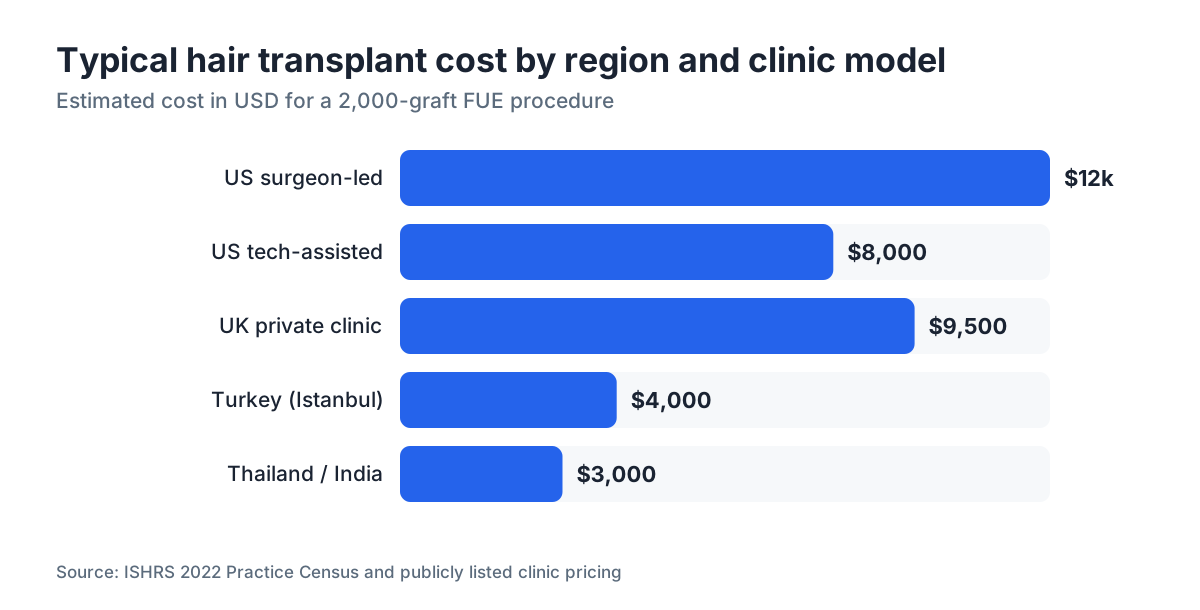
How do prices compare between surgeon-led and tech-run clinics?
Price alone isn't a reliable indicator, but it's part of the picture.
| Setting | Typical price per graft (USD) | Typical 2,000-graft cost | Model commonly used |
|---|---|---|---|
| US surgeon-led clinic | $4, $8 | $8,000, $16,000 | Surgeon performs or directly supervises all steps |
| US tech-assisted clinic | $3, $5 | $6,000, $10,000 | Surgeon designs, techs extract/implant |
| UK private clinic | £3, £6 per graft | £6,000, £12,000 | Varies widely; no universal standard |
| Turkey (Istanbul) | $1.50, $3 | $2,500, $6,000 | Commonly tech-run; surgeon oversight varies |
| Thailand/India | $1, $2.50 | $2,000, $5,000 | Varies; verify independently |
Source: ISHRS 2022 Practice Census and publicly listed clinic pricing as of 2024 [5].
A lower price is not proof of lower quality. Some well-regarded clinics in Turkey and India deliver excellent surgeon-led outcomes. But a price well below the regional average for surgeon-led care almost always means something in the cost structure got cut, and the most common cut is physician time.
If you're eyeing a clinic abroad, the same six questions apply. A language barrier is no excuse for a clinic to hide who will hold the punch on your scalp.
What should you do if you suspect a clinic misrepresented who performed your procedure?
This happens. The options are real.
If you're still pre-surgery, you can simply not proceed. Cancel the booking, request a refund under the consumer protection laws of the jurisdiction where you paid, and dispute the charge with your credit card company if the clinic goes quiet.
If the procedure already happened and you believe the clinic misrepresented the surgeon's role, your options include:
- Filing a complaint with the state medical board (which investigates unauthorized practice of medicine)
- Contacting the state attorney general's consumer protection division
- Consulting a medical malpractice attorney (many offer free initial consultations)
- Leaving documented reviews on Google, RealSelf, and Trustpilot that describe your specific experience factually
If the procedure was performed abroad, legal remedies shrink. Medical tourism contracts often bury arbitration clauses in the clinic's home jurisdiction. One more argument for due diligence before, not after.
The ISHRS runs a patient complaint process and keeps a directory of member surgeons who have agreed to its ethics code [11]. If the clinic is an ISHRS member and you believe it violated disclosure standards, a formal complaint is worth filing regardless of anything else you do.
Myhairline.ai's free AI scan won't grade a past procedure, but it can help you read your current hair pattern and figure out realistic next steps if you're weighing revision or alternative treatments.
Sources
- Journal of the American Academy of Dermatology, Avram et al., 2019
- Medical Board of California, Enforcement Policies
- NHS England, Keogh Review of Cosmetic Surgery Regulation
- International Society of Hair Restoration Surgery (ISHRS), 2022 Practice Census
- National Library of Medicine, PubMed (FUE follicular transection rate literature)
- American Board of Hair Restoration Surgery (ABHRS), Member Directory
- Federation of State Medical Boards, Physician Data Center
- National Library of Medicine, PubMed (graft out-of-body time and survival literature)
- U.S. Department of Health and Human Services, Patient Self-Determination Act (42 U.S.C. § 1395cc(a))
- International Society of Hair Restoration Surgery (ISHRS), Ethics and Patient Complaints