

TL;DR: A stable hairline looks the same in photos taken 6 to 12 months apart, sheds no more than the normal 50 to 100 hairs per day, and shows no new temple or crown thinning. Active recession means visible changes across repeated photos, increasing shed, or a soft, miniaturized hairline edge. Tracking over time is the only reliable method.
Why is it so hard to know if your hairline is receding or stable?
Your hair does not fall out in one dramatic sweep. Androgenetic alopecia, the medical name for male and female pattern baldness, is a slow process driven by DHT gradually shrinking individual follicles over years [1]. That pace is exactly what makes it hard to read in real time. You see yourself every day, which is the worst possible vantage point for detecting gradual change.
The other complication is that normal shedding is high. The American Academy of Dermatology puts typical daily hair loss at 50 to 100 strands [2]. Shower drain anxiety is real, but a handful of hair after shampooing does not tell you whether your hairline is moving. What tells you is pattern, not quantity alone.
There is also a distinction most people miss: a hairline can look different on different days without actually receding. Dehydration, lighting angle, how you slept, and even forehead swelling from allergies all shift the apparent position of your hairline. That is why single-day observations are almost meaningless. The signal is in the trend across many months, not any single morning mirror check.
What are the real signs a hairline is still actively receding?
Active recession has four reliable tells. Know them and you stop second-guessing.
First, your hairline moves backward in photos taken under consistent conditions three to six months apart. This is the gold standard. Not a phone selfie in different lighting each time, but a proper comparison: same spot, same light source, hair pushed back the same way, same camera distance [3].
Second, the hairs at your temple corners and frontal hairline look thin, short, and wispy compared to hair a centimeter behind them. This is miniaturization. DHT-sensitive follicles shrink their output before they quit entirely, so you get a fringe of fine, unpigmented hairs at the leading edge. Run a finger along your hairline. If the hair there feels noticeably finer and shorter than hair further back, the follicles are still under attack.
Third, you notice the hairline feels less dense under your fingers than it did a year ago, even if the line itself has not moved much. Density loss often precedes visible recession.
Fourth, you are shedding more than usual for you. More than the normal 50 to 100 hairs daily, and noticeably above your own baseline for weeks running. A temporary spike from stress or illness is different from a sustained, elevated shed that stretches past two or three months. Sustained elevated shedding that goes on longer than three months with no obvious trigger can point to ongoing miniaturization rather than telogen effluvium, which typically resolves [4].
Two or more of these signs together is a strong signal that recession is active.
What does a genuinely stable hairline look like?
Stability means consistency over time. A stable hairline holds a uniform density at its edge. The hairs at the very front are similar in caliber to the hairs behind them. There is no progressive widening of the temples and no new thinning at the crown.
Compare photos taken six months apart and then a year apart. If the hairline sits in the same position in each photo and the texture looks similar, that is genuine stability. Not perfect thickness necessarily, because a hairline can be somewhat receded and fully stable at that position. Stability means stopped, not restored.
One practical check: measure from the midpoint of your hairline to a fixed point like your glabella (the flat area between your eyebrows) using a flexible tape measure or a ruler held flat against your forehead. Record it. Measure again in four months. A change of more than 3 to 4 millimeters in that window is worth paying attention to, though this kind of measurement has real variability from technique, so consistent method matters more than any single number.
People on finasteride or minoxidil for men sometimes misread stability as treatment failure. If your hairline has not moved in a year, the treatment is working. The goal of most medical treatments is stabilization, not regrowth, though some regrowth does occur in clinical trials [5].
How do you use photos to track hairline changes accurately?
Photography is your best tool if you use it right. Done sloppily, photos give you false alarms. Done consistently, they give you actual data.
Set a protocol and stick to it. Stand at the same distance from the mirror or camera each time. Use a fixed light source, ideally diffuse overhead lighting, not a window that changes with the weather. Pull your hair back the same way every time. Take the photo from the same angle: straight front, and then angled 45 degrees from each side. The 45-degree shots catch temple recession that a straight-on photo hides.
Take photos every three months for the first year, then every six months once you have a baseline. Date each one and store them in a folder you can access side by side. The comparison does the work.
If you want a more objective read, tools like the free AI scan at MyHairline can compare hairline photos and flag changes in position and density that are easy to miss when you are the one staring at them every day. That kind of consistent, repeated analysis takes a lot of the subjective bias out of self-assessment.
One thing to avoid: comparing a photo taken under bright flash to one taken in dim bathroom light. That is not a hairline difference. That is a photography difference. Lighting changes the apparent density of hair dramatically, which is why dermatologists use standardized photography equipment in clinical trials [3].
Does the Norwood scale help you figure out if you are progressing?
The Norwood-Hamilton scale rates male pattern baldness from Type I (no recession) to Type VII (nearly complete loss), with Types II through IV covering the progressive temple and frontal recession most men notice first [6]. Knowing your current Norwood stage gives you a useful baseline, but the scale alone does not tell you whether you are moving through it.
What the scale does help with is setting expectations. A man at Norwood II may stabilize there for decades or may progress to Norwood V. The scale describes a destination, not a speed. To know whether you are advancing through it, you need the same repeated-photo approach described above, assessed against the Norwood diagrams.
Some dermatologists use dermoscopy to assess follicle miniaturization directly. Under magnification, you can see the ratio of terminal (thick) hairs to vellus (miniaturized) hairs along the hairline. A ratio above 20 percent vellus hairs in the frontal zone is generally considered diagnostic of androgenetic alopecia [7]. This is something a dermatologist can assess in a single visit, which saves months of self-photographing if you want a definitive answer quickly.
For an overview of the full receding hairline picture including what each Norwood stage looks like in practice, the Hamilton-Norwood classification published in 1975 remains the reference dermatologists use [6].
Can a dermatologist tell if your hairline has stabilized in one visit?
Sometimes, yes. A dermatologist can pull out old photos for comparison if you bring them. They can do a dermoscopy exam and count miniaturized vs. terminal hairs. They can perform a pull test: gripping 40 to 60 hairs between thumb and forefinger and pulling gently. Extracting more than 10 percent of the grabbed hairs (about 6 or more from a 60-hair grab) is a positive pull test and suggests active shedding [2].
What a dermatologist cannot do in a single visit without prior photos or baseline blood work is confirm long-term stability. They can give you a snapshot. Stability requires comparing snapshots over time.
If you go, ask specifically for a dermoscopy assessment of hair shaft diameter variation along the hairline. That is the most informative single-visit data point. Some dermatologists also use phototrichogram techniques, which photograph a shaved patch of scalp and count hair density and growth rates, though this is more common in research settings than routine clinical practice [7].
Blood work matters too if you have not ruled out other causes. Thyroid dysfunction, iron deficiency (ferritin below 30 ng/mL is often cited as a threshold in hair loss literature, though the exact cutoff is debated), and deficiencies in zinc or vitamin B12 can all cause or worsen shedding beyond any pattern loss [4]. Treating an underlying deficiency can calm an elevated shed and make a stabilized hairline look stable again.
What causes a hairline to suddenly look worse without actually receding?
Several things mimic recession without being recession. Knowing them saves a lot of unnecessary anxiety.
Telogen effluvium is the most common masquerader. A physical or emotional shock (surgery, illness, crash diet, childbirth, severe stress) pushes a large number of follicles into the resting phase at once, and they shed two to four months later. The result looks like diffuse thinning or sudden hairline loss, but it is temporary. Most cases resolve within six to nine months of the triggering event [4]. You can read more about how this differs from pattern loss in the telogen effluvium explainer.
Hairstyle tension causes traction alopecia, which hits the hairline first. Tight ponytails, braids, and certain extensions chronically stress the follicle. The hairline recedes uniformly across the front, which looks like pattern baldness. Unlike androgenetic alopecia, it can partially reverse if the tension is removed early enough.
Sunburn or scalp irritation can inflame follicles temporarily, making hair look thinner or causing a brief elevated shed. Same with product buildup: a thick residue at the scalp can flatten and clump hair, making the hairline appear thinner than it is.
Weight changes affect hair too. Rapid weight loss is a known trigger for telogen effluvium. So are some medications, including anticoagulants and certain antidepressants. Always think about what changed in your life three to six months before the shedding started. The answer is often right there.
How long does it take to confirm a hairline is truly stable?
The honest answer is six to twelve months of consistent observation. That feels like a long time when you are anxious about it, but shorter observation windows produce too many false conclusions.
Three months is not enough because seasonal shedding is real. Many people shed more in autumn, a pattern documented in a 2009 study in the British Journal of Dermatology that found peak hair shedding in late summer and fall [8]. A single three-month window might catch a natural seasonal peak and look like active recession.
Six months with consistent photos gives you a reasonable signal. Twelve months with consistent photos, taken across at least two seasons, is genuinely reliable. If you are also on a treatment like finasteride, the FDA-approved label for finasteride notes that at least three to six months of use are needed before you can evaluate whether it is working, and that it can take twelve months to see maximum effect [5].
If nothing has changed in your photos over twelve months and the miniaturization at your hairline edge looks similar, you are probably stable. Probably. Hair loss is not perfectly predictable, and a hairline that sits still for three years can occasionally start moving again, usually in response to a hormonal change, significant stress, or stopping a treatment that had been holding it.
For context on what triggers ongoing loss, the what causes hair loss guide covers the main mechanisms.
If your hairline is still receding, what actually slows it down?
Two treatments have solid evidence: finasteride and minoxidil. Everything else is in the supplement aisle.
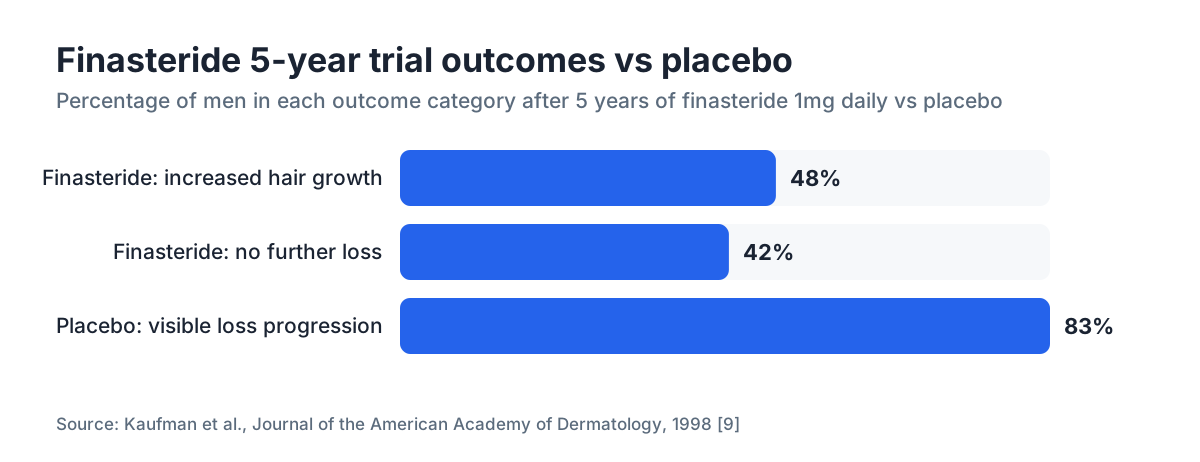
Finasteride 1 mg daily reduces serum DHT by roughly 70 percent [5]. A five-year placebo-controlled trial found that 48 percent of men using finasteride showed increased hair growth, and 42 percent had no further loss, compared to 83 percent of placebo recipients who had visible hair loss progression [9]. Put another way, finasteride stops progression in roughly 9 out of 10 men who use it consistently. It does not regrow all lost hair, but it holds the line. For a full breakdown of how it works and what the side effect profile looks like, see the finasteride overview.
Minoxidil extends the anagen (growth) phase and increases follicle size. Topical minoxidil 5% has been FDA-approved for men since 1991 [5]. It works better on the crown than the hairline for most men, but evidence supports its use for frontal recession too. Oral minoxidil at low doses (0.25 mg to 5 mg daily) has growing evidence and is increasingly used off-label when topical application is inconvenient. Check the minoxidil side effects page before starting either form.
Using both together is supported by data. A 2021 review in the Journal of the American Academy of Dermatology found combination therapy with finasteride and minoxidil produced greater hair density improvements than either alone [10]. The finasteride and minoxidil guide covers how to combine them practically.
DHT blockers in supplement form (saw palmetto is the most studied) have much weaker evidence. One small randomized trial showed some effect, but the effect size is well below what prescription finasteride produces [11]. Hair loss supplements broadly get a skeptical look from most dermatologists for the same reason: the evidence does not match the marketing see the hair loss supplements guide.
If recession has already removed enough hair that medical treatment alone will not restore the hairline, a hair transplant is worth understanding. Transplants move DHT-resistant follicles from the back and sides of the scalp to the front. They are permanent, but expensive (typically $4,000 to $15,000 in the US), and they work best on patients whose loss has stabilized, because ongoing recession around a transplant looks strange.
Does creatine or any supplement make a hairline recede faster?
The creatine concern comes from a single 2009 study in 20 rugby players that found creatine supplementation raised serum DHT by 56 percent over three weeks [12]. That is a real finding from a real study, and it raised fair questions. But 20 subjects is a small sample, the study was not designed to measure hair loss, and no later study has replicated the DHT finding cleanly or connected it to measurable hairline recession.
The theoretical concern is plausible: if creatine raises DHT and DHT drives follicle miniaturization, creatine might speed up hairline recession in men genetically susceptible to it. But we do not have good clinical data on hair loss outcomes specifically. The full picture is covered in does creatine cause hair loss.
If you are already losing your hair and you take creatine, switching to creatine-free training for six months and monitoring your photos is a reasonable experiment. But do not expect a definitive answer from the literature, because the literature does not yet have one.
A practical checklist: stable vs. still receding
Here is a straightforward way to assess where you stand.
| Signal | Likely stable | Likely still receding |
|---|---|---|
| Serial photos (6-12 months) | No position change | Visible backward movement |
| Hairline edge texture | Hairs similar caliber front to back | Noticeably finer/shorter hairs at edge |
| Pull test | Fewer than 6 hairs per 60-hair grab | 6 or more hairs extracted easily |
| Daily shed | At or below your normal baseline | Elevated baseline for over 8 weeks |
| Temple corners | Shape unchanged | Widening or deepening of temples |
| Crown density | Stable | Thinning visible under overhead light |
| Dermoscopy (if done) | Less than 20% vellus hairs at frontal scalp | Over 20% vellus hairs [7] |
You do not need all seven signals pointing the same way for a conclusion. Three or more in one column is a reasonable signal. If you are reading this in the early stages and genuinely unsure, the most useful thing you can do right now is take a standardized set of photos today. Every week you wait without a baseline is a week of data you can never recover.
For an objective baseline that does not depend on your own interpretation, MyHairline's free AI scan analyzes your hairline photos and gives you a starting measurement you can return to at three and six months. That removes the anxiety of subjective comparison and gives you an actual reference point.
Sources
- National Institutes of Health, MedlinePlus, Androgenetic Alopecia
- American Academy of Dermatology, Hair Loss
- Journal of Investigative Dermatology, Standardized scalp photography in clinical trials (Olsen et al.)
- Hamilton JB, American Journal of Anatomy, 1951; Norwood OT, Southern Medical Journal, 1975, Norwood-Hamilton Scale
- British Journal of Dermatology, Seasonal changes in hair shedding (Kunz et al., 2009)
- Journal of the American Academy of Dermatology, Finasteride 5-year trial (Kaufman et al., 1998)
- Journal of the American Academy of Dermatology, Combination minoxidil and finasteride review, 2021
- Journal of Alternative and Complementary Medicine, Saw palmetto vs finasteride trial (Wessagowit et al.)
- Clinical Journal of Sport Medicine, Creatine supplementation and DHT (van der Merwe et al., 2009)