TL;DR: Most clinical evidence supports 1% or 2% ketoconazole shampoo two to three times a week, left on the scalp for three to five minutes before rinsing. One randomized trial found it matched 2% minoxidil for hair density gains. It won't regrow a bald patch. It's a cheap, low-risk add-on to a real hair-loss plan.
What is ketoconazole shampoo and why would it affect hair loss?
Ketoconazole is an antifungal drug. It was built to treat scalp conditions like seborrheic dermatitis and dandruff, both driven by a yeast called Malassezia, and it kills that yeast by breaking down its cell membranes. That's the FDA-approved reason to reach for it.
The hair-loss angle showed up almost by accident. People using ketoconazole shampoo for dandruff kept reporting thicker, less shed-prone hair. That prompted actual controlled studies, and the results were good enough that dermatologists have kept recommending it off-label ever since.
The leading theory involves DHT (dihydrotestosterone), the androgen that shrinks hair follicles in androgenetic alopecia. Some in-vitro research suggests ketoconazole has mild anti-androgenic properties, meaning it may partly block DHT's effect right at the follicle. That's a different route than finasteride, which shuts down the enzyme that converts testosterone to DHT throughout your body. Ketoconazole's version is local and modest.
There's a second possible effect: less scalp inflammation. Malassezia overgrowth sets off low-grade inflammation that can worsen follicle miniaturization. Clear the yeast, lower the inflammatory load, and you may give hair a slightly better place to grow. Neither mechanism is nailed down, but both fit the trial data we have.
What does the clinical evidence actually say?
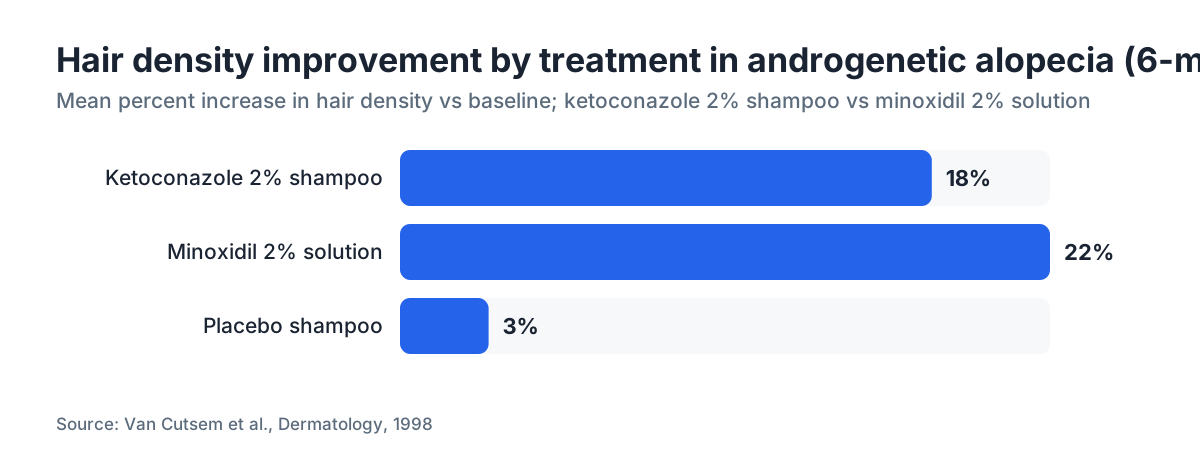
The most-cited study is a 1998 randomized controlled trial in Dermatology by Van Cutsem and colleagues, comparing 2% ketoconazole shampoo to 2% minoxidil solution in men with androgenetic alopecia. After six months, both groups showed higher hair density and larger follicles, with no statistically significant difference between them [1]. That's the headline researchers keep repeating, and it's real. The catch: the trial was small (about 30 men per arm) and partly funded by the shampoo maker, so treat it as encouraging, not settled.
A 2019 systematic review in Skin Appendage Disorders looked across the ketoconazole studies and called the evidence supportive but weak by modern standards, mostly small trials with no long-term follow-up [2]. The reviewers still flagged consistent positive signals across those trials, which is why dermatologists haven't written it off.
Here's what the evidence does not show. Ketoconazole shampoo does not regrow hair on a bald scalp, and it does not beat finasteride or high-dose minoxidil as a standalone treatment. Read it as an add-on. If you're already on finasteride or minoxidil for men, stacking ketoconazole shampoo on top is a sensible, low-risk move. Starting with ketoconazole alone and skipping everything else is probably underplaying your hand if your hair loss is still moving.
How often should you use ketoconazole shampoo for hair loss?
Two to three times a week. That's the frequency in most clinical guidance and dermatology literature [1][3], and it's not a random number. Malassezia recolonizes the scalp fast, so daily ketoconazole isn't necessary and tends to dry you out. Once a week may not hold the antifungal effect between washes.
The 1998 Van Cutsem trial had subjects washing every two to three days with the 2% formulation [1]. That lines up cleanly with what most dermatologists say now. On off days, use your regular shampoo or plain water, depending on your hair type and how much you sweat.
Contact time matters as much as frequency. The studies used three to five minutes on the scalp before rinsing [1]. Lathering and rinsing in ten seconds probably doesn't give the drug enough time to do anything. Set a timer. Three minutes feels long in the shower the first few times, then you stop noticing.
Some people drop to once a week for maintenance once their scalp settles down. That's fine if you're mainly managing dandruff. For hair loss, the limited evidence points to the higher end, so two to three times a week is where most practitioners land.
Does the concentration matter: 1% vs 2% ketoconazole shampoo?
Yes, and the practical picture is a little annoying.
The 2% ketoconazole shampoo (Nizoral 2%, by brand) is prescription-only in the US. It's the version used in the trials that showed hair density gains [1]. The 1% version (Nizoral A-D and many generics) sells over the counter. The FDA cleared 1% OTC ketoconazole shampoos mainly for dandruff control, not for hair loss [4].
So is 1% useless for hair? Probably not. It's still antifungal, it still cuts Malassezia load, and it likely carries some of the same anti-androgenic effect at the follicle. But no head-to-head trial comparing 1% against 2% specifically for androgenetic alopecia has been published at a level that lets anyone claim a confident difference in hair outcomes.
If you can get a 2% prescription from your dermatologist and the cost works, that's the formulation the strongest evidence backs. If you're on 1% OTC and your scalp feels healthier with less shedding, you're probably getting a real, if smaller, benefit. Generic 2% ketoconazole shampoo also turns up at compounding pharmacies with a prescription, often below the brand-name price.
Is ketoconazole shampoo FDA-approved for hair loss?
No. Worth saying plainly. The FDA has approved ketoconazole 1% shampoo for dandruff (seborrheic dermatitis) and 2% for tinea versicolor and other fungal scalp conditions [4]. Hair loss is not an approved indication for any ketoconazole formulation.
When a dermatologist recommends it for hair loss, that's off-label use. Off-label prescribing of approved drugs is legal and routine across medicine. It's a different thing from using an unapproved drug. Ketoconazole's safety profile is well-known, and the odds of serious systemic side effects from a topical shampoo are very low, because almost none of the drug gets through a healthy scalp.
For comparison, the FDA has approved topical minoxidil for androgenetic alopecia and oral finasteride for male pattern hair loss [9][5]. Ketoconazole shampoo carries neither approval, so it always sits in a lower tier than those two when dermatologists weigh the evidence.
Who benefits most from ketoconazole shampoo for hair loss?
People with androgenetic alopecia plus an oily or flaky scalp are the best candidates. If you have visible dandruff or seborrheic dermatitis alongside your thinning, treating the fungal side hits two problems with one bottle.
Men with a receding hairline in early Norwood stages (I through III) who want a low-risk addition to finasteride or minoxidil get the most plausible benefit. There's still enough follicle activity for an anti-inflammatory, mildly anti-androgenic shampoo to work with.
Women with telogen effluvium or early androgenetic alopecia may find it useful too, especially if scalp inflammation is part of the picture. The evidence in women is thinner, but the biology isn't sex-specific.
If your follicles are heavily miniaturized across a large area, don't expect ketoconazole shampoo to change much. It's the wrong tool for advanced loss. Not sure what stage or type you're dealing with? Get a clear read on your pattern before spending money on anything. The free AI hair analysis at MyHairline (/scan) gives you a starting point before a dermatologist visit.
Anyone with a known liver condition should mention ketoconazole use to their doctor. Topical absorption is minimal, but oral ketoconazole carries a real hepatotoxicity risk, so the conversation is worth having [6].
Can you use ketoconazole shampoo with minoxidil or finasteride?
Yes. Most dermatologists treating androgenetic alopecia combine approaches instead of betting on one. Ketoconazole, minoxidil, and finasteride each work through a different mechanism, so they aren't redundant.
Minoxidil for men stretches out the anagen (growth) phase of the hair cycle. Finasteride drops DHT throughout the body by roughly 70% [5]. Ketoconazole works on the scalp itself, possibly trimming DHT locally and calming fungal-driven inflammation.
Using ketoconazole shampoo on the same days you apply minoxidil is fine, with one practical rule: put minoxidil on a dry scalp, after your hair has fully dried from the shower. A wet scalp cuts minoxidil absorption. So wash with ketoconazole in the morning, let your hair dry all the way, then apply topical minoxidil.
Finasteride and minoxidil together are the most evidence-backed combination for androgenetic alopecia in men. Adding ketoconazole shampoo as a third layer is reasonable and shows no known interaction problems, though nobody has run a large trial on the triple stack specifically.
About minoxidil side effects: scalp irritation is the most common complaint. If that's you, ketoconazole shampoo may actually help, since some of that irritation ties back to fungal overgrowth encouraged by a moist scalp after minoxidil goes on.
What are the side effects of using ketoconazole shampoo regularly?
The most common one is scalp dryness and occasional irritation, worse if you use it more than three times a week or leave it on too long [6]. Some people find it dries out colored or chemically treated hair more than a standard shampoo does.
Contact dermatitis (an allergic skin reaction) is possible but uncommon. Watch for redness, itching, or a rash that gets worse instead of better. If that happens, stop and see a doctor.
Systemic toxicity from topical ketoconazole is rare, because absorption through intact scalp skin is low. The serious liver toxicity linked to ketoconazole comes from the oral tablets, which the FDA restricted in 2013 over hepatotoxicity risk [6]. That risk doesn't carry over to topical use, but it's why the packaging warns about it.
Years of use appear safe for most healthy adults, going by how widely the shampoo is used for seborrheic dermatitis, though no formal long-term safety trial for hair loss specifically has been run. The AAD lists ketoconazole as a generally safe option for managing scalp conditions [3].
How long does it take to see results from ketoconazole shampoo?
Set realistic expectations, because impatience makes people quit treatments that are working.
Any treatment that changes follicle behavior takes months to show up as visible density, thanks to the hair cycle. In the 1998 Van Cutsem trial, measurable density improvements appeared at the six-month mark [1]. Don't judge the shampoo at six weeks. Your scalp may feel less itchy or flaky sooner than that, which is the antifungal doing its job, but that's not the same as new density.
Give it four to six months of steady use at the right frequency (two to three times a week, three to five minutes of contact) before deciding whether it's doing anything. If you started it alongside minoxidil or finasteride, you probably can't separate out ketoconazole's share, and that's fine. You're after the outcome, not the credit.
Some people notice reduced shedding in the first few months, which feels like a win. Whether that becomes a net density gain depends on whether new growth keeps pace with ongoing loss.
Is ketoconazole shampoo worth it if you're already using other treatments?
Probably yes, if the cost and the extra wash days fit your life. Here's the honest math. A bottle of 1% OTC ketoconazole shampoo runs about $10 to $20 and lasts a couple of months at two to three washes a week. That's a tiny barrier against the possible scalp-environment payoff.
The 2% prescription version costs more but stays cheap next to finasteride or a transplant. Hair transplant procedures in the US run $4,000 to $15,000 or more depending on graft count and clinic [7]. Ketoconazole shampoo isn't a stand-in for that. It's a background measure while you protect what you still have.
If money's tight and you're choosing between ketoconazole and minoxidil, minoxidil has stronger evidence. Buy that first. But if you're already on minoxidil or finasteride and haven't added ketoconazole, the extra cost is small enough that it's hard to argue against a trial run.
For anyone weighing the full menu, including hair loss supplements and the rest of the market, ketoconazole shampoo is one of the few cheap options with real human trial data behind it. Most supplements have none. You can also get a clearer read on your hair loss type and severity with a free AI scan at MyHairline (/scan) before committing to any stack.
If you suspect causes beyond DHT, like what causes hair loss tied to stress, diet, or medication, deal with those root factors too. Ketoconazole won't fix a telogen effluvium driven by iron deficiency.
How does ketoconazole compare to other anti-dandruff shampoos for hair loss?
Four anti-dandruff ingredients come up in hair-loss talk: zinc pyrithione, selenium sulfide, coal tar, and ketoconazole. Of the group, ketoconazole has the most direct human trial evidence in androgenetic alopecia [1][2].
Zinc pyrithione is also antifungal and anti-inflammatory. A 2003 study in the British Journal of Dermatology found a zinc pyrithione shampoo used daily over six months produced modest hair density gains in men with androgenetic alopecia [8]. So it isn't worthless here. But the effect looked smaller than what ketoconazole managed in the Van Cutsem data, and no one has run a proper head-to-head.
Selenium sulfide works for seborrheic dermatitis and tinea versicolor and has essentially no published evidence for androgenetic alopecia.
Coal tar has anti-inflammatory properties but also lacks AGA-specific trial data and comes with cosmetic downsides (the smell, and staining of lighter hair).
Ketoconazole is the best-evidenced anti-dandruff active for hair loss. That doesn't make it a strong standalone treatment. It does put it ahead of the alternatives in this specific category.
Sources
- Van Cutsem et al., Dermatology (1998) — ketoconazole 2% vs minoxidil 2% RCT
- Skin Appendage Disorders (2019) — systematic review of ketoconazole for hair loss
- American Academy of Dermatology — hair loss and scalp condition guidance
- FDA — OTC ketoconazole 1% shampoo approved labeling (Nizoral A-D)
- FDA — finasteride (Propecia) prescribing information
- FDA — 2013 drug safety communication on oral ketoconazole (Nizoral tablets)
- International Society of Hair Restoration Surgery — patient pricing survey
- Berger et al., British Journal of Dermatology (2003) — zinc pyrithione shampoo for AGA
- FDA — minoxidil topical solution (Rogaine) OTC labeling
- Piérard-Franchimont et al., Journal of the American Academy of Dermatology (1998)