
TL;DR: Litfulo (ritlecitinib 50 mg daily) is an FDA-approved oral JAK inhibitor for severe alopecia areata in people 12 and older. In the ALLEGRO trial, about 23% of patients reached a SALT score of 20 or below (at least 80% scalp coverage) at week 24, versus 1.6% on placebo. Most responders first notice new growth between weeks 8 and 16. Peak results take 6 to 12 months.
What is Litfulo and how does it treat alopecia areata?
Litfulo is the brand name for ritlecitinib, a once-daily oral pill the FDA approved in June 2023 for severe alopecia areata in patients 12 and older [1]. It's a JAK inhibitor, and it targets JAK3 plus the TEC family of kinases specifically. That distinction matters. Alopecia areata is an autoimmune disease, not the hormone-and-genetics story behind androgenetic hair loss. If you want the difference laid out plainly, what causes hair loss is a good place to start.
Here's the mechanism in one breath. In alopecia areata your immune system decides your hair follicles are foreign tissue and attacks them. JAK3 and TEC kinases carry the signal that tells cytotoxic T cells to do that attacking. Ritlecitinib blocks the signal, and follicles that have been frozen in immune-driven dormancy get a chance to wake up [2].
This is a systemic drug, not a topical. It works throughout your body, which is why it can regrow hair on the scalp, eyebrows, eyelashes, and body all at once. That reach is also exactly why it carries a real side-effect and monitoring burden you have to take seriously.
Litfulo is not the same as baricitinib (Olumiant), the other oral JAK inhibitor for this disease, which is approved for adults only. Ritlecitinib's approval down to age 12 makes it the first JAK inhibitor with a pediatric indication for alopecia areata [1].
How long does Litfulo take to start working?
Most people see nothing in the first four weeks. The follicles are rebuilding underneath, but the new hair is too short and fine to notice. The window where most responders first spot real growth is weeks 8 to 16.
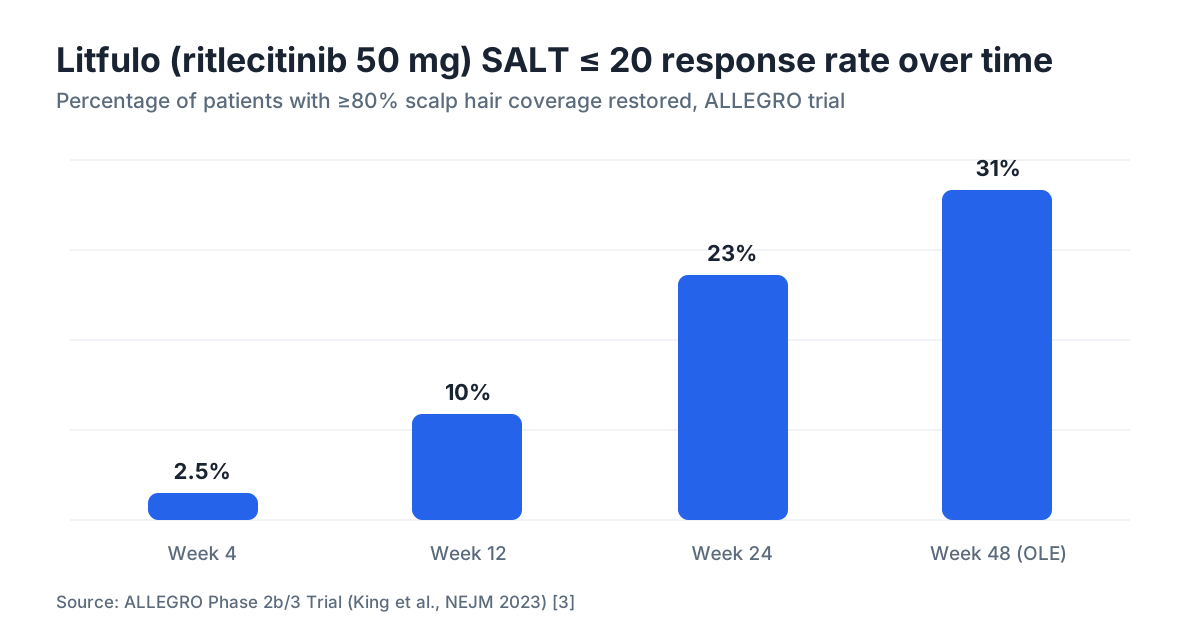
Here's how the ALLEGRO trial data breaks down the trajectory [3]:
| Timepoint | % achieving SALT ≤ 20 (80%+ scalp coverage) |
|---|---|
| Week 4 | ~2 to 3% |
| Week 12 | ~10% |
| Week 24 | 23.0% (ritlecitinib 50 mg) |
| Week 48 (extension) | ~30 to 33% (open-label data) |
SALT stands for Severity of Alopecia Tool. A score of 20 means at most 20% of your scalp is bald, so at least 80% of coverage is back. That's the benchmark the FDA used to judge whether the drug works [3].
A few honest things about those numbers. Twenty-three percent sounds modest until you see the placebo arm sitting at 1.6% at the same timepoint. The gap is the point. And for someone with alopecia totalis or universalis, who may have lost 95 to 100% of their scalp hair, any real regrowth is a big deal.
Patience is not optional here. People who quit after a month of seeing nothing walked out before the response window even opened. If you've hit week 24 with no growth at all, that's a genuine conversation to have with your dermatologist about whether to keep going.
What does the ALLEGRO trial actually show about results?
The ALLEGRO phase 2b/3 trial is the evidence base for Litfulo. It enrolled 718 patients aged 12 and up with severe alopecia areata, defined as a SALT score of 50 or higher, meaning at least 50% of the scalp had lost hair [3]. Everyone had to have had the condition for at least six months going in.
The primary endpoint was the share of patients reaching SALT ≤ 20 at week 24. By dose:
- Ritlecitinib 50 mg: 23.0%
- Ritlecitinib 30 mg: 14.9%
- Placebo: 1.6%
Fifty milligrams is the approved dose, so 23% is the headline number [3].
The trial also tracked eyebrow and eyelash regrowth. Roughly 30 to 40% of patients who started with brow or lash loss showed meaningful improvement, though the results scattered more than the scalp numbers did [3].
Quality-of-life scores went along for the ride. Responders improved on the Skindex-16 and ALOPECIA-QoL instruments, both of which measure the emotional and social weight of visible hair loss.
One finding is worth sitting with: patients with shorter disease duration tended to respond better. Two years of alopecia areata is not the same biology as twenty. Long-standing disease may involve follicle changes that don't reverse.
So what does "23% response rate" mean in plain English? About 1 in 4 people on the approved dose cleared the 80%-coverage bar within six months. A bigger group had partial responses, real regrowth that fell short of that specific line. The trial didn't put the full partial-response data front and center, which is a gap in the public numbers.
When do eyebrows and eyelashes come back?
Eyebrows and eyelashes usually lag a bit behind scalp hair. For a lot of patients they're also the part that matters most emotionally.
In ALLEGRO, brow and lash responses were measured with the Clinician-Reported Outcome for eyebrow and eyelash assessment, scored at week 24 alongside scalp outcomes [3]. In absolute terms the lash and brow response rates ran lower than scalp SALT responses, but they still landed clearly above placebo.
Anecdotally, dermatologists and patients describe fine eyebrow regrowth starting around weeks 12 to 20, with thicker, pigmented hair filling in over months 4 to 8. Eyelashes follow a similar curve. Neither runs on a tidy schedule.
If brows and lashes are your main concern, say so out loud with your dermatologist and set benchmarks for those areas specifically. Don't let the scalp SALT score be the only thing telling you whether treatment is working.
Does Litfulo work for alopecia totalis and universalis?
Yes, and this is where Litfulo and JAK inhibitors as a group pull furthest ahead of the old treatments. Corticosteroids and topical minoxidil do very little for alopecia totalis (AT) or alopecia universalis (AU), the most severe forms of the disease [6].
ALLEGRO deliberately included AT and AU patients. In a subgroup analysis, patients starting with complete or near-complete scalp loss (SALT ≥ 95) still showed response rates on ritlecitinib 50 mg that beat placebo by a statistically significant margin [3].
That said, the AT/AU subgroup responded less often than patients with milder baseline loss. Climbing to SALT ≤ 20 from a starting point of SALT 100 (zero hair) is a far bigger biological climb than starting from SALT 60.
Some context: before JAK inhibitors, a dermatologist would usually tell a patient with alopecia universalis that the odds of meaningful regrowth on any treatment were slim. Litfulo doesn't promise results in AT or AU. It offers a real chance where almost none existed [2].
What happens if you stop taking Litfulo?
This is the single most important thing to understand about Litfulo, and the prescribing information is blunt about it: alopecia areata usually comes back when you stop the drug [1].
The FDA label states that ritlecitinib has not been shown to bring lasting remission. In the ALLEGRO open-label extension, patients who discontinued generally relapsed, with hair starting to shed again within weeks to months.
Think of it less like a course of antibiotics and more like blood pressure medication. It controls the condition while you take it. The autoimmune process underneath is still there.
What that means in practice: if Litfulo works for you, you're likely looking at years of ongoing therapy. That carries real cost and real monitoring. The U.S. list price runs roughly $49,000 to $54,000 per year before insurance or assistance, though what you actually pay swings widely depending on coverage and eligibility for Pfizer's patient assistance program [4].
For anyone weighing long-term treatment for autoimmune hair loss against the far more common androgenetic kind, the logic is completely different. Finasteride and minoxidil for men act on hormone-driven loss, not the immune attack behind alopecia areata. They have nothing to offer for Litfulo's indication.
Who is a good candidate for Litfulo?
The FDA approval covers adults and adolescents 12 and older with severe alopecia areata [1]. In clinical practice, "severe" usually means SALT ≥ 50, at least half the scalp gone, though individual dermatologists and payers draw the line slightly differently.
Good candidates tend to:
- Have active disease, meaning the autoimmune process is still running rather than burned out
- Have had significant loss for less than five to ten years, though a longer history doesn't rule you out
- Have failed or been unable to tolerate earlier treatments like intralesional corticosteroids
- Have no contraindications: active serious infection, active TB, known cancer, or meaningful immune compromise
Litfulo does nothing for androgenetic alopecia, telogen effluvium, or other non-autoimmune types of shedding. It targets the alopecia areata mechanism and only that.
Before you start, your doctor should run a complete blood count, liver function tests, a lipid panel, and tuberculosis screening. These aren't optional. They're in the label because JAK inhibitors carry class-wide warnings around serious infections, cardiovascular events, cancer, and blood clots [1].
The boxed warning, which is the FDA's strongest, covers serious infections, death, malignancy, thrombosis, and major cardiovascular events. Most of that data comes from other JAK inhibitors in older rheumatoid arthritis populations, but it applies to the class. Your dermatologist should walk through your personal risk before writing the script.
What are the most common side effects and how serious are they?
In ALLEGRO, the most common adverse events on ritlecitinib 50 mg were [3]:
- Headache (about 14%)
- Diarrhea (about 10%)
- Nausea (about 8%)
- Acne (about 7%)
- Folliculitis (about 6%)
Most were mild to moderate and didn't push people off the drug. The folliculitis is an odd one: a drug that helps follicles recover can also inflame them, especially early on.
Less common but more serious events include upper respiratory infections, urinary tract infections, and elevated liver enzymes. Shingles (herpes zoster) reactivation is a known JAK inhibitor risk across the class, which is why the FDA wants patients up to date on vaccinations before starting [1].
The full boxed warning covers serious infections, higher mortality compared with TNF blockers (that data comes from rheumatoid arthritis populations, not alopecia areata patients), cancers including lymphoma, cardiovascular events in people with cardiovascular risk factors, and blood clots [1].
The typical alopecia areata patient is younger and healthier than the RA population that generated the safety signal, so the absolute risk of the worst events is probably lower. Lower is not zero. Anyone over 50 or carrying cardiovascular risk factors needs a direct conversation with their doctor.
If you're sizing up the monitoring burden against simpler options, know that finasteride and minoxidil for men have much lighter safety profiles, though they treat an entirely different disease.
How does Litfulo compare to baricitinib (Olumiant) for alopecia areata?
Baricitinib (Olumiant) was the first oral JAK inhibitor approved for alopecia areata, cleared by the FDA in June 2022 for adults only. Ritlecitinib followed in June 2023 with a label reaching down to age 12 [1][5].
Here's the side-by-side:
| Feature | Ritlecitinib (Litfulo) | Baricitinib (Olumiant) |
|---|---|---|
| Approval date | June 2023 | June 2022 |
| Approved age | 12+ | 18+ (adults only) |
| Dose | 50 mg once daily | 2 mg or 4 mg once daily |
| Primary endpoint (SALT ≤ 20) | 23% at 24 weeks | 35% (4 mg) at 36 weeks |
| JAK targets | JAK3 / TEC-family | JAK1 / JAK2 |
| Boxed warning | Yes (class) | Yes (class) |
The baricitinib 4 mg number of 35% looks higher, but the two trials used different timepoints (36 weeks versus 24) and different patient groups, so a straight comparison doesn't hold up. There's no head-to-head trial to point at.
In practice, ritlecitinib's pediatric approval makes it the only choice in its class for teenagers. For adults, the pick between the two usually comes down to insurance coverage, prior authorization rules, and how each one sits with the individual.
Anyone who tells you flatly that one drug is "better" is reaching past the evidence.
Can Litfulo be combined with other hair loss treatments?
ALLEGRO tested ritlecitinib on its own, so there's no controlled trial data on combining it with other drugs for alopecia areata [3].
In real practice, some dermatologists do layer topicals onto systemic JAK inhibitors. Topical minoxidil sometimes goes on top to support scalp circulation, though no published evidence says it adds meaningfully to ritlecitinib's effect. If you're curious about minoxidil as an add-on, minoxidil side effects covers what to watch for, and oral minoxidil explains how the oral version's risk profile differs.
Two systemic JAK inhibitors together is not a thing. Stacking other immunosuppressants adds infection risk and is generally avoided.
Intralesional corticosteroid injections sometimes go alongside systemic treatment in early or patchy disease for a faster local bump, but that's clinical judgment, not trial data.
If you have androgenetic alopecia on top of alopecia areata (the two can co-exist), it's reasonable to treat both, just with separate drugs. Ritlecitinib does nothing for the DHT-driven follicle miniaturization in androgenetic loss. A DHT blocker is the tool for that layer.
Not sure which type of loss you have? Start by understanding your own pattern. The free AI scan at MyHairline can help you characterize your loss before you decide whether to chase an autoimmune workup or focus on androgenetic treatments.
How much does Litfulo cost and how do you get it covered?
Litfulo's U.S. list price runs about $49,000 to $54,000 per year as of 2024 [4]. That's roughly $4,000 to $4,500 a month at wholesale acquisition cost.
Few patients pay that. Coverage runs through three main routes:
-
Commercial insurance. Most major insurers cover Litfulo for severe alopecia areata with prior authorization. Expect to need documentation of SALT ≥ 50, a confirmed diagnosis, and often a record of prior treatment attempts.
-
Pfizer's patient support program (Pfizer RxPathways). Commercially insured patients with high out-of-pocket costs may qualify for co-pay help. Uninsured or underinsured patients may qualify for free drug through the assistance program. Current details live on Pfizer's site [4].
-
Medicaid. Coverage depends on your state. Some states list Litfulo for alopecia areata; others require step therapy or leave it off entirely.
Prior authorization is nearly universal. Your dermatologist's office handles most of it, but be ready for a two to six week process that may include a peer-to-peer review if the first request gets denied.
For cost context: finasteride and minoxidil together run roughly $30 to $100 a month, but they treat androgenetic alopecia, a different disease. There's no cheap off-label swap with comparable evidence for severe alopecia areata.
What should you track during the first 6 months on Litfulo?
Tracking your progress carefully does two things: it tells you whether to keep going, and it builds the case to your insurer for continued coverage.
Here's a practical approach.
Photography. Shoot consistent photos under the same light, from the same angles, every four weeks. Ask your dermatologist to score SALT at each visit. Many offices do this routinely for patients on biologics or JAK inhibitors.
Lab monitoring. The label recommends checking CBC, liver function, lipids, and creatinine at baseline and periodically during treatment [1]. Your doctor sets the schedule; most run a 3-month check and then move to every 6 months after baseline.
Side effect diary. Note headaches, GI symptoms, or skin changes. Acne and folliculitis in weeks 2 to 8 are common and usually settle on their own. Any sign of infection (persistent fever, respiratory symptoms) needs prompt attention.
Quality of life. This is real data, not a soft extra. Alopecia areata carries genuine emotional weight, and tracking how you feel matters as much as how you look. The Skindex-16 or even a plain journal can show whether treatment is improving your daily life beyond what the SALT score captures.
At six months, if your SALT score hasn't moved from baseline, that's a solid data point for your dermatologist. Some people are late responders and improve between months 6 and 12, but running indefinitely with zero signal isn't standard practice.
If a separate scalp problem seems to be overlapping with your alopecia areata, the AI scan at MyHairline can help you map your pattern before the dermatology appointment.
Sources
- National Institute of Arthritis and Musculoskeletal and Skin Diseases (NIAMS), Alopecia Areata
- King B et al., ALLEGRO Phase 2b/3 Trial, New England Journal of Medicine 2023
- FDA, Olumiant (baricitinib) Approval for Alopecia Areata
- American Academy of Dermatology, Alopecia Areata
- FDA, Drug Approvals and Databases
- National Alopecia Areata Foundation (NAAF), About Alopecia Areata
- ClinicalTrials.gov, ALLEGRO study NCT03732807
- Pfizer Inc., Litfulo Product Information Page