
TL;DR: Topical minoxidil (usually 3-5%) can grow beard and mustache hair in men with patchy or thin coverage. Small controlled trials show real density gains after 16 weeks. It's off-label for the face, not FDA-approved, and results swing wildly with genetics. Stop using it and most of the gains reverse within 3-6 months.
What is minoxidil and why would it affect facial hair?
Minoxidil began as an oral blood-pressure drug in the 1970s. Doctors noticed patients sprouting hair in unexpected places, and that side effect became the product. The FDA approved topical minoxidil for scalp hair loss in 1988 under the brand name Rogaine [1]. Facial use came later, driven by off-label curiosity and, eventually, a handful of real clinical trials.
The mechanism isn't fully understood, and that's an honest thing to say upfront. The working theory: minoxidil opens potassium channels in follicle cells, widens the blood vessels around each follicle, and stretches out the anagen (active growth) phase of the hair cycle [2]. Facial follicles answer to the same biological signals as scalp follicles, so it makes sense the drug could work there too. The catch is that beard growth is heavily androgen-driven. The testosterone environment in your skin matters a lot, and minoxidil doesn't touch your hormone levels. It changes the local conditions around the follicle, nothing more.
Here's the part people miss. Minoxidil only works on follicles that already exist. Scar tissue where hair should grow, or skin with almost no follicles in it, gives the drug nothing to act on. It can wake up dormant or thin follicles and make existing hairs thicker and longer-lasting. It cannot conjure new follicles out of bare skin.
Is minoxidil FDA-approved for facial hair growth?
No. The FDA has approved topical minoxidil only for androgenetic alopecia on the scalp, at 2% (marketed to women) and 5% (for men and women) [1]. Using it on your face is off-label. That doesn't make it unsafe or illegal. It means the FDA hasn't reviewed that specific use. Doctors prescribe drugs off-label every day, and OTC minoxidil is yours to apply wherever you decide.
The off-label status has one practical effect. No manufacturer prints facial dosing on the label, and no drug company has funded a large Phase III beard trial. So the evidence base for the face is smaller and messier than the mountain of data behind scalp use.
What does the clinical evidence actually show?
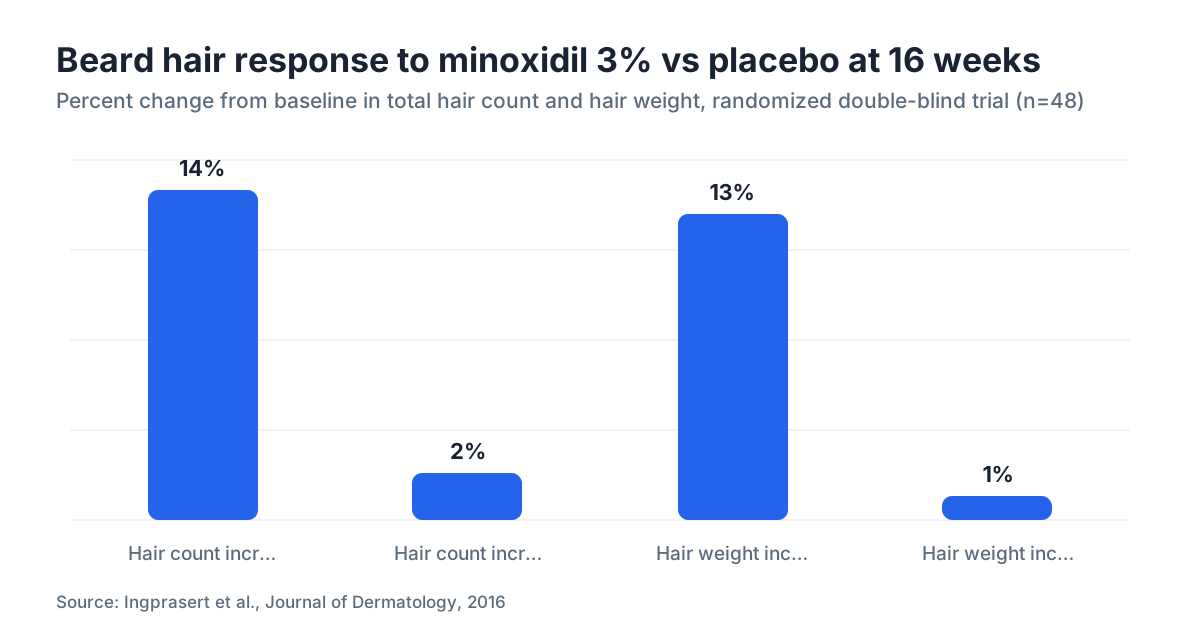
The strongest trial we have is a randomized, double-blind study in the Journal of Dermatology in 2016. Researchers put 48 men with thin beards on either 3% minoxidil lotion or placebo, twice daily. After 16 weeks, the minoxidil group had statistically significant gains in beard hair count and weight over placebo. The authors wrote that "Minoxidil 3% lotion significantly increases beard hair count and total weight of beard hair compared with placebo in a double-blind, randomized study." [3]
A 2021 review in the Journal of the American Academy of Dermatology looked at minoxidil's off-label uses and called the beard evidence promising but held back by small samples and short follow-up [4]. Most published studies run 16 to 24 weeks. Nobody has published a two-year beard trial.
The numbers from the 2016 trial are concrete enough to be useful. At week 16 the minoxidil group showed roughly a 13-15% rise in total hair count in treated areas, against almost nothing in the placebo group [3]. That's real. It's also not dramatic. A completely hairless cheek is not going to fill in. What the drug does best is close patchy gaps and turn thin, barely-visible vellus hairs into darker, coarser terminal ones.
Curious how minoxidil performs on the scalp before you try it elsewhere? The full picture is in our minoxidil for men article.
What concentration and form works best for facial hair?
Most trials used 3% topical minoxidil, which isn't the standard OTC product in the US. The common off-the-shelf option is 5%, sold as a liquid solution or a foam. The 2% version exists but sits mostly on the women's-and-scalp shelf. No published head-to-head trial compares 3% versus 5% on the face.
So most men use what they can buy: 5% solution or foam. Foam wins for facial use because it's less runny and easier to place on one spot without dripping. The liquid usually contains propylene glycol, which irritates facial skin more than scalp skin for a lot of people.
The oral-versus-topical question comes up constantly. Low-dose oral minoxidil (0.625 mg to 5 mg daily) is increasingly prescribed off-label for hair conditions, and some dermatologists now see it discussed for beard density too. Systemic exposure is a different animal, and the side effect profile shifts in a way you feel. That's its own subject, covered in our oral minoxidil article. For the face, most clinicians start topical because the risk is easier to predict.
| Form | Typical concentration | Ease of facial application | Irritation risk |
|---|---|---|---|
| Foam | 5% | High (doesn't drip) | Lower (no propylene glycol) |
| Liquid solution | 2% or 5% | Moderate | Moderate to higher |
| Oral tablet | 0.625-2.5 mg | N/A (systemic) | Different risk profile |
| Compounded lotion | 3% | Moderate | Varies by base |
How long does it take to see results on the face?
Three to six months. That's the honest answer. The hair cycle guarantees you won't see much in the first four weeks. Follicles have to shift from telogen (resting) into anagen (growing) and then actually push out visible hair. Most men using minoxidil for a beard notice the first changes around 8 to 12 weeks, with clearer results by 16 to 24 weeks.
The 2016 Journal of Dermatology trial measured at 16 weeks, and that's where the significant data landed [3]. Some men respond faster, some slower. Genetics, baseline testosterone, and how many follicles already sit in the target area all bend the timeline.
One surprise: the early weeks can look like things are getting worse. You may shed more as follicles reset into a new growth phase. This is the same telogen effluvium pattern seen with scalp minoxidil, explained further in our telogen effluvium article. It passes. If the shedding keeps going past 8 weeks, bring it to a dermatologist.
How do you apply minoxidil to your face correctly?
The routine is simple, but the mistakes are common.
Apply to dry skin on the target area (cheeks, jawline, or the mustache zone) using roughly 1 mL of liquid or half a capful of foam per go. Rub it in gently. Then wash your hands well. Minoxidil on your fingers transfers to everything you touch, including your eyes, which you really don't want.
Let it dry fully before bed or before your face touches anything. The drug needs contact time with the skin. Most makers say at least 4 hours, and overnight is fine.
Twice daily is the regimen the trials used, so it's the standard. Some people drop to once daily to calm irritation. No trial compares once versus twice daily on the face directly, but for the scalp, twice daily beats once daily consistently in the data [9].
Keep it away from your mouth. Swallowed minoxidil, even a little, can hit your cardiovascular system. Near the mustache, be careful. Foam stays put better than liquid.
Not sure if your thinning is a broader hair loss pattern versus plain sparse-beard genetics? Start by figuring out what's actually driving your case. Our free AI scan at MyHairline can help you pin down your type of hair loss before you spend money on a product.
What are the side effects of using minoxidil on your face?
The most common one is local skin irritation: redness, dryness, flaking, or itch at the application site. It shows up more with liquid (thank the propylene glycol) than with foam. Usually it settles as your skin adapts, or it clears when you switch formulas.
Systemic absorption is real but generally low with topical use [7]. Some men report headaches, dizziness, or palpitations. These are less likely with facial application than with large-area scalp use, simply because you're treating a smaller patch of skin. If any of them show up, stop and see a doctor.
The hair doesn't always land where you aimed. Minoxidil can grow hair in areas the product migrates to. Some men find growth creeping higher on the cheeks or closer to the eyes than they wanted. That's a genuine risk worth thinking through before you start.
And this: stop using it, and most of the gain reverses within 3 to 6 months as follicles drift back to baseline [10]. That's not damage. It's just the drug ceasing to do its job. Plan to use it indefinitely if you want to keep the results. The wider side effect picture is in our minoxidil side effects article.
Who is most likely to see good results from minoxidil for beards?
Men with patchy beards who clearly have some follicle activity in the gaps get the best results. If an area holds thin, downy hair, minoxidil can often thicken and darken it. Younger men (roughly 18 to 30) tend to be the most motivated because gaps feel obvious at that age, and they're also earlier in androgenization, so some of their beard may still fill in from hormones alone, drug or no drug.
Men with little or no follicular activity in an area, meaning genuinely bare skin with no vellus hairs, respond much more weakly. You can check for follicles by looking closely under bright light or magnification at the supposedly bare patches. Fine, colorless hairs mean minoxidil has something to work with.
Ethnicity matters too, not because of anything minoxidil-specific, but because baseline androgen sensitivity of facial follicles varies. Men of East Asian descent, for example, often have lower androgen sensitivity in facial follicles and fewer beard follicles at baseline. The 2016 Journal of Dermatology study was run in Thailand [3]. Results were positive, though the participants' baseline beard density was lower than you'd expect in a study of European or Middle Eastern men.
Age is a real factor. Beard development runs into the mid-20s for many men, sometimes later. A 20-year-old with a thin beard may just not be finished growing yet.
Does minoxidil work better than beard transplants for thin facial hair?
They solve different problems. A beard transplant moves follicles from the back of your scalp to your face. Those transplanted hairs keep their scalp properties, so they may grow faster than beard hair and need more trimming. But a transplant is permanent. You're not tied to a product.
Minoxidil is reversible, far cheaper, carries no surgical risk, and needs no anesthesia. A beard transplant in the US typically runs $3,000 to $7,000 depending on graft count, and it takes a surgeon who does facial work [5]. Minoxidil runs roughly $15 to $40 per bottle for a few months.
If your problem is genuinely sparse coverage from a limited follicle count, and you can afford the surgery and recovery, a transplant gives you a permanent structural fix. If your problem is patchiness where follicles exist but underperform, minoxidil is the sensible first move. Most people should run minoxidil for at least 6 months before considering surgery. Not because one leads to the other, but because surgery is irreversible and pricey, and minoxidil works well enough for many men that surgery never becomes worth it.
More on the surgical route is in our hair transplant article.
Can minoxidil make existing facial hair grow faster or thicker?
Yes, and this is one of its clearer effects. Hair that's already growing can get visibly coarser and darker because minoxidil stretches the anagen phase, giving each hair more time to develop before it sheds. Men who already have decent coverage but want denser texture are often pleasantly surprised.
The engine here is vellus-to-terminal conversion. Vellus hairs are the fine, barely-pigmented hairs you might not notice in ordinary light. Minoxidil can push some of them into the terminal category: thicker, darker, and holding on longer before they cycle out [7]. The conversion takes time, usually 3 months or more, and not every vellus hair makes the jump.
Growth rate in centimeters per month probably won't change much. The bigger effect is on density (how many active terminal hairs you have at once) and caliber (how thick each one is). Those two together are what make a beard look full.
Are there any drug interactions or health conditions that make facial minoxidil risky?
People with cardiovascular disease, low blood pressure, or an existing heart condition should talk to a doctor before starting any minoxidil, topical or oral. Even topical use lets some drug into the bloodstream, and minoxidil has real cardiovascular effects at systemic doses [1].
If you're pregnant or trying to conceive, minoxidil is FDA Pregnancy Category C, meaning animal studies showed adverse effects and there's no adequate human data [1]. Pregnant women should avoid it entirely. In the beard context, this matters mostly if a pregnant partner handles the product.
Some people have a contact allergy to minoxidil itself or to the propylene glycol in the liquid. A rash that spreads, blistering, or real swelling means stop and see a doctor. Mild redness and dryness at the site is a different thing from an allergic reaction.
Minoxidil can also interact with other topicals on the same skin. Tretinoin, for instance, raises skin permeability and has been studied as an absorption enhancer for scalp minoxidil, but it can crank up irritation too. Don't stack multiple actives on your face without knowing what you're mixing [8].
What happens if you stop using minoxidil on your beard?
Short answer: the gains reverse. Minoxidil doesn't permanently reset your follicles' baseline. Once you quit, follicles slide back toward how they grew before you started, which for most men means smaller, finer, or patchier again over 3 to 6 months [10].
People frame this as a big downside, and it is one, but be accurate about what's actually happening. You're not losing more hair than you had at the start. You're returning to baseline. The drug was holding an enhanced state open. Take it away and that state closes.
Some men report that after 1 to 2 years, enough of the beard has filled in with terminal hairs that stopping doesn't hit as hard. There's no strong trial evidence for this. The logic is that terminal hairs are more stable than vellus hairs and lean less on ongoing stimulation. Don't bank on it. Assume stopping puts you back where you began.
Sources
- FDA, Rogaine (minoxidil) prescribing and OTC label information
- Badri T, Nessel TA, Kumar DD. Minoxidil. StatPearls, NCBI Bookshelf
- Ingprasert S et al. Journal of Dermatology, 2016: Efficacy and safety of minoxidil 3% lotion for beard enhancement
- Randolph M, Tosti A. Journal of the American Academy of Dermatology, 2021: Oral minoxidil treatment for hair loss
- American Board of Cosmetic Surgery, Beard Transplant Guide
- Suchonwanit P, Thammarucha S, Leerunyakul K. International Journal of Dermatology, 2019: Minoxidil and its use in hair disorders
- MedlinePlus, National Library of Medicine: Minoxidil topical
- Olsen EA et al. Journal of the American Academy of Dermatology, 2007: Global photographic assessment of twice daily vs once daily 5% minoxidil foam
- Shapiro J, Price VH. Dermatologic Clinics, 1998: Hair regrowth - therapeutic agents