TL;DR: Minoxidil is an FDA-approved topical (and now low-dose oral) treatment for hair loss that works by prolonging the hair growth phase and widening follicles. Clinical trials show meaningful regrowth in roughly 40-60% of users after 4-6 months of consistent use. It does not stop the hormone driving most male and female pattern hair loss, so it works better combined with finasteride in men and must be used indefinitely to hold results.
What is minoxidil and how does it work?
Minoxidil started as an oral blood pressure medication in the 1970s. Researchers noticed that patients taking it grew unexpected body and scalp hair. That side effect became a product. Upjohn developed the 2% topical solution, and the FDA cleared it for androgenetic alopecia (pattern hair loss) in men in 1988, then for women in 1991. [1]
The exact mechanism is still not fully pinned down, but the current best explanation goes like this. Minoxidil (or rather its active metabolite, minoxidil sulfate, produced by sulfotransferase enzymes in the scalp) opens potassium channels in the outer root sheath cells of the follicle. That opening hyperpolarizes the cell, which seems to extend the anagen (active growth) phase of the hair cycle and shorten the telogen (resting/shedding) phase. The follicle also gets a bit wider, so the hairs it produces are thicker in diameter. [2]
One consequence of this mechanism is that it does not touch dihydrotestosterone (DHT), the hormone responsible for miniaturizing follicles in androgenetic alopecia. Minoxidil buys time and improves the follicle environment. It does not fix the underlying hormonal problem. That distinction matters enormously for setting realistic expectations.
For a broader look at what causes hair loss in the first place, including the DHT pathway and other contributors, that guide covers the full picture.
Does minoxidil actually work for hair loss?
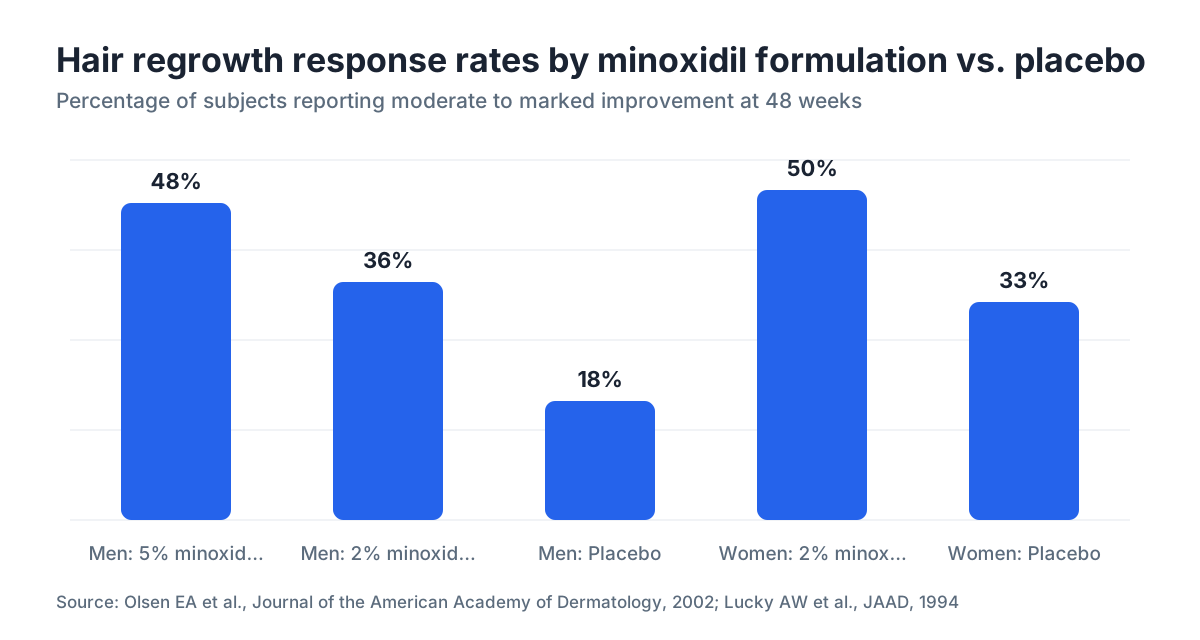
Yes, with caveats. The most-cited trial, published in the Journal of the American Academy of Dermatology, followed 984 men with androgenetic alopecia using 5% topical minoxidil versus 2% versus placebo over 48 weeks. The 5% group had 45% more nonvellus hair in the target area than placebo, and subjects rated their hair regrowth as "moderately more" to "much more" at a meaningfully higher rate than the placebo group. [3]
For women, a randomized, double-blind trial of 2% minoxidil versus placebo showed statistically significant increases in total hair count and hair weight, with about 50% of women reporting moderate to marked improvement versus around 33% on placebo. [4]
Here is the honest framing. "Work" means different things. For most users, minoxidil stabilizes shedding and produces modest-to-moderate density gains. A subset, probably around 10-15%, see dramatic results. Another subset sees almost nothing, partly because of low scalp sulfotransferase activity (some people simply do not convert enough minoxidil to its active form). Nobody can predict which group you are in before you try it.
For a deeper look at the evidence, does minoxidil work breaks down the trial data, response predictors, and what "non-responder" actually means clinically.
Results also depend on how early you start. Minoxidil cannot revive a follicle that has been dead for years. The closer to onset you begin, the better the outcome. This is one of the clearest points of agreement in the dermatology literature.
What are the different forms of minoxidil and which is best?
| Form | Concentration | FDA status | Typical cost/month | Notes |
|---|---|---|---|---|
| Topical solution | 2% or 5% | Approved (OTC) | $10-$25 | Liquid; spreads easily, can feel greasy |
| Topical foam | 5% | Approved (OTC) | $20-$35 | Less runoff, lower alcohol irritation |
| Oral tablets | 0.625-5 mg | Off-label (Rx) | $15-$40 | Systemic, growing evidence base |
The 5% topical solution and foam are available over the counter for men. The 2% solution is labeled for women, though many dermatologists now use 5% off-label for women as well. The foam at 5% was approved in 2006 and tends to have lower rates of contact dermatitis than the propylene glycol-containing solution. [1][10]
Oral minoxidil is a different animal. Doses used for hair loss (typically 0.625 mg to 2.5 mg daily for women, 2.5 mg to 5 mg for men) sit far below the 10-40 mg cardiovascular doses, but this is still a systemic drug requiring a prescription. A 2021 review in the Journal of the American Academy of Dermatology covering 47 studies found oral minoxidil effective for multiple hair loss types with a generally manageable side-effect profile at low doses, though fluid retention and hypertrichosis (unwanted body hair) are real concerns. [5]
Which is best? For someone starting fresh with no contraindications, the 5% topical foam is the easiest entry point. It is OTC, predictable, and avoids the systemic exposure of the pill. If topical fails, or someone can't stick with applying product twice daily, oral minoxidil is a reasonable next conversation with a dermatologist. More detail on the pill version is at oral minoxidil.
How do you use minoxidil correctly?
The FDA label for 5% topical solution calls for 1 mL applied directly to the dry scalp in the affected area twice daily, morning and night. The foam label is half a capful twice daily. [1] You do not shampoo it out right away. You leave it on the scalp.
A few things that actually matter for results:
Application spot matters more than people realize. Minoxidil needs to reach the scalp, not the hair shaft. Part the hair and apply directly to the skin. Rubbing it in lightly helps distribution without sending it down onto your face.
Twice daily is the labeled dosing. Some people switch to once daily for convenience, and some dermatologists tolerate that, but the clinical trials ran at twice-daily dosing. If you are not seeing results, frequency is worth examining.
Dry scalp before application. A wet scalp dilutes the product and increases systemic absorption slightly. Apply to a dry scalp and let it fully dry (20-30 minutes) before sleeping or exercising hard.
Consistency over months, not days. The hair cycle is slow. Most people see shedding worsen in weeks 2-8 (more on that below), and meaningful density gains typically appear between months 4 and 6. The 48-week trial cited above used 48 weeks for a reason. The drug keeps improving results past the 4-month mark.
Do not expect results to hold if you stop. Minoxidil does not cure the underlying condition. Hair gained typically sheds within 3-6 months of discontinuation.
Why does minoxidil cause more shedding at first?
The early shed freaks people out. It is real and it is expected.
When minoxidil pushes follicles from telogen (resting) into anagen (growth), the old telogen hairs get physically ejected to make room for the new anagen hairs underneath. So you lose more hairs than usual for the first 2-8 weeks. Some people experience this shed quite heavily. It is not a sign of failure.
The medical term is telogen effluvium secondary to treatment initiation. The AAD notes this as an expected response, not an adverse event. [6] If shedding continues beyond 3 months with no visible regrowth, that is worth discussing with a dermatologist. But stopping minoxidil during the early shed almost guarantees poor results, because you interrupt the process right as the new hairs are forming.
For more on what telogen effluvium looks like and how to tell it apart from worsening hair loss, hair loss telogen explains the hair cycle in plain terms.
What are the side effects of minoxidil?
Topical minoxidil is generally well-tolerated, but side effects are real. The most common ones:
Scalp irritation and contact dermatitis. This shows up more with the propylene glycol-based solution than the foam. Redness, itching, and flaking are the usual complaints. Switching to the foam formulation often resolves it.
Unwanted facial hair. Women in particular report hair growth on the forehead and cheeks, usually from product running down during application or sleep. Applying to a dry scalp, not over-applying, and washing hands immediately helps reduce this.
Cardiovascular effects. Topical minoxidil at labeled doses produces measurable systemic absorption, but usually at blood levels low enough to avoid meaningful cardiovascular effects in healthy adults. Oral minoxidil carries more risk here. Fluid retention, tachycardia, and pericardial effusion are documented concerns at therapeutic cardiovascular doses and theoretically possible at lower hair-loss doses. [7] This is why oral minoxidil requires a prescription and medical oversight.
Hypertrichosis (excess body hair). More of a concern with oral than topical, but some users of topical also report slightly increased body hair.
The FDA label includes a warning that minoxidil should not be used by people with certain cardiovascular conditions without physician supervision. [1] Anyone with a history of heart disease, low blood pressure, or kidney issues should talk to a doctor before starting even the topical version.
The dedicated guide at minoxidil side effects covers the full list with frequency data from clinical trials.
Is minoxidil better for men or women?
It works in both sexes, but the labeled concentrations and the underlying hair loss patterns differ.
For men, 5% twice daily is the standard. The trials show consistent hair count and weight gains in men with vertex (crown) thinning, which is where the drug works best. The frontal hairline is harder to treat with minoxidil alone, partly because frontal follicles tend to be more DHT-sensitive and more advanced by the time treatment starts. Men with a receding hairline often need to combine minoxidil with finasteride to see meaningful frontal results.
For women, the FDA-labeled dose is 2% twice daily, though the 5% foam is used off-label by many dermatologists and shows better results in several comparative studies. Female pattern hair loss usually presents as diffuse thinning across the crown (Ludwig pattern) rather than recession, and minoxidil addresses that pattern reasonably well. Women who are pregnant or may become pregnant should not use minoxidil. The drug is teratogenic in animal studies, and the FDA label carries a specific warning against use in pregnancy. [1]
For men specifically, minoxidil for men covers dosing, the frontal hairline challenge, and how to read your own progress.
Should you combine minoxidil with finasteride?
For men with androgenetic alopecia, yes. This is not a close call in the clinical literature.
Minoxidil addresses the growth phase of the follicle. Finasteride (a 5-alpha-reductase inhibitor) blocks the conversion of testosterone to DHT, the hormone miniaturizing the follicles in the first place. They attack the problem from two different angles.
A randomized controlled trial published in the Journal of Dermatology showed that oral finasteride 1 mg plus topical minoxidil 5% produced significantly greater hair count increases than either drug alone over 12 months. [8] The additive effect makes biological sense.
The practical question is sequencing and commitment. Finasteride takes 6-12 months to show its full effect and carries its own side-effect profile (sexual side effects in roughly 2-4% of men in clinical trials, though post-marketing reports suggest the number may be higher). Starting both at once makes it harder to identify which drug is responsible for any side effect you experience. Some dermatologists recommend starting one, stabilizing, then adding the other.
The full case for combination therapy, including data on hair count improvements and finasteride side effect rates, is at finasteride and minoxidil.
For women, finasteride is not FDA-approved for hair loss and is absolutely contraindicated in pregnancy. Spironolactone is the more common add-on in women.
If you want to know where you stand before committing to a treatment plan, the free AI hair analysis at MyHairline can assess your pattern and loss stage from photos in under two minutes. That at least gives you a starting frame for the conversation with a dermatologist.
How long does minoxidil take to work?
The honest timeline:
Weeks 1-8: Shedding often increases. No visible regrowth yet. Months 2-4: Shedding normalizes. Some people notice early fine vellus hairs. Months 4-6: Most responders see measurable density gains. Hair feels fuller. Months 6-12: Ongoing improvement if treatment continues. 12+ months: Peak effect for most users, though some keep improving slightly.
The 48-week JAAD trial measured peak hair count gains at around 32-48 weeks, meaning results kept improving well past the 6-month mark. [3] Stopping before 6 months is a common mistake. Many people quit during the awkward 2-4 month window when they have shed but not yet regrown.
Photography every 4 weeks in the same lighting and angle is the only reliable way to track progress. The hair cycle is too slow for day-to-day observation to mean anything.
What happens if you stop using minoxidil?
You lose the gains. That is the core limitation.
Minoxidil does not modify the underlying disease. It does not prevent DHT from miniaturizing follicles. It just keeps those follicles producing larger, longer hairs while you use it. When you stop, the follicles return to their pre-treatment state, and the hairs shed over roughly 3-6 months.
This is not unique to minoxidil. Most hair loss treatments require indefinite use to maintain results. The difference is that minoxidil is cheap, over-the-counter, and generally safe for long-term use, so indefinite use is realistic.
The calculus changes if you have used finasteride long enough to actually slow the underlying DHT-driven miniaturization. In that scenario, stopping minoxidil might result in less loss than if you had never used finasteride, because the root cause is more controlled. But this is theoretical for most users.
Treat minoxidil like a subscription, not a course of antibiotics. You are renting the results.
When is minoxidil not enough and what comes next?
Minoxidil has real limits. It works best on active follicles, not scar tissue or long-dead follicles. A crown that has been bald for a decade is unlikely to respond. Norwood stage 6-7 in men, where the scalp is extensively bald, sees diminishing returns from minoxidil alone.
In those cases, or for men and women who want a permanent, medication-independent result, a hair transplant is the other evidence-based option. Transplants move DHT-resistant follicles from the back and sides of the scalp to the thinning areas. The results are permanent (the transplanted follicles keep their donor characteristics). But cost, recovery, and candidacy requirements are significant. A realistic budget for a quality procedure in the US runs $4,000-$15,000 depending on graft count and technique, and you still need to manage the native thinning hair with minoxidil or finasteride post-transplant. The cost breakdown is at hair transplant expenses.
Hair loss supplements (biotin, saw palmetto, marine-based proteins) are also popular, but the evidence base is much thinner than for minoxidil. Most have small trials or none at all. They are not a substitute.
For men wondering whether creatine might be worsening their hair loss alongside existing treatment, does creatine cause hair loss examines that question with the actual data.
If your loss is advanced or accelerating, a dermatologist visit is the right next step. MyHairline's free AI scan can help you document your current pattern and track change over time, but a board-certified dermatologist is who you want interpreting those results and ruling out non-androgenetic causes.
Sources
- FDA, Rogaine (minoxidil) prescribing information and OTC label
- Messenger AG, Rundegren J. Minoxidil: mechanisms of action on hair growth. British Journal of Dermatology, 2004
- Olsen EA et al. A randomized clinical trial of 5% topical minoxidil versus 2% topical minoxidil and placebo in the treatment of androgenetic alopecia in men. Journal of the American Academy of Dermatology, 2002
- Lucky AW et al. A randomized, placebo-controlled trial of 2% topical minoxidil in female androgenetic alopecia. Journal of the American Academy of Dermatology, 1994
- Randolph M, Tosti A. Oral minoxidil treatment for hair loss: A review of efficacy and safety. Journal of the American Academy of Dermatology, 2021
- American Academy of Dermatology, Hair loss: Diagnosis and treatment
- FDA, Loniten (oral minoxidil) prescribing information
- Khandpur S et al. Comparative efficacy of various treatment regimens for androgenetic alopecia in men. Journal of Dermatology, 2002
- American Academy of Dermatology, Minoxidil: Overview
- FDA, Drug Approvals and Databases