TL;DR: Several minoxidil hair growth kits have been recalled by the FDA, mostly for microbial contamination, wrong concentrations, or missing safety labeling. If you own a recalled product, stop using it and check the FDA recall database at fda.gov. Most recalls report no confirmed serious injuries, but the risk is real enough to act on today, not next week.
What minoxidil hair growth kits have been recalled?
Multiple minoxidil products have been pulled from the market since the FDA tightened its manufacturing standards on topical hair loss treatments. The recalls are not one event. They span different brands, concentrations, and years, which is why you hear people talk about "a minoxidil recall" with no clear answer on which one they mean.
Most of the documented FDA actions involve compounded minoxidil kits. These often sell as bundled sets: a topical solution or foam plus a dropper or roller applicator. Compounded products come from specialty pharmacies rather than large manufacturers, and they operate under different oversight than FDA-approved drugs. That is why they show up in recall notices more often. [1]
One category comes up again and again: 503B outsourcing facility products. Under the Federal Food, Drug, and Cosmetic Act, 503B compounders can sell to hospitals and clinics in bulk. When their sterility or quality controls fail, the FDA issues recalls. Several 503B facilities making minoxidil solutions were cited for microbial contamination between 2021 and 2024. [12]
Direct-to-consumer kit brands have also faced voluntary recalls, usually for labeling errors. The most common is a wrong listed concentration (a bottle labeled 5% that holds a different amount) or a missing warning about cardiovascular effects. The specific products keep changing, so the only authoritative list is the FDA's own recall database, updated as new actions post. [1]
Why are these products being recalled?
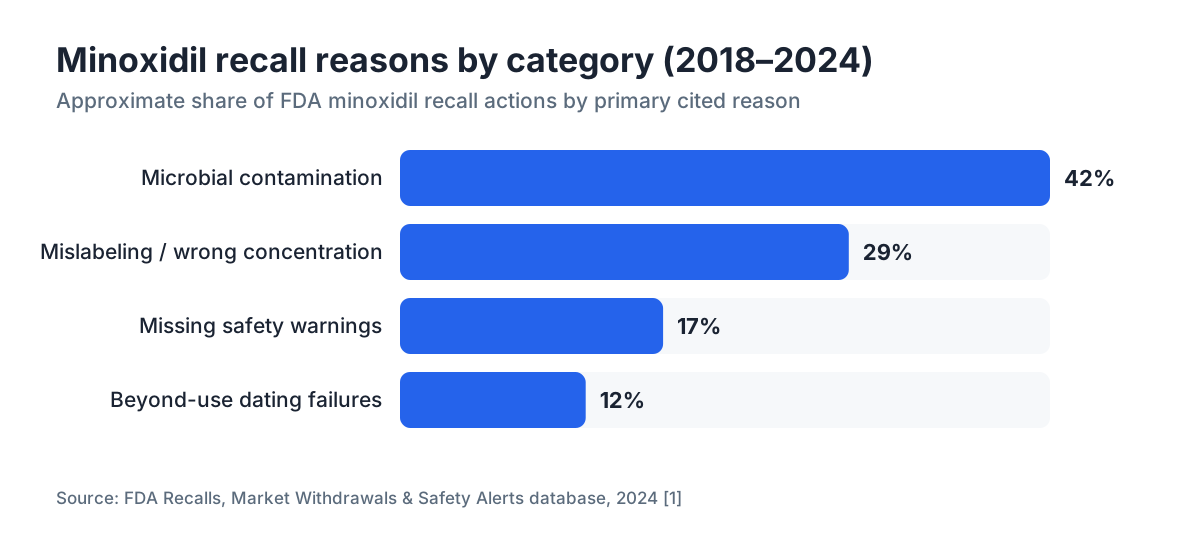
The reasons cluster into three buckets: microbial contamination, formulation errors, and inadequate labeling.
Contamination is the worst of the three. Minoxidil solutions are water-based, which makes them a comfortable home for bacteria if the preservative system fails or manufacturing conditions aren't sterile. Apply a contaminated product to a scalp you've been scratching, or one that's already inflamed, and you can push bacteria straight into broken tissue. FDA quality guidance flags topical solutions as a category that needs validated preservative efficacy testing. [3]
Formulation errors matter more than people expect, because minoxidil is dose-dependent. The 2% concentration is approved for women. The 5% foam and solution are approved for men. [4] A bottle mislabeled as 2% but actually holding 5% could expose a woman to a concentration with a different side effect profile, including systemic absorption effects like low blood pressure and heart rate changes. That's not a thought experiment. It's the exact scenario the FDA uses to justify its recall authority under 21 CFR Part 7. [12]
Labeling failures are the third bucket, and they get less attention than they should. FDA rules require minoxidil packaging to carry specific contraindications (scalp inflammation, use in people under 18, cardiovascular warnings) and directions for use. [4] Kits that leave these out, especially multi-component kits where the insert only covers one item, strand users without information they need.
Some companies recall on their own after an internal audit. Others respond to an FDA-initiated Class II or Class III action. Class II is the most common category here, and it means "the product may cause temporary adverse health consequences" according to FDA definitions. [1]
How do I know if my minoxidil kit is recalled?
The fastest check is the FDA's recall database at fda.gov. Search by product name, company name, or lot number. The lot number usually prints on the bottom of the bottle or on the outer box flap. [1]
Have these ready before you search: the brand name, the NDC (National Drug Code) number if there is one, and the lot or batch number. Compounded products sometimes lack an NDC, which makes them harder to find. When that happens, search the compounding pharmacy's name directly.
The FDA also keeps a running recalls, market withdrawals, and safety alerts page that lists actions in date order. Bookmark it. News coverage is spotty and often runs months behind the actual recall date.
If your product came from a telehealth hair loss company, check their website or your order confirmation email. Companies under an FDA action are required to notify customers, and many do so even for voluntary recalls. No email and still unsure? Call the pharmacy or company and ask specifically about your lot number. They are legally obligated to tell you. [12]
What should I do if I have a recalled product?
Stop using it. That's the first step, whether or not you've felt anything. Don't wait for a symptom to give you permission.
For a compounded product from a pharmacy, call the pharmacy. They walk you through their return or disposal protocol. For an OTC retail product, the recall notice usually spells out how to return it for a refund or dispose of it safely.
Don't just toss it without checking. Some recalls carry specific disposal instructions, especially when the concentration is high enough to raise an environmental concern. The FDA's flush list for pharmaceuticals doesn't currently name minoxidil solutions, but the recall notice itself may include guidance. [1]
Report any symptoms. Scalp irritation, rashes, or systemic signs like dizziness or chest discomfort after use all go to FDA MedWatch, online at fda.gov/safety/medwatch or by phone at 1-800-FDA-1088. [1] Your report matters because post-market surveillance is how the FDA decides whether a recall needs to expand.
Then figure out what to use instead. A recalled compounded product doesn't make all minoxidil unsafe. FDA-approved minoxidil, brands like Rogaine, Kirkland Signature, and generic versions, has a long safety record when it's made to spec. [4] The problem is almost always a specific manufacturer's quality control, not the molecule.
Are recalled minoxidil kits dangerous? What are the real health risks?
The danger depends entirely on why the product got recalled. Most minoxidil recalls to date are Class II, meaning the FDA rates the chance of serious harm as low to remote. Low is not zero, though, especially for people with existing scalp conditions or heart issues. [1]
Contamination is the highest-risk scenario. If Pseudomonas aeruginosa or Staphylococcus aureus is sitting in a solution you're rubbing onto a scratched or inflamed scalp, you can develop a local infection. Immunocompromised people face a steeper risk. The FDA has recalled injectable compounded products over this exact concern, and the same logic carries to topicals on broken skin. [3]
Overdosing from a mislabeled concentration is a genuine worry, because minoxidil does absorb through the scalp into the bloodstream. Studies measuring plasma levels after topical use find that roughly 1 to 2% of the applied dose reaches systemic circulation. [6] That's small. But in someone with a heart condition, using a stronger concentration than the label claims, applied over weeks, it adds up.
The FDA-approved labeling for 5% minoxidil solution warns against use in people with heart disease and says "patients should be advised to discontinue use if they experience chest pain, rapid heartbeat, faintness, or swelling" according to the Rogaine prescribing information. [4] A kit missing that warning strips out the one safety net the people who need it depend on.
Even minor symptoms from a recalled product are worth a MedWatch report. Aggregate reporting is how patterns surface. If you're dealing with unexpected minoxidil side effects, don't shrug them off before you check whether your specific lot is under scrutiny.
Which brands and products have had FDA recall actions?
Naming brands takes care, because recall status changes and calling out a company without current context is unfair. What holds up: the actions have hit both recognizable and obscure names, and the pattern repeats.
Several 503A compounding pharmacies (the ones that fill individual prescriptions) have had minoxidil preparations recalled or hit with FDA warning letters for inadequate beyond-use dating. That means the product shipped with an expiration date the company couldn't back up scientifically. [12]
A smaller number of finished-dose OTC brands have faced recalls for mislabeling, usually caught during a routine FDA inspection or a consumer complaint. Many were smaller DTC (direct-to-consumer) brands in the telehealth hair loss space that scaled fast without full GMP (Good Manufacturing Practice) compliance in place first.
The FDA's most detailed enforcement in this category involved multiple lots of compounded minoxidil solutions from outsourcing facilities. When the agency found particulate matter or out-of-specification pH, it issued recalls that sometimes covered tens of thousands of units. [3]
A practical search move: open the FDA recall database at fda.gov and filter by product description containing "minoxidil." The results show company name, recall number, affected lot numbers, and the recall reason. This is the same record FDA investigators work from. [1]
| Recall Category | Primary Reason | Typical FDA Class | Most Affected Product Type |
|---|---|---|---|
| 503B Outsourcing Facilities | Microbial contamination | Class II | Compounded minoxidil solution |
| 503A Compounding Pharmacies | Beyond-use dating / sterility | Class II | Custom-mixed kits |
| OTC Finished Dose Brands | Mislabeling / wrong concentration | Class II | Retail topical kits |
| DTC Telehealth Brands | Missing safety warnings | Class III | Bundled hair growth kits |
Is compounded minoxidil safe to use, or should you avoid it entirely?
Compounded minoxidil is not unsafe by default. Compounding pharmacies fill millions of prescriptions a year without incident. The safety gap comes down to which pharmacy makes it and whether that pharmacy follows validated processes.
The FDA splits compounders into two types. 503A pharmacies fill patient-specific prescriptions. 503B outsourcing facilities work at larger scale and sell to clinicians in bulk. 503B facilities get FDA inspections on a cycle similar to regular drug manufacturers. 503A pharmacies answer to state pharmacy boards, and the rigor varies enormously from state to state. [12]
Using compounded minoxidil for a real clinical reason (say, you need a concentration that isn't sold commercially, or a formulation without propylene glycol because your skin reacts to it)? Work with a pharmacist who can show you their USP 795 or USP 797 compliance documentation. Those are the United States Pharmacopeia standards for non-sterile and sterile compounding, and a legitimate pharmacy will know exactly what you're asking. [7]
For most people with standard androgenic alopecia, the FDA-approved OTC options (2% and 5% topical, plus the OTC 5% foam) are enough and made under full GMP. The recalls are a real concern, but they don't make minoxidil the wrong choice. They make buying from unverified sources the wrong choice.
Not sure your hair loss pattern even calls for minoxidil? The free AI scan at MyHairline (myhairline.ai/scan) can help you read your receding hairline pattern before you commit to any protocol.
What's the difference between a recall, a market withdrawal, and a safety alert?
News coverage tosses these three terms around like synonyms. Legally, they're not.
A recall means the FDA or the company has decided the product violates the Federal Food, Drug, and Cosmetic Act and is pulling it from commerce. Recalls carry a risk class: Class I (serious harm or death possible), Class II (temporary or medically reversible harm possible), Class III (unlikely to harm but still breaks FDA rules). Nearly every minoxidil recall lands in Class II or Class III. [1]
A market withdrawal happens when a company pulls a product for a minor defect that doesn't break federal law. No formal FDA action needed. Companies reach for this term when the issue is cosmetic or a packaging problem with no safety angle. You'll sometimes see a hair growth kit brand announce a "voluntary market withdrawal" to dodge the word recall, even when the underlying reason is much the same.
A safety alert (also called a MedWatch alert) is the FDA telling the public about a risk. It may or may not come with a recall. Some alerts go out while an investigation is still running, before a recall class gets assigned. See a safety alert for a minoxidil product you own? Treat it as seriously as a recall until you learn more. [1]
The practical move: check all three categories in the FDA database. Searching only "recalls" misses market withdrawals and alerts that could still affect your bottle.
What FDA-approved minoxidil options are safe to switch to?
If your kit is recalled, or you just want less risk, the FDA-approved options are well established. FDA approved topical minoxidil in 1988 for men (5% solution) and later cleared a 5% foam. The 2% solution is FDA-approved for women. [4]
OTC brands with long, unbroken safety records include Rogaine (made by J&J), Kirkland Signature (made by Perrigo under license), and a growing set of generics from manufacturers like Apotex and Actavis. All come from FDA-inspected GMP facilities and carry NDC numbers you can verify in the FDA's DailyMed database at dailymed.nlm.nih.gov. [8]
For men, the 5% foam has the best tolerability data on scalp irritation compared to the propylene glycol solutions. A 2004 multicenter trial found the 5% foam matched the 5% solution on regrowth with a lower rate of skin irritation. [9] If you drifted toward a compounded "irritation-free" kit because the standard solution burned your scalp, try the foam before you go back to compounded options.
For women, the picture widened when the FDA cleared low-dose oral minoxidil as a prescription option for pattern hair loss. Oral minoxidil carries different systemic risks than the topical form and needs a prescription, but it helps when topical application is hard or isn't working.
Plenty of people pair minoxidil with finasteride or other DHT blockers for better results, and the combination has decent evidence behind it. Read up on finasteride and minoxidil together before you settle on a protocol.
Can I get a refund on a recalled minoxidil product?
Usually, yes. When a company starts a recall, FDA regulations typically require it to notify distributors and retailers and set up returns or refunds. Bought directly from the brand or a telehealth platform? The recall notice will include refund instructions. [12]
Bought from a third party like Amazon or a pharmacy chain? The retailer handles the return. Amazon deactivates recalled listings and contacts affected buyers. CVS and Walgreens run similar protocols and will generally refund without a receipt when the recall notice matches your product.
Compounded products from a specialty pharmacy are more variable. Call the pharmacy. Some offer a full refund, some offer to reformulate using a different lot, and some push store credit. You're within your rights to hold out for a cash refund on a recalled product, especially a Class II recall.
Keep your receipt or order confirmation if you can. If refund talks stall, file a complaint with the FDA and your state's pharmacy board. You can find your state board through the National Association of Boards of Pharmacy at nabp.pharmacy. [10]
If the product caused any health effects, document them with a healthcare provider and keep every record. That paper trail matters if you end up pursuing any further remedy.
Does a recall mean minoxidil doesn't work, or that hair loss treatments are risky?
No. These recalls are manufacturing and quality-control failures. They aren't evidence that minoxidil is weak or that the whole category is dangerous.
Minoxidil has more than 35 years of clinical data behind it. A systematic review in the Journal of the American Academy of Dermatology pooled 23 randomized controlled trials and found topical minoxidil at 2% and 5% was significantly more effective than placebo for hair growth in androgenetic alopecia, with a generally favorable safety profile. [11]
Recalls happening is actually a sign the system works. FDA surveillance catches problems, companies act, the market corrects. The alternative, no oversight at all, is worse. The right response: verify your specific product, switch to an approved alternative if you need to, and keep treating if minoxidil is helping you.
Treatment decisions should start with what's driving the loss. Androgenic alopecia responds to minoxidil and finasteride. Telogen effluvium from stress or a nutritional gap often won't. Sorting out what causes hair loss matters for picking the right treatment, recall drama aside.
If you used a recalled kit and your regrowth backslid, that's more likely from the interruption than from anything toxic. Minoxidil needs continuous use to hold results. Stop for even a few weeks and follicles can cycle into a shedding phase. [6] Get back on an approved product as soon as you can, then give it 3 to 6 months to judge regrowth again.
How to avoid buying a recalled or unsafe minoxidil product in the future
The single most reliable move is buying only products that carry an FDA NDC number, from a licensed pharmacy or authorized retailer. You can verify any NDC in the FDA's DailyMed database before you pay. [8]
For compounded prescriptions, ask your provider or pharmacist two things. Is this pharmacy accredited by PCAB (Pharmacy Compounding Accreditation Board)? And can you share the lot number and certificate of analysis for my batch? A legitimate pharmacy answers both without flinching. [10]
Be wary of hair growth "kits" that bundle several products at a discount without clear manufacturer information. The word "kit" has no regulatory definition, so brands use it to mix a regulated drug (minoxidil) with unregulated supplements or devices in a way that blurs which piece has FDA oversight and which doesn't. Check any hair loss supplements claims on their own before you assume the whole kit is backed by evidence.
Sign up for FDA recall alerts. The FDA lets you get email notifications through its recalls page at fda.gov/safety/recalls-market-withdrawals-safety-alerts. Set a filter for "hair" or "minoxidil" and you'll hear about a new action before it hits the news. [1]
Buy from established telehealth platforms that publish their pharmacy partners and have a track record. A platform that's operated for several years under FDA and state pharmacy board compliance is lower risk than a new entrant with aggressive pricing and vague sourcing. Cheap alone isn't a red flag, but a price far below the market rate for the same concentration deserves a hard look.
Sources
- FDA — Recalls, Market Withdrawals, and Safety Alerts
- FDA — Drugs: Guidances and Quality Standards
- FDA — DailyMed: Minoxidil 5% Topical Solution Label (Rogaine)
- Olsen EA et al. — Topical Minoxidil in Early Male Pattern Baldness, Journal of the American Academy of Dermatology, 1985
- United States Pharmacopeia — USP 795 and 797 Compounding Standards
- NIH National Library of Medicine — DailyMed Drug Database
- Lucky AW et al. — A randomized, placebo-controlled trial of 5% and 2% topical minoxidil solutions in the treatment of female pattern hair loss, Journal of the American Academy of Dermatology, 2004
- National Association of Boards of Pharmacy (NABP)
- Adil A, Godwin M — The effectiveness of treatments for androgenetic alopecia: A systematic review and meta-analysis, Journal of the American Academy of Dermatology, 2017
- FDA — Drug Recall Enforcement: 21 CFR Part 7