TL;DR: Minoxidil is an FDA-approved topical (and now off-label oral) drug that prolongs the hair growth phase and widens follicles. Clinical trials show meaningful regrowth in 40-60% of users after 4-6 months of daily use. It does not cure androgenetic alopecia. Stop using it and the gains reverse within 3-6 months.
What is minoxidil and why does it grow hair?
Minoxidil was invented as a blood-pressure pill in the 1970s. Patients kept showing up with unexpected hair growth, and Upjohn eventually ran the trials to figure out why. The FDA approved a 2% topical solution for women in 1991 and a 5% solution for men in 1997. A 5% foam for men came along in 2006. Generic versions flooded the market shortly after patent expiry, and today a month's supply of the foam costs $15-30 at any pharmacy. [1]
The honest mechanism is still not fully worked out. The leading explanation is that minoxidil (or its active metabolite, minoxidil sulfate) acts as a potassium-channel opener in dermal papilla cells. This increases blood flow and nutrient delivery to the follicle, and it extends the anagen (active growth) phase of the hair cycle while shortening the telogen (resting) phase. The result is thicker, longer hairs and more of them actively growing at once. [2]
One thing worth knowing upfront: minoxidil does not change the underlying genetic program driving androgenetic alopecia. It buys you time. That's genuinely useful, but it means you're committing to ongoing use, not a one-time fix. If this sounds frustrating, you're not wrong, though most dermatologists consider it one of the two most evidence-backed tools available for pattern hair loss (the other being finasteride). [3]
How long does minoxidil take to show hair growth?
Expect nothing in the first two months, a modest visible change around month four, and a real verdict only at month twelve. The first 2-8 weeks often feel like minoxidil is making things worse. It isn't. What you're seeing is "shedding," which happens because the drug pushes resting follicles into an active cycle and the old telogen hairs fall out to make room. This is expected and temporary. If it bothers you, read more about hair loss telogen to understand why this shed happens at the follicle level.
After that initial shed, the real timeline looks like this:
| Timeframe | What typically happens |
|---|---|
| Weeks 1-8 | Possible shedding; scalp absorption establishing |
| Months 2-4 | Fine vellus (peach-fuzz) hairs appear at treated areas |
| Months 4-6 | Vellus hairs thicken into terminal hairs; coverage improves |
| Month 12 | Peak response visible; what you see now is likely your ceiling |
| After month 12 | Maintenance phase; results hold as long as you keep using it |
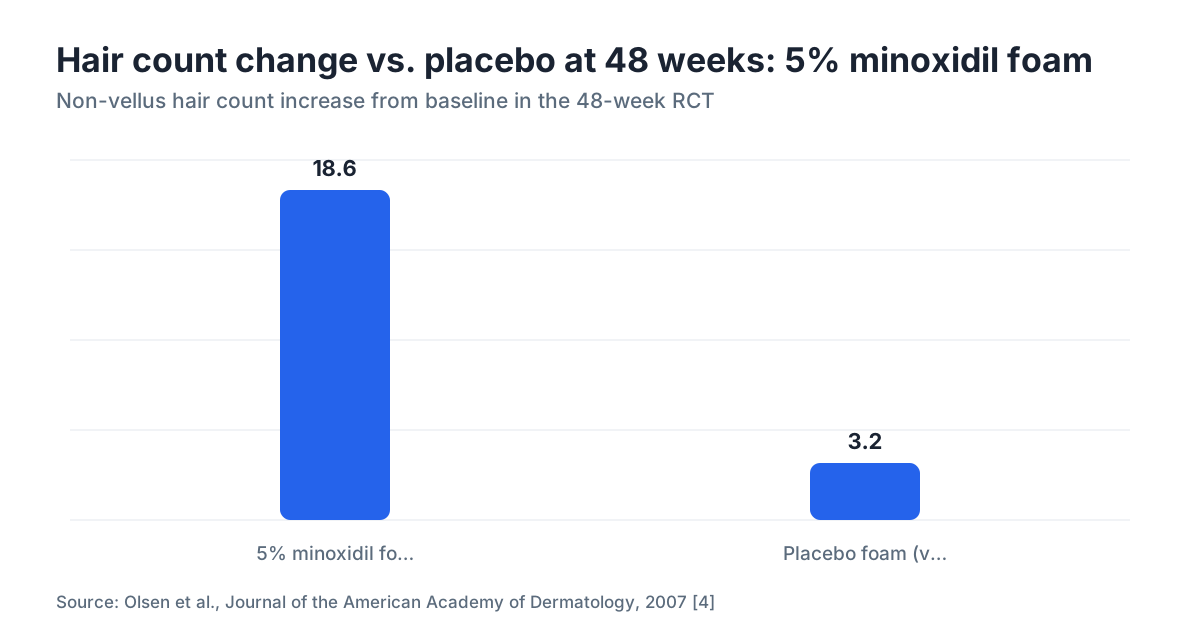
The main 48-week trial for the 5% foam, published in the Journal of the American Academy of Dermatology, found statistically significant increases in hair count versus placebo at week 16 and beyond. [4] The American Academy of Dermatology recommends giving any topical minoxidil regimen a full 12 months before deciding it isn't working, because early measurements undercount the improvement. [3]
So be patient. The people who quit at month three quit right before the results show up.
Does minoxidil actually work, and for whom?
It works for a meaningful minority, it partially works for many, and it does nothing for some. Clinical trials for 5% topical minoxidil in men with androgenetic alopecia (male pattern baldness) generally report that 40-60% of users see at least moderate hair regrowth. [4] A 1999 New England Journal of Medicine review put the response rate in the same range and summarized the drug's clinical use. [8] A Cochrane review of randomized controlled trials found that 5% minoxidil consistently outperforms 2% minoxidil and placebo for non-scarring alopecia. [5]
It works best on the vertex (crown) of the scalp. The hairline and temples respond more slowly and less dramatically, which matters a lot if you're dealing with a receding hairline rather than top-of-head thinning. It also works better in people who started treatment earlier in the hair loss process. Someone at Norwood stage 2 will likely see better results than someone at Norwood stage 5.
Minoxidil is FDA-approved for women too, specifically the 2% solution applied twice daily and the 5% foam once daily. Several studies show it reduces shedding and increases hair density in women with female pattern hair loss. Response rates are broadly similar to men. [1]
It does not work on completely bald patches where the follicle is gone. A follicle that has been miniaturized can often be reactivated. A follicle that has scarred over cannot. This is why doctors talk about treating hair loss early.
If you want to understand why you're losing hair in the first place before deciding on treatment, the article on what causes hair loss is a good starting point.
What happens when you stop using minoxidil?
You cannot stop without losing your gains. Within 3-6 months of stopping, most of the regrown hair sheds back to where you started. This is the question people search for after six months of decent results, when they start wondering if they can just quit.
This isn't a side effect in the clinical sense. It's the drug wearing off and the follicles returning to their hormonally driven miniaturization. The FDA label for minoxidil states that "two and four months after stopping minoxidil topical solution, hair counts returned to baseline." [1]
That's probably the biggest practical consideration for anyone starting minoxidil. You're signing up for a lifelong daily habit. Some people are perfectly happy with that trade-off, especially when the alternative is progressive hair loss. Others find it psychologically or logistically difficult and either switch to finasteride, consider a hair transplant, or accept the loss.
There's no tapering needed when you stop. You can just discontinue. But do it knowing what to expect.
What's the difference between topical and oral minoxidil for hair growth?
Oral minoxidil for hair loss is a real thing and the evidence is growing fast, though it's being used off-label because the FDA never approved it specifically for hair. The approved indication for oral minoxidil is severe hypertension that hasn't responded to other drugs. [9]
Dermatologists prescribing it off-label for hair typically use very low doses: 0.625 mg to 2.5 mg daily for women, and 2.5 mg to 5 mg for men. These are a fraction of the 10-40 mg doses used for hypertension, which is why cardiovascular side effects are uncommon at hair-loss doses but not impossible. [6]
A 2022 systematic review and meta-analysis in the Journal of the American Academy of Dermatology analyzed 17 studies covering 635 patients and found oral minoxidil effective for androgenetic alopecia with a favorable tolerability profile at low doses. The most common side effect was unwanted body hair growth (hypertrichosis), reported in roughly 14% of patients in that review. [6]
The practical comparison:
| Feature | Topical minoxidil | Oral minoxidil |
|---|---|---|
| FDA approval for hair | Yes (2% and 5%) | No (off-label) |
| Typical dose | 1 mL solution or 0.5 g foam, once or twice daily | 0.625-5 mg/day |
| Application hassle | Applies to scalp; can feel greasy | One small pill daily |
| Main side effects | Scalp irritation, unwanted facial hair | Hypertrichosis, fluid retention |
| Systemic absorption | Low but real | Higher |
| Prescription required | No (OTC) | Yes |
For a full breakdown on the pill form, see the oral minoxidil guide. And for more on the specific side effect profile across both forms, minoxidil side effects covers it in detail.
How should you apply topical minoxidil for the best results?
Application method matters more than most people expect. The drug has to get through the scalp barrier and reach the dermal papilla. Keeping it sitting on oily or wet hair means it's not doing much.
For the solution (liquid):
- Start with a dry scalp. Wet hair dilutes the solution and lets it run off.
- Part the hair to expose the thinning area. Use the dropper to apply 1 mL directly to the scalp, not to the hair shafts.
- Spread it gently with your fingertips and wash your hands immediately after. Minoxidil absorbed through your palms can cause unwanted hair there.
- Wait at least 4 hours before washing your hair or going to bed. Most people apply it in the evening and rinse in the morning.
For the foam:
- Dispense half a capful (approximately 0.5 g, which equals about 1 mL of solution in minoxidil content) onto your fingers.
- The foam melts quickly on your fingers, so work fast. Apply directly to the scalp, not to hair.
- The foam is alcohol-free compared to some solutions, which is why scalp irritation tends to be lower with foam for many users.
Twice-daily application was originally the FDA-approved regimen for the solution, but the 5% foam is approved for once-daily use in men, and many dermatologists say once daily is what patients actually stick to long-term. Consistency over months and years beats the perfect twice-daily schedule you abandon after three weeks.
Avoid applying to irritated, sunburned, or broken skin. Minoxidil absorbs faster through compromised skin, which increases systemic exposure and the risk of side effects.
Does minoxidil work better combined with finasteride?
Yes, and by a meaningful margin. The two drugs work through completely different pathways, which is why they stack well. Finasteride reduces dihydrotestosterone (DHT), the hormone that miniaturizes follicles in genetically susceptible men. Minoxidil keeps those same follicles in active growth mode. They attack the problem from both sides. [7]
A randomized controlled trial published in Dermatologic Therapy compared 1 mg finasteride alone, 5% minoxidil alone, and the combination. At 12 months, the combination group showed significantly greater increases in hair count than either drug alone. [7] The American Hair Loss Association notes the combination as the most effective non-surgical medical approach for men.
The practical catch is that finasteride carries its own side effect profile (sexual side effects in a small percentage of men, and it's contraindicated in women who are pregnant or may become pregnant). That's a separate calculation. But if you're a man under 60 with androgenetic alopecia, the combination is worth the conversation with a doctor.
For a detailed comparison of how the two drugs work together, the finasteride and minoxidil article goes deep on the evidence.
For men specifically thinking about which form of minoxidil makes sense for their situation, minoxidil for men covers the dosing decisions in more detail.
What do minoxidil hair growth products actually contain?
The active ingredient is minoxidil: either 2% or 5% concentration. Everything else in the formulation is there to help it penetrate the scalp, preserve shelf life, or improve aesthetics. In solution form, you'll typically find propylene glycol (penetration enhancer, but the main cause of scalp irritation), ethanol (solvent and preservative), and purified water. Some formulations add finasteride, tretinoin, or other actives to create combination products, mostly sold through telehealth platforms.
Foam formulations replace much of the propylene glycol with isobutane and other propellants, which is why they're often better tolerated by people with sensitive scalps. They do tend to cost slightly more.
When you're choosing between minoxidil hair growth products, the actual minoxidil concentration is what matters. A $60 "premium" product at 5% is not more effective than a $15 generic at 5%. The branded version (Rogaine) and the cheapest store-brand generic are bioequivalent at the same concentration. [1] I'd buy the generic unless you have a specific reason to prefer a particular formulation (foam vs. solution, or sensitivity to propylene glycol).
A small number of compounding pharmacies offer higher concentrations (10% or even 15%) combined with other ingredients like ketoconazole or tretinoin. There's some evidence that tretinoin improves minoxidil penetration, but these aren't FDA-approved products, and the evidence base is thinner. If you go that route, it should be with a doctor's oversight.
Are there any minoxidil side effects worth knowing about before you start?
Topical minoxidil is genuinely well-tolerated for most people, which is part of why it's OTC. That said, side effects exist and you should know about them going in.
Scalp irritation (redness, itching, flaking) is the most common complaint and usually traces to propylene glycol in the solution formulation. Switching to the foam resolves it for most people.
Unwanted facial or body hair affects some users, particularly women. Minoxidil doesn't know where to stop, so if it drips from your hairline onto your forehead, it can stimulate hair growth there. Careful application prevents most of this.
Systemic cardiovascular effects (racing heart, fluid retention, chest pain) are rare with topical application because absorption is low, but they're not zero. People with pre-existing heart conditions should check with a physician before starting, and with oral minoxidil the cardiovascular caution is more serious.
Fast heart rate and dizziness are the signals to stop and get checked out.
Some people should not use minoxidil or need medical supervision: pregnant women, people with scalp psoriasis or severe dermatitis (because absorption is unpredictable), and people on other medications that lower blood pressure.
The full side effect breakdown is at minoxidil side effects. Worth reading before you buy.
When is minoxidil not enough and what are the alternatives?
Minoxidil handles hair loss maintenance well. It's a weaker tool for people who are far along in hair loss, have significant areas of complete baldness, or who have scarring alopecia.
If you've lost a large area of hair and want to restore actual hairline architecture, a hair transplant may be the only option that achieves meaningful cosmetic change. Hair transplants move permanent, DHT-resistant follicles from the back of the scalp to the front. The procedure costs $4,000-$15,000 depending on graft count and technique, which is addressed in detail at hair transplant expenses.
Other medical options include finasteride (prescription, for men primarily), spironolactone (prescription, for women), and low-level laser therapy (LLLT) devices. Hair loss supplements like biotin, saw palmetto, and others get a lot of attention; the evidence for most of them is weak compared to minoxidil, but some people use them alongside proven treatments.
Myhairline.ai has a free AI hair analysis tool at /scan that looks at your scalp photos and tells you which Norwood or Ludwig stage you're at. It's a useful starting point for figuring out how much hair loss you're dealing with before deciding whether minoxidil alone makes sense or whether you need a combination approach.
The honest answer is that most people doing well on minoxidil are in the early-to-moderate range of hair loss. If you're further along, layer in other treatments rather than relying on minoxidil alone.
What does the research say minoxidil cannot do?
No honest article about hair growth with minoxidil skips this part.
Minoxidil cannot regrow hair on a completely bald scalp where follicles have permanently atrophied. The drug stimulates follicles; it does not create new ones.
It cannot stop the hormonal and genetic process of androgenetic alopecia. You might maintain hair count while on it, but underneath, DHT is still doing its work. This is why finasteride, which actually reduces DHT, makes minoxidil work better: finasteride slows the underlying disease while minoxidil props up the results.
It does not work equally well everywhere on the scalp. Vertex response is strongest. Hairline response is weaker. This is documented in the original clinical trials and consistent with real-world dermatology practice. [4]
It is not a substitute for addressing underlying causes of hair loss that aren't androgenetic alopecia. Telogen effluvium from thyroid disease, iron deficiency, or severe caloric restriction won't respond to minoxidil in the same predictable way. The what causes hair loss article covers how to tell the difference.
Nobody has good long-term data (beyond 5 years) on whether minoxidil's effect weakens over time for the average user. Some patients report diminishing returns; others maintain gains for a decade. The closest long-term data we have is from the 48-week trials, which just aren't long enough to answer this definitively. [4] That's an honest gap.
How much does minoxidil cost and where can you get it?
Generic 5% minoxidil foam runs $15-30 per month at most US pharmacies and online retailers. The branded Rogaine foam costs $35-55 per month for the same active ingredient and concentration. Solution formulations are usually slightly cheaper than foam. [1]
Minoxidil in the US is available without a prescription. You don't need to see a doctor to start topical minoxidil (though it's never a bad idea, especially if you're unsure whether your hair loss is androgenetic or something else).
Oral minoxidil requires a prescription. Telehealth platforms have made this relatively accessible; many prescribe low-dose oral minoxidil for $20-50 per month including the prescription fee, depending on the platform.
Compounded versions with added ingredients (tretinoin, finasteride, ketoconazole) typically cost $60-120 per month and require a prescription.
Over a year, basic OTC topical minoxidil costs roughly $180-360. Over five years, that's $900-1,800. Factor that into your thinking, especially against a one-time hair transplant cost, though the two options aren't identical in what they deliver.
Sources
- FDA, Minoxidil Topical Solution and Foam Drug Label
- National Library of Medicine / StatPearls, Minoxidil
- Olsen EA et al., Journal of the American Academy of Dermatology, 2007 to 5% minoxidil foam 48-week trial
- van Zuuren EJ et al., Cochrane Database of Systematic Reviews, Interventions for female pattern hair loss
- Vañó-Galván S et al., Journal of the American Academy of Dermatology, 2022, systematic review of oral minoxidil for hair loss
- Khandpur S et al., Dermatologic Therapy, 2002, finasteride vs minoxidil vs combination RCT
- Price VH, New England Journal of Medicine, 1999, Treatment of hair loss
- FDA, Oral Minoxidil (Loniten) Prescribing Information