

TL;DR: A receding hairline at 20 is usually early male-pattern baldness (androgenetic alopecia), driven by DHT sensitivity in your follicles. Roughly 16% of men in their late teens and early 20s show signs of it. It's treatable. Finasteride and minoxidil are the two best-studied options, and starting early gives you the best chance of keeping what you have.
Is a receding hairline at 20 actually normal?
Yes, and more common than most 20-year-olds realize.
Studies using the Norwood-Hamilton scale put the prevalence of male-pattern hair loss at roughly 16% in men aged 18 to 29 [1]. That number climbs fast: by the mid-30s it's closer to 40%, and by 50 it's over half of all men. So if your temples started pulling back before you finished college, you're not an outlier.
That said, "receding hairline at 20" is not one single thing. It can be the early stages of androgenetic alopecia (the genetic kind that keeps progressing), a temporary shed from stress or diet, or even just a normal shift from your juvenile hairline to your adult hairline, which happens to most men between 17 and 22 and does not keep moving. Figuring out which one you're dealing with changes everything about what you should do next.
The honest short answer: if the recession is slow, symmetrical, and you have male relatives with similar hair, it's almost certainly androgenetic alopecia and it will progress without treatment. If it came on fast over a few months, look at stress, illness, or diet first.
What causes a receding hairline at such a young age?
The short version is genetics plus a hormone called dihydrotestosterone (DHT).
Androgenetic alopecia (AGA) is polygenic, meaning dozens of genes contribute. The most studied is the androgen receptor gene on the X chromosome, which is why the "you inherit it from your mother's father" idea has some truth to it but is also an oversimplification. Your father's side matters too [2]. If both sides of your family have early hair loss, your odds go up meaningfully.
DHT is a more potent derivative of testosterone, produced when the enzyme 5-alpha reductase converts testosterone in the scalp. In men genetically susceptible to AGA, DHT binds to receptors in the hair follicle and progressively miniaturizes it. Each growth cycle produces a slightly thinner, shorter hair until eventually the follicle stops producing a visible hair at all. This process can start in the mid-to-late teens [3].
Other causes worth knowing about at this age:
- Telogen effluvium: a diffuse shedding triggered by a major stressor (illness, surgery, rapid weight loss, extreme dieting). It typically shows up 2 to 4 months after the trigger and usually reverses within 6 to 12 months. See telogen effluvium for how to tell it apart from AGA.
- Traction alopecia: tight hairstyles pulling on the hairline over months or years. Common and reversible if caught early.
- Nutritional deficiency: low ferritin (stored iron), low zinc, or severely low protein can all cause shedding. These are worth a blood panel if the timeline fits.
- Scalp conditions: seborrheic dermatitis and tinea capitis can damage follicles and cause localized recession.
For a broader look at all the mechanisms, what causes hair loss covers each one with the underlying research.
If you're wondering about supplements like creatine, the evidence is weak but worth knowing about: one small study showed creatine raised DHT levels by about 56% after a loading phase [4]. The effect on actual hair loss in humans hasn't been properly tested, but the biological link is real enough that it shows up in the conversation. More detail at does creatine cause hair loss.
How do you know what Norwood stage you're at?
The Norwood-Hamilton scale is the standard classification, running from Stage 1 (no recession) through Stage 7 (a horseshoe fringe). At 20, most guys presenting with early recession are Stage 2 or 2A, sometimes Stage 3 [1].
Here's what the early stages look like in practice:
| Norwood Stage | What you see | Typical action |
|---|---|---|
| 1 | Adolescent/young adult hairline, no recession | None needed |
| 2 | Slight recession at temples, symmetrical | Start treatment if you want to prevent progression |
| 2A | Recession also moves along the front midline | Treatment recommended |
| 3 | Deep temple recession, hairline clearly moved back | Treat now; some loss is likely permanent |
| 3 Vertex | Temple recession plus thinning at the crown | Treat now |
| 4 | Significant recession front and crown with a band of hair between | Treatment plus possibly thinking about transplant timeline |
If you're not sure where you fall, photographs in consistent lighting (same angle, same time of day, wet hair) taken a month apart are the most practical home tool. A dermatologist can do a dermoscopy exam to check follicle miniaturization directly, which is more accurate than eyeballing it.
For a detailed guide to the full scale, see receding hairline.
What treatments actually work for hair loss at 20?
Two treatments have real FDA approval and decades of trial data behind them: finasteride and minoxidil. Everything else is either adjunctive, experimental, or marketing.
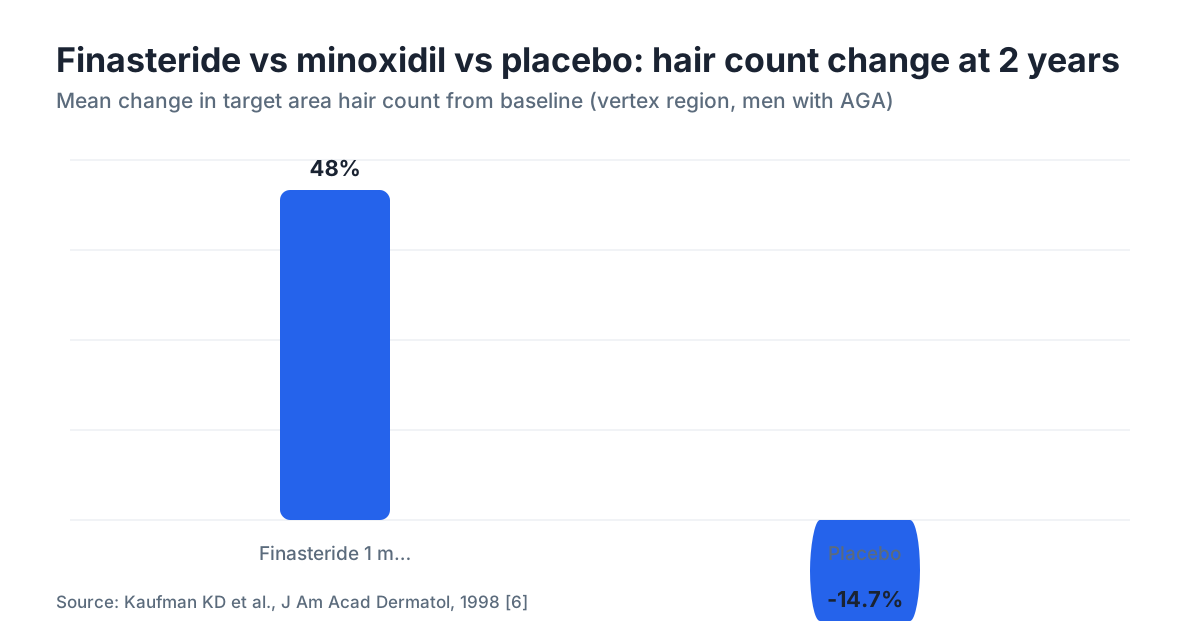
Finasteride (oral) Finasteride 1 mg daily is FDA-approved for male androgenetic alopecia [5]. It works by inhibiting type II 5-alpha reductase, which cuts scalp DHT by roughly 60 to 70%. The main trials (published in the Journal of the American Academy of Dermatology) showed that over 5 years, 90% of men on finasteride maintained or improved hair count versus significant loss in the placebo group [6]. The number that sticks: in a two-year trial, men on finasteride had a 48% increase in hair count in the vertex area compared to baseline, while the placebo group had a 14.7% decrease [6].
At 20, the calculus is pretty straightforward: the earlier you start, the more follicles you're working with. Finasteride can't regrow hair from dead follicles, but it's very good at preserving what's actively miniaturizing. That's exactly where most 20-year-olds are.
Side effects get a lot of attention online. The FDA label lists sexual side effects (decreased libido, erectile dysfunction, ejaculation disorder) in about 3.8% of men in clinical trials, compared to 2.1% in placebo [5]. A small subset of men report persistent effects after stopping, called Post-Finasteride Syndrome. The data on PFS is genuinely contested, and nobody has clean epidemiological numbers on incidence. Read the full picture at finasteride before deciding.
Minoxidil (topical and oral) Topical minoxidil (2% and 5%) was the first FDA-approved hair loss treatment, originally approved in 1988 [5]. It works through a different mechanism than finasteride: it's a vasodilator that appears to shorten the telogen (resting) phase and prolong anagen (growth). A 12-month trial in men with AGA found that 5% minoxidil topical solution produced significantly more regrowth than 2% and outperformed placebo [7].
For men at 20, applying minoxidil foam or solution twice daily is low-risk and easy to add. The main catch is that it requires indefinite use. Stop using it and the follicles it was maintaining will shed within 3 to 6 months.
Oral minoxidil at low doses (0.625 mg to 2.5 mg daily) is increasingly used off-label, with growing evidence that it's more effective than topical for some patients and easier to stick with. A 2021 review in JAAD found significant hair density improvements at 6 months [8]. For a full comparison, see oral minoxidil and minoxidil for men.
Combining both Finasteride plus minoxidil together consistently outperforms either alone in head-to-head trials. If you're going to treat, this combination is where most dermatologists start. More on the evidence at finasteride and minoxidil.
DHT blockers and supplements Ketoconazole shampoo (1-2%) has some evidence for reducing scalp DHT locally, often used alongside the main treatments rather than instead of them. Saw palmetto shows up in a lot of supplements; the data is weak but it's the most studied natural option. Full breakdown at dht blocker and hair loss supplements.
Low-level laser therapy (LLLT) The FDA has cleared several LLLT devices for promoting hair growth (cleared, not approved, meaning they passed a safety bar, not an efficacy bar). Meta-analyses show modest benefit, typically in the range of 10 to 20% increase in hair density over 26 weeks. The effect size is smaller than finasteride or minoxidil. It's an option for people who can't or won't take medication.
What I'd actually do at 20 with a Stage 2 recession If you have no contraindications and you've read the finasteride side-effect profile honestly, the combination of finasteride 1 mg daily and minoxidil 5% foam twice daily is the most evidence-backed starting point. Get a baseline photo set. Give it 12 months before judging results. If you're unwilling to take finasteride right now, starting minoxidil alone is still better than doing nothing.
Before checking side effects, make sure you read minoxidil side effects so you know what's normal (initial shedding in the first 6 to 8 weeks is expected) versus a reason to stop.
Are hair transplants an option at 20?
Technically possible. Usually a bad idea at this age.
The problem is that a hair transplant at 20 fixes your hairline at the pattern of a 20-year-old while the native (untransplanted) hair behind it keeps receding. By 35 you can end up with a transplanted frontal tuft sitting in front of a bald scalp, which looks worse than the original recession. Most ethical surgeons will not operate on someone under 25 unless the loss is very advanced and stabilized, and even then they'll want to see you on medical treatment for a year or two first.
The other issue is donor supply. You only have a finite number of follicles on the back and sides of your scalp. If you use them at 20, you might not have enough left to address the additional loss that happens in your 30s and 40s.
If you're considering this route anyway, read hair transplant for what the procedure actually involves and how surgeons determine candidacy.
The realistic picture: medical treatment now, reassess for a transplant in your late 20s or 30s when the pattern is more established.
Could my receding hairline at 20 reverse on its own?
If it's androgenetic alopecia: no. AGA doesn't reverse without treatment. The follicles that have miniaturized don't spontaneously recover.
If it's telogen effluvium from a stressor, illness, or diet problem: yes, often. Telogen effluvium typically resolves within 6 to 12 months once the underlying trigger is gone, and the hairline can return to its pre-shed state if no AGA was already in progress [9]. The catch is that AGA and telogen effluvium can coexist, so the diffuse shed might recover while the underlying AGA pattern continues.
If it's traction alopecia from tight styles: yes, if caught early. Stop the traction, the follicles can recover over several months. Left too long, the scarring becomes permanent.
The practical step here is to figure out which you're dealing with. A board-certified dermatologist can usually tell the difference with a thorough history and a scalp exam, and sometimes a pull test or dermoscopy. Blood tests (ferritin, thyroid, zinc, CBC) take 10 minutes to order and rule out the reversible causes quickly.
How fast does a receding hairline progress at 20?
There's no reliable way to predict your individual trajectory, and anyone who tells you otherwise is guessing. What the population data shows is that early-onset AGA (before 25) tends to correlate with more extensive eventual loss, not necessarily faster loss, but more total loss by middle age [1].
Some men recede from Stage 2 to Stage 4 over 5 years. Others stay at Stage 2 for a decade. Family history gives you a rough idea, but it's not a firm prediction because your pattern can differ from either parent.
What definitely accelerates visible change: not treating it when follicles are still active. The window where finasteride and minoxidil are most effective is while the follicles are miniaturizing but not yet dead. A follicle that's been miniaturized for 10 years is much harder to rescue than one that started miniaturizing 2 years ago.
That's the strongest argument for early action: you're not trying to reverse much damage yet, you're trying to prevent future damage. That's an easier target for these treatments.
Does stress cause a receding hairline at 20?
Stress causes hair shedding, yes, but it doesn't directly cause androgenetic alopecia. The distinction matters.
Physical or psychological stress can push a large number of follicles into the telogen (resting/shedding) phase simultaneously, resulting in diffuse thinning and hairline shedding 2 to 4 months after the stressor. This is telogen effluvium. It's typically temporary.
Where stress intersects with AGA is more subtle: chronic stress raises cortisol, and some research suggests chronic cortisol elevation can affect the hair follicle cycle [9]. There's also evidence from mouse models that stress-related signaling can inhibit hair follicle stem cell activation. The human data on this is still limited. What's clearer is that stress-related shedding can make underlying AGA more visible, because both are happening at once and the total loss looks worse than either alone.
If you've been through a genuinely hard period (major illness, severe dieting, sleep deprivation, grief) in the 2 to 4 months before the hair loss started, it's worth accounting for that before assuming the worst. Give it 6 months with the stressor resolved and a decent diet before panicking.
What should you actually do first if you're 20 with a receding hairline?
Here's the honest sequence:
-
Document it. Take clear photos in good lighting, same angle, same time of day. Wet hair makes the recession easier to see. Do this now and again in 3 months. If it's not moving, you have time. If it moved noticeably in 3 months, that's your signal.
-
Rule out the reversible stuff. Get a basic blood panel: ferritin, TSH, zinc, CBC. If you've had a major stressor in the last 6 months, account for it. These tests cost little and take one visit.
-
See a dermatologist if you can. A dermatologist (ideally one with hair loss experience) can confirm the diagnosis, stage your Norwood level, and recommend treatment tailored to your situation. This is worth the copay.
-
Decide on treatment. If it's AGA, the decision is: treat now or watch and wait. Watching for 6 months while documenting is reasonable. Waiting indefinitely is how people end up in a worse position.
-
If you want an objective baseline before your appointment, a tool like the free AI hair analysis at MyHairline can help you see your current hairline pattern and Norwood stage estimate, which gives you something concrete to bring to a doctor.
-
Once on treatment, commit to 12 months. Neither finasteride nor minoxidil produces dramatic results in 8 weeks. Most people see meaningful change between 6 and 12 months, and the first 3 months sometimes look worse (the initial minoxidil shed). Don't quit early.
How do lifestyle factors affect hair loss at 20?
They matter less than genetics, but they're not irrelevant.
Diet: Severe caloric restriction or very low protein intake can trigger telogen effluvium on top of any existing AGA. You don't need a special "hair diet", but you do need adequate protein (most guidelines suggest at least 0.8 g per kg of body weight, though athletes often need more) and adequate iron. Ferritin below roughly 40 ng/mL has been associated with hair loss in some studies, though the evidence is stronger in women than men [10].
Sleep: Chronic poor sleep elevates cortisol and suppresses growth hormone, both of which affect the hair cycle. Not a smoking gun for AGA, but worth sorting out for general health reasons.
Smoking: Some observational data links smoking to accelerated AGA, possibly through oxidative stress on follicles and reduced scalp blood flow. The association isn't as strong as with cardiovascular disease, but it's real [11].
Exercise: Generally positive. It improves circulation and reduces chronic stress. There's no good evidence that exercise itself accelerates hair loss. The creatine question (see earlier) is a separate matter.
Tight hairstyles: Man buns, cornrows, tight braids worn repeatedly over months can cause traction alopecia along the hairline. This is separate from AGA but can look identical at first glance and can compound it.
The bottom line on lifestyle: fix the obvious problems (deficiencies, smoking, extreme dieting, tight styles) but don't expect lifestyle changes alone to stop androgenetic alopecia. They're not strong enough for that.
What do doctors actually prescribe for early hair loss in young men?
In practice, most dermatologists treating a 20-year-old with Stage 2 to 3 androgenetic alopecia will start with one or both of the following:
Finasteride 1 mg daily: FDA-approved for AGA in men, generic versions are inexpensive (often under $30/month without insurance), and the evidence base goes back to the 1990s [5][6]. Some dermatologists prescribe 0.5 mg daily to reduce side effect risk while maintaining most of the efficacy, though this is off-label.
Minoxidil 5% topical: Available over the counter, no prescription needed. Generic foam versions cost $15 to $25/month. Applied once or twice daily depending on formulation [7].
Oral minoxidil 0.625 mg to 2.5 mg daily: Increasingly popular because compliance is higher (a once-daily pill versus twice-daily topical application), and the evidence on efficacy is growing [8]. It's off-label for hair loss but used routinely at academic hair clinics.
Ketoconazole shampoo (2% prescription, 1% OTC) is often added as an adjunct. The evidence for it as a standalone is weak, but used 2 to 3 times per week alongside the main treatments it likely contributes some benefit.
Platelet-rich plasma (PRP) injections are available at many dermatology practices and some hair clinics. The evidence is mixed: a 2019 meta-analysis found improvements in hair density but noted the trials were generally small and heterogeneous [12]. Cost ranges from $500 to $2,000 per session with multiple sessions needed. It's not a first-line treatment at 20 unless medication is contraindicated.
The American Academy of Dermatology guidelines recommend minoxidil and finasteride as the primary evidence-backed medical treatments for AGA in men [13]. That's the baseline; anything beyond it is adjunctive or experimental.
Sources
- Hamilton JB. Patterned loss of hair in man; types and incidence. Ann N Y Acad Sci. 1951
- Genetics Home Reference / MedlinePlus, NIH: Androgenetic alopecia
- van der Merwe J et al. Three weeks of creatine monohydrate supplementation affects dihydrotestosterone to testosterone ratio. Clin J Sport Med. 2009;19(5):399-404.
- Kaufman KD et al. Finasteride in the treatment of men with androgenetic alopecia. J Am Acad Dermatol. 1998;39(4):578-589.
- Olsen EA et al. A randomized clinical trial of 5% topical minoxidil versus 2% topical minoxidil and placebo in the treatment of androgenetic alopecia in men. J Am Acad Dermatol. 2002;47(3):377-385.
- Randolph M, Tosti A. Oral minoxidil treatment for hair loss: A review of efficacy and safety. J Am Acad Dermatol. 2021;84(3):737-746.
- Malkud S. Telogen Effluvium: A Review. J Clin Diagn Res. 2015;9(9):WE01-WE03.
- Trost LB, Bergfeld WF, Calogeras E. The diagnosis and treatment of iron deficiency and its potential relationship to hair loss. J Am Acad Dermatol. 2006;54(5):824-844.
- Su LH, Chen TH. Association of androgenetic alopecia with smoking and its prevalence among Asian men: a community-based survey. Arch Dermatol. 2007;143(11):1401-1406.
- Giordano S et al. A Meta-analysis on Evidence of Platelet-Rich Plasma for Androgenetic Alopecia. Int J Trichology. 2018;10(1):1-10.