

TL;DR: FDA-approved treatments (minoxidil and finasteride) have solid but limited trial evidence: finasteride stopped progression in about 83% of men and regrew hair in roughly 66% over two years, while minoxidil produced meaningful regrowth in around 40% of men. Most marketed supplements, laser devices, and shampoos have far weaker data. This article maps what trials found versus what ads claim.
Why do marketing claims almost always outrun the clinical evidence?
Hair loss is an emotionally loaded topic. That makes it an unusually easy market to oversell. A company can run a small, short, uncontrolled study on thirty volunteers, see some improvement in hair counts at week twelve, and use that to justify claims like "clinically proven to thicken hair" on packaging. The phrase sounds rigorous. It usually isn't.
The gap between what a trial actually demonstrates and what a product claims comes down to a few consistent tricks. Studies are small and short. Controls are absent or weak. Endpoints measure something easy (hair shaft diameter) rather than something meaningful (terminal hair count on a standardized area). Responder rates are cherry-picked: if 25% of participants saw "improvement," the ad says the product works without disclosing the 75% who didn't.
Regulatory exposure for these claims is low. The FDA regulates drugs (minoxidil, finasteride) tightly through its drug-approval pathway. It regulates cosmetics and supplements far more loosely. A shampoo or supplement can claim to "support healthy hair" without proving anything, because under federal law that kind of structure/function claim does not require pre-market approval [1]. So you end up with a legal grey zone that savvy marketers exploit constantly.
The only way to cut through this is to read the trial data, not the ad copy. That's what this article does.
What did clinical trials actually find for minoxidil?
Minoxidil is the only topical hair loss drug FDA-approved for both men and women [2]. It's also the most studied over-the-counter hair treatment in existence, so the evidence base is real, if imperfect.
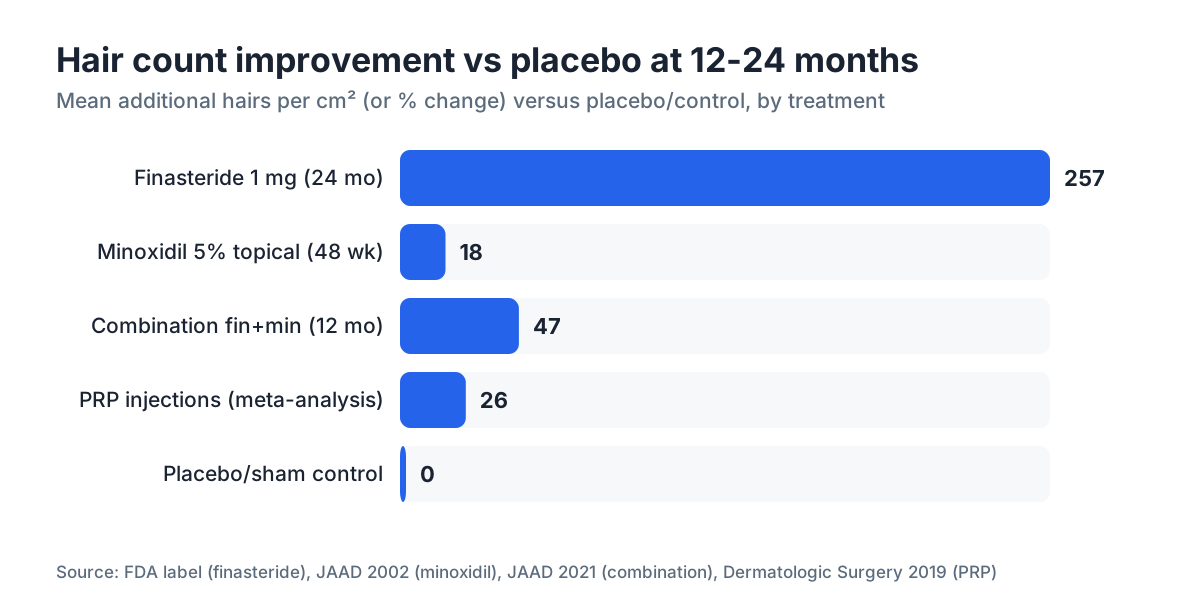
The trials that earned FDA approval used 2% minoxidil for women and 2% and 5% minoxidil for men. In the main male androgenetic alopecia studies, researchers counted non-vellus (terminal or intermediate) hairs in a 1 cm² target area at baseline, week 16, and week 32. The result most ads cite: 5% minoxidil produced statistically significantly more hair regrowth than 2%, and both beat placebo. What ads leave out: the average difference in hair count between 5% minoxidil and placebo at 48 weeks was roughly 18 hairs per cm² [3]. That's real, but it's modest. Clinically meaningful regrowth, defined as the patient rating themselves as improved or greatly improved, happened in about 40-45% of men, not in all of them.
For women, a 2002 randomized controlled trial in the Journal of the American Academy of Dermatology found 5% minoxidil produced significantly greater increases in total hair count than 2%, but the absolute numbers were again moderate, and shedding in the first two to eight weeks is nearly universal and consistently under-reported in ads [4].
The marketing version: "regrows hair in 4 to 6 months." The honest version: about 40% of users see meaningful regrowth, nearly everyone has early shedding that looks alarming, and the treatment only works while you use it. Stop minoxidil and whatever you regrew is typically gone within three to four months. For the full side effect picture, including the shedding phase and cardiovascular signals at higher doses, see our article on minoxidil side effects and the specific evidence for minoxidil for men.
What did clinical trials actually find for finasteride?
Finasteride 1 mg (sold as Propecia) is FDA-approved for male androgenetic alopecia. The two-year placebo-controlled trial data, submitted to FDA and referenced in the label, is the benchmark [5].
Over 24 months, 83% of men taking finasteride 1 mg maintained their hair count versus baseline, compared to 28% on placebo. Visible regrowth was rated as improved or better by 66% of finasteride patients versus 7% on placebo in global photographic assessment. Scalp hair count in the target area rose by a mean of about 107 hairs on finasteride versus a decrease of about 150 hairs on placebo over 24 months, a difference of roughly 257 hairs [5]. That's a genuinely large effect by dermatological standards.
What the ads typically leave out: finasteride works better at the crown and midscalp than at the frontal hairline. The five-year extension data showed continued benefit, but stopping finasteride reverses the gains within 9 to 12 months in most men. Sexual side effects (decreased libido, erectile dysfunction) were reported in roughly 1.8% of men in trials versus 1.3% on placebo, though post-marketing surveillance and observational data suggest these rates may be higher in real-world use, and a subset of men report persistent effects after stopping. That debate is unresolved.
The marketing claim "clinically proven to stop hair loss and regrow hair" is, in this case, actually supported by the data for most men. But it's almost never paired with the responder rate (about 1 in 3 men won't see regrowth, only maintenance) or the reversibility issue. For more on how the drug works, see our piece on finasteride. If you're interested in combining both approved drugs, the evidence for that is covered in finasteride and minoxidil.
How do FDA-approved treatments compare to supplements and unproven products?
This is where the gap between evidence and claims is widest.
| Treatment | Trial quality | Responder rate (meaningful regrowth) | FDA status |
|---|---|---|---|
| Finasteride 1 mg | RCTs, 2-5 yr, N>1500 | ~66% regrowth, 83% stabilization | Approved for male AGA |
| Minoxidil 5% topical | RCTs, 1-2 yr, N>600 | ~40-45% meaningful regrowth | Approved for male and female AGA |
| Low-level laser therapy (LLLT) | Small RCTs, 16-26 wk | ~40% modest density increase (limited data) | Cleared as device (510k), not approved as drug |
| Saw palmetto | One small RCT, N=38 | ~38% showed improvement vs 68% for finasteride | Not FDA-approved |
| Biotin supplements | Case reports only (for deficiency) | Unknown in non-deficient users | Supplement, not approved |
| Ketoconazole shampoo | Small pilot trials | Modest increase in hair shaft diameter | Rx for dandruff, off-label for hair loss |
| Caffeine shampoos | In vitro + very small human trials | No large RCT evidence | Cosmetic |
Saw palmetto is the most interesting comparison. A 2002 study in the Journal of Alternative and Complementary Medicine randomized 38 men and found 38% rated as improved on saw palmetto versus 68% on finasteride [6]. That trial was tiny and short, but it's the data behind a lot of "natural DHT blocker" marketing. The claim isn't completely fabricated. The magnitude is meaningfully weaker, and the study is far too small to draw firm conclusions from. Our article on DHT blockers covers the full landscape.
Low-level laser therapy (LLLT) devices got FDA 510k clearance, which means the device is "substantially equivalent" to a legally marketed predicate device, not that efficacy was proven to the drug standard. Clearance and approval are different things. A 2009 RCT in the American Journal of Clinical Dermatology found statistically significant increases in hair density with an LLLT device versus sham over 26 weeks, but the absolute gains were modest and the study was funded by the device manufacturer [7]. That funding relationship doesn't automatically invalidate the finding. You should know it exists.
Biotin is the most oversold product in the category. The vast majority of people losing hair are not biotin-deficient. There is no good clinical trial evidence that biotin supplementation improves hair density in people with normal biotin levels. The FDA has also warned that high-dose biotin supplements can interfere with certain lab test results, which is a real safety concern [1]. See our hair loss supplements page for more on this.
If you want to understand your specific pattern before spending money on any of these, a baseline assessment matters. The free AI hair scan at MyHairline (myhairline.ai/scan) can help you identify your Norwood stage and whether your pattern is more likely to respond to medical treatment or warrant a transplant consultation.
What does the clinical evidence say about hair transplants?
Hair transplant marketing tends to use before/after photography, which is hard to control for lighting, angle, styling, and time post-procedure. The clinical literature on transplants is different in character from drug trials: there are no placebo-controlled blinded studies because you can't blind a surgery. What exists is large case series, technique comparisons, and long-term follow-up cohort data.
The key facts the evidence supports: both follicular unit transplantation (FUT) and follicular unit excision (FUE) produce permanent hair in the transplanted area because donor follicles from the back of the scalp are genetically resistant to DHT. Graft survival rates in skilled hands run approximately 90-95% [8]. The literature consistently shows that outcome quality correlates with surgeon experience and graft handling time, not primarily with price point or clinic brand.
What transplant marketing often omits: the transplanted hair does not prevent continued loss of your existing native hair. A man who gets a transplant at 28 may have a great result at 32 and look noticeably odd at 45 because the native hair behind the transplanted hairline kept thinning. Good surgeons address this with conservative hairline design and by recommending finasteride alongside the transplant. Some clinics don't, because a second procedure later is financially profitable.
Oral minoxidil is increasingly used around the time of transplant to reduce post-operative shedding. The evidence for this is still early but promising. More on that in our oral minoxidil piece. For the full transplant picture, see hair transplant.
How do you spot a clinical claim that's weaker than it sounds?
About six patterns repeat across bad hair loss evidence, and once you know them you can't unsee them.
First, "clinically tested" is not "clinically proven." Tested means a study was run. Proven implies a standard of evidence the claim doesn't actually cite.
Second, check the control condition. Self-comparison ("hair looks thicker than before") with no placebo arm is nearly worthless because hair naturally cycles, lighting differs, and people's perception of their own appearance shifts when they're hoping for a result.
Third, look at the endpoint. Hair shaft diameter is easier to improve than terminal hair count, which is easier than patient-rated global improvement, which is easier than blinded photographic assessment by a dermatologist panel. Ads tend to cite the easiest endpoint.
Fourth, n=30 over twelve weeks proves almost nothing for a condition that changes slowly over years. Androgenetic alopecia moves on a timeline of decades. You need at least six months of data, ideally two years.
Fifth, watch for "up to" language. "See up to 35% more hair density" means someone, somewhere, in an optimistic analysis, hit 35%. The median result may be much lower.
Sixth, industry-funded trials carry a consistent publication bias. A 2017 Cochrane review published in BMJ found that industry-sponsored drug studies more often report results favorable to the sponsor than independently funded ones, across medicine generally [9]. That doesn't mean sponsored studies are wrong. It's a real structural pressure on what gets published and how results get framed.
What does the FDA actually require before a hair loss treatment can claim to work?
For a product sold as a drug, the FDA requires substantial evidence of effectiveness from adequate and well-controlled studies under 21 CFR 314.126 [10]. That means randomized, controlled trials with pre-specified endpoints, adequate sample sizes, and independent statistical analysis. Minoxidil and finasteride cleared this bar. Almost nothing else sold for hair loss has.
For a product sold as a cosmetic, the standard for efficacy is essentially zero. Cosmetics cannot legally claim to affect the structure or function of the body. A shampoo that claims to "strengthen hair" is walking a fine line the FDA tolerates because "strengthen" can be read as referring to the fiber itself rather than follicular biology. A shampoo that claimed to "regrow hair" would cross into drug territory and face enforcement action.
Supplements fall under the Dietary Supplement Health and Education Act (DSHEA) of 1994. Manufacturers can make structure/function claims ("supports healthy hair") without pre-market proof, and they do not need FDA approval before selling. They are supposed to have substantiation, but FDA enforcement is complaint-driven and resource-constrained [1].
The practical upshot: "clinically studied" on a supplement bottle means almost nothing legally, and FDA approval on a drug label means trials were rigorous. The word "approved" is legally protected in a way that "tested" and "proven" are not.
Does the evidence support using finasteride and minoxidil together?
Combination therapy is where some of the more interesting recent trial data lives. A 2021 randomized trial in the Journal of the American Academy of Dermatology (Hu et al.) compared finasteride alone, minoxidil alone, and the combination in men with androgenetic alopecia. The combination group showed significantly greater increases in hair count at twelve months than either agent alone [11]. The absolute difference wasn't enormous, but the trend matched the mechanistic logic: finasteride reduces DHT-driven miniaturization while minoxidil extends the anagen (growth) phase and increases follicular blood flow through a different pathway.
The main practical limitation is adherence. Topical minoxidil twice daily plus a daily oral pill is more burden than either alone, and adherence predicts outcome in real-world use far better than any pharmacological difference between treatments. Oral minoxidil (0.625 to 2.5 mg daily in women, 2.5 to 5 mg in men) is increasingly prescribed off-label as an alternative to topical for adherence reasons, with a growing but still limited evidence base.
You can find the deeper breakdown in our finasteride and minoxidil article. The honest summary: the combination has the best evidence, but it's not magic, and a meaningful minority of people don't respond to either.
What do clinical trials say about hair loss from causes other than genetics?
Most hair loss marketing focuses on androgenetic alopecia because it's the most common type and the most commercially addressable. But a significant fraction of people losing hair have telogen effluvium, which is triggered by physiological stress (illness, surgery, rapid weight loss, postpartum hormonal shifts) rather than genetics.
Clinical trials for telogen effluvium are sparse because the condition typically resolves on its own within six to twelve months of removing the trigger. There is no FDA-approved treatment for it. Marketing minoxidil or supplements to people in the telogen effluvium shedding phase is particularly misleading: the hair often comes back anyway, and the product gets the credit.
Alopecia areata has a different evidence base entirely. Baricitinib (a JAK inhibitor) was FDA-approved for severe alopecia areata in 2022, the first systemic oral treatment ever approved for the condition. The BRAVE-AA2 trial found 39% of patients on baricitinib 4 mg reached a SALT score of 20 or less (meaning at least 80% scalp coverage) at 36 weeks versus 23% on placebo [12]. That's a genuine advance, but it's for a specific autoimmune condition, not androgenetic alopecia. Conflating the two is a marketing trick.
Understanding what causes hair loss before buying anything is probably the most financially sound thing you can do. Treating the wrong diagnosis is the most common reason treatments fail.
What does a realistic outcome look like for someone starting minoxidil or finasteride today?
Realistic expectations matter because people who experience normal early shedding on minoxidil, or who hit month four without visible density change, frequently quit, which guarantees a bad outcome.
For minoxidil: expect early shedding for the first four to eight weeks. This is telogen follicles being pushed into a new cycle, and it's a sign the drug is working, not that you're losing more hair. Meaningful changes in density take six months minimum. If you're in the 40% who respond, the improvement is real but typically partial, bringing miniaturized hairs back to intermediate size rather than full terminal caliber everywhere.
For finasteride: the clinical trials showed continued improvement through at least 24 months, and some of the five-year extension data suggests gradual further benefit. This means patience measured in years, not weeks. Men who stop at month three because they "didn't see anything" are quitting right before the window where benefit typically becomes visible.
For combination therapy: the 2021 Hu et al. trial showed mean increases in total hair count of about 18.6% over baseline in the combination group at 12 months versus 11.8% for finasteride alone and 13.1% for minoxidil alone [11]. Those numbers are for the scalp vertex; frontal results were more modest. Real people in real clinics have more variable results than trial populations because adherence is imperfect and baseline severity differs.
If you're trying to figure out where you are on the progression curve before committing to a protocol, tools that assess your current Norwood stage help set a baseline. You can get a free starting-point assessment at myhairline.ai/scan before spending money on a consultation or a year's supply of anything.
Which hair loss products are essentially a waste of money based on the evidence?
I'll say it plainly, because the evidence allows it.
Biotin supplements for people without a confirmed deficiency. There is no clinical trial evidence that they do anything for hair density in replete individuals. The FDA has flagged high-dose biotin for lab test interference [1]. Save the money.
Most "DHT-blocking" shampoos. The contact time of a shampoo on the scalp is two to four minutes. Even if the ingredient (saw palmetto extract, ketoconazole) had DHT-blocking activity (ketoconazole does have modest evidence), the exposure duration is probably too short for a meaningful follicular effect. Ketoconazole shampoo has more plausible biological rationale than most, but the evidence is preliminary.
Platelet-rich plasma (PRP) injections from unvetted providers. PRP has a genuinely interesting mechanism and some small-trial evidence suggesting benefit in androgenetic alopecia. A 2019 meta-analysis in Dermatologic Surgery found PRP increased hair density by a mean of about 25.8 hairs per cm² versus control, but the included studies were highly heterogeneous in protocol, platelet concentration, and patient selection [13]. Provider skill and preparation method vary enormously, and the evidence base is not strong enough to justify the $1,500 to $3,500 per session pricing common in U.S. clinics.
Collagen powders and beauty gummies. Zero randomized controlled trial evidence for hair growth specifically in non-deficient adults. The hair loss supplements page covers the full landscape.
For receding hairlines specifically, finasteride is the only treatment with solid evidence of slowing frontal recession. Nothing else has convincing data there.
How should you read a study cited in a hair loss ad?
You don't need a science degree. You need four questions.
Was there a control group? A trial comparing a treatment only to its own baseline is not a controlled trial. Improvements can come from regression to the mean, seasonal hair cycling, or expectation effects.
How many people were enrolled, and for how long? Under 50 people or under six months: treat the result as preliminary. Over 200 people, randomized, over twelve months: worth taking seriously.
Who funded the study? Manufacturer-funded studies are not automatically wrong, but they're more likely to use favorable endpoints and less likely to publish negative results. Look for independent replication.
What was the actual effect size? A statistically significant result in a hair study may mean 8 more hairs per cm². Statistically significant and clinically meaningful are different things. Ask: does this number matter to a real person looking in a mirror?
If a product's marketing cites a study but doesn't link to it, that's a red flag. PubMed (pubmed.ncbi.nlm.nih.gov) is free. Paste the study title. Read the abstract. The methods section will tell you within two minutes whether the study is rigorous or promotional.
Sources
- FDA, Dietary Supplements guidance and DSHEA structure/function claim rules
- FDA, Minoxidil Drug Label (DailyMed)
- Olsen EA et al. Journal of the American Academy of Dermatology, 2002; 47(3):377-385
- Olsen EA et al. Journal of the American Academy of Dermatology, 2002 (female androgenetic alopecia RCT data)
- Merck Sharp & Dohme, Propecia (finasteride 1 mg) FDA-approved prescribing information
- Prager N et al. Journal of Alternative and Complementary Medicine, 2002; 8(2):143-152
- Leavitt M et al. American Journal of Clinical Dermatology, 2009; 10(2):129-141
- International Society of Hair Restoration Surgery (ISHRS), Practice Standards
- Lundh A et al. Cochrane Database of Systematic Reviews, 2017 (Industry sponsorship and research outcome), summarized in BMJ
- FDA, 21 CFR 314.126 - Adequate and well-controlled studies
- Hu R et al. Journal of the American Academy of Dermatology, 2021; 84(3):785-787
- King B et al. New England Journal of Medicine, 2022; 386(18):1687-1699 (BRAVE-AA2 baricitinib trial)
- Gupta AK et al. Dermatologic Surgery, 2019; 45(3):340-359 (PRP meta-analysis)