

TL;DR: Transplanted follicles come from your DHT-resistant donor zone, so they keep growing for life. Your untransplanted native hair does not. It keeps falling out around the grafts on your genetic schedule. Without medication to slow that loss, you can end up with permanent grafts sitting in a thinning scalp, which makes a transplant look patchy or oddly islanded decades later.
Why transplanted hair doesn't fall out the same way native hair does
Transplanted hair comes from follicles harvested out of the occipital and parietal donor zones at the back and sides of your scalp. Those follicles are genetically resistant to dihydrotestosterone (DHT), the androgen that drives androgenetic alopecia in men and women [1]. When a surgeon moves them to the top of your head, they carry that DHT resistance with them. Surgeons call this "donor dominance," first described by Norman Orentreich in 1959 [2].
Because the follicles keep the genetic programming of where they came from, they behave like donor-zone hair for the rest of your life. They miniaturize slowly, if at all, next to the native hairs around them. That's the good news.
Here's the part most people miss. Donor dominance only protects the follicles that were moved. It does nothing for the hairs that were already on top of your scalp before surgery. Those native follicles are still fully sensitive to DHT, and they keep miniaturizing on whatever schedule your genetics set. That's what surprises people five or ten years out, when they notice thinning in spots that looked fine on the day the bandages came off.
Does transplanted hair actually last a lifetime?
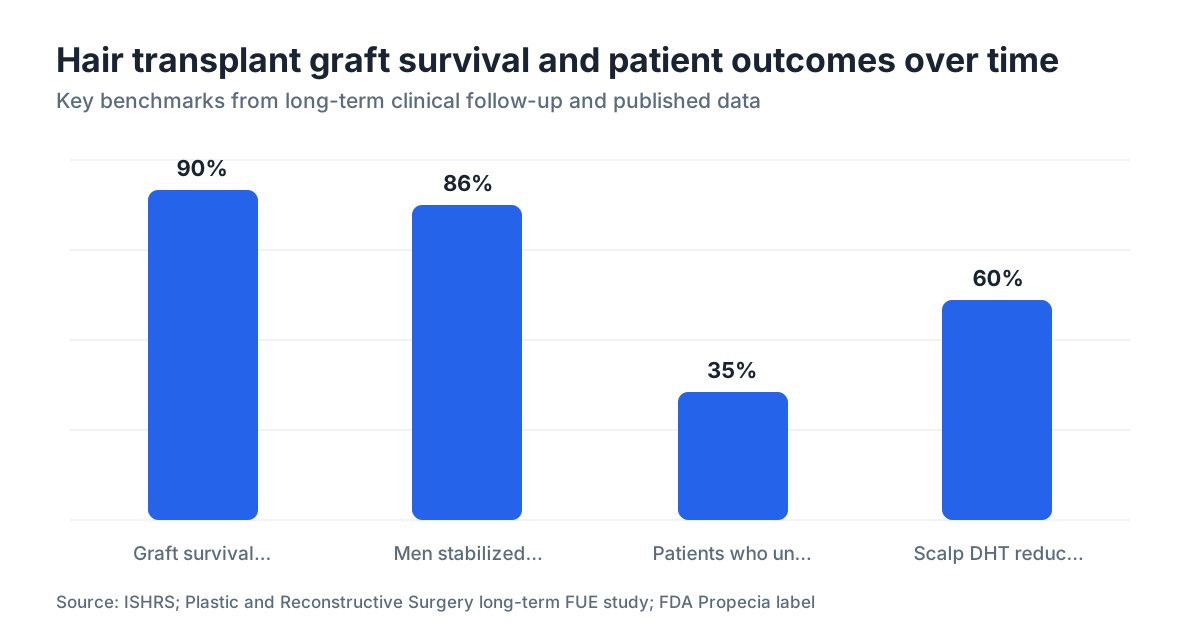
For most people, yes, and the data backs it. A 2019 long-term follow-up in Plastic and Reconstructive Surgery tracked FUE patients for up to 20 years and reported graft survival consistently above 90% in well-performed procedures [3]. The follicles don't suddenly turn DHT-sensitive because they sit on a different part of your scalp.
But "lasts a lifetime" is not the same as "looks exactly like it did at 12 months." A few things shift over decades.
The transplanted hairs do age. Every follicle, donor-zone or not, goes through aging that slowly reduces shaft diameter and growth rate. By your 60s or 70s, even grafted hairs may be a bit finer than they were at 35, though that change is modest compared to DHT-driven miniaturization [4].
The scalp changes too. Skin thins, loses collagen, and sits differently on the skull. Hairline grafts placed along the leading edge can read slightly differently at 60 than they did at 40, partly because the skin behind them has changed texture.
The biggest change is density, and it usually has nothing to do with the grafts. The native hairs around them keep falling. A transplant that looked full at year one can look sparse at year fifteen if nothing was done to protect the remaining native hair. That is not graft failure. That is native loss running on schedule.
What does progressive hair loss do to a transplant over 10 to 30 years?
This question deserves a longer answer than most clinics give during a consultation. A transplant is a snapshot. Your hair loss is a movie that keeps playing.
When a surgeon designs a transplant, they're working with your scalp at a single moment. Say you're 28, a Norwood 3, and you get 2,000 grafts to rebuild a receding hairline. At year one it looks great. But your untreated Norwood progression doesn't stop. By 38 you might be a Norwood 5, and that transplanted hairline now sits in front of a large bald area that wasn't there before [5].
Surgeons call the result the "halo" or "island" effect. You get a strip of healthy transplanted hair at the front, then a visible gap where native hairs fell, then maybe a remaining crown. It can look stranger than the original hair loss did.
How bad this gets depends on a handful of things: how fast your pattern progresses, how much donor hair you have for future sessions, whether you use medication to slow native loss, and how conservatively your surgeon planned the hairline for your predicted future loss instead of your current loss.
A surgeon who drops a low, aggressive hairline onto a 25-year-old is setting that patient up for a hard cosmetic spot by 45 if native loss isn't controlled. That's exactly why experienced surgeons push back when a patient asks for the hairline he had at 17.
How much donor hair do you actually have, and why it matters more as you age
The donor zone is finite. Most men have somewhere between 6,000 and 8,000 grafts available over a lifetime, though anatomy varies a lot and some people have fewer [6]. Each graft holds one to four follicular units.
In a first session a skilled surgeon might harvest 1,500 to 3,000 grafts, leaving a reserve for later. Undergo several procedures over decades as your loss spreads, and you can drain that supply. Once the donor zone is spent, there's no more material, and any remaining bald areas stay bald.
So transplant planning is really lifetime planning. A surgeon who extracts too hard in a first session, chasing maximum density at 25, can leave you with nothing for the much larger bald area you'll carry at 45. Good surgeons call this "donor management," and they bring it up before you ever book.
Body hair transplants (beard or chest follicles) exist as a backup source, but the results are less predictable, the hairs behave differently, and most surgeons treat them as a last resort rather than a primary plan [6].
Knowing what causes hair loss and your likely progression pattern belongs in any transplant conversation you have before you're lying under local anesthetic.
Do you need finasteride or minoxidil after a hair transplant?
You don't need them to keep the grafts. You very likely need them to keep the rest of your hair, which is what keeps the transplant looking like it was worth the money.
Finasteride (Propecia) blocks the 5-alpha reductase enzyme that converts testosterone to DHT, cutting scalp DHT by roughly 60% [7]. That protects native follicles from miniaturizing. Randomized trials show finasteride stabilizes hair loss in around 83% to 90% of men who take it consistently [7]. It won't bring back follicles that are already gone, but it slows the loss of the ones still there, which is exactly what a post-transplant patient needs.
Minoxidil, topical or oral, stretches the anagen (growth) phase of existing follicles and may increase follicle size [8]. It works by a different route than finasteride, so the two get paired. A meta-analysis in the Journal of the American Academy of Dermatology found the combination beat either drug alone for hair count [8].
Get a transplant and stop there, and you're betting your native loss won't progress much. Some people win that bet. Plenty don't. The odds shift if you're older and already at an advanced Norwood stage on surgery day, because there's less native hair left to lose.
More on how these work: finasteride, minoxidil for men, and finasteride and minoxidil together.
What's the shock loss after a transplant, and is that different from long-term loss?
Shock loss (post-transplant effluvium) is temporary shedding of both transplanted and native hairs in and around the surgical area. It happens in the weeks to months after surgery because the trauma pushes follicles early into the telogen (resting) phase [9].
For the grafts, this is expected and normal. The shaft sheds but the follicle stays. New growth starts around 3 to 4 months, and real density shows up between 9 and 12 months. Most surgeons tell you not to judge the final result until 12 to 18 months out.
For native hairs near the grafts, shock loss is usually temporary too, and those hairs typically recover. But a native follicle that was already badly miniaturized before surgery can get the final push from shock loss and never come back. That's why some patients feel the transplant made the area around it worse. The transplant didn't cause the permanent loss; the follicle was already nearly gone. The timing just creates the impression.
This is not the same as the long-term native loss above. Shock loss resolves in months. Progressive native loss is a decades-long grind driven by DHT and genetics.
More on the mechanism in our piece on telogen effluvium.
How do surgeons plan for a patient's future hair loss before doing a transplant?
A well-trained surgeon thinks about where you're going more than where you are. The standard workup covers your current Norwood stage, your age, your family history on both sides (maternal and paternal inheritance both matter for androgenetic alopecia [10]), and a miniaturization map made with dermoscopy or trichoscopy to spot follicles that are already weakening.
Younger patients carry more risk of over-promised results because their final pattern hasn't declared itself. The American Academy of Dermatology recommends conservative hairline design for young patients precisely because future progression is unpredictable [5].
A responsible surgeon also talks donor density out loud. If you have 6,000 grafts for life and you're 25 with a Norwood 3, using 2,500 now versus 1,800 now looks very different by the time you're 50 at a Norwood 6.
Some surgeons pull up photos of your relatives or run age-progression modeling to show what you'll likely look like untreated. It isn't guaranteed accurate, but it frames the decision honestly.
The best question any patient can ask before booking is this: "What do you expect my scalp to look like in 20 years if I do this procedure and take no medication?" The answer tells you whether the surgeon is being straight with you.
If you're not sure where your hairline stands, get a baseline first. The free AI hair analysis at MyHairline gives you a Norwood stage estimate so you walk into a consultation already prepared.
Can you get a second or third transplant as hair loss continues?
Yes. Multiple sessions are common and often planned from the start. Roughly 30% to 40% of hair transplant patients have more than one procedure in their lifetime, per the International Society of Hair Restoration Surgery [6].
Whether a second or third procedure is feasible comes down to remaining donor supply and scalp laxity. FUE (follicular unit extraction) and FUT (follicular unit transplantation) deplete the donor zone differently. FUT takes a strip and leaves a linear scar; more strips are possible up to a point. FUE removes individual follicles and can thin the whole donor area if overused. A surgeon who harvests too hard early narrows your options later.
Repair work is also possible for people stuck with poor transplants from years ago, whether from old plug techniques or modern work that was badly executed. These cases are harder and cost more. Removing or redistributing bad grafts takes skill and often more donor material than the patient has left.
One more thing: the texture of donor hair can shift over decades. A second procedure 15 years after the first may pull hair that's a touch finer or coarser. Most surgeons account for that when they blend.
See our full overview of hair transplant options if you're weighing a first or later procedure.
Does the transplanted hairline look natural decades later?
It comes down to three things: the quality of the original work, the design choices made at the time, and whether the surrounding native hair has been kept alive.
Graft angle, depth, and direction matter enormously for long-term naturalness. A skilled surgeon sets grafts at the correct angle with irregular spacing at the hairline to copy natural growth. Work done in the 1980s and 1990s with round "plug" grafts often looks obviously fake today because those techniques couldn't reproduce natural follicular groupings [2].
Modern FUE and FUT, done well, should be nearly undetectable at any age, as long as density around the transplant doesn't collapse from untreated native loss.
The biggest naturalness risk as you age is contrast. If the transplanted hairline stays dense while the midscalp or crown behind it goes bald, the contrast itself looks off, not the grafts. That's the scenario that produces the "plugged-in" look people blame on bad transplants, even when the graft quality was fine.
A hairline designed for a 28-year-old can also read differently at 58. A very low, sharp hairline looks great in your 20s and slightly incongruous on an older face, because hairlines naturally recede with age and a full low one starts to mismatch the face around it. That's a real aesthetic point good surgeons raise up front.
What's the realistic timeline for hair transplant results and aging?
Here's how the timeline usually runs for someone who gets a transplant in his late 20s or early 30s.
| Time After Surgery | What's Happening |
|---|---|
| 0 to 3 months | Grafts shed (expected). Shock loss of nearby native hair possible. |
| 3 to 6 months | New growth begins from transplanted follicles. |
| 9 to 12 months | Majority of transplanted hair visible. |
| 12 to 18 months | Final density of grafts established. |
| 1 to 5 years | Native hair keeps thinning if untreated. Gap between grafts and native scalp may become visible. |
| 5 to 15 years | Significant native loss possible without medical therapy. Second procedure may be warranted. |
| 15 to 30+ years | Transplanted follicles keep growing. Native pattern reaches its final stage. Overall look decided mostly by how well ongoing loss was managed. |
Patients who start finasteride or minoxidil early and stay on it consistently tend to get the best long-term result from a transplant. The ones who rely on surgery alone often find themselves unhappy a decade later, not because the procedure failed, but because the disease it was fighting kept moving.
For an honest read on what DHT blockers can and can't do here, see dht blocker.
Are there any medical conditions or lifestyle factors that accelerate transplanted hair aging?
Transplanted follicles aren't invincible. A few things affect their long-term health.
Scalp conditions like seborrheic dermatitis or folliculitis can damage follicles over time if you leave them untreated. Chronic inflammation around follicles is a known driver of miniaturization and should be managed with a dermatologist.
Nutritional deficiencies, especially iron, ferritin, zinc, and vitamin D, can impair hair growth across the whole scalp, grafts included [4]. Correct the deficiency and it's reversible, but years of chronic malnutrition do real harm. Our article on hair loss supplements covers what actually has evidence behind it.
Smoking cuts scalp blood flow and is tied to higher hair loss risk and slower wound healing after surgery. The evidence isn't clean for transplanted versus native hair specifically, but most surgeons want you to stop smoking before and after a procedure.
High psychological stress triggers telogen effluvium, which sheds hair across the whole scalp including grafted areas. The grafts recover, but repeated bouts of severe stress-related shedding can add up [9].
Autoimmune conditions like alopecia areata can attack transplanted follicles. It's less common but documented. Anyone with a history of alopecia areata should raise it with a surgeon before proceeding, because a transplant may be the wrong tool for that type of loss.
And for a supplement question people ask constantly, does creatine cause hair loss has a more careful answer than the headlines suggest.
How should you track your hair after a transplant to catch problems early?
The single most useful habit after a transplant is baseline photography. Photos taken at 12 months post-op, once results are stable, give you a reference point that's hard to argue with. Same lighting, same camera position, every 6 to 12 months after that.
Dermoscopy, available through most dermatologists and some trichologists, lets you watch follicle miniaturization at a microscopic level before visible thinning shows. If miniaturization is climbing in an area next to your grafts, that's your early signal to start or adjust medication.
A follow-up with your transplant surgeon every 2 to 5 years makes sense, especially if you notice a change in density where things looked stable. A receding hairline around an otherwise intact transplant is almost always native loss, not graft failure, but confirming which one matters for picking the right response.
If you want a starting point before seeing a surgeon, the free AI hair analysis at MyHairline helps you track Norwood stage changes over time and gives you something concrete to bring to appointments.
The American Academy of Dermatology's guidance is blunt: any new or worsening hair loss lasting more than three months warrants evaluation by a dermatologist, transplant or not [5].
Sources
- National Library of Medicine, StatPearls: Androgenetic Alopecia
- National Library of Medicine, StatPearls: Hair Transplantation
- Plastic and Reconstructive Surgery (via NLM PMC), long-term FUE follow-up
- National Library of Medicine, StatPearls: Hair Follicle Anatomy and Physiology
- American Academy of Dermatology: Hair Loss resource
- International Society of Hair Restoration Surgery (ISHRS)
- U.S. Food and Drug Administration, Propecia (finasteride) prescribing label
- Journal of the American Academy of Dermatology: combination therapy meta-analysis
- National Library of Medicine (PubMed): Genetics of Androgenetic Alopecia, PMID 18356820