
TL;DR: Most men who start topical minoxidil at Norwood 3 slow their hair loss, and about a third see modest regrowth, usually visible after 4 to 6 months. Full hairline restoration is unlikely without adding finasteride or a transplant. Start early. The more viable follicles you still have, the better your odds of keeping them.
What does Norwood 3 actually mean for your hair?
Norwood 3 is the first stage most hair loss specialists call clinically significant. The Hamilton-Norwood scale runs from 1 (no loss) to 7 (near-complete crown and mid-scalp loss), and stage 3 marks deep temporal recession in an M or U shape, sometimes with early thinning at the crown (3 vertex). You still have a lot of hair. That's the good news.
The follicles in your recession zones are not gone. Many are miniaturized, meaning they're alive but producing progressively thinner, shorter hairs under the influence of dihydrotestosterone (DHT). Miniaturized follicles can often be revived. Dead, scarred follicles cannot. Starting minoxidil at Norwood 3 puts you in a genuinely better position than someone at Norwood 5 or 6.
The bad news: Norwood 3 usually means androgenetic alopecia has been active for years before the pattern gets obvious. Follicle damage runs ahead of what you see in the mirror. That matters for setting honest expectations.
How does minoxidil work, and why does it matter at this stage?
Minoxidil started life as an oral blood pressure drug. Researchers noticed patients grew unexpected body and scalp hair. The topical form (2% and 5% solutions, 5% foam) was developed for hair loss and is FDA-approved for androgenetic alopecia [1]. The label approves the 5% foam for men and the 2% solution for women, though dermatologists commonly use 5% off-label for women too.
The mechanism isn't fully understood, which is an honest thing to admit about a drug on the market since 1988. Here's what we know: minoxidil opens potassium channels in follicle cells, increases blood flow to the scalp, and pushes more follicles from the resting phase (telogen) into the active growth phase (anagen) [1]. It also appears to extend anagen itself.
At Norwood 3, many of your vulnerable follicles are still miniaturized but alive. Minoxidil works best on follicles in exactly that state. It does not block DHT, the hormone actually killing your follicles. That's its core limitation, and it's why combining minoxidil with a DHT blocker comes up so often.
Understand this clearly. Minoxidil does nothing about the hormonal root of androgenetic alopecia. It buys time. Used alone at Norwood 3, it slows the decline while leaving the driver untouched.
What do clinical trials actually show for regrowth and stabilization?
The most-cited placebo-controlled trial of topical 5% minoxidil in men with androgenetic alopecia found that after 48 weeks, treated men had significantly greater nonvellus hair counts than placebo, with responders gaining roughly 18 hairs per cm² in the target zone [2]. That sounds modest because it is modest. It's also real.
The American Academy of Dermatology (AAD) puts it plainly: minoxidil "can regrow hair" in some people and "works best" for those who are younger and whose hair loss is recent [3]. Norwood 3 in a man in his 20s or 30s fits that profile. Norwood 3 in a man in his 50s with decades of loss is a different animal.
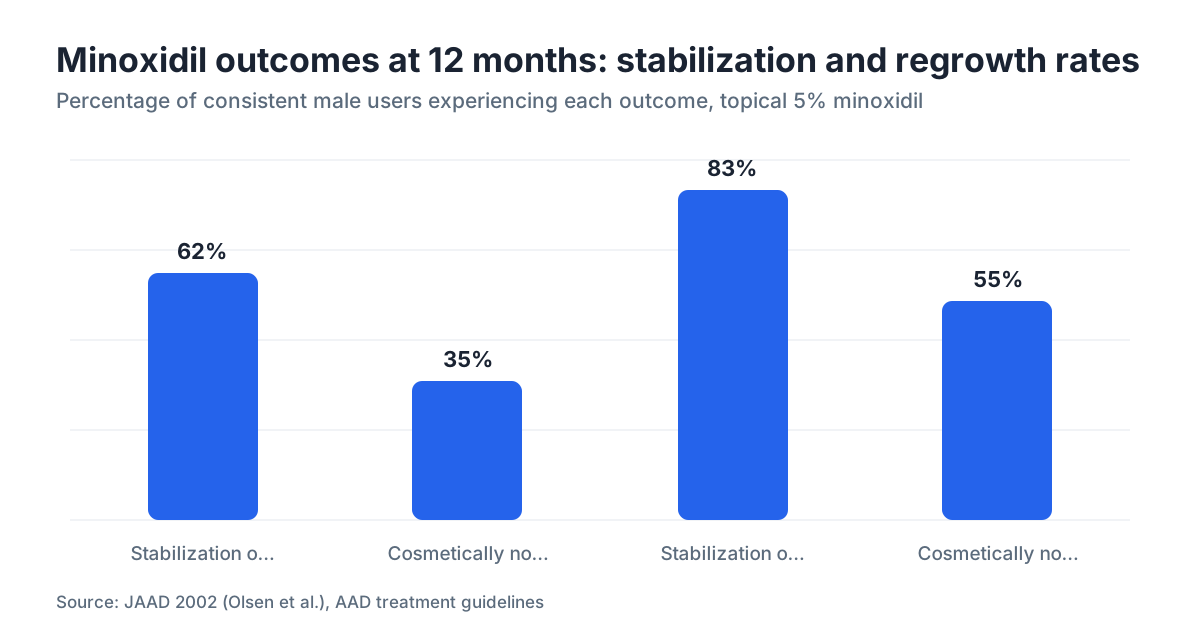
Stabilization numbers beat regrowth numbers. Across multiple trials, roughly 60 to 65% of men who use minoxidil consistently see their loss stabilize or improve rather than progress [2]. Cosmetically obvious regrowth, the kind you'd notice without counting hairs per cm², happens in a smaller group, around 30 to 40% of consistent users.
A 2022 network meta-analysis in the Journal of the American Academy of Dermatology found that combining minoxidil with finasteride produced significantly greater hair count gains than either drug alone [4]. At Norwood 3, that combination is the most evidence-backed approach if you can take finasteride. More on that below.
| Outcome | Minoxidil alone | Minoxidil + finasteride |
|---|---|---|
| Stabilization at 1 year | ~60-65% | ~80-85% |
| Cosmetically notable regrowth | ~30-40% | ~50-60% |
| Full hairline restoration | Rare | Very rare |
| Time to see results | 4-6 months | 6-12 months |
Sources: FDA label [1], JAAD 2022 [4]. Ranges reflect variation across trials.
When will you actually see results from minoxidil?
The honest timeline runs slower than anyone expects when they buy their first bottle.
Months 1-2: Nothing visible. The drug is working at the follicle level, but you won't see it. Some people shed more. That's real, and it's called minoxidil-induced telogen effluvium: resting-phase hairs get pushed out to make room for anagen hairs. Temporary but alarming. If it worries you, read up on telogen effluvium before you start so you don't quit at the worst possible moment.
Months 3-4: Fine, short vellus hairs may show up in recession zones. They can look like peach fuzz and may not feel like progress. They are progress.
Months 4-6: Terminal hairs (thicker, pigmented) start replacing vellus hairs in responders. This is when most people first notice a visible change. The AAD says minoxidil needs at least four months of consistent use before you can fairly judge the response [3].
Month 12 and beyond: Peak response for most users. Hair counts settle, and whatever regrowth you're going to get is largely locked in.
Stop minoxidil and any preserved or regrown hair drifts back to its pre-treatment trajectory within 3 to 6 months. This is not a one-year course. It's a maintenance medication, indefinitely.
How much regrowth is realistic at the temples and hairline?
This is the question people actually want answered. The honest answer: less than most people hope, more than nothing.
The temporal recession zones in Norwood 3 are DHT-sensitive areas with follicles that have often been under hormonal assault for years. Minoxidil can stimulate those follicles if they're still viable, but it cannot drag a fully receded hairline back to a Norwood 1 or 2 position. Nobody should promise that.
What's achievable for a consistent Norwood 3 user over 12 months: some filling of the temporal corners, a softer M-shape, thicker density where follicles still exist. Catch your recession early in the Norwood 3 range and the visual result can be genuinely satisfying, even if hair counts never hit baseline.
At the deeper end of Norwood 3, with well-established temporal recession, minoxidil alone usually holds the line rather than reversing it. The follicles at the very front are often the most damaged and the least responsive. That's why many dermatologists steer Norwood 3 men toward the combination approach or, for a restored hairline specifically, an early and realistic conversation about hair transplant options for the future.
A receding hairline at Norwood 3 can still be transplanted conservatively, which is another argument for acting now on medical treatment. Stabilize loss today with minoxidil (and ideally finasteride), and a future transplant has a more predictable donor supply and less surrounding loss to work around.
Should you combine minoxidil with finasteride at Norwood 3?
If you can take finasteride, the evidence says yes. Strongly.
Finasteride blocks the enzyme 5-alpha reductase, which converts testosterone to DHT. Less DHT means less follicle miniaturization. The five-year finasteride trial that anchors its approval showed 48% of men maintained or improved hair count and 42% showed visible improvement, while the placebo group kept losing throughout [5]. Minoxidil stimulates growth from the follicle side. Finasteride removes the hormonal insult causing the damage. Two different mechanisms.
The 2022 JAAD meta-analysis found combination therapy beat either drug alone on hair count [4]. For a Norwood 3 man who wants the best realistic medical result, finasteride and minoxidil together is the first-line approach.
Finasteride isn't for everyone. It carries a known side effect profile including sexual side effects (reported in roughly 1 to 2% of men in clinical trials, though real-world figures vary), and it's contraindicated in women who are or may become pregnant because of the risk of fetal harm [5]. Women with androgenetic alopecia have different options. Men who can't or won't take finasteride still benefit from minoxidil alone, but they should know they're leaving the main driver of their loss untreated.
Low-dose oral minoxidil (0.625 to 2.5 mg daily) is a newer option some dermatologists now prefer for compliance reasons. It reaches the scalp systemically and skips the application hassle. Read the tradeoffs on oral minoxidil.
What if you only use minoxidil without finasteride?
You'll likely see real benefit, just less of it.
For men who pick topical minoxidil alone at Norwood 3, the realistic outcome is stabilization for the majority and modest improvement for a meaningful minority. Androgenetic alopecia keeps progressing at its genetically set pace because DHT is still working. Minoxidil can partly offset that for some people, but it's swimming against the current, not shutting the current off.
Over 2 to 3 years, here's what that often looks like: the areas you had at Norwood 3 when you started may hold reasonably well, but you're likely to drift slowly toward Norwood 4 unless your underlying loss rate is slow or your minoxidil response is strong. Nobody can predict which you'll be.
There's nothing wrong with this path. Some men have contraindications to finasteride. Some aren't ready for a second daily medication. Starting minoxidil now and deciding on finasteride later is reasonable, as long as you know what you're getting.
What does minoxidil not do at Norwood 3?
It does not cure androgenetic alopecia. The FDA label makes no cure claim, and neither should anyone prescribing or selling it [1].
It does not stop DHT. The hormone driving your loss keeps working. That's the core limitation.
It does not restore dead follicles. Once a follicle site has been inactive long enough to be replaced by scar tissue, topical minoxidil has nothing to work with. That's why results at Norwood 6 or 7 are minimal, and why Norwood 3 does better: more viable follicles remain.
It does not work on every follicle. Even in responders, patchy non-response is common. The temples and front hairline are generally tougher to treat than the vertex (crown).
It does not work if you skip applications. Solution needs twice-daily use, foam once daily, to hold the effect. Irregular use predictably cuts the response. That's one honest reason some clinicians prefer oral minoxidil for patients who struggle with topical routines.
Are there side effects you should know about before starting?
The side effect profile for topical 5% minoxidil is generally mild, which is part of why it moved from prescription-only to over-the-counter. The common issues are scalp irritation, itching, and flaking, often from the propylene glycol carrier in solution form (foam usually causes less) [6].
Unwanted facial or body hair can appear, especially in women, when topical minoxidil runs down the face during application or sleep. Applying it at least an hour before lying down helps.
Systemic effects (low blood pressure, fluid retention, rapid heartbeat) are theoretically possible with topical use but rare at standard doses because absorption is limited. They matter more with oral minoxidil. Anyone with a cardiovascular condition should talk to a physician before starting either form [6].
The shedding in the first 6 to 8 weeks genuinely catches people off guard and drives a lot of early quitting. Knowing about it in advance helps. Get the full picture on minoxidil side effects before you start.
For a full walkthrough of how men should use the drug, minoxidil for men covers dosing, application technique, and what to expect.
How should you track whether minoxidil is working for you?
Give it a minimum of six months before drawing conclusions. Twelve months is the honest assessment window.
The most practical tracking method is consistent photography under identical conditions: same lighting, same angle, same hair length, same day of the week. Shoot at baseline, month 3, month 6, and month 12. Comparing month 1 to month 3 in bad lighting tells you nothing. A consistent photo series tells you a lot.
Some clinicians use trichoscopy (dermoscopy of the scalp) to measure hair caliber and follicle density over time. If you have access to a dermatologist who does this, it beats the mirror by a mile. The AAD recommends a dermatologist evaluation before starting treatment to set a baseline and rule out other causes of hair loss [3].
Want an easy starting point? MyHairline's free AI scan (/scan) can analyze your current hairline pattern and estimate your Norwood stage. It's not a clinical diagnosis, but it's a useful baseline before you start your own photos.
If you hit 12 months of consistent twice-daily topical minoxidil and see continued progression with no improvement, that's real information. It means you're a non-responder, compliance slipped, or your loss rate is outpacing the drug. A dermatologist visit is the right next step, not bumping up the dose on your own.
Is Norwood 3 the right time to think about a hair transplant instead?
Probably not instead, but possibly alongside medical treatment as a future plan.
Most transplant surgeons are cautious about operating on Norwood 3 patients for a practical reason: if underlying loss continues, the transplanted area looks preserved while surrounding hair recedes, which creates an unnatural look and forces more surgery to fix. The better play is to stabilize loss with medication first, watch it over 1 to 2 years, then evaluate a transplant from a position of predictable, stable loss.
That said, Norwood 3 is a favorable stage for eventual transplantation. Donor supply is typically plentiful, the recipient area is small, and the surgical goals are modest. A man who stabilizes at Norwood 3 with medication and then gets a conservative hairline transplant is in a genuinely good spot cosmetically.
Cost matters here. A hair transplant for a Norwood 3 hairline in the US typically runs $4,000 to $10,000 depending on graft count and clinic [7]. Minoxidil costs roughly $120 to $240 per year for generic topical. The math favors trying medical treatment first and reserving surgery for when loss is stable and the picture is clearer.
What other factors affect your minoxidil results at Norwood 3?
Age matters. Younger men with more recent loss tend to respond better. A 25-year-old at early Norwood 3 has more viable follicles to rescue than a 45-year-old at the same visual stage.
Family history matters, but not in a simple way. Maternal grandfather inheritance is a folk myth. Androgenetic alopecia is polygenic, with risk from both sides of your family [8]. What family history does give you is a rough sense of trajectory: if your father hit Norwood 6 by 40, your Norwood 3 at 28 is probably early in a long slide. That affects how aggressively you might treat.
Scalp health matters. Chronic seborrheic dermatitis, psoriasis, or other inflammatory conditions can impair follicle function and blunt your minoxidil response. Treating scalp inflammation is often a worthwhile parallel step.
Compliance matters more than almost anything. Minoxidil used intermittently barely works. The most common reason for treatment failure in the real world is inconsistency, not true non-response. A treatment you'll actually do every day beats a theoretically superior one you skip half the time.
Supplements and lifestyle factors (diet, sleep, stress) get a lot of airtime in hair loss forums but have weak evidence for androgenetic alopecia specifically. You can explore what's known about hair loss supplements separately, but don't let supplement research stall your start on minoxidil if you're already at Norwood 3.
What's the honest bottom line for someone starting minoxidil at Norwood 3?
Norwood 3 is a genuinely good time to start. The follicles are damaged but mostly alive. The pattern is established enough to treat but not so advanced that medical therapy is a long shot.
Be honest about what you're hoping for. If the goal is stopping further loss and holding roughly what you have with some modest improvement, minoxidil alone is a reasonable choice with a real chance of delivering. If the goal is restoring your Norwood 1 hairline, no topical drug gets you there. Combination therapy with finasteride gives you the best medical odds, and a transplant at a future stable point gives you the cosmetic result medications can't.
The worst outcome is doing nothing. Androgenetic alopecia doesn't pause while you decide. Norwood 3 becomes Norwood 4, and the window where medical treatment can preserve the most keeps narrowing. Start now, track consistently, and adjust based on your actual response over 12 months.
For a personalized sense of where your hairline stands today, the free AI analysis at MyHairline (/scan) can classify your current Norwood stage from photos. Use it as a baseline, then start your photos on day one of treatment.
Sources
- FDA, Rogaine 5% Minoxidil Topical Aerosol label
- Olsen EA et al., Journal of the American Academy of Dermatology, 2002. 5% vs 2% minoxidil 48-week RCT
- American Academy of Dermatology, Hair Loss: Diagnosis and Treatment
- Gupta AK et al., Journal of the American Academy of Dermatology, 2022. Network meta-analysis of androgenetic alopecia treatments
- Merck, Propecia (finasteride 1 mg) FDA prescribing information
- FDA, MedlinePlus: Minoxidil Topical
- International Society of Hair Restoration Surgery (ISHRS), Practice Census 2022
- Heilmann-Heimbach S et al., Nature Communications, 2017. Genome-wide association study of androgenetic alopecia
- van Zuuren EJ et al., Cochrane Database of Systematic Reviews, 2016. Interventions for female pattern hair loss
- Sinclair R, British Journal of Dermatology, 1999. Male pattern androgenetic alopecia review