

TL;DR: Crown transplants fail long-term mainly because the underlying genetic hair loss keeps going after surgery. The transplanted follicles survive. The native hairs around them keep thinning under DHT. Without ongoing finasteride or minoxidil, most patients see real crown loss again within 5 to 10 years. Surgeon skill, graft density limits, and the crown's spiral growth pattern make it worse.
What actually happens inside the crown after a hair transplant?
A hair transplant moves follicles from a donor area, usually the back and sides of the scalp, to the recipient zone. Those transplanted follicles are genetically resistant to dihydrotestosterone (DHT), the hormone that drives androgenetic alopecia. In theory, they should survive indefinitely in their new location.
The crown is not a simple flat zone. It's a spiral or whorl pattern, and hair radiates outward from a central point. To look natural, grafts have to be angled differently across that spiral, which is technically harder than restoring a hairline where most hairs grow in roughly the same direction. Surgeons working quickly, or with less experience in crown restoration, can place grafts at wrong angles and produce results that look thin or patchy even when graft survival rates are technically fine.
The deeper problem isn't surgical. It's biological. The transplanted hairs survive. The thousands of native hairs that were still present at the time of surgery, thin but alive, keep thinning and eventually disappear. That process doesn't stop at the operating table. So what looks like transplant failure is often progressive native hair loss happening on schedule around a successful graft.
The crown is also the last area to get blood supply on the scalp and tends to have lower baseline follicular density than the frontal zone [1]. Those two facts together mean graft survival can run slightly lower in the crown than the hairline, and the margin for error on how it looks is smaller.
Why does the crown keep losing hair even after a transplant?
Androgenetic alopecia, the genetic condition behind most male and female pattern hair loss, is progressive. Surgery removes the bald look at a single point in time. It doesn't touch the genetic program still running in the follicles you kept.
DHT binds to androgen receptors in susceptible follicles and shrinks them over years or decades [2]. A 30-year-old getting a crown transplant may still have tens of thousands of miniaturizing native hairs in the crown zone. Those hairs look like coverage in the pre-op photos. By 45, many of them are gone, and the transplanted grafts, now perfectly healthy, sit in an otherwise bare scalp. The result can look worse than before surgery, because the transplanted hairs have no surrounding native density to blend into.
This is the defining risk of crown transplants and the main reason experienced surgeons are careful about them. A 2020 analysis in the Journal of Cosmetic Dermatology found that patient dissatisfaction after crown transplants was linked to continued native hair loss rather than graft failure itself [3].
Finasteride and minoxidil can slow this, but they don't stop it completely in every patient. Nobody has good data on exact preservation rates at 10 years with consistent medical therapy. The closest trial data comes from the Merck-funded 5-year finasteride trials, which showed continued benefit in the vertex specifically, with 48% of men maintaining or improving hair count at year 5 versus baseline [4]. What happens beyond year 5 in real-world patients with spotty compliance is much less clear.
Learn how DHT blockers work and what the evidence actually shows before you treat them as a guaranteed backup plan.
How does the crown's blood supply affect graft survival?
Graft survival depends heavily on the recipient area getting enough blood flow fast after implantation. Follicles are living tissue that sits outside the body for hours during an FUE or FUT procedure, and they need to revascularize within a few days of placement.
The vertex, the actual top of the scalp, is sometimes called a "watershed zone" because it's the farthest point from the main arterial supply coming up from the temporal and occipital arteries [5]. Surgeons who have operated a lot on crown cases will tell you graft survival there can run 5 to 15 percentage points lower than in the frontal region, depending on patient anatomy and technique. No large controlled trial nails down a precise number, and individual variation is huge.
This matters in practice because the crown needs a lot of grafts to get meaningful coverage. If a real chunk of them don't survive, the density you're aiming for never shows up. Patients read this as "the transplant didn't work," when the surgery actually worked at average rates and the crown simply needed more grafts than were placed.
Does the Norwood stage at the time of surgery affect long-term outcome?
Yes, a lot. The Norwood-Hamilton scale sorts male pattern baldness from Type I (no loss) to Type VII (only a narrow horseshoe of hair remains) [6]. The crown starts thinning noticeably around Norwood Type III Vertex and usually becomes the dominant loss zone by Type V and VI.
A man who gets a crown transplant at Norwood IV still has moderate loss ahead of him. If he skips medical therapy and his genetics push him toward Type VI or VII, he'll burn through a big part of his donor supply patching a crown that keeps expanding. The transplanted area may look good in isolation while the bald zone grows outward around it.
Surgeons who treat this conservatively often refuse crown transplants on young patients (under 30 or 35) whose loss pattern hasn't settled, because the long-term donor math doesn't add up. Use 2,000 to 3,000 grafts on a crown at 28 and you may not have enough donor hair left at 40 to handle a much worse overall situation.
| Norwood Stage | Crown involvement | Crown transplant risk level |
|---|---|---|
| III Vertex | Crown thinning begins | Moderate, loss likely to progress |
| IV | Defined crown bald spot | High, continued progression likely |
| V | Crown joins frontal loss | Very high, donor supply concerns |
| VI | Large merged bald zone | Extreme, usually not recommended |
| VII | Minimal donor hair | Transplant often not viable |
What role does surgical planning and graft density play?
The crown is a large surface area. Covering it with natural-looking density takes 40 to 60 follicular units per square centimeter in the spots that need the most coverage. A crown bald spot at Norwood IV or V might span 50 to 100 square centimeters. Do the math and you're looking at 2,000 to 6,000 grafts for the crown alone, when a patient's total lifetime donor supply might be 5,000 to 8,000 grafts.
Most surgeons won't hand that much donor hair to the crown in one procedure, so results look thin against what the patient expected. Patients who weren't clearly counseled about density limits before surgery feel this as failure even when everything went exactly as planned.
The whorl pattern also creates an optical problem. Hair in the crown radiates outward, and the central vortex tends to look sparse even with reasonable graft counts, because that's where light hits the scalp most directly. A good surgeon compensates by packing more density at the center point, but that's a judgment call that varies widely between practitioners.
If you're evaluating surgeons, ask exactly how they plan for the whorl and what density they're targeting per square centimeter. Surgeons who can't answer that precisely probably aren't doing enough crown cases to have the pattern recognition the procedure needs. A free AI photo analysis tool like MyHairline's scan can give you a starting baseline on your current loss pattern before those conversations.
Does shock loss after a crown transplant explain some of the disappointment?
Shock loss, also called telogen effluvium, is temporary shedding of existing hairs triggered by the physical trauma of surgery. It shows up in the recipient zone and sometimes nearby areas within a few weeks of the procedure [7].
In the crown, shock loss can be alarming because the patient watches hair they had before surgery fall out fast. For most patients this is temporary. Those hairs re-enter anagen (growth phase) within 3 to 6 months. But in patients already deep in miniaturization, some shocked hairs never fully return, because the follicle was barely viable before surgery and the insult pushed it into permanent rest.
This is different from transplant failure, but it adds to long-term crown disappointment because it permanently depletes some native density. Read more about telogen effluvium to tell temporary shedding apart from actual follicle loss.
Patients often notice their crown looks worse 6 weeks post-op than it did before surgery. That's normal shock loss. The problem comes when the 3-to-6-month recovery is incomplete because the shocked follicles were already weakened by DHT.
What happens if you don't take finasteride or minoxidil after a crown transplant?
Skip medical therapy after a crown transplant and you're accepting that the native hairs in and around the transplanted zone will keep declining on their genetic schedule. The transplanted grafts will survive. Everything else might not.
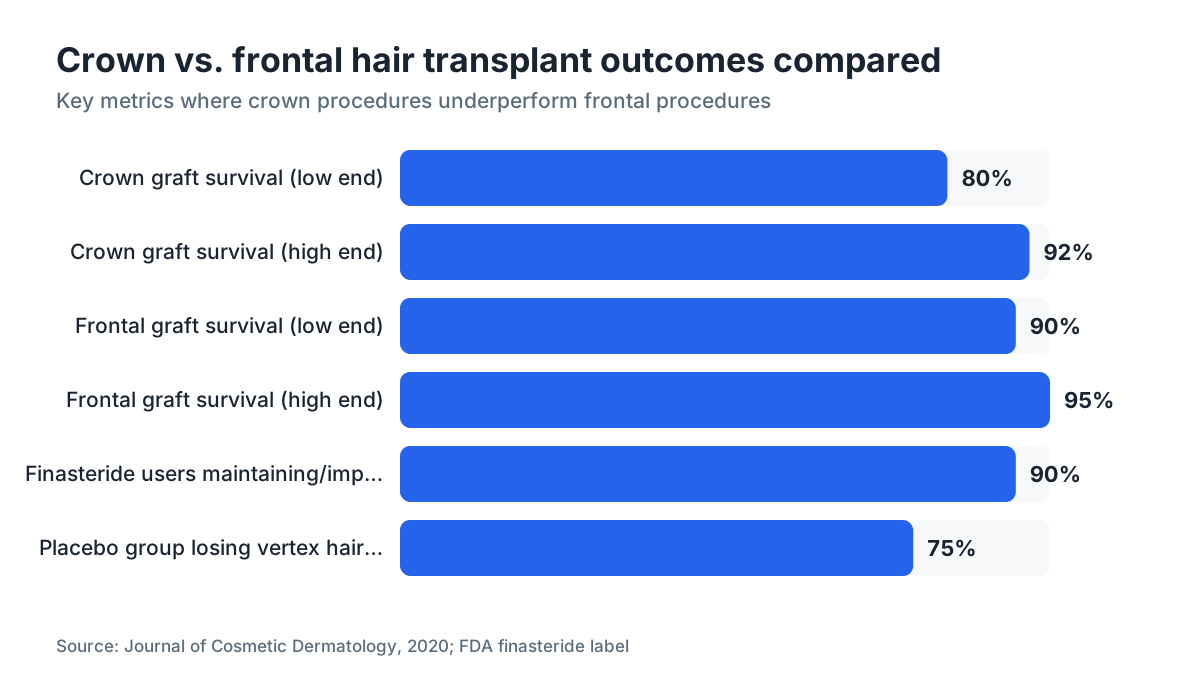
Finasteride works by inhibiting 5-alpha reductase, the enzyme that converts testosterone into DHT. The FDA approved it at 1mg daily for androgenetic alopecia in men [8]. Clinical trials show it cuts scalp DHT by roughly 60%, and the 5-year vertex data from the key trials found 90% of finasteride-treated men maintained or improved hair count versus 75% of placebo patients who lost hair. That's a real, meaningful difference.
Minoxidil, applied topically or taken orally, extends the anagen phase and increases follicle diameter. It doesn't block DHT, but it keeps miniaturizing hairs alive longer [9]. Most dermatologists recommend combining both after a crown transplant for the best shot at preserving native density.
Skipping both after a transplant isn't a neutral choice. It's an active decision to let the condition that created the transplant need in the first place run unchecked. Some patients have philosophical objections to long-term medication, and that's a legitimate personal call, but surgeons should be spelling out the likely consequences.
For a closer look at how these drugs work together, see finasteride and minoxidil combined.
How long does it take for a crown transplant to show it's failing?
The transplanted grafts take 12 to 18 months to show their full result. Graft failure, where a real percentage of transplanted follicles don't survive, usually becomes obvious by month 12. If you still have thin or patchy results at 18 months, that's when a surgeon assesses whether graft survival was the problem.
Native hair loss failure is slower and sneakier. It can take 3 to 7 years before the surrounding loss becomes obvious enough that patients notice their crown looks much worse than it did at the 18-month high point. That's why the medical literature sometimes splits short-term outcome (graft survival, 12 to 18 months) from long-term outcome (5 to 10 years with continued loss).
A patient who reads their 18-month result as a success and skips finasteride may be on track for a real setback by year 5 or 6. The trajectory is predictable. It's just slow enough that it's easy to ignore in the short term.
Can a second transplant fix a failed crown?
Sometimes, but with serious limits.
The main constraint is donor supply. Each follicular unit can only be harvested once. If the first crown transplant used 2,500 to 3,500 grafts and the surrounding loss has spread, a second procedure has to cover more area with fewer available donor hairs. Surgeons often say the second procedure is harder than the first, because you're working around existing grafts, the donor area has scarring (especially with FUT), and the scalp has been altered.
For patients who stopped medical therapy and lost a lot of native hair, a second transplant without restarting finasteride and minoxidil will likely produce a third round of disappointment. The graft math gets worse each time.
There are situations where a second crown procedure makes sense. If graft survival was genuinely poor the first time from surgeon error or infection, a second pass with a skilled surgeon can improve density. If the patient's loss is stable, well-managed medically, and donor supply is adequate, a second procedure to add density is reasonable.
Get a clear picture of your current loss stage and donor reserves before you commit to a repeat procedure. Tools like MyHairline's free AI scan can help you map where you stand today, and then you can bring that to a transplant consult where the surgeon counts available donor follicles.
Read the full overview of hair transplant surgery to understand donor supply math before you decide anything.
Are women at the same risk of crown transplant failure?
Women lose hair in a different pattern. Female pattern hair loss, also called Ludwig pattern, usually causes diffuse thinning across the crown and mid-scalp rather than the defined bald spots of the Norwood scale [10]. That has two consequences for transplants.
First, women often don't have a clear stable donor zone the way most men do. The back and sides of a woman's scalp can also be hit by androgenetic alopecia, which means harvested follicles may not be truly DHT-resistant and could miniaturize after transplantation. This is one reason many hair restoration surgeons are more careful about transplants in women than in men.
Second, the diffuse thinning makes it harder to pick discrete zones to treat. Crown transplants in women with diffuse loss often need more grafts to get visible density, and the surrounding loss can keep going at the same rate as in men.
Women with female pattern loss should be evaluated with a scalp biopsy or trichoscopy before any transplant to confirm the loss pattern and donor zone quality [11]. The what causes hair loss guide covers the hormonal and genetic factors that differ between men and women.
What's the honest success rate for crown hair transplants?
This is genuinely hard to answer, because "success" means different things and long-term follow-up studies are scarce. Most published transplant data tracks graft survival at 12 to 18 months, not patient satisfaction at 5 or 10 years.
Graft survival rates in skilled hands run 90 to 95% for frontal procedures. Crown graft survival in published series ranges from 80 to 92%, with the lower end seen in larger sessions and in zones with compromised blood supply [3]. Those are the surgical numbers.
Patient satisfaction at 5 years with the crown specifically is much lower. One retrospective analysis found crown transplant patients were roughly twice as likely to request a follow-up corrective procedure compared to frontal transplant patients, and continued native hair loss was the most common reason cited [3].
The honest picture: a crown transplant by a skilled surgeon, in a patient with stable loss and a real commitment to finasteride and minoxidil, can produce good long-term results. The same procedure in a young patient with aggressive loss and no medical therapy is likely to look much worse within a decade.
| Outcome metric | Crown transplant | Frontal transplant |
|---|---|---|
| Reported graft survival | 80-92% | 90-95% |
| Long-term patient satisfaction (5+ yrs) | Lower | Higher |
| Corrective procedure requests | Higher | Lower |
| Risk from continued native loss | High | Moderate |
| Density challenge (grafts/cm²) | High | Moderate |
How should you protect a crown transplant long term?
The evidence points to a few consistent behaviors that improve outcomes over time.
Medical therapy is the foundation. Finasteride 1mg daily has the strongest evidence base for preserving crown density in men, documented in the FDA-approved label and backed by 5-year trial data [8]. Minoxidil, topical or oral, adds coverage through a different mechanism [9]. Most hair loss dermatologists recommend running both together after a crown transplant, not one or the other. For side effect worries on minoxidil, the minoxidil side effects article covers what's real versus overstated.
Choose your surgeon carefully before you ever get to post-op management. Ask to see crown-specific patient photos at 3 years or more, more than 12-month results. Ask what density per square centimeter they're targeting and how they approach the whorl. Ask what they'd advise if you come back at 5 years with significant surrounding loss.
Plan the donor supply conservatively. If your surgeon wants to commit nearly your entire donor reserve to the crown, that's a red flag unless your frontal hairline is completely stable. Leaving donor hair in reserve for future procedures is often the smarter financial and cosmetic strategy.
Stay realistic about crown coverage. A crown transplant in most patients produces improvement, not perfection. Hair in the crown, even at good density, looks thinner from above because light hits the scalp perpendicularly. Styling, scalp pigmentation, and hair texture all affect how it reads in the crown more than anywhere else on the scalp. Men with finer, lighter hair tend to be harder cases than men with darker, coarser hair.
Sources
- American Academy of Dermatology, Hair loss: who gets and causes
- NIH National Library of Medicine, Androgenetic Alopecia (StatPearls)
- Journal of Cosmetic Dermatology, Outcome and satisfaction analysis in hair transplantation (2020)
- Journal of the American Academy of Dermatology, Finasteride 5-year vertex outcome data (Merck trials)
- International Society of Hair Restoration Surgery, Hair Transplantation: The Art of Repair
- NIH National Library of Medicine, Norwood-Hamilton Classification (StatPearls)
- American Academy of Dermatology, Hair loss: diagnosis and treatment
- U.S. Food and Drug Administration, Propecia (finasteride) prescribing information
- NIH National Library of Medicine, Minoxidil (StatPearls)
- American Academy of Dermatology, Female pattern hair loss
- Journal of the American Academy of Dermatology, Trichoscopy in hair and scalp disorders