

TL;DR: A receding hairline at 17 is real and can be early androgenetic alopecia, but it might also be a maturing hairline, stress-related shedding, or something else entirely. Finasteride is not approved for under-18 use. Minoxidil has limited evidence in teens. The right first step is a dermatologist visit, not a pharmacy run.
Is a receding hairline at 17 normal, or is something wrong?
It depends on what you're actually seeing. Some hairline change in the mid-to-late teens is completely normal. Between about 17 and 21, the juvenile hairline, the nearly-straight edge most kids have, matures into a slightly higher, more angular adult hairline. That process is called hairline maturation, and it is not the same as male pattern baldness.
A maturing hairline typically moves back symmetrically, no more than about 1 to 1.5 cm at the temples, and then stops [1]. The hair density behind it stays the same. If your hair is thinning at the crown, the temple recession looks uneven, or the shedding feels dramatic, that's a different picture worth taking seriously.
Androgenetic alopecia (AGA) can start in teenagers. Studies of adolescent boys referred to dermatology clinics find AGA beginning before age 20 in a meaningful minority of cases [2]. Early onset often means a stronger family history and a faster progression curve. So no, 17 is not too young for real hair loss to begin, but it's also not too young for a completely benign, normal hairline shift to cause unnecessary panic.
The honest answer: you cannot tell which one you have by looking in the mirror or reading an article. A receding hairline looks different from a maturing hairline mostly in degree and pattern, and that distinction usually takes a trained eye.
What causes a receding hairline in a teenager?
The same thing that causes it in a 35-year-old: dihydrotestosterone (DHT), the hormone that signals genetically sensitive follicles to miniaturize and eventually stop producing visible hair [3]. At 17, testosterone levels are peaking. More testosterone means more raw material for the enzyme 5-alpha reductase to convert into DHT. If your follicles inherited the sensitivity gene, they're being hit with DHT at exactly the wrong time.
But DHT-driven AGA is not the only explanation. Here are the other causes worth ruling out before anyone prescribes anything:
| Cause | Key distinguishing sign | Reversible? |
|---|---|---|
| Androgenetic alopecia | Temple recession, crown thinning, positive family history | Partially, with treatment |
| Hairline maturation | Symmetric, small recession, no density loss | Yes (it just stops naturally) |
| Telogen effluvium | Diffuse shedding after illness, crash diet, or stress | Yes, usually 3-6 months |
| Traction alopecia | Hair loss where tight styles pull hardest | Yes, if caught early |
| Nutritional deficiency (iron, zinc, vitamin D) | Diffuse shedding, fatigue, other symptoms | Yes, if corrected |
| Thyroid disorder | Diffuse shedding, weight change, fatigue | Yes, with treatment |
| Alopecia areata | Patchy, often sudden | Variable |
Telogen effluvium is worth calling out because it's common in teenagers, often triggered by the kind of physical and emotional stress that's everywhere in high school. You can lose a lot of hair fast from TE and feel certain you're going bald when the real cause is last semester's anxiety and a bad diet. TE almost always resolves on its own.
Creatine supplementation has been floated as a possible hair loss trigger too. The evidence is thin but not zero. One 2009 study found creatine supplementation raised DHT levels in college rugby players, though it didn't directly measure hair loss [4]. If you're using creatine and noticing hairline changes, pausing it while you get evaluated is reasonable. More on that at does creatine cause hair loss.
Understanding what causes hair loss at a deeper level helps you advocate for yourself at the doctor's office.
How do you tell if your hairline is just maturing or actually receding?
Look at three things: symmetry, density, and the scalp line.
A maturing hairline moves back evenly on both sides, keeps the same arc shape, and leaves thick, healthy hair behind it. If you run your fingers through the area behind your temples, the hair feels normal. Photographs from a year or two ago can help you judge the rate of change.
A receding hairline from AGA tends to start at the corners and dig in unevenly. The hair in the affected zone often looks thinner, shorter, or finer even before it visibly disappears. This miniaturization is the signature. Under a dermatoscope (a magnifying tool dermatologists use) you'd see hair shaft diameter variability, where some hairs in the same zone are noticeably thinner than others [5]. You can't see that with the naked eye in a bathroom mirror.
The Norwood scale classifies hairline recession from Stage 1 (no recession) through Stage 7 (near-total loss). A 17-year-old noticing temple changes is typically looking at Stage 1 to Stage 2. Stage 2 involves slight recession at the temples but preserved front and crown density. Reaching Stage 2 doesn't mean Stage 7 is coming. Many men stay at Stage 2 for decades. Many progress faster. Family history is the single best predictor, but it's not destiny.
If you want a faster read on your hairline pattern, the free AI scan at MyHairline can map your hairline against Norwood staging from a photo, which is a reasonable starting point before a clinical visit.
What can a 17-year-old actually do to stop a receding hairline?
This is where the article has to be honest with you, because most of the internet will just tell you to buy things.
Finasteride, the most effective pharmaceutical treatment for AGA in men, is FDA-approved only for adult men [6]. It works by blocking 5-alpha reductase and cutting DHT production by roughly 70 percent. It works well. It is also not approved for use in anyone under 18, and there's a real physiological reason for that: testosterone and DHT drive development during adolescence, and interfering with that process in a still-developing body is not something any reputable prescriber should do casually. You will find online clinics that will prescribe it to a 17-year-old anyway. That's not a reason to take it.
Minoxidil is topically applied and FDA-approved for adults with AGA. Its labeling says "for use by adults only" [7]. There is very limited pediatric data. It's been used off-label in children with specific hair conditions under close medical supervision, but recreational use in a 17-year-old trying to stop early recession isn't backed by safety or efficacy evidence in that age group. That said, a dermatologist who has examined you in person might make a different judgment call after weighing your specific situation.
What you can do right now, at 17, without a prescription:
-
Get a blood panel. Ask your GP to check ferritin, thyroid (TSH, free T4), zinc, vitamin D, and a complete blood count. Correcting a deficiency won't reverse AGA, but it can slow shedding a lot and sometimes restore some density.
-
Stop anything that pulls on your hairline. Tight styles, headbands worn for hours daily, hats worn so tight they leave marks: these can cause traction alopecia, which in teenagers is very reversible if caught early.
-
Look at your diet honestly. Hair follicles are among the fastest-dividing cells in the body and they need protein, iron, and biotin. Teens eating 1200 calories, vegans who aren't supplementing, or anyone on a crash diet will see shedding. Hair loss supplements won't fix AGA, but fixing a real nutritional gap does matter.
-
Reduce DHT-amplifying inputs where you can. Obesity raises circulating DHT. Creatine may raise DHT modestly. Anabolic steroids definitely will. If any of those apply, the fix there is obvious.
-
Document carefully. Take identical photos (same lighting, same angle, same camera distance) once a month starting now. When you turn 18 and can meaningfully discuss treatment options, you'll have baseline documentation that's genuinely useful for a clinician to assess your rate of progression.
Should a 17-year-old use minoxidil for a receding hairline?
The short answer is: not without a doctor's sign-off.
Topical minoxidil works by prolonging the anagen (growth) phase of the hair cycle and widening follicles. In adult men with AGA, roughly 40 percent see meaningful regrowth; most see at least stabilization with consistent use [7]. Those numbers come from studies in adults. There are no published randomized controlled trials of topical minoxidil for AGA specifically in adolescents.
The practical risks at 17 are different from adult risks. Systemic absorption from topical minoxidil is low but not zero. Minoxidil's cardiovascular effects (it was originally an oral blood pressure medication) are manageable in adults but less studied in still-developing adolescent cardiovascular systems. Oral minoxidil carries more systemic exposure; see oral minoxidil for what that looks like in adults before even considering it at a younger age.
If a dermatologist evaluates you, confirms early AGA, and decides topical minoxidil is appropriate in your specific case, that's a different situation from buying a bottle off Amazon at 17 because you're worried. Get the evaluation first. The side effects profile you'd want to understand is laid out at minoxidil side effects and minoxidil for men.
One more practical note: minoxidil requires indefinite use. Stop it, and any hair you kept or regrew sheds within a few months. Starting at 17 means potentially decades of daily application. That's a commitment worth understanding before you start.
What happens when you turn 18? What treatments become available?
At 18, you're an adult in the eyes of most prescribers and can make an informed consent decision about FDA-approved treatments.
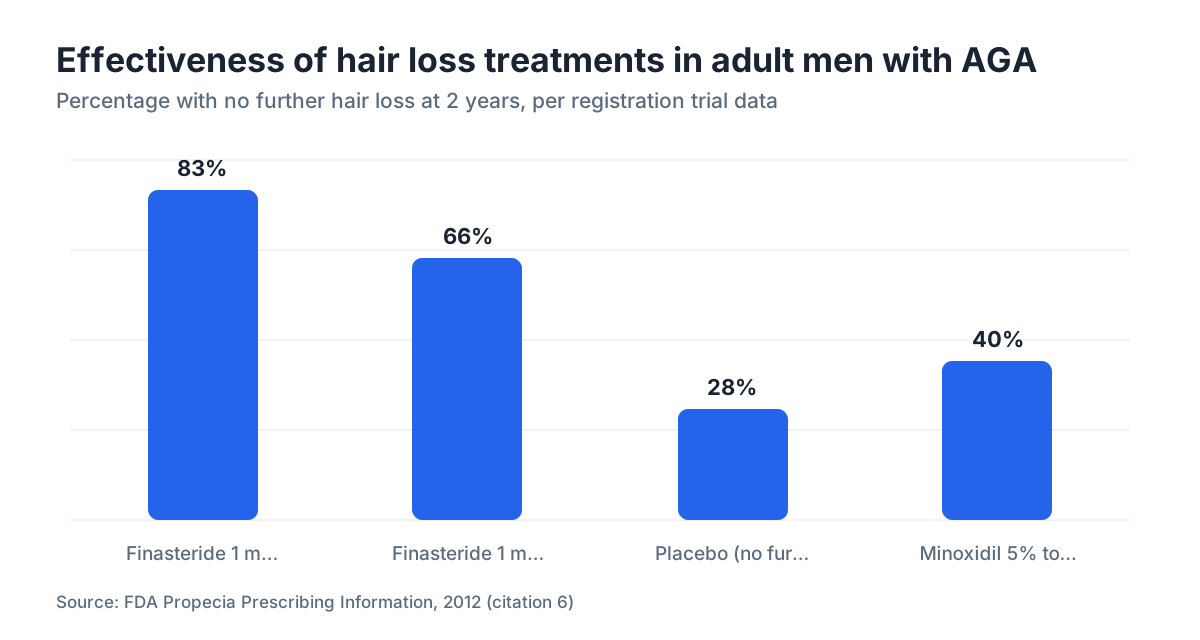
Finasteride 1 mg (Propecia and generics) is the standard first-line oral treatment. It reduces scalp DHT by about 60 percent and serum DHT by roughly 70 percent [6]. In the original registration trials, 83 percent of men taking 1 mg finasteride had no further hair loss at two years, and 66 percent saw hair count increases [6]. It works better the earlier you start, because it can stabilize follicles that are still producing miniaturized hair but cannot resurrect follicles that are already dead.
Combining finasteride and minoxidil is generally more effective than either alone. A 2020 study published in Dermatologic Therapy found the combination produced significantly greater hair count improvements than monotherapy [8]. More on that at finasteride and minoxidil.
Finasteride's sexual side effects (reduced libido, erectile dysfunction, ejaculatory changes) affect somewhere between 1 and 4 percent of users in clinical trials [6]. Post-finasteride syndrome, a reported condition where sides persist after stopping, is real but its true prevalence is disputed and hard to quantify. Read finasteride before making a decision, not after.
DHT blockers like saw palmetto and other supplements are often pitched as natural alternatives. The evidence for any of them is a lot weaker than for finasteride. A 2020 review found saw palmetto had some supporting data but was significantly less effective than finasteride in head-to-head comparisons [9]. More detail at dht blocker.
Hair transplants are not appropriate for a 17-year-old and are generally not recommended until pattern stabilizes, which usually means at least your mid-20s. Transplanting hair onto a scalp where the native hair continues to fall out produces an unnatural, island-like result over time. The honest hair transplant conversation starts much later.
Does family history predict how fast your hairline will recede?
Yes, but it's messier than the old "look at your mom's dad" rule.
Androgenetic alopecia is polygenic, meaning many genes contribute, and they come from both parents' families [2]. The most well-studied gene is on the X chromosome (which you inherit from your mother), specifically the androgen receptor gene. That's where the maternal grandfather myth came from. But large genome-wide association studies have now found over 280 loci linked to male pattern baldness, spread across many chromosomes [10]. Your father's history matters too.
In practice, early onset in a first-degree relative (father, older brother) is the strongest single predictor that your own hair loss will progress faster and further. Early onset in a 17-year-old specifically correlates with higher-stage eventual loss compared to onset at 25 or 30. That's not a certainty, but it's why acting early, once you're old enough to do so safely, genuinely matters.
The flip side: plenty of men with strong family histories of baldness start early and then stabilize. Treatment works better when started before significant follicle death, which is exactly why monitoring carefully in your late teens sets you up for better outcomes.
When should a 17-year-old see a dermatologist about hair loss?
Honestly, sooner than most teens do.
A board-certified dermatologist can do a dermatoscopy in-office, run the right labs, distinguish AGA from TE from alopecia areata, and make an evidence-based recommendation about your specific situation. That's worth more than any combination of Googling and supplement-buying.
See someone promptly if:
- Your hair is visibly thinner over the crown, more than at the temples.
- You're shedding more than 100 to 150 hairs per day consistently (the average person sheds 50-100).
- You have patches of complete hair loss anywhere on your scalp.
- Your eyebrows, eyelashes, or body hair are also thinning.
- A parent or sibling had significant hair loss before age 25.
- You've noticed the change over less than three months and it's clearly accelerating.
Most GPs can order the initial blood panel and refer you on. If you want to skip the referral queue, a dermatologist who subspecializes in hair (a "trichologist" is a non-medical title in the US, but a dermatologist with a hair fellowship is the real credential) is the gold standard.
Bring your monthly photos. That documentation is genuinely useful clinical data.
What lifestyle changes actually slow hair loss at 17?
None of them will stop genetic AGA on their own. But several create the best possible environment for whatever hair you have, and they remove variables that speed up shedding.
Protein intake. Hair is made of keratin. Your follicles need adequate protein to build it. The recommended dietary allowance for a 17-year-old male is 0.85 grams per kilogram of body weight per day, but growing teens actively building muscle are often better served by 1.2 to 1.6 g/kg [11]. Crash dieting or undereating protein causes noticeable shedding within weeks.
Iron. Ferritin below 40 micrograms per liter has been linked to increased hair shedding in multiple dermatology studies, even in people without classic anemia [12]. Teen girls are at much higher risk (menstrual blood loss), but teen boys who eat poorly or avoid red meat can land here too. A blood test tells you where you actually stand.
Scalp hygiene and heat. Washing your hair regularly is fine and does not cause hair loss. Washing too infrequently lets sebum and DHT pool at the follicle, which isn't good either. Heat styling won't cause AGA but it will damage the hair shaft and make whatever you have look thinner. Keep blow dryer use moderate.
Sleep and stress. Severe psychological stress triggers telogen effluvium by pushing follicles into the resting phase early. Teenagers are often genuinely stressed. Fixing the stress won't reverse AGA, but it can stop the TE on top of AGA that makes things look twice as bad.
Scalp massage. A 2016 Japanese study found 4 minutes of standardized scalp massage daily for 24 weeks increased hair shaft thickness (though not total hair count) compared to baseline [13]. It's not a treatment, but it costs nothing and the data, while small, is real.
Are there any treatments to completely avoid at 17?
A few things are worth actively avoiding, not because they're useless in adults but because they carry specific risks at your age or are simply a waste of money.
Anabolic steroids. If you've been tempted by them for gym results: they massively speed up AGA in anyone with genetic susceptibility. They flood the system with testosterone that converts to DHT. This is probably the single fastest way to go from Norwood 1 to Norwood 3 in two years if you're genetically susceptible. Don't.
Unsupervised finasteride from online clinics that don't verify age. It exists. Some platforms will hand you a prescription without a real clinical review. This isn't safe at 17 for the reasons described above. Wait.
Ketoconazole shampoo as a standalone treatment. Sold as a mild DHT blocker at the scalp, it has some weak supporting data in adults. In teens, it's not something to add without medical guidance, and treating it as a substitute for real evaluation is a mistake.
Biotin megadoses sold as hair growth supplements. Biotin deficiency is rare and correcting it can restore hair. Taking 10,000 mcg of biotin when you're not deficient does nothing for hair but can interfere with lab tests, including thyroid panels and cardiac troponin tests, creating false results that lead to misdiagnosis [14]. The FDA specifically warned about this in 2019 [14]. Take biotin only if a test shows you're actually deficient.
PRP (platelet-rich plasma) injections. Marketed to teenagers online. Expensive (often $1,500 to $3,000 per session), not FDA-approved as a hair loss treatment, and with inconsistent evidence even in adults. Not appropriate at 17.
What does early treatment actually look like if you start at 18?
Assuming a dermatologist confirms early AGA at 18, here's what a reasonable first-line approach looks like in practice:
Most clinicians start with topical minoxidil 5% once daily (or the foam formulation) plus close monitoring. If progression continues after three to six months, finasteride 1 mg daily is typically added. The combination approach is considered standard of care in major dermatology guidelines.
Generic finasteride costs roughly $10 to $30 per month at most pharmacies in the US. Generic minoxidil 5% solution costs about $5 to $15 per month. Brand-name versions cost dramatically more without better outcomes.
Timeline expectations: neither drug works fast. Minoxidil takes about three to four months to show initial response, and full effect takes a year. Finasteride's stabilizing effect shows at three to six months; visible density improvements (where they occur) take 12 months or more. The Journal of the American Academy of Dermatology notes that hair count improvements from finasteride peak around 12 to 24 months of use [6].
You'll shed more hair during the first six to eight weeks of minoxidil use. This is expected and not a sign it's making things worse. It happens because minoxidil pushes old telogen hairs out to make room for new anagen hairs.
If you want to track your response objectively, the AI scan at MyHairline can compare standardized photos over time to detect density changes that are hard to see month-to-month. It's not a substitute for a dermatologist's assessment but it's a reasonable monitoring tool.
Sources
- American Academy of Dermatology, Hair Loss Overview
- Genetics of androgenetic alopecia, PubMed / NCBI
- NIH MedlinePlus, Androgenetic Alopecia
- van der Merwe J et al., Clinical Journal of Sport Medicine, 2009 (PMID 19910804)
- Olsen EA et al., Journal of the American Academy of Dermatology, Dermatoscopy in hair disorders
- FDA, Propecia (finasteride) Prescribing Information
- FDA, Rogaine (minoxidil topical) Drug Facts labeling
- Hu R et al., Dermatologic Therapy 2020, Combination finasteride and minoxidil
- Evron E et al., Skin Appendage Disorders 2020, Saw palmetto systematic review
- Heilmann-Heimbach S et al., Nature Communications 2017, GWAS of male pattern baldness
- NIH Office of Dietary Supplements
- Trost LB et al., Journal of the American Academy of Dermatology 2006, Iron and hair loss
- Koyama T et al., ePlasty 2016, Standardized scalp massage study
- FDA Safety Communication, Biotin interference with lab tests, 2019