

TL;DR: Isotretinoin (Accutane) can push hair follicles into the resting phase early, causing a shedding pattern called telogen effluvium in an estimated 10 to 20% of patients. The shedding usually starts 2 to 4 months into the course and resolves within 6 to 12 months of stopping the drug. Permanent loss is uncommon but documented in rare cases.
What is telogen effluvium and why does Accutane cause it?
Telogen effluvium is a type of diffuse hair shedding that happens when a large number of follicles are simultaneously pushed out of the growth phase (anagen) and into the resting phase (telogen). Normally about 10 to 15% of scalp hairs are in telogen at any given time. When a physiological stressor forces that number much higher, hairs shed in a wave 2 to 4 months later, once the resting period ends.
Isotretinoin is a synthetic retinoid derived from vitamin A. It works by dramatically shrinking the sebaceous glands, which is why it clears severe acne so well. But sebaceous glands are directly attached to hair follicles, and retinoids have potent effects on how follicle cells proliferate and differentiate [1]. The leading hypothesis is that isotretinoin shortens the anagen phase itself, pushing follicles into telogen earlier than they would otherwise go. Some researchers also point to isotretinoin's effect on follicular keratinocytes as a secondary mechanism.
A 2013 review published in the Journal of the European Academy of Dermatology and Venereology found hair loss listed as one of the more common mucocutaneous side effects of isotretinoin therapy, affecting roughly 10 to 20% of patients across published case series [2]. The FDA-approved prescribing information for isotretinoin lists "hair thinning" and "alopecia" under adverse reactions in the skin and appendages category [3].
Here is the part that changes everything about your prognosis: isotretinoin-related telogen effluvium is not androgenetic alopecia. The hair follicles are not miniaturizing. They are simply cycling incorrectly. You can read more about the broader triggers and mechanics on our telogen effluvium overview.
How common is hair loss on Accutane, really?
The honest answer is that nobody has a single clean number. Published case series and retrospective studies give estimates that range from about 3% to 22%, depending on how hair loss was defined, how patients were asked about it, and what dose was used [2].
The FDA's prescribing information does not give a specific incidence percentage for hair loss. It lists the reaction as observed in post-marketing experience and clinical trials without breaking out a frequency tier [3]. The American Academy of Dermatology acknowledges it as a recognized side effect without publishing its own incidence figure [4].
Dose appears to matter. Higher cumulative doses (above 120 to 150 mg/kg, which is what dermatologists often aim for to reduce relapse) seem to correlate with higher rates of reported shedding. Lower-dose or intermittent protocols generate fewer reports, though the evidence here is mostly observational. Sex may matter too. Women report hair shedding on Accutane more often than men in most case series, though it is not clear whether that reflects biology or reporting bias.
When does hair shedding start and how long does it last?
The timeline follows the basic biology of the hair cycle. Isotretinoin begins affecting follicle cycling within weeks of starting treatment, but there is a built-in delay because a follicle that enters telogen takes about 2 to 3 months to actually shed the hair. Most patients who experience isotretinoin-related shedding notice it starting around month 2 to 4 of their course.
Shedding typically continues for as long as the drug is being taken and for a period after stopping. The standard isotretinoin course lasts 4 to 6 months. Most patients see shedding slow down within 3 to 6 months of finishing the course, with fuller regrowth by 6 to 12 months post-treatment in the majority of cases [2].
A small subset of patients report that shedding persists beyond 12 months or that hair does not fully return to its prior density. These cases are harder to study because by that point, other factors (including underlying androgenetic alopecia that the stress may have revealed) often complicate the picture. If you have a family history of pattern hair loss, isotretinoin shedding can effectively unmask it by accelerating a process that was already beginning.
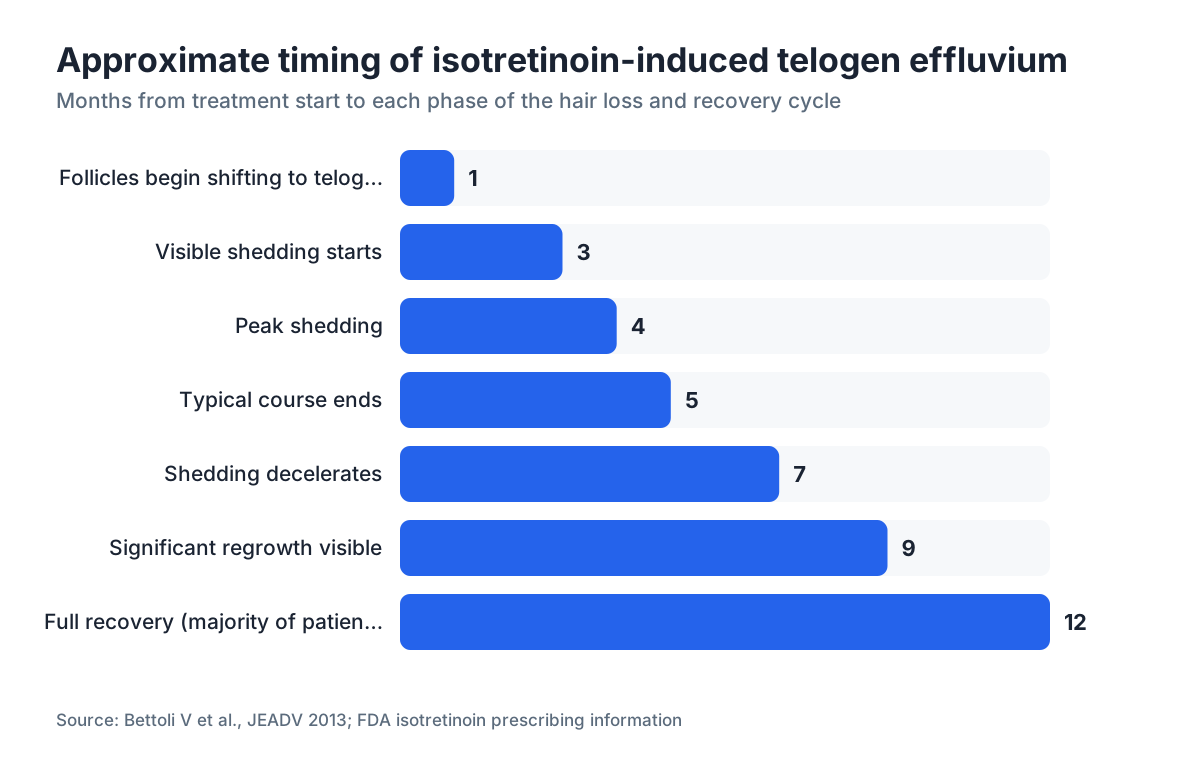
Below is a rough timeline based on published case reports and the known biology of telogen effluvium:
| Phase | Approximate timing |
|---|---|
| Isotretinoin starts | Day 0 |
| Follicles begin shifting to telogen | Weeks 2 to 8 |
| Visible shedding begins | Months 2 to 4 |
| Peak shedding | Months 3 to 5 |
| Course ends (typical) | Months 4 to 6 |
| Shedding decelerates | 1 to 3 months post-course |
| Significant regrowth | 6 to 12 months post-course |
| Full recovery (majority) | 12 months post-course |
Can Accutane cause permanent hair loss?
Yes, though it is rare. Permanent hair loss after isotretinoin has been documented in case reports and pharmacovigilance databases [3]. The FDA's MedWatch system has received reports of persistent alopecia following isotretinoin use, which is why the drug's label includes alopecia as a listed adverse event [11].
The mechanism for permanent loss is not fully understood. Possibilities include direct follicular toxicity at very high cumulative doses, triggering of underlying androgenetic alopecia that then progresses on its own, or a chronic form of telogen effluvium where the trigger is not truly resolved. In practice, most dermatologists treat permanent diffuse hair loss from isotretinoin as uncommon enough that it should not be a default reason to avoid the drug in someone with severe, scarring acne who has failed other treatments. But you should know it exists.
Still shedding heavily 12 months after stopping isotretinoin? See a dermatologist for a scalp biopsy. That can separate true telogen effluvium from other diagnoses like chronic telogen effluvium, alopecia areata, or early androgenetic alopecia.
What does the research actually show about isotretinoin and hair follicles?
Retinoids bind to retinoic acid receptors (RARs) and retinoid X receptors (RXRs), both of which are expressed in hair follicle cells. In vitro studies have shown that all-trans retinoic acid can inhibit the proliferation of outer root sheath keratinocytes, which are the cells that support the hair shaft during anagen [1]. That gives a plausible cell-level explanation for why isotretinoin shortens anagen.
A 2001 study in the journal Dermatology found that among 30 patients on isotretinoin, trichograms (a diagnostic technique counting hair phases by plucking) showed a significant increase in telogen hairs during treatment compared to baseline [5]. That kind of direct follicular evidence is more convincing than self-report data.
The picture gets muddier because acne itself, particularly severe inflammatory acne, can cause stress-related telogen effluvium independently of any treatment. A prospective study that accounts for pre-treatment shedding would be needed to cleanly isolate isotretinoin's contribution, and that kind of rigorous trial is still missing from the literature. Nobody has good randomized controlled data here. The closest evidence is the trichogram study and retrospective case series.
Vitamin A toxicity is relevant context. Isotretinoin is structurally related to vitamin A, and hypervitaminosis A is a well-known cause of telogen effluvium [6]. This is essentially a pharmacological version of that same mechanism, delivered at a therapeutic dose for acne.
Who is most at risk for hair loss on isotretinoin?
Several factors seem to raise risk, based on the available observational data:
Higher cumulative dose. The standard target of 120 to 150 mg/kg cumulative dose produces more side effects in general, and hair loss is no exception. Some dermatologists use lower-dose protocols (0.25 to 0.3 mg/kg/day instead of the typical 0.5 to 1 mg/kg/day) for patients who are concerned about hair loss, though this trades some relapse risk for fewer side effects.
Female sex. Women consistently report higher rates of hair shedding on isotretinoin in case series. One possible reason: female hair is often longer and diffuse shedding is more visible and more distressing, which may push reporting rates up. But hormonal differences in how follicles respond to retinoids may also be real.
Pre-existing nutritional deficiencies. Low iron, low ferritin, low zinc, and B12 deficiency all independently increase telogen effluvium risk. Isotretinoin itself can affect lipid and liver enzyme levels, and nutritional status entering a course may influence how the follicles respond.
Family history of androgenetic alopecia. If you were already heading toward pattern hair loss, the stress of isotretinoin can speed up the timeline. What you experience as isotretinoin-related shedding may partly be androgenetic alopecia revealing itself sooner than it would have otherwise. Understanding what causes hair loss at a deeper level can help you separate these two processes.
Is there anything that actually helps with Accutane hair loss?
This is where honesty requires some restraint. There are no randomized controlled trials testing any treatment specifically for isotretinoin-induced telogen effluvium. What we have is extrapolation from general telogen effluvium management and case reports.
Correct nutritional deficiencies first. Get a ferritin level checked before and during your course. A ferritin below 40 ng/mL is associated with worse telogen effluvium outcomes in the general literature, and getting it above 70 ng/mL seems to help in observational studies [7]. The same goes for zinc and vitamin D. Isotretinoin itself can affect absorption and metabolism of some nutrients, so this is not a trivial point.
Do not add more vitamin A supplements. Isotretinoin already saturates the retinoid receptor system. Adding vitamin A or high-dose retinyl palmitate supplements on top of an isotretinoin course is both useless and potentially harmful.
Minoxidil comes up a lot. Topical minoxidil is the only FDA-approved topical treatment for hair loss, and it can support the anagen phase of the hair cycle [8]. Some dermatologists suggest it during or after an isotretinoin course for patients with significant shedding. The evidence for this specific application is anecdotal, but the safety profile of topical minoxidil is well established. If you want to understand minoxidil's side effects before adding it to your regimen, read our minoxidil side effects guide first.
Waiting is often the answer. For most patients, doing nothing beyond keeping nutritional status good and waiting 6 to 12 months after the course ends is the clinically appropriate approach. Regrowth happens on its own once the trigger (isotretinoin) is removed.
For patients who suspect their shedding has an androgenetic component on top of the telogen effluvium, a conversation with a dermatologist about finasteride or other DHT blockers may be relevant, but only after the telogen effluvium has been properly diagnosed and the isotretinoin course is complete.
Should you stop Accutane early to prevent further hair loss?
This is a real question patients ask, and the answer is almost always the same: talk to your dermatologist before making that call. Stopping isotretinoin early sharply increases relapse rates for acne, and severe acne carries its own physical and psychological costs including scarring.
From a hair loss standpoint, stopping early does not instantly stop shedding, because follicles already in telogen will still shed over the next 2 to 3 months regardless. The benefit of stopping early is removing the trigger so no additional follicles are pushed into telogen. Whether that benefit outweighs the acne relapse risk is a personal and clinical decision.
Some dermatologists opt for a dose reduction rather than full discontinuation when a patient is experiencing distressing hair loss. Dropping from 1 mg/kg/day to 0.5 mg/kg/day, for instance, may reduce the intensity of the telogen effluvium while still reaching a therapeutic cumulative dose over a longer treatment period. Again, this is a judgment call that belongs with the prescribing physician, not a solo decision.
If you used our free AI hair analysis scan at MyHairline to track your density before starting isotretinoin, that baseline data becomes genuinely useful here: you can compare pre-treatment and current photos objectively rather than relying on memory.
How do you tell if Accutane is causing your hair loss or if something else is going on?
The classic pattern of isotretinoin-induced telogen effluvium is diffuse shedding across the entire scalp, not thinning at the temples or crown alone. If you are losing hair primarily at the front hairline or vertex while on isotretinoin, androgenetic alopecia (or something triggering it) may be the larger factor. A receding hairline specifically suggests pattern loss. See our receding hairline article for how to assess it.
A dermatologist can do a pull test: pulling 60 hairs from different scalp quadrants and counting how many come out. More than 6 telogen hairs (identifiable by the small white bulb at the root) per 60 pulled is considered a positive pull test indicating active telogen effluvium [9].
Blood work helps rule out other causes. Thyroid disease, iron deficiency anemia, low ferritin, autoimmune conditions, and hormonal imbalances can all cause diffuse shedding that coincidentally overlaps with an isotretinoin course. Being on isotretinoin does not make those other causes impossible.
A scalp biopsy is the gold standard for separating telogen effluvium from other conditions, but dermatologists usually reserve it for cases where the diagnosis is genuinely unclear after blood work and clinical examination. It involves taking a small punch sample from the scalp under local anesthesia and examining the follicle ratio under a microscope.
What about hair loss supplements and nutrients during an Accutane course?
A few specific nutrients have real evidence behind them for telogen effluvium in general, though not for isotretinoin specifically.
Iron and ferritin are the most important. Studies in the dermatology literature have linked low ferritin to worse telogen effluvium outcomes, and case reports document improvement in shedding after ferritin is corrected [7]. Get a ferritin level, more than a hemoglobin, because you can have normal hemoglobin and still have depleted iron stores that affect follicle cycling.
Zinc has some evidence from randomized trials for alopecia areata, and observational evidence for telogen effluvium. Zinc at 50 mg/day has been used in some studies, though that dose is at the upper limit of what is advisable long-term without medical supervision.
Biotin is marketed everywhere for hair loss. The evidence does not support it for people who are not biotin-deficient, which is the vast majority of adults [10]. Taking biotin during an isotretinoin course is unlikely to help and can interfere with certain lab tests, including thyroid function tests and troponin assays, by disrupting streptavidin-biotin immunoassay methods.
Our hair loss supplements article walks through the evidence hierarchy for each supplement category in more detail. The short version: fix deficiencies, don't pile on extras.
What happens to hair after stopping Accutane?
For most patients, the trajectory after stopping isotretinoin is positive. The trigger is removed, the follicles eventually complete their telogen phase and re-enter anagen, and density returns over the following 6 to 12 months. Dermatologists generally treat 12 months as a reasonable observation window before deciding whether any intervention beyond nutritional correction is warranted.
Regrowth hair is often initially finer in texture before returning to its prior caliber. Some patients read this fine regrowth as continued thinning, but it is usually a normal part of the anagen cycle restarting. Hair shaft diameter typically normalizes over the following growth cycles.
The patients who do worst after stopping are those in whom the isotretinoin course unmasked significant underlying androgenetic alopecia. In those cases, the telogen effluvium resolves but the pattern loss continues and progresses. If that is happening to you, the treatment landscape is different: topical minoxidil for men is well studied [8], and finasteride or other approaches may be appropriate depending on your situation and whether you are male or female. The finasteride and minoxidil comparison is a useful next read if you are trying to decide between options.
By 12 months post-course, the patients who are going to recover fully have largely done so. If significant diffuse thinning persists at that point, a dermatologist visit with trichoscopy or biopsy is warranted. You deserve a clear diagnosis, not continued uncertainty.
Tracking and monitoring your hair during an isotretinoin course
One practical problem with isotretinoin-related hair loss is that patients often cannot tell whether their shedding is within normal range or genuinely significant. The average person sheds 50 to 100 hairs per day normally [9]. Shedding 150 to 200 per day looks alarming but may still resolve completely on its own.
The most useful thing you can do before starting isotretinoin is establish a baseline. Take photographs in consistent lighting with a consistent parting. Part the hair down the middle and photograph the scalp directly. Do the same in bright overhead light to show density. Repeat monthly during the course.
Midway through an isotretinoin course, if you're worried about whether your shedding is accelerating, a free AI hair scan from MyHairline can give you an objective read on density changes compared to your baseline photos, which beats trying to judge by how much hair is on your pillow.
Also keep a simple count: collect all shed hairs for 24 hours on a day when you are not washing your hair, and do the same count 4 weeks later. It is tedious but gives you real data to bring to your dermatologist.
Sources
- PubMed: Billoni N et al., 'Evidence of androgen-dependent growth and differentiation in human hair follicle in vitro', Skin Pharmacology and Applied Skin Physiology, 2000
- Journal of the European Academy of Dermatology and Venereology: Bettoli V et al., 'Isotretinoin: a consensus review', 2013
- FDA: Isotretinoin (Amnesteem) prescribing information, FDA drug label
- American Academy of Dermatology: Clinical guidelines and patient resources on isotretinoin
- PubMed: Dermatology 2001, trichogram study showing increased telogen hair percentage in isotretinoin-treated patients
- NIH Office of Dietary Supplements: Vitamin A fact sheet
- PubMed: Rushton DH, 'Nutritional factors and hair loss', Clinical and Experimental Dermatology, 2002
- FDA: Minoxidil topical solution drug label and approval history
- American Academy of Dermatology: Hair loss types, telogen effluvium overview
- NIH Office of Dietary Supplements: Biotin fact sheet for health professionals
- FDA MedWatch: Isotretinoin post-marketing adverse event reports