
TL;DR: Alopecia barbae is patchy beard hair loss from an autoimmune attack on follicles. First-line treatment is intralesional corticosteroid injections, which regrow hair in roughly 60-70% of cases. Topical minoxidil, contact immunotherapy, and JAK inhibitors are second-line. Many mild cases resolve on their own within a year. Recurrence is common.
What is alopecia barbae and why does it happen?
Alopecia barbae is alopecia areata confined to the beard. The immune system mistakes follicle cells for foreign tissue and attacks them, pushing hairs into a long resting phase. The follicle itself survives. That single fact is why the hair can come back.
The trigger isn't fully understood. Genetics matter: a first-degree relative with alopecia areata or another autoimmune disease raises your risk in a real way. Stress, illness, and thyroid problems show up alongside flares, though whether they cause the flares or just travel with them is harder to pin down. Nobody has clean causal data here. The best mechanistic evidence points to a collapse of the "immune privilege" that follicles normally use to hide from T-cells [1].
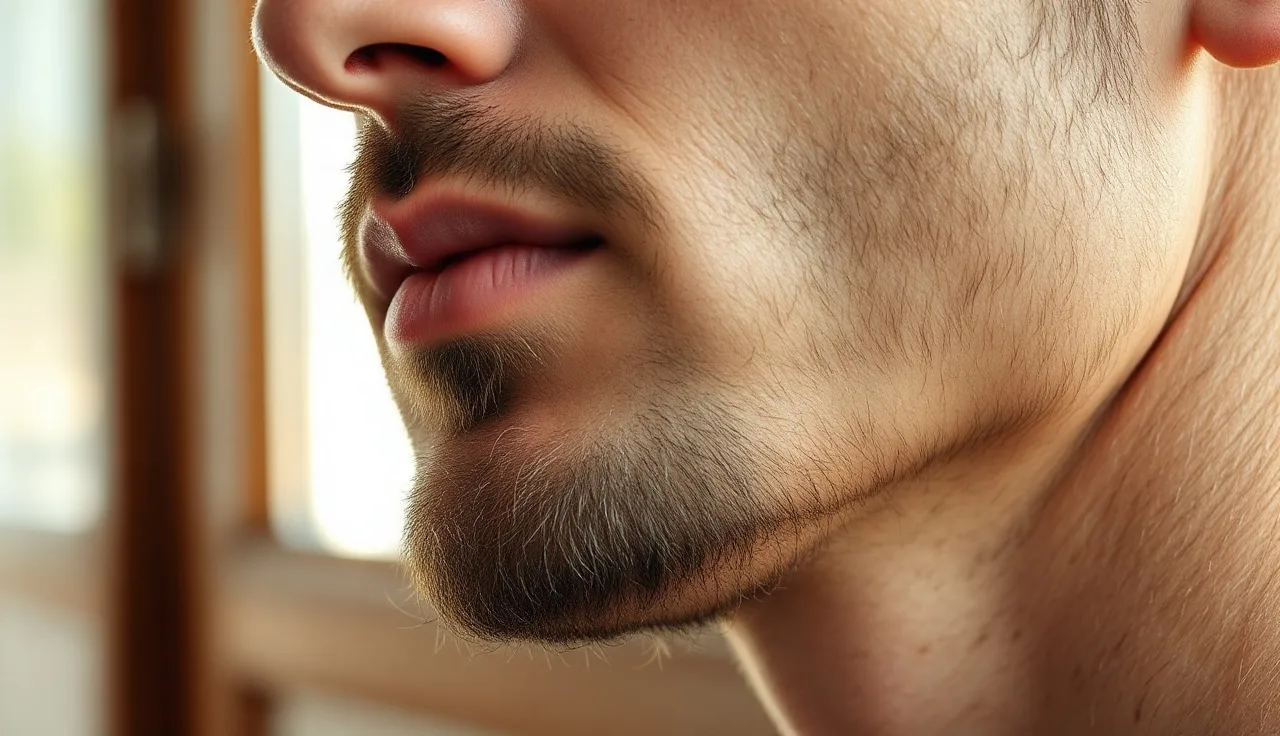
You'll usually see one or more oval or round bald patches in the beard, sometimes with short broken hairs at the edge called "exclamation-mark hairs." The skin underneath looks normal. No scarring, no scaling, no permanent follicle loss by default. That's what separates alopecia barbae from conditions like lichen planopilaris, which scar and destroy follicles for good.
Some men get scalp patches at the same time. If you want the broader what causes hair loss picture beyond autoimmunity, that article covers the full differential.
How is alopecia barbae diagnosed?
Diagnosis is mostly clinical. A dermatologist looks at the pattern of patches, checks for exclamation-mark hairs under a dermatoscope, and asks about personal and family history of autoimmune disease. No blood test confirms alopecia areata. A dermatologist may still order thyroid function tests (TSH, free T4) and a CBC to rule out common coexisting conditions.
A beard or scalp biopsy happens only when the diagnosis is uncertain, usually to separate non-scarring alopecia from a scarring variant. Under the microscope, alopecia areata shows a dense ring of lymphocytes around the hair bulb, the so-called "swarm of bees" pattern.
If you're unsure whether you're looking at alopecia barbae or something else, a free AI scan at MyHairline gives you a fast visual read before your appointment. It doesn't replace a dermatologist's exam, and beard-area findings in particular need a real eye on them.
What are the main treatments for alopecia barbae?
No drug is FDA-approved specifically for alopecia barbae. The treatments used are either approved for alopecia areata broadly, approved for something else and used off-label, or backed by dermatology society guidance [2]. That distinction changes what you try and what you pay for.
Here's how the main options compare:
| Treatment | Evidence level | Typical response rate | How it's given |
|---|---|---|---|
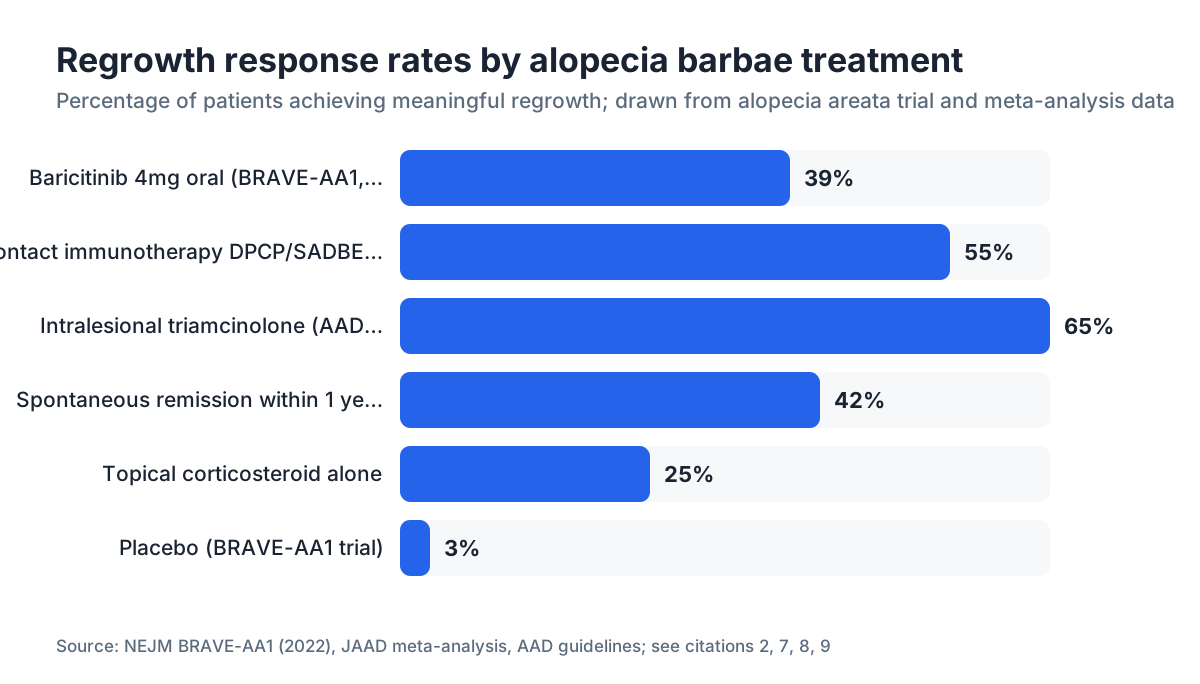
| Intralesional triamcinolone | Strong (first-line) | ~60-70% regrowth | Injection into patch every 4-6 weeks |
| Topical corticosteroid | Moderate | Lower than injections | Cream/ointment daily |
| Topical minoxidil | Moderate (off-label) | Variable | 5% foam or solution daily |
| Contact immunotherapy (DPCP/SADBE) | Moderate | ~40-60% in severe AA | Applied in clinic weekly |
| Oral/topical JAK inhibitors | Strong for severe AA | ~30-50% complete response | Oral daily or topical |
| Systemic corticosteroids | Weak (short-term only) | Short-term benefit, high relapse | Oral taper |
Those response rates come from alopecia areata trials broadly. Very few trials look at beard-only disease, so the numbers carry real uncertainty when you apply them to the beard.
For most men with a few small patches, intralesional corticosteroid injections are the right first move. They work locally, cause little systemic trouble at beard-area doses, and repeat every four to six weeks. Topical minoxidil is a useful add-on because it stimulates follicle activity no matter what the immune system is doing. For dosing and application specifics, the minoxidil for men article covers it in detail.
Do corticosteroid injections work for beard alopecia?
Yes. Intralesional corticosteroid injections are the standard first-line treatment for localized alopecia areata, beard included, per American Academy of Dermatology (AAD) guidance [2]. The usual agent is triamcinolone acetonide, injected at 5-10 mg/mL directly into or just below the bald patch.
Regrowth usually starts within four to eight weeks of the first injection. Most dermatologists repeat every four to six weeks for two to three sessions before judging whether it's working. The AAD notes that intralesional corticosteroids "are the preferred treatment for patients with patchy alopecia areata involving less than 50% of the scalp," and the same logic carries over to beard patches [2].
Side effects at beard doses stay minor: temporary skin thinning (atrophy) and small dents at injection sites, both of which usually fill back in over a few months. Systemic absorption is low when the total dose per session stays under 20 mg. The pain is real. The needle goes into beard skin several times per session, which most patients call uncomfortable but manageable.
One thing to know. Injections treat the patch in front of you but don't reset your immune system. The same spot can go bald again, and new patches can turn up elsewhere. That happens more often in men with a longer alopecia areata history or coexisting thyroid disease.
Is there an alopecia barbae treatment cream that works?
A few topicals exist, but none replaces injections for an established patch.
Topical corticosteroids (betamethasone valerate, clobetasol propionate) get prescribed as add-ons between injection sessions or for men who won't do needles. They're cheap and painless. The catch is penetration. Beard follicles sit deep, and topical steroids reach them less reliably than a needle does, so response rates run lower.
Topical minoxidil 5% solution or foam gets used off-label on the beard. It doesn't quiet the autoimmune attack, but it can push follicles back into cycling, and case series show visible regrowth in some patients. Apply once or twice a day to the patch. Foam tends to sit on beard skin more comfortably than the liquid. Check minoxidil side effects before you start, especially if you're applying near the mouth or have heart concerns.
Topical JAK inhibitors are the newer entry. Ruxolitinib 1.5% cream (brand name Opzelura) got FDA approval in September 2022 for non-scarring alopecia areata in patients 12 and older [3]. That matters because it's one of the first topicals aimed at the actual autoimmune process rather than just stimulating growth. A phase 3 trial published in the New England Journal of Medicine found ruxolitinib cream produced significantly more scalp hair regrowth than vehicle at 24 weeks [4]. Beard-specific data are thin, but the same mechanism applies to beard follicles.
The practical starting point for most men is intralesional injections plus topical minoxidil. Ruxolitinib cream comes into the conversation if that stalls or if injections aren't tolerable.
What about oral JAK inhibitors for alopecia barbae?
Oral JAK inhibitors are the strongest systemic option for alopecia areata right now, and they matter for beard disease when patches are widespread or won't budge with local treatment.
Baricitinib (Olumiant) got FDA approval in June 2022 for severe alopecia areata in adults, defined as 50% or more of the scalp affected [5]. Ritlecitinib (Litfulo) followed in June 2023 for adults and adolescents 12 and older [6]. Both are once-daily pills. Neither is labeled for alopecia barbae specifically, but dermatologists use them for extensive beard involvement.
The baricitinib data are worth quoting: in the BRAVE-AA1 trial published in the New England Journal of Medicine, 38.8% of patients on 4 mg daily reached a SALT score of 20 or less (80% or more scalp coverage) at 36 weeks, versus 3% on placebo [7]. Ritlecitinib showed results pointing the same direction in its phase 3 program.
The catch is safety. JAK inhibitors carry FDA boxed warnings for serious infections, malignancy, major cardiovascular events, thrombosis, and death, drawn from rheumatoid arthritis studies [5]. Most dermatologists reserve oral JAK inhibitors for severe or stubborn cases, not a few beard patches. These aren't drugs to start without a dermatologist and baseline labs.
Cost is a wall too. Baricitinib and ritlecitinib list well above $20,000 a year without insurance. Coverage swings hard by plan.
What is contact immunotherapy and how is it used for beard alopecia?
Contact immunotherapy uses a chemical sensitizer to trigger a controlled allergic reaction on the treated skin, which seems to pull the misfiring immune attack away from the follicle. The two agents used clinically are diphenylcyclopropenone (DPCP) and squaric acid dibutyl ester (SADBE). Neither is FDA-approved for anything. Both are used entirely off-label at academic dermatology centers.
The process starts with sensitization, then repeated weekly or biweekly applications at rising concentrations until a mild, controlled reaction shows up. It has to be done in a clinic that knows the technique. You can't do it at home.
Meta-analyses of contact immunotherapy for alopecia areata report pooled response rates around 50-60% for extensive disease, though those numbers come from studies with different designs and different definitions of success [8]. For localized beard disease, most dermatologists try injections and minoxidil first and hold contact immunotherapy for cases that don't respond.
Side effects include stubborn dermatitis, swollen regional lymph nodes, and, rarely, vitiligo-like pigment loss at treated sites.
Does alopecia barbae go away on its own?
Sometimes it does. Spontaneous remission happens most in men with a first episode, small patches, and no family history of extensive disease. The odds drop with each relapse, larger patches, and longer duration. A systematic review estimated that roughly 34-50% of patients with limited alopecia areata see full spontaneous regrowth within a year, but recurrence rates are high across the board [9].
The beard may recover on its own somewhat more readily than the scalp, though that read comes from clinical experience rather than beard-specific trials.
If you're watching and waiting, watch for expansion. One small patch holding steady for a few months is a different situation from a patch that doubles every few weeks. Rapid growth, patches merging, or new patches showing up are all signals to start treatment instead of waiting longer.
Are there differences in treatment depending on severity?
Severity drives the whole treatment ladder. Dermatologists sort beard alopecia into tiers based on how much of the beard is gone and how long it's been that way.
For limited patches (under 25-30% of the beard), intralesional corticosteroid injections every four to six weeks, with or without topical minoxidil, is the usual start. Many of these clear in two to four rounds.
For moderate involvement (25-75% of the beard lost) or cases that fail first-line injections, contact immunotherapy or topical ruxolitinib cream become reasonable to discuss. Topical steroids under occlusion can bridge the gap between injection sessions.
For extensive loss, or when beard loss rides alongside significant scalp alopecia areata, systemic therapy with oral JAK inhibitors or a short course of systemic steroids may be on the table. Systemic steroids act fast but relapse hard after the taper and carry real risks with repeated courses: weight gain, blood sugar spikes, bone density loss, adrenal suppression.
Whatever the severity, get a full skin and lab workup at the first visit. Thyroid disease, vitiligo, and other autoimmune conditions co-occur with alopecia areata at rates well above the general population. Fixing a thyroid disorder won't necessarily regrow the beard, but leaving it untreated helps nobody.
What should I expect from alopecia barbae treatment in Nashville or any other city?
Beard alopecia is treated by dermatologists. Not primary care, not barbers. Access to the newer stuff, like contact immunotherapy or JAK inhibitor trials, tends to cluster at academic medical centers.
In a city like Nashville, Vanderbilt University Medical Center has a dermatology department that manages alopecia areata, and several private practices offer intralesional injections. First-line care (injections, topical minoxidil) is available at any board-certified dermatologist's office.
If you specifically want contact immunotherapy or a spot in a JAK inhibitor trial, you may need a referral to an academic center no matter where you live. The National Alopecia Areata Foundation keeps a physician directory that helps locate dermatologists with alopecia expertise [10].
Sort out insurance before your first visit. Intralesional injections for alopecia areata are generally covered as a recognized treatment. Topical minoxidil is cheap over the counter. Ruxolitinib cream and oral JAK inhibitors need prior authorization and often step-therapy paperwork, meaning you usually have to show that older treatments failed first.
One more thing. The MyHairline AI scan can help you document patch progression over time, which is genuinely useful for building a prior authorization case or tracking your response between derm visits.
What treatments are a waste of time and money?
The hair loss supplement market is huge and mostly useless for autoimmune beard loss. Biotin, collagen powders, saw palmetto, and DHT blockers all aim at androgenetic alopecia, the DHT-driven pattern baldness on the scalp. Alopecia barbae runs on a different mechanism entirely. Blocking DHT does nothing to stop the T-cell attack on your follicles. Our dht blocker article explains what DHT blockers actually do and who they help.
Same story for finasteride and minoxidil for men as a pair. That combination is well established for scalp pattern baldness, but finasteride has no established role in alopecia areata or alopecia barbae.
Platelet-rich plasma (PRP) injections come up a lot. The evidence for PRP in alopecia areata is weak and conflicting. A few small trials show a benefit, others show nothing. It runs $500-$1,500 per session out of pocket and shouldn't replace treatments that actually work.
Onion juice, garlic, essential oils, and various topical concoctions fill patient forums. A 2014 randomized trial tested crude onion juice against tap water in alopecia areata and found a statistically significant benefit, but the study was small, unblinded, and followed patients only briefly [11]. I wouldn't call it a treatment. I also wouldn't call it dangerous. The danger is using it instead of something with real evidence.
Can alopecia barbae come back after successful treatment?
Yes, and often. Alopecia areata is a chronic autoimmune condition, not a one-off. Regrowth from injections or anything else doesn't mean your immune system won't fire again. Relapse rates in the literature run from 30% to over 80%, depending on the population, the definition of relapse, and how long patients were followed [9].
Higher relapse risk goes with longer disease duration before first treatment, a family history of alopecia areata, coexisting atopic dermatitis or thyroid disease, and a history of prior relapses. Men with a single isolated patch and no family history do better over the long run.
Once you've regrown a patch, some dermatologists keep patients on topical minoxidil to try to stretch out the remission, though the evidence for that in alopecia barbae is case-series level, not trial-level. Others continue lower-frequency injections (every two to three months) as maintenance. That's practice-based, not guideline-mandated.
If you're tracking whether patches are returning, comparing photos taken in consistent lighting over time works surprisingly well. It's the same approach clinical trials use to measure outcomes.
Sources
- National Institute of Arthritis and Musculoskeletal and Skin Diseases (NIAMS) - Alopecia Areata
- American Academy of Dermatology - Alopecia Areata: Diagnosis and Treatment
- U.S. Food and Drug Administration - FDA drug news and events (ruxolitinib cream, Opzelura approval)
- New England Journal of Medicine - King et al., Ruxolitinib Cream for Alopecia Areata (2023)
- U.S. Food and Drug Administration - FDA drug news and events (baricitinib, Olumiant approval)
- U.S. Food and Drug Administration - FDA drug news and events (ritlecitinib, Litfulo approval)
- New England Journal of Medicine - King et al., BRAVE-AA1 trial, Baricitinib for Alopecia Areata (2022)
- Journal of the American Academy of Dermatology - meta-analysis of contact immunotherapy for alopecia areata
- Journal of the American Academy of Dermatology - Mirzoyev et al., Lifetime incidence risk of alopecia areata (2014)
- National Alopecia Areata Foundation - Physician Directory
- Journal of Dermatology - Sharquie & Al-Obaidi, Onion juice (Allium cepa L.) in the treatment of alopecia areata (2002)
- ClinicalTrials.gov - Alopecia Areata Treatment Studies Registry