

TL;DR: ARTAS is a robotic system that automates the follicle-extraction step of FUE hair transplant surgery. It costs roughly $7,000 to $20,000 depending on graft count and clinic. Studies show graft transection rates around 5 to 8%, comparable to skilled manual FUE. It is FDA-cleared for harvesting hair follicles in men with black or brown straight hair.
What is the ARTAS robotic hair transplant system?
ARTAS is a physician-assisted robotic system made by Restoration Robotics (now owned by Venus Concept) that automates the punch-extraction phase of follicular unit extraction, or FUE. A camera and algorithm identify individual follicular units in the donor zone, and a robotic arm delivers two concentric punches to score and extract each graft. The surgeon sets parameters and monitors the procedure. The robot does the mechanical harvesting work.
The system was FDA-cleared in 2011 for harvesting hair follicles in men with dark, straight hair. That clearance language is worth reading closely: it says "harvesting," not "transplanting." The placement of grafts into recipient sites is still done by hand, either by the surgeon or a trained technician. ARTAS automates one step in a multi-step procedure.
Before you commit to any specific technique, read our primer on how hair transplant surgery works and what separates FUE from strip surgery. Understanding the whole procedure helps you ask sharper questions at a consultation.
The ARTAS iX is the current generation. It added an assisted site-making feature and an imaging algorithm called the ARTAS Hair Studio that lets patients preview a projected hairline digitally before surgery.
How does the ARTAS procedure work step by step?
The morning of surgery, the donor area (usually the back and sides of the scalp) is shaved to about 1 mm. You lie face-down in a chair that keeps your head stable. A tension array, essentially a frame with a small skin-contact interface, is placed against the donor scalp to hold the skin taut and let the camera track follicle angles.
The robot maps the field. Its vision system identifies individual follicular units and calculates the angle, depth, and spacing needed for each punch. It skips follicles that sit too close together so it doesn't strip the donor zone.
Extraction follows. A 0.9 mm or 1.0 mm punch scores around the follicle, a second punch dissects deeper, and the graft is loosened. A technician or the surgeon removes it with forceps and places it in a holding solution.
This extraction phase is the only part ARTAS automates. After that, the surgeon makes small incisions in the recipient (balding) area, either manually or using the ARTAS site-making feature, and technicians place each graft by hand. Placement technique and angle matter enormously for natural-looking results, and that part has not changed.
A session typically runs four to eight hours depending on graft count. Most patients have local anesthesia throughout. You go home the same day. Crusting clears in about ten days, transplanted hairs shed at three to six weeks (this is normal and expected), and visible regrowth starts around four to six months. Full results take twelve to eighteen months [1].
How much does ARTAS hair transplant cost?
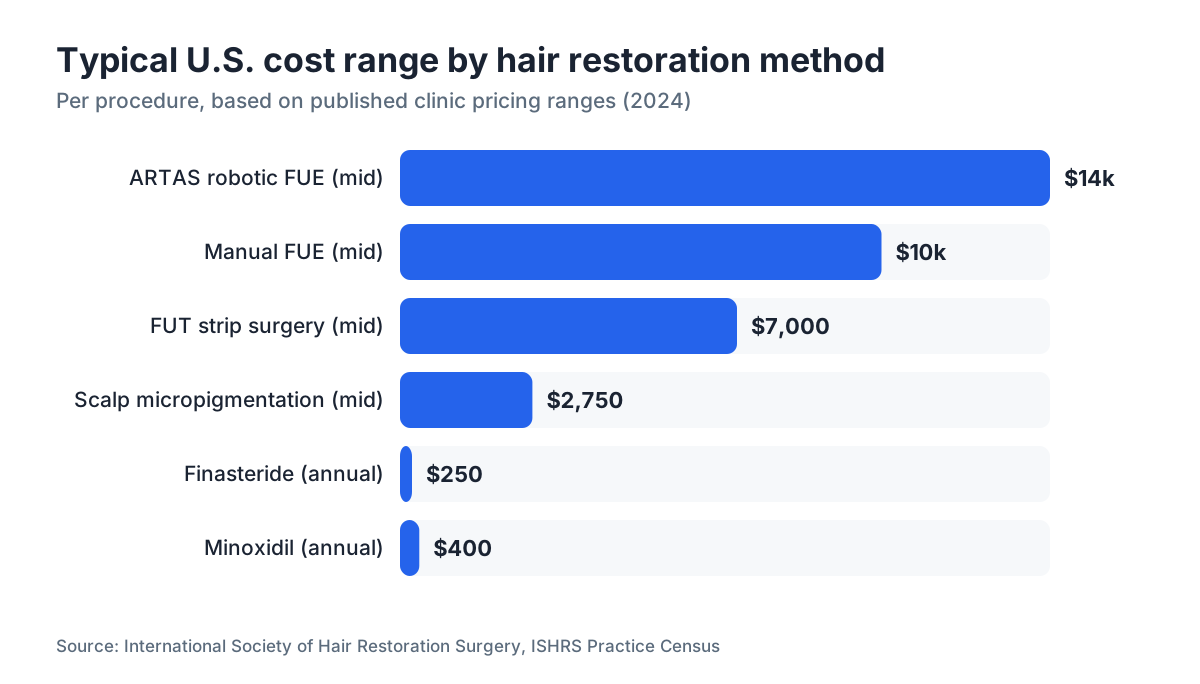
Expect to pay between $7,000 and $20,000 for an ARTAS procedure in the United States. The range is wide because pricing depends almost entirely on how many grafts you need, and graft counts vary from roughly 1,000 for an early hairline case to 3,000 or more for significant crown and frontal loss.
Clinic pricing splits into two camps. Some charge per graft, typically $5 to $10 per graft for ARTAS, which puts a 2,000-graft session at $10,000 to $20,000. Others charge a flat session fee. The flat-fee model can be a better deal if your graft count is high, but it can also hide what you're actually getting.
ARTAS is almost always priced 10 to 30% higher than manual FUE at the same clinic, because the clinic pays a licensing and maintenance fee to run the system. That premium doesn't translate into better outcomes for every patient, which is worth chewing on before you sign.
Hair transplants are cosmetic. Health insurance does not cover them. Financing is widely available, but interest adds meaningfully to total cost over a multi-year plan.
Cost comparison across common hair restoration options:
| Procedure | Typical U.S. Cost Range | Graft Placement Method |
|---|---|---|
| ARTAS robotic FUE | $7,000 to $20,000 | Manual |
| Manual FUE | $5,000 to $15,000 | Manual |
| FUT (strip) | $4,000 to $10,000 | Manual |
| Scalp micropigmentation | $1,500 to $4,000 | N/A |
| Minoxidil (annual) | $200 to $600 | N/A |
| Finasteride (annual) | $100 to $400 | N/A |
What does the research say about ARTAS graft quality and success rates?
The most useful metric for comparing hair transplant methods is transection rate, the percentage of follicles damaged or severed during extraction. A transected graft usually won't grow.
A 2014 study published in Dermatologic Surgery reported transection rates of around 7.9% for robotic FUE versus 9.8% for manual FUE punch extraction in the same patient comparison, though the difference was not statistically significant across all conditions [2]. Other published comparisons put ARTAS transection rates anywhere from roughly 5% to 12% depending on operator experience and hair characteristics, which overlaps heavily with the range for skilled manual FUE surgeons.
Here's what that means in practice. An experienced manual FUE surgeon likely produces outcomes indistinguishable from ARTAS. The robot's consistency advantage matters most when the surgeon or technician doing manual extraction is less experienced. It doesn't make an average surgeon great. It may reduce variability.
Graft survival after placement, the rate at which transplanted follicles actually produce hair, is harder to isolate in published data because it hangs on so many post-extraction variables: holding solution, time out of body, placement depth, recipient site angle. Most studies report survival rates of 85 to 95% for properly handled FUE grafts regardless of extraction method [3].
One honest caveat: the published literature on ARTAS is thin, and several studies were industry-funded. Nobody has run a large, independent, randomized controlled trial comparing ARTAS to experienced manual FUE surgeons with long-term follow-up. The closest data we have suggests parity, not superiority.
Who is a good candidate for ARTAS, and who isn't?
The FDA clearance specifies dark, straight hair. That matters. The ARTAS vision algorithm was trained and validated on hair with high contrast against the scalp. Men with lighter hair (blonde, gray, white) or with curly or wavy hair get meaningfully lower algorithm accuracy, which raises transection risk and can mean the system won't complete the procedure efficiently.
Beyond hair type, good candidates share a stable donor zone with enough density. The system needs adequate spacing between follicles to identify and skip grafts correctly. Patients with diffuse thinning throughout the donor area, rather than concentrated loss on top, may not have a usable donor zone regardless of extraction method.
Candidacy for any hair transplant also depends on realistic expectations. A transplant moves hair from where you have it to where you don't. It doesn't create new hair. If your loss is still progressing, grafts placed today may look good in two years and sit surrounded by new bald skin in five, unless you're also managing the underlying cause.
That's why most experienced surgeons want you to stabilize loss with medical therapy before or alongside surgery. Finasteride is the most studied oral option for male pattern hair loss, and understanding how it works and who it fits is relevant to any transplant conversation. Using finasteride and minoxidil together is the approach most specialists recommend for men trying to hold onto existing hair while transplanted grafts grow in.
Women are generally not ARTAS candidates under the current clearance, which is limited to men. Some women with female pattern hair loss may be candidates for manual FUE, but that needs a separate evaluation.
Patients with certain scalp conditions, active infections, a history of keloid scarring, or clotting disorders may not be surgical candidates at all, no matter which technique is used.
ARTAS vs. manual FUE: what's actually different?
Marketing for ARTAS clinics leans on precision, consistency, and comfort. The honest version has more texture.
Precision. For patients with dark straight hair, ARTAS does deliver consistent punch angles, and the algorithm adjusts in real time to follicle angle variation. A skilled manual FUE surgeon with good technique does this too, just with trained hands instead of a robotic arm.
Consistency. This is probably where ARTAS holds a real, if modest, edge. It doesn't get tired at hour six of an extraction session. Human fatigue is a genuine factor in long manual FUE sessions. If you need 2,500 or more grafts, a robotic system may hold extraction quality better toward the end than a worn-out technician.
Comfort. The robotic arm applies suction-based tension to the scalp, which some patients dislike and others find easier to sit through than the pressure of manual extraction. It varies.
Speed. ARTAS extracts grafts more slowly than an experienced manual surgeon. A highly skilled manual FUE surgeon may pull 800 to 1,000 grafts per hour. ARTAS typically runs 300 to 500 grafts per hour, which makes large sessions very long days [6].
Scarring. Both ARTAS and manual FUE leave small circular scars in the donor zone. At short hair lengths they're essentially invisible. Neither leaves the linear scar you get with FUT strip surgery.
The surgeon still matters enormously. Recipient site design, hairline planning, and graft placement are all done by humans. Picking a clinic because it owns a robot, rather than because the surgeon has strong credentials and a large portfolio of healed results, is a mistake.
ARTAS vs. FUT (strip surgery): which produces better results?
FUT and ARTAS suit different situations. They aren't always competing.
FUT removes a strip of scalp from the donor area, dissects it under microscopes into individual grafts, and sutures the wound closed. It leaves a linear scar but lets surgeons harvest very large graft counts (sometimes 4,000 or more) in a single session [10]. It's faster and often significantly cheaper.
ARTAS leaves no linear scar, which matters if you want to wear your hair very short. But ARTAS has practical graft-count limits per session, often capped around 1,500 to 2,500 grafts by extraction speed, so severely bald patients may need two sessions.
For patients with extensive loss (Norwood 5, 6, or 7 on the receding hairline scale), FUT may produce more coverage in fewer sessions at lower total cost. For patients with early-to-moderate loss who want to keep hair short, ARTAS or manual FUE has a clear lifestyle advantage.
Some surgeons combine methods: FUT first to maximize donor yield, then manual or robotic FUE in a later session to harvest remaining grafts from areas the strip left untouched. It isn't common, but it's an option for patients who need maximum density over a large area.
What are the risks and side effects of ARTAS surgery?
ARTAS shares most risks with any FUE procedure. Knowing them going in is basic due diligence.
Temporary effects are nearly universal. Swelling, redness, and tenderness in both donor and recipient areas last one to two weeks. Shock loss, where existing non-transplanted hairs shed temporarily due to surgical trauma, hits some patients and can be alarming. It's usually reversible, with hairs returning over two to four months [4].
Graft failure happens. Some percentage of transplanted follicles simply won't produce hair, even with good technique. Industry figures generally quote 5 to 15% failure across methods, but this is hard to verify independently because definitions vary.
Donor zone depletion is a real long-term risk with FUE specifically. Because individual grafts are spread across the donor area, overharvesting can leave the donor zone thin or patchy. A reputable surgeon plans graft counts to stay well below the donor zone's density threshold.
Infection is rare but possible. Prophylactic antibiotics are standard. Numbness in the donor zone can linger for weeks to months before nerve endings regenerate.
Here's the robotic-specific risk worth knowing: algorithm errors. The system can misidentify follicle angles or punch too deep, transecting grafts. That's why the surgeon monitors in real time and should step in when the system drifts. Asking a prospective surgeon how they handle real-time system errors is a fair question.
Serious complications like significant scarring, permanent donor damage, or poor growth track more closely with inexperienced operators or bad patient selection than with the robotic versus manual choice itself.
What should you ask before booking an ARTAS consultation?
The consultation is where you evaluate the clinic more than the technology. A few questions that actually matter:
How many ARTAS cases has the surgeon personally overseen? Volume matters. Ask to see a large portfolio of before-and-after photos at twelve months or more post-surgery, not three-month progress shots.
What is the surgeon's ARTAS transection rate? Some clinics track and share it. If they can't give you a number, ask why.
Who designs the hairline and recipient sites? Ask whether the surgeon does this or delegates it. Hairline design has a bigger effect on how natural you look than the extraction method.
What is your hair type, and are you a good candidate for ARTAS specifically? If you have lighter or curlier hair, a clinic pushing ARTAS on you anyway deserves skepticism.
What's the plan if your hair loss continues? Surgery doesn't stop the underlying condition. Ask whether they recommend medical therapy alongside or after surgery, and what the follow-up protocol looks like.
Who actually performs the graft placement? In many clinics, technicians place grafts, not the surgeon. That's common and not necessarily bad, but you should know who's doing what.
If you want a preliminary sense of where your hair loss stands before a paid consultation, the free AI hair analysis at MyHairline can give you a baseline read on your pattern and severity to bring into the conversation.
What should you expect during ARTAS recovery?
Days one through three are the most uncomfortable. The scalp is tender. Sleeping elevated (two to three pillows) reduces swelling. Most surgeons prescribe a short course of pain medication, an anti-inflammatory, and an antibiotic. Some add a short prednisone taper to cut swelling.
Days four through ten involve crusting at recipient sites. You'll wash your hair gently with a diluted baby shampoo protocol the clinic provides. Picking at crusts risks dislodging grafts. Leaving them alone is the main job during this stretch. Most patients return to sedentary desk work within three to five days. Exercise and heavy sweating should wait two to three weeks.
Weeks three through eight bring the shed. The transplanted hairs fall out. This is telogen effluvium triggered by the trauma of surgery, and it is normal, but it's psychologically hard. Understanding telogen effluvium before surgery sets the right expectation: the follicle is still there, just resting before it grows a new hair shaft.
Months four through twelve are when results develop. Most patients see meaningful density at six months. The final result isn't assessable until twelve to eighteen months post-surgery, which is why early follow-up photos don't tell you much.
Sun protection of the scalp matters during the first year. UV exposure to healing skin can affect pigmentation of scars and recipient sites. A hat is simple and effective.
Does ARTAS work for women?
The FDA clearance for ARTAS is for men only. The algorithm and clinical validation behind it were built on male-pattern hair loss, where donors on the sides and back are typically stable.
Women with hair loss have a different pattern in most cases. Female pattern hair loss often involves diffuse thinning across the entire scalp including the donor zone, meaning there may be no reliable zone to harvest from [9]. Women are generally not good FUE candidates for this reason, robotic or otherwise.
Some women with specific loss patterns (for example, traction alopecia from tight hairstyles, or localized scarring alopecia with a clear stable donor zone) are candidates for manual FUE. Whether ARTAS would be used off-label depends on the individual surgeon's judgment and the patient's hair characteristics.
For women researching hair loss causes and treatment options more broadly, understanding what causes hair loss in the first place is a useful starting point before evaluating surgical options.
Can ARTAS transplanted hair fall out again?
Transplanted hair resists DHT because it comes from the donor zone on the back and sides of the scalp. Those follicles carry a genetic program that makes them largely immune to the miniaturization process that drives male pattern baldness. That property travels with the follicle. It's the basis for why hair transplants are considered permanent [8].
But "resistant" is not "immune." Some transplanted hairs can still miniaturize over decades, especially in patients with aggressive loss patterns. More to the point, the non-transplanted hairs around the grafts can keep falling out if the underlying condition isn't managed.
That's why medical therapy matters after surgery. A DHT blocker like finasteride is typically recommended to protect existing hairs [11]. Minoxidil for men can support graft survival and density. Without them, you may watch new bald patches open up around otherwise successful transplants.
The transplant is one tool. It doesn't touch the biology driving ongoing hair loss, and no reputable surgeon should tell you otherwise.
Is ARTAS worth the cost compared to alternatives?
This is the real question, and the honest answer depends on what you're comparing it to.
Against a skilled manual FUE surgeon with a strong portfolio, ARTAS at a premium price is hard to justify on outcomes alone. The published evidence doesn't show ARTAS producing meaningfully better growth or lower transection rates than experienced hands. You're paying for consistency insurance and marketing.
Against a less experienced clinic or surgeon doing manual FUE, ARTAS may genuinely cut procedural error. The robotic consistency advantage is most real when the alternative is an inexperienced operator.
Against doing nothing, a successful transplant is permanent and, unlike medication, needs no ongoing compliance. Medical therapy with finasteride and minoxidil costs far less, but it demands daily commitment indefinitely and doesn't restore hair that's already gone.
The most common regret among hair transplant patients isn't "I chose the wrong extraction method." It's "I had surgery before my hair loss was stable," or "I chose a surgeon on price rather than results," or "I didn't understand how many sessions I'd need."
If you're seriously weighing surgery, the surgeon's skill and the clinic's patient selection process matter far more than whether the extraction step is done by a robot or by experienced hands. MyHairline's free AI hair scan can help you map your current loss pattern and think through timing before you book a consultation.
For context on the medical alternatives worth considering before or alongside surgery, the data on finasteride and minoxidil together is stronger than most people realize.
Sources
- American Academy of Dermatology, Hair loss: Diagnosis and treatment
- International Society of Hair Restoration Surgery, ISHRS Practice Census
- U.S. National Library of Medicine, MedlinePlus, Hair transplant
- National Library of Medicine, PubMed (Harris JA, Robotic-Assisted Follicular Unit Extraction, Facial Plastic Surgery Clinics 2013)
- Journal of Cosmetic Dermatology (Cervantes J et al., Platelet-rich plasma for androgenetic alopecia review, 2019)
- U.S. National Library of Medicine, MedlinePlus, Hair transplant
- American Academy of Dermatology, Hair loss in women
- International Society of Hair Restoration Surgery, hair restoration surgery patient resources
- U.S. Food and Drug Administration, Drugs (Propecia/finasteride prescribing information)