

TL;DR: A bad hair transplant means unnatural hairlines, visible scarring, pluggy grafts, thin density, or grafts that never grew. Hair restoration societies estimate 10 to 15% of patients are unhappy with their results. Most bad outcomes trace back to surgeon inexperience, the wrong technique, or a rushed consultation. Many can be partly or fully corrected with revision surgery, camouflage, or medical treatment.
What makes a hair transplant go wrong?
A hair transplant fails one of two ways: the grafts die, or the grafts live but look terrible. Both happen more than the industry admits.
Graft survival is the foundation. Healthy grafts have to be harvested cleanly, kept cool and moist, and implanted fast. The International Society of Hair Restoration Surgery (ISHRS) says survival should top 90% in experienced hands, but poorly run clinics routinely land at 60 to 70% [1]. Every dead graft is a permanent loss of donor hair you could have used later.
Then there's the artistry problem. Even if every graft survives, an unnatural hairline, grafts pointing the wrong way, or plugs packed too close produce a result that looks worse than doing nothing. This is what most patients mean when they say they got a bad hair transplant.
The two root causes rarely change: a surgeon who hasn't designed enough hairlines, and a clinic that chases speed and volume over outcomes. Some of the ugliest results come from so-called "hair mills" in countries with light regulatory oversight, processing dozens of patients a day with technician-led teams who do most of the graft work without a qualified surgeon in the room [1].
Hair loss progression is the third cause, and the one patients ignore most. A man who gets a transplant at Norwood Stage 3 but drifts to Stage 6 ends up with islands of transplanted hair marooned by bald scalp. That looks just as bad as a poorly designed procedure. It's why medical management with finasteride or minoxidil for men belongs in any surgical plan from day one.
What are the signs of a bad hair transplant?
Some problems show up in weeks. Others take a full year. Here's what to look for and when.
Pluggy or doll-hair appearance. This is the classic bad-transplant look everyone pictures. It happens when grafts hold too many hairs (the old punch-graft technique of the 1970s and 90s), or when modern follicular unit grafts sit too far apart. A proper FUT or FUE transplant uses individual follicular units of 1 to 4 hairs, placed at a density that copies natural hair groupings [2]. Pluggy grafts stick out, literally and figuratively.
An unnatural or ruler-straight hairline. Real hairlines are irregular, slightly jagged at the edge, with single-hair micro-grafts along the front. A hairline that looks drawn on with a straightedge, or one that starts too low on the forehead, gives away poor planning.
Visible scarring. FUT (strip) procedures leave a linear scar at the back of the scalp. A skilled surgeon keeps it thin enough to hide under moderate-length hair. A thick, wide, or raised FUT scar points to sloppy suturing. FUE procedures leave small circular punch marks; done badly, they merge into white pockmarks or "moth-eaten" patches across the donor area [3].
Shock loss that doesn't recover. After any transplant, native hairs near the recipient zone can shed for a while, a process called telogen effluvium. It normally clears within 3 to 6 months. If it doesn't, or if donor-area hairs shed and never return, the procedure caused permanent damage.
Patchy or thin results. Some patchiness at 6 months is normal because grafts grow in waves. By 12 months, the full result should be visible. Patchy areas still there after 12 months usually mean graft failure, not slow growth.
Wrong direction or angle. Scalp hair grows at specific angles and follows specific swirl patterns. Grafts stabbed in perpendicular to the scalp, or against the natural whorl, produce hair that lies wrong no matter how you style it.
How common are bad hair transplant outcomes?
Good data is hard to get because the industry has no mandatory outcome reporting. The ISHRS 2022 Practice Census estimated roughly 703,000 hair restoration procedures worldwide in 2021, up 28% from 2016 [1]. Patient dissatisfaction rates in published studies run from about 5% to 15%, depending on how you define dissatisfaction and who's counting [4].
Where the surgery happens matters a lot for quality. Turkey, Thailand, and some Eastern European clinics pull in large volumes of medical tourists partly because prices sit 60 to 80% below the US or UK. Cheap doesn't automatically mean bad, but the ISHRS has singled out "hair mills" in these markets as a safety concern, warning that technician-led procedures without a board-eligible surgeon supervising are becoming more common [1].
In the US, hair transplantation counts as a surgical procedure, but there's no federal certification specific to hair restoration. Any licensed physician can legally perform it. The American Board of Hair Restoration Surgery (ABHRS) offers voluntary board certification, and the ISHRS offers fellowship membership as a quality signal, but neither is required by law [5].
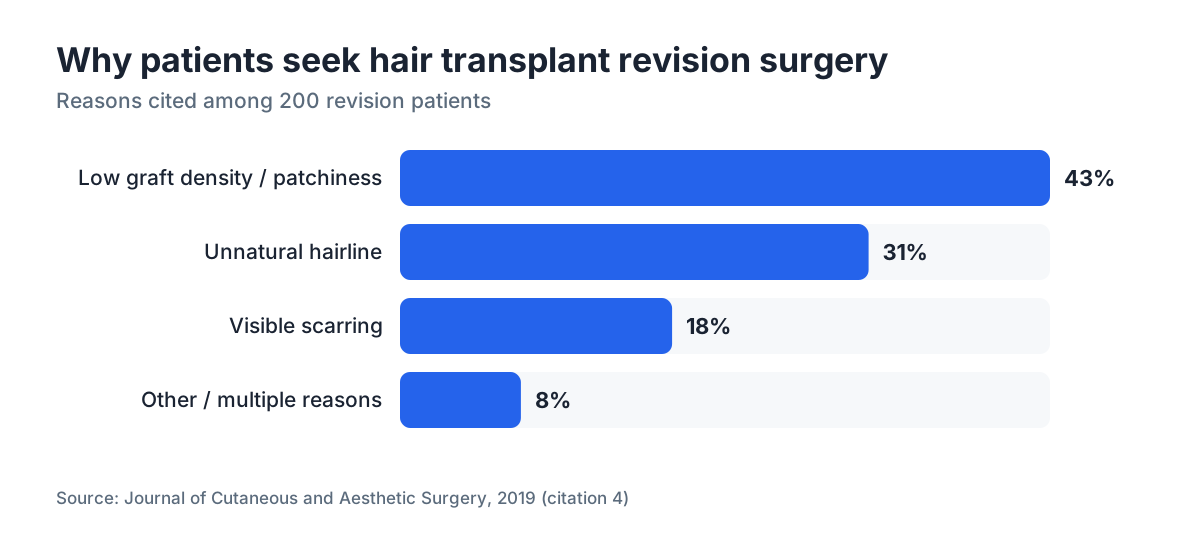
The clearest numbers we have come from revision data. A 2019 study in the Journal of Cutaneous and Aesthetic Surgery looked at 200 patients showing up for revision and found the top reasons were low graft density (43%), unnatural hairline (31%), and visible scarring (18%) [4]. That's a self-selected group seeking correction, so the true failure rate is probably lower, but the pattern of what goes wrong is likely representative.
What are the most common bad hair transplant results by technique?
FUT (Follicular Unit Transplantation) and FUE (Follicular Unit Extraction) each fail in their own way.
| Problem | More common with | Why |
|---|---|---|
| Wide linear donor scar | FUT | Poor suturing, too much tension, or a too-wide strip |
| Pockmarked donor area | FUE | Overharvesting, punches too large, poor angle |
| Low graft survival | FUE (in unskilled hands) | FUE grafts are more fragile and transection risk is higher |
| Pluggy appearance | Both (older tech or poor design) | Too many hairs per graft, wrong spacing |
| Unnatural hairline | Both | Poor design by the surgeon, not technique-specific |
| Shock loss to native hair | Both | Trauma to surrounding follicles during implantation |
FUE has mostly replaced FUT worldwide because patients want to skip the linear scar, but the tradeoff is real. FUE grafts are more vulnerable during extraction, and transection rates (cutting through and destroying the follicle) of 5 to 30% have been reported depending on surgeon skill [3]. A highly skilled FUT surgeon can sometimes beat a mediocre FUE surgeon on graft survival and density, scar and all.
Robotic FUE systems like ARTAS claim to lower transection rates, but independent peer-reviewed data comparing robotic to manual FUE is thin. The FDA cleared ARTAS for harvesting follicular units in men with dark, straight hair, so it has real regulatory grounding, but clearance is not a promise of a good result [6].
Can a bad hair transplant be fixed?
The honest answer: often yes, but not always fully, and it costs more than getting it right the first time.
Revision hair transplant surgery is its own subspecialty. What's possible depends on exactly what went wrong.
Low density or patchy areas. If enough donor hair is left, a second session can add grafts to fill in. The catch is that a failed first procedure may have drained donor reserves and damaged the follicles that remain. A careful count of remaining donor density comes before you book anything.
Pluggy grafts. Old multi-hair plugs can be surgically removed, then split and redistributed as proper follicular units. This needs an extremely skilled surgeon and it's slow, painstaking work. Some plugs can also be softened by adding single-hair grafts in front of them to break up the obvious pattern.
Unnatural hairline. Hairline revision removes some grafts from the wrong spot and adds properly angled micro-grafts to build a natural feathered edge. Results can be very good in experienced hands.
Visible FUT scar. The scar can be cut out and re-sutured with a trichophytic closure, which lets hairs grow through the scar line. Or FUE grafts can be placed straight into the scar to camouflage it. The AAD notes that scar revision results vary widely by scar type and skin characteristics [7].
Depleted or scarred FUE donor area. This is the hardest problem to solve. If donor follicles are destroyed by overharvesting or scarring, they don't come back. Body hair transplantation (beard, chest) is sometimes used as a supplement, but body hair grows differently and usually looks worse cosmetically.
Scalp micropigmentation (SMP) is a non-surgical route that tattoos tiny dots to fake hair follicles, camouflaging both sparse zones and visible scars. It doesn't add a single real hair, but it can sharply improve the visual impression and it costs far less than revision surgery.
If you want a baseline on your hair loss before any intervention, the free AI scan at MyHairline reads your current pattern so you walk into a surgeon consultation with clear information.
How much does fixing a bad hair transplant cost?
Revision surgery costs more than the original, every time. Surgeons charge more because it's technically harder, planning takes longer, and outcomes are less predictable.
In the US, a primary hair transplant usually runs $4,000 to $15,000 depending on graft count and clinic, based on ISHRS member survey data [1]. Revision procedures at specialist clinics often hit $8,000 to $25,000 or more, especially when plug removal and redistribution are involved. No insurance covers cosmetic hair restoration.
SMP for camouflage runs $1,500 to $4,000 for a full scalp treatment at most US clinics, with touch-ups needed every 3 to 6 years.
Medical therapy can slow further loss and sometimes thicken the surrounding native hair, which makes transplanted zones look better by contrast. Finasteride costs roughly $10 to $50 a month depending on brand-name Propecia versus generic, and finasteride and minoxidil together is the most evidence-backed medical protocol for male pattern loss [8].
The financial case for avoiding a bad transplant is blunt. Fixing one costs two to three times the original, burns through more of your finite donor supply, and still may not restore everything you lost.
How do you find a surgeon who won't give you a bad result?
This is where most patients underspend their research time. The consultation is the most important part of the whole process.
Start with credentials. Look for ABHRS board certification or ISHRS fellowship membership. Neither is a guarantee, but both are meaningful filters [5]. In the UK, look for GMC registration with a dermatology or plastic surgery background. Wherever you are, demand the operating surgeon's own before-and-after portfolio, not the clinic's general marketing photos.
Ask these questions in the consultation:
- Who actually performs the extractions and implantations? If the answer is "our trained technicians" with the surgeon there only at the start, that's the hair mill model.
- How many grafts do you recommend, and why? An ethical surgeon will sometimes tell you surgery isn't indicated yet, or that you need medical therapy first.
- What is your transection rate, and how do you measure it?
- Can I speak with three previous patients?
Check the photos hard. A good result at 12 months looks natural from 18 inches away, from every angle, including when the hair is wet. Portfolios that only show dry, styled hair from one flattering angle are a red flag.
Be suspicious of rock-bottom prices. A procedure priced at $1,500 to $2,500 for 3,000 grafts is almost certainly a mill running on undertrained staff. The math doesn't work for a legitimate surgeon-led procedure at that price.
Think about your long-term loss trajectory before you commit. A 25-year-old at Norwood Stage 3 may keep losing hair for decades. A surgeon who won't discuss what causes hair loss in your case, or who ignores your DHT sensitivity and never mentions a DHT blocker, isn't thinking about your result 10 years out.
What role does hair loss progression play in poor transplant outcomes?
This is the most overlooked cause of bad-looking transplants, and fixing it takes honesty from both surgeon and patient.
A transplant moves permanent, DHT-resistant hairs from the back and sides to balding areas. Those moved hairs keep their genetic programming and should last a lifetime. The native hairs around them don't. If you keep losing native hair after surgery, the transplanted islands look stranger and stranger as everything around them disappears.
The ISHRS recommends that all transplant candidates consider concurrent medical therapy to slow native loss, specifically finasteride for men who are good candidates [1]. A 2003 randomized controlled trial in the Journal of the American Academy of Dermatology found finasteride 1mg/day maintained hair count in 83% of men over 2 years versus 28% on placebo [8]. Stopping the progression protects the result you paid for.
Minoxidil has real data too. The FDA approved topical minoxidil 2% for men in 1988 and 5% in 1991, specifically for androgenetic alopecia [9]. Used after a transplant, it can help both graft growth (by increasing blood flow) and preservation of native hair. There's more on the mechanism and realistic expectations in our guide to minoxidil for men.
Patients who skip medical management and go straight to surgery often need a second procedure within 5 to 10 years, purely because the surrounding hair kept falling out. That's not technically a bad transplant. The surgery was fine. The plan was half-finished.
What should you do immediately if you think your transplant went wrong?
Know your timeline first. Newly transplanted grafts shed their shafts around 2 to 6 weeks after surgery, which is normal and does not mean the graft died. Real growth usually starts at 3 to 4 months, and the full result is only fair to judge at 12 months. Panicking at month 4 is premature. Panicking at month 14 is legitimate.
If you're past 12 months and it looks bad, do these in order:
Get an independent assessment. Don't go back to the original clinic for an honest opinion. Find an ISHRS member surgeon at a different clinic. Many offer paid consultations of $100 to $300 that apply toward a procedure. The evaluation should include a scalp density check, a donor area check, and high-resolution photos.
Document everything. Gather your pre-procedure photos, consent forms, the quoted versus actual graft count, and every post-op care instruction you were given. You may need all of it for a complaint or a legal claim.
Consider medical therapy while you wait. If you're not already on finasteride or minoxidil, starting now can slow further native loss and modestly improve the transplanted area's appearance. Check minoxidil side effects first if you're worried about tolerability.
File a complaint if it fits. In the US, complaints about physicians go to your state medical board. The Federation of State Medical Boards runs a public directory at fsmb.org [10]. In the UK, complaints go to the GMC. These processes rarely produce money, but they build a record and can protect the next patient.
Understand your legal options. Medical malpractice for cosmetic procedures is a real cause of action, but it means proving the surgeon deviated from the accepted standard of care, not merely that you're disappointed. Talk to a medical malpractice attorney who offers a free initial consultation before you assume you have a case.
To track your hair status during recovery or before a revision, MyHairline's free AI scan gives you a quick baseline read on pattern and density without a clinic visit.
Are there warning signs to watch for before booking a transplant?
Yes. Most patients who end up with bad results ignored at least one of these while booking.
The loudest red flag is pressure to book fast, usually paired with a "limited time" discount. Good surgeons have waitlists, not flash sales.
A consultation under 30 minutes with no examination of your donor density is not enough. Your donor area is a finite resource. How much you have decides what's realistically achievable. A surgeon who promises 4,000 grafts without measuring your donor density is guessing or lying.
Be skeptical of guaranteed graft counts. Ethical surgeons quote a planned range, not a fixed number, because actual yield depends on what they find during the procedure.
Staff who can't tell you the surgeon's credentials, or dodge the question entirely, are a serious concern.
Think hard about any procedure sold purely on price. A hair transplant is a permanent, irreversible surgery on a visible part of your body. Donor follicles wasted in a botched procedure can't be returned. Price is a fair consideration. It just belongs after quality, not before it.
Sources
- International Society of Hair Restoration Surgery (ISHRS), 2022 Practice Census
- American Academy of Dermatology (AAD), Hair Loss: Diagnosis and Treatment
- Dermatologic Surgery, Bernstein RM et al., Follicular Unit Extraction: Minimally Invasive Surgery for Hair Transplantation, 2002
- Journal of Cutaneous and Aesthetic Surgery, Revision Hair Transplant Study, 2019
- American Board of Hair Restoration Surgery (ABHRS), Certification Overview
- U.S. Food and Drug Administration (FDA), 510(k) Database, ARTAS Robotic System
- American Academy of Dermatology (AAD), Scars: Overview
- Journal of the American Academy of Dermatology, Finasteride 1mg randomized controlled trial, 2003
- U.S. Food and Drug Administration (FDA), Drug Approval Database, Minoxidil
- Federation of State Medical Boards (FSMB), Physician Lookup
- ISHRS, Patient Safety and Hair Mill Warning Statement