
TL;DR: Black men get androgenetic alopecia at broadly similar rates to other groups, but carry extra risk from traction alopecia and certain styling habits. Minoxidil and finasteride both work in Black patients. Early treatment matters most. A receding hairline is not inevitable, and several options can slow or reverse it.
Why does a receding hairline look different in Black men?
The recession pattern is broadly the same across racial groups: the temples pull back first, then the frontal hairline retreats, then the crown thins. But in Black men there are a few things worth knowing before you assume it is purely genetics.
First, hair texture changes how recession looks. Tightly coiled hair clusters at the front, so early recession can look more dramatic than it measures against the scalp. That cuts both ways. Some men panic over normal density loss, and some dismiss real thinning as a styling artifact.
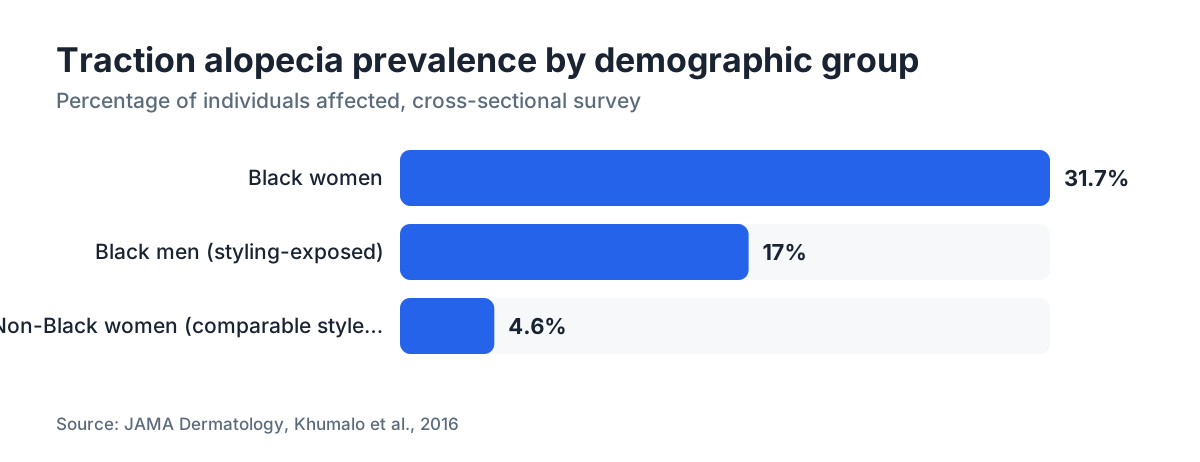
Second, traction alopecia is far more common in Black men and women. It causes a very specific recession pattern at the frontal and temporal hairline, identical in appearance to early androgenetic alopecia, but the cause is mechanical. Braids, locs, tight twists, and rubber bands worn repeatedly over years pull follicles out of the skin. A 2016 cross-sectional study in JAMA Dermatology (Khumalo et al.) found traction alopecia prevalence of 31.7% among the Black women surveyed, with similar styling-related mechanical forces documented in Black men who wear tight styles [1].
Third, folliculitis keloidalis nuchae (also called acne keloidalis nuchae) is more common in Black men. It is not the same as a receding hairline, but it can destroy follicles at the occiput and produce a different pattern of loss that gets confused with genetic thinning.
So here is the practical point. Before you spend money on finasteride or a transplant, a dermatologist should rule out traction and inflammatory causes, because those need completely different management.
What causes a receding hairline in Black men specifically?
There are three main buckets, and most men have a mix.
Androgenetic alopecia (male pattern hair loss). This is the same DHT-driven miniaturization that affects men of all backgrounds. Dihydrotestosterone binds to receptors in genetically susceptible follicles, shortening the growth cycle over years until those follicles produce nothing. Prevalence data across racial groups is genuinely messy. Some studies suggest Black men have slightly lower rates of androgenetic alopecia than white men of the same age, but the evidence is not strong enough to say so confidently. The American Academy of Dermatology notes that by age 50, roughly 50% of men have noticeable hair loss, with genetic predisposition as the main driver [2].
Traction alopecia. Chronic mechanical tension on the hairline. The damage stacks up slowly. If you have worn tight styles for years and your hairline has crept back specifically at the temples and frontal margin, traction is a serious suspect. Caught early, follicles can recover. Caught late, after years of scarring, they cannot. This is the hair loss cause most directly under your control. See what causes hair loss for the wider picture.
Central centrifugal cicatricial alopecia (CCCA). CCCA is a scarring alopecia that starts at the crown and spreads outward. It hits Black women hardest but occurs in Black men too. It is inflammatory and eventually destroys follicles for good. A biopsy is the only way to diagnose it definitively, and earlier is better. It is not a receding hairline in the classic sense, but it gets mistaken for diffuse genetic thinning.
Stress, thyroid dysfunction, and iron deficiency can speed up any of the above. Telogen effluvium, where sudden diffuse shedding follows illness or a crash diet, is another trigger that can expose an underlying recession that density was hiding.
DHT is the molecular engine behind androgenetic alopecia. If you want the mechanism, the DHT blocker explainer covers how the androgen pathway works and which compounds interfere with it.
How do Norwood stages apply to a receding hairline in Black men?
The Norwood-Hamilton scale is the standard way clinicians describe male pattern hair loss progression. It runs from Type I (essentially no recession) to Type VII (a narrow horseshoe of hair remaining at the sides and back). It was built on mostly white subjects, but the anatomical progression it describes applies across racial groups for androgenetic alopecia.
Here is a plain-language breakdown.
| Norwood Stage | What you see | Treatment urgency |
|---|---|---|
| I | No recession; baseline hairline | None needed medically |
| II | Slight recession at temples | Good time to start prevention |
| III | Deeper temple recession; may see thinning at vertex (IIIa/IIIv) | First real intervention window |
| IV | More recession, definite crown thinning | Finasteride + minoxidil most effective here |
| V | Bridge of hair between front and crown thinning | Medications help; transplant planning possible |
| VI | Bridge gone; front and crown merge | Medical therapy limited; transplant donor supply matters |
| VII | Only side and back fringe remains | Transplant planning urgent; limited donor available |
Most Black men who seek help for a receding hairline sit at Stage II through Stage IV. That range is where medications have the best documented track record. The earlier you act, the more you are preserving, and preserving is easier than regrowing.
One real complication: in men with traction alopecia, the recession pattern often does not follow Norwood at all, because it tracks the hairline where tension was highest, not the androgen-sensitive zones. A dermatologist who knows the difference matters here.
For the full breakdown of recession patterns across all stages, the receding hairline guide goes deeper.
Does traction alopecia cause permanent hairline loss?
It depends entirely on how long the tension lasted and whether the follicle has scarred.
In early-stage traction alopecia, follicles are still alive but inflamed and stressed. Remove the tension source, and hair often regrows over six to twelve months. Dermatologists sometimes read a fringe of fine "baby hairs" along the hairline as a good sign: those miniaturized follicles are not dead yet.
In late-stage or chronic traction alopecia, fibrosis replaces the follicle. No follicle, no hair. No topical, no oral drug, and no laser will regrow hair from a scarred follicle bed. At that point the only realistic option is a hair transplant to move donor follicles into the scarred area, and that only works once the scarring has stopped spreading.
The 2016 JAMA Dermatology study that documented 31.7% prevalence of traction alopecia also found that most cases occurred in women who had used the implicated styles for more than ten years [1]. Duration is the key variable.
Here is the practical guidance. If you have worn tight braids, locs, or extensions for years and your temples are noticeably thinner, see a dermatologist before assuming it is genetic. Do more than switch to minoxidil and keep the same styles. The tension has to stop.
What treatments actually work for a receding hairline in Black men?
Here is what has real evidence behind it, and what does not.
Minoxidil (topical and oral). Minoxidil is FDA-approved for androgenetic alopecia at 2% and 5% topical concentrations and has been in use since the mid-1980s [3]. It prolongs the anagen (growth) phase and increases blood flow to follicles. It does not block DHT, so it does not fix the root cause of androgenetic alopecia, but it demonstrably slows loss and regrows some hair in a meaningful share of users. A 48-week randomized controlled trial published in the Journal of the American Academy of Dermatology (Olsen et al., 2002) found 5% topical minoxidil significantly outperformed placebo for hair count and thickness [4]. Oral low-dose minoxidil (0.625 to 2.5 mg daily) is increasingly used off-label with strong real-world results; see oral minoxidil for the details. Side effects are real, so read minoxidil side effects before starting. The full evidence base for topical use is in minoxidil for men.
Finasteride. Finasteride 1 mg daily is FDA-approved for male androgenetic alopecia. It inhibits the 5-alpha reductase enzyme that converts testosterone to DHT, cutting scalp DHT by roughly 60% [5]. The 2-year Merck trial showed 83% of men on finasteride had no further hair loss versus 28% on placebo, and 66% had visible regrowth [5]. A minority of users report meaningful side effects, including sexual side effects, that you need to read about honestly before deciding. The finasteride explainer covers dosing, risks, and what the post-finasteride syndrome debate actually shows.
Finasteride plus minoxidil combined. The two drugs work by different mechanisms, so the combination has an additive effect. A 2021 randomized trial in JAMA Dermatology (Hu et al.) found combination therapy significantly outperformed either drug alone over 24 weeks [6]. The finasteride and minoxidil article has the specifics.
Hair transplant. For men who have lost significant ground, a follicular unit extraction (FUE) or follicular unit transplantation (FUT) procedure can rebuild a natural hairline. The main constraint for Black men is curly donor hair. The curved follicle shape pushes FUE transection rates (accidentally cutting follicles during extraction) higher with less experienced surgeons. A surgeon with specific experience in Afro-textured hair is not optional. See hair transplant for a full cost and process breakdown.
Stopping traction. If the cause is mechanical, stopping the cause is the treatment. No drug speeds follicle recovery from mechanical damage faster than simply removing the tension.
What does not work (but sells well). Biotin supplements, caffeine shampoos, and most "hair growth serums" have no good evidence for androgenetic alopecia. Biotin deficiency is rare. If you are not deficient, supplementing does nothing. The hair loss supplements piece is honest about which supplements have any signal and which are marketing.
Want a data snapshot of your hairline before committing to a plan? The free AI hair analysis at MyHairline reads your hairline pattern and Norwood stage from photos and gives you a starting point.
Can a receding hairline grow back, or is the loss permanent?
It depends on the cause and the stage.
For androgenetic alopecia: follicles miniaturized for years but still making some vellus (fine, colorless) hair can often be partly recovered with minoxidil and finasteride. Follicles that have fully stopped are unlikely to come back on topical or systemic treatment, but a transplant can restore coverage using donor follicles from a resistant zone.
For traction alopecia: early-stage loss is often reversible once tension is removed. Late-stage scarring is not.
For CCCA and other scarring alopecias: once scarring sets in, regrowth is not possible in that area. Anti-inflammatory treatment (often tetracyclines or intralesional steroids) aims to stop progression, not reverse it.
The FDA-approved drugs will not rebuild the hairline you had at 18. They slow loss and, in a meaningful subset of users, produce visible regrowth. The AAD states that minoxidil can help regrow hair and slow hair loss for some people, but results vary and continuous use is needed to keep any gains [2].
Realistic framing: start treatment at Norwood II or III, and most men keep most of what they have and see modest regrowth. That is a genuinely good outcome. Wait until Norwood V or VI, and you sharply narrow what any medical treatment can do.
Is a receding hairline more common or more severe in Black men?
The honest answer: the data is not great.
Several epidemiological studies suggest androgenetic alopecia rates are somewhat lower in Black men than in white men of the same age, though higher than East Asian men on average. A frequently cited review found the lowest rates of male pattern baldness in Asian men and the highest in white European men, with Black men in between, but methodological differences across studies make firm conclusions hard [7].
What is clear: traction alopecia is genuinely more prevalent in Black communities because of specific styling practices that pull the hairline. The 31.7% prevalence figure from the JAMA Dermatology study is striking [1]. That is a preventable cause of hairline loss far more common in Black patients than in other groups.
So the answer is nuanced. Purely genetic hairline recession may be somewhat less common in Black men on a population level, but total rates of visible hairline loss, including traction-related causes, are not low. And the two types often coexist, which complicates both diagnosis and treatment.
The clinical takeaway: a dermatologist evaluating a receding hairline in a Black male patient should look hard at styling history, more than family history.
What hairstyles make a receding hairline worse?
Anything that pulls the hairline repeatedly.
The highest-risk styles documented in the literature are tight cornrows (especially when pulled toward the front), locs that are frequently re-tightened at the scalp, extensions sewn or glued near the hairline, tight ponytails or man buns, and rubber bands or tight headbands worn daily.
The risk is cumulative and positional. Tension at the temple and frontal hairline is where traction alopecia shows up. Styles that pull uniformly backward (like a tight bun) recede the frontal hairline. Styles that pull sideways hit the temples.
A 2019 consensus statement from the American Academy of Dermatology noted that patients with traction alopecia should avoid hairstyles that pull on the hairline, and specifically named braids, weaves, and locs worn tight for long periods [8].
This does not make these styles inherently harmful. The damage comes from chronic high tension held over years. Loose locs, natural styles with minimal tension, and protective styles installed loose are lower risk. The variable that matters is mechanical force at the scalp, not the style category.
When should you see a dermatologist about a receding hairline?
Earlier than most men go. Most wait until the loss is obvious and hard to ignore, usually Stage IV or later. By then, the window for the best medical outcomes has already narrowed.
Make an appointment if your hairline has moved back noticeably in the last one to two years, you see more hair in the drain than usual for more than a few months, your temples have thinned faster than normal aging would explain, or you have any scalp symptoms like persistent itching, tenderness, or follicular pustules (which can point to CCCA or folliculitis).
A dermatologist who specializes in hair, or a trichologist with medical training, will typically do a visual exam, sometimes with dermoscopy, and may run a pull test or order bloodwork to rule out thyroid issues, iron deficiency, or other systemic causes. If a scarring alopecia is suspected, a punch biopsy gives a definitive answer.
The reason to go early is simple. The medications that work for androgenetic alopecia preserve hair; they do not reliably restore it. Every month of delay at a vulnerable stage is hair you will have to fight harder to keep, or lose for good.
If you want a preliminary read before booking, the free AI scan at MyHairline assesses your pattern and stage from a few photos and gives you something concrete to bring to a dermatologist.
How much do receding hairline treatments cost for Black men?
Here is an honest cost breakdown for the main options.
| Treatment | Typical monthly cost (US) | Notes |
|---|---|---|
| Generic finasteride 1 mg | $15 to $30/month | Requires prescription; GoodRx prices available |
| Brand Propecia 1 mg | $80 to $100/month | Same drug; no reason to pay more |
| 5% topical minoxidil (generic) | $10 to $20/month | OTC; Kirkland brand is the reference |
| Oral minoxidil (off-label) | $20 to $40/month | Requires prescription; off-label use |
| Combination (fin + min) | $25 to $60/month | Most cost-effective approach with evidence |
| PRP therapy (per session) | $700 to $1,500 | Usually 3 sessions recommended; evidence mixed |
| FUE hair transplant | $5,000 to $15,000+ | One-time; varies by graft count and surgeon |
| Low-level laser devices | $200 to $900 (device) | FDA-cleared for hair loss; evidence modest |
Finasteride and minoxidil together run roughly $25 to $60 per month for the generics, which makes them the best-evidenced and cheapest place to start. Hair transplants are a one-time cost but still need ongoing medical therapy afterward to protect the hair you did not transplant.
For Black men with Afro-textured hair, transplant costs can run higher because the procedure demands more surgical precision and experience. Get at least two to three consultations before choosing a surgeon, and ask flat out about their experience with curly, coiled donor hair.
Insurance rarely covers hair loss treatment. Some flexible spending accounts allow the cost of prescribed finasteride, but the rules vary. Nobody has a clean national dataset on what people actually pay out of pocket; the ranges above come from pharmacy pricing aggregators and published transplant industry surveys.
Are there any unique considerations for Black men using finasteride or minoxidil?
No strong evidence shows finasteride or minoxidil works differently by race in terms of core mechanism. The 5-alpha reductase inhibition finasteride relies on and the vasodilation minoxidil uses operate the same way across racial groups.
That said, a few things are worth knowing.
Most large finasteride trials enrolled majority-white subjects. The 1998 Merck trials that led to FDA approval showed 83% of participants had no further hair loss at two years [5], but a subgroup analysis by race was not a primary endpoint. The drug is approved for male androgenetic alopecia broadly, not for any specific group.
For topical minoxidil, formulation matters more for men with natural or loc styles than for men who can apply liquid to a bare scalp easily. Foam formulations (which skip propylene glycol and leave less residue) often work better for men who maintain natural textures. This is a practical consideration, not a medical one.
Oral low-dose minoxidil sidesteps the scalp application problem entirely, which is why it is increasingly preferred, though it requires a prescription and carries its own side effect profile (see the oral minoxidil breakdown).
If you are also using anything for scalp psoriasis or seborrheic dermatitis, tell your prescribing physician. Scalp inflammation from dermatitis can add to shedding, and some prescription treatments interact with or complement hair loss therapy.
Sources
- JAMA Dermatology, Khumalo et al., 2016 – Prevalence of traction alopecia in Black women
- American Academy of Dermatology – Hair loss overview
- FDA – Minoxidil topical solution label (Rogaine)
- Journal of the American Academy of Dermatology – Olsen et al., 2002; 5% vs 2% minoxidil RCT
- FDA – Finasteride (Propecia) prescribing information and Merck clinical trial data
- JAMA Dermatology – Hu et al., 2021; finasteride plus minoxidil combination RCT
- Dermatologic Clinics – Xu et al., 2017; racial differences in androgenetic alopecia prevalence review
- American Academy of Dermatology – Traction alopecia consensus statement, 2019
- National Institutes of Health MedlinePlus – Finasteride