

TL;DR: It depends entirely on the cause. Telogen effluvium triggered by stress, illness, or nutritional deficiency often reverses fully within 3 to 6 months once the trigger is gone. Alopecia areata can spontaneously regrow in mild cases. Male and female pattern baldness does not reverse on its own and will progress without treatment.
Why the answer is 'it depends', and what it depends on
Hair loss is not one condition. It's a symptom that around a dozen distinct conditions can produce, and those conditions have almost nothing in common biologically. Asking whether hair loss reverses itself is like asking whether a fever goes away by itself: sometimes yes, sometimes no, and the difference matters a lot.
The key split is between hair loss caused by a temporary disruption to the hair cycle and hair loss caused by permanent structural damage to the follicle itself. Temporary disruptions can recover completely once the cause is removed. Structural damage generally can't, because the follicle that made the hair is gone or replaced by scar tissue.
Understanding what causes hair loss in your specific situation is the first step, because no amount of waiting will regrow hair that pattern baldness has permanently miniaturized. A lot of people waste months hoping when early intervention would have actually changed their outcome.
Which types of hair loss can reverse spontaneously?
Several forms of hair loss have real, documented spontaneous recovery rates. Here are the main ones:
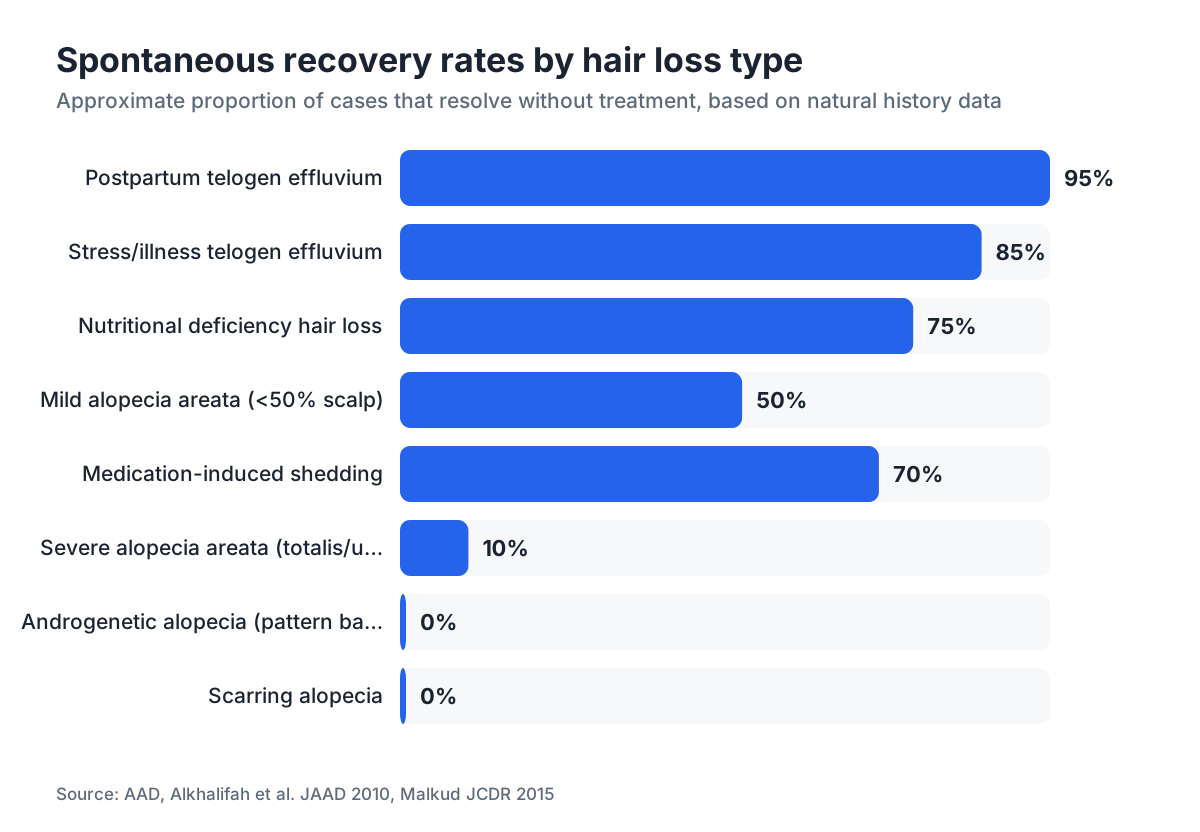
Telogen effluvium is the most common type with spontaneous reversal. A physical or emotional shock, including childbirth, surgery, a high fever, crash dieting, or severe stress, pushes a large proportion of growing hairs into the resting (telogen) phase at once. Two to three months later those hairs shed in a wave. Once the trigger resolves, the cycle restarts and most people see complete regrowth within 3 to 6 months without any treatment [1]. A detailed breakdown of what triggers it and what the timeline looks like is in our guide to telogen effluvium.
Alopecia areata (mild, patchy) is an autoimmune condition that causes coin-sized bald patches. The American Academy of Dermatology notes that in mild cases with fewer than half the scalp affected, about 50% of people recover spontaneously within a year [2]. The catch: it can come back, and severe forms (alopecia totalis or universalis) have very low spontaneous recovery rates.
Nutritional deficiency hair loss is essentially a subtype of telogen effluvium. Iron deficiency, low ferritin, significant zinc depletion, and severe protein restriction can all suppress normal hair cycling. When the deficiency is corrected, hair typically recovers within 6 months, though some studies put the full regrowth timeline closer to a year [3].
Medication-induced hair loss from drugs like beta-blockers, retinoids, anticoagulants, and some antidepressants usually reverses 3 to 6 months after stopping the medication, assuming no other compounding factor [4].
Postpartum hair loss is a specific version of telogen effluvium driven by the hormonal crash after delivery. The AAD describes postpartum shedding as expected, peaking at around 3 to 4 months postpartum, and typically self-resolving by the child's first birthday [2].
Which types of hair loss will not reverse on their own?
This is where honest information matters most, because the types that don't reverse are also the most common.
Androgenetic alopecia (pattern baldness) affects roughly 50% of men by age 50 and a meaningful proportion of women after menopause [5]. It is driven by dihydrotestosterone (DHT) progressively miniaturizing follicles until they stop producing visible hair. No biological mechanism causes this to reverse spontaneously. It will continue progressing at whatever pace your genetics dictate. Waiting without treatment means losing ground you can't get back.
Traction alopecia caused by years of tight hairstyles can reverse early on, but once follicles are permanently damaged by sustained tension, that hair does not return. The AAD is explicit that long-term traction alopecia can cause permanent loss [2].
Scarring alopecias (lichen planopilaris, frontal fibrosing alopecia, central centrifugal cicatricial alopecia) involve inflammation that destroys the follicle and replaces it with fibrous tissue. Spontaneous reversal is not documented in these conditions. The goal of treatment is to stop progression, not to regrow what's already gone.
Tinea capitis (scalp ringworm) is a fungal infection that causes patchy loss. It does not clear without antifungal treatment and can cause permanent scarring if left long enough [6].
If you're seeing a receding hairline, progressive thinning at the crown, or a widening part, pattern baldness is the most likely cause and it will not self-correct.
How do researchers measure spontaneous recovery?
Most spontaneous reversal data comes from natural history studies and placebo arms of clinical trials, where a control group receives no active treatment and researchers track what happens.
For telogen effluvium, the evidence is largely observational, but it's consistent: prospective studies following patients after a defined trigger (surgery, illness) confirm that the vast majority regrow to baseline without intervention within 6 months [1].
For alopecia areata, the data is more mixed. A widely cited natural history analysis found that about 34% to 50% of patients with limited disease experience complete spontaneous remission within 1 year, but 14% to 25% of all AA patients eventually progress to total scalp or body hair loss [7]. The more patches you have, the worse the spontaneous recovery odds.
For androgenetic alopecia, placebo arms in FDA-registration trials for minoxidil and finasteride show that untreated men continue to lose hair measurably over 12 to 24 months. There is no documented spontaneous reversal cohort [8].
Nobody has good long-term follow-up data on what happens to pattern baldness patients who simply do nothing for 20 years. The closest we have is observational cohort data showing progressive Norwood stage advancement over time in untreated men.
What does spontaneous regrowth actually look like physically?
When telogen effluvium reverses, the first sign is usually short, fine hairs appearing along the hairline and part line. These are called vellus hairs transitioning back into terminal hairs. People often notice baby-fine fuzz a couple of inches long appearing 3 to 4 months after the shedding peaks. Full terminal thickness can take another 6 to 12 months because each strand grows roughly half an inch per month.
In alopecia areata, spontaneous regrowth typically starts as fine white or colorless hairs in the center of the patch, which then pigment over time. Some people describe it as stubble growing back in the bald circle. The hairline stays intact, unlike pattern baldness.
Pattern baldness does not produce these recovery signs on its own. If anything, the hairs that remain thin progressively. A few shed telogen hairs landing on your pillow after a stressful month is not the same process as the slow miniaturization of androgenetic alopecia, even though both involve hair on the floor.
Does stress cause hair loss, and does it go away when stress does?
Stress is a real and well-documented trigger for telogen effluvium, but the mechanism has a built-in delay that confuses people. The stress event causes the follicle disruption immediately, but the shedding doesn't become visible until 2 to 3 months later, when those resting hairs fall out together [1]. By the time you're seeing heavy shedding in the shower, the triggering stress may be long past.
When the stress resolves and no other factor sustains the disruption, the cycle corrects itself and shedding normalizes within weeks. Regrowth then takes several more months to become visible.
The important caveat: chronic, sustained stress can keep the cycle disrupted. If the trigger never resolves, telogen effluvium can become chronic (lasting more than 6 months). Chronic telogen effluvium is less well understood and may not resolve as cleanly. Some researchers believe it can unmask underlying androgenetic alopecia in predisposed individuals, though the evidence for that mechanism is limited.
Can diet changes or supplements cause hair to regrow without other treatment?
If hair loss is specifically caused by a deficiency, then correcting that deficiency through diet or supplementation is a legitimate form of reversal. A 2017 review in the journal Dermatology Practical & Conceptual found that iron deficiency, low vitamin D, and zinc deficiency are all associated with hair shedding, and that correction of these deficiencies can support regrowth [3]. But the key word is "correction," not "optimization."
Taking supplements when you don't have a documented deficiency does not appear to accelerate regrowth beyond your baseline. A person with normal ferritin who adds an iron supplement will not grow more hair. The return is from correcting a deficit, not from adding beyond sufficiency.
For hair loss caused by androgenetic alopecia, no supplement has FDA clearance as a treatment, and none has shown the kind of effect in large randomized trials that minoxidil or finasteride have. Our overview of hair loss supplements covers the evidence grades for the most popular ones. The honest summary: biotin is almost certainly useless unless you have a frank biotin deficiency; saw palmetto has weak data; nothing in the supplement aisle reverses pattern baldness.
How long should you wait to see if hair grows back before seeking treatment?
This question has a different answer depending on what you think is causing your loss.
If you can point to a clear, resolved trigger (a major illness in the last 3 months, childbirth, a crash diet that ended, a medication you've stopped), it's reasonable to wait 6 months from when the trigger resolved and see what happens. Document your hair with photos in consistent lighting every 4 to 6 weeks. Progress is slow and the human brain notoriously misremembers how things looked.
If you can't identify a clear trigger, or if the loss is patterned (temples receding, crown thinning, part widening), do not wait 6 months hoping it's temporary. Pattern baldness is not reversible and time lost is hair lost. A dermatologist or trichologist can usually distinguish the two causes in a single appointment using a dermoscopy exam.
The general clinical guideline is to investigate hair loss that persists beyond 3 to 4 months without a clear explanation, or any hair loss that follows a classic androgenetic pattern from the start [2].
If you want a quick starting point before booking an appointment, the free AI scan at MyHairline can help you understand what pattern you're seeing and whether it resembles reversible or progressive loss.
What treatments are proven to work when hair won't reverse on its own?
If your hair loss is not going to self-correct, you have real options. Two FDA-approved treatments have the strongest evidence base.
Minoxidil is available over the counter as a topical solution or foam (2% and 5%) and by prescription as an oral tablet. The FDA approved topical minoxidil for male-pattern hair loss and female-pattern hair loss specifically [8]. In the registration trials, 5% topical minoxidil produced significantly more regrowth than placebo at 48 weeks. Oral minoxidil at low doses (0.25 mg to 2.5 mg) has growing evidence supporting it as an effective alternative for people who don't tolerate the topical form. The minoxidil for men guide covers dosing and what to expect in detail.
Finasteride (1 mg daily, prescription only) is a 5-alpha reductase inhibitor that blocks DHT conversion. In the registration trial, men taking finasteride had statistically significant increases in hair count at 12 and 24 months versus placebo, while placebo patients continued to lose hair [9]. It works by blocking the hormone signal that miniaturizes follicles. More context on how DHT interacts with hair follicles is in our DHT blocker article.
Combining both is common and evidence suggests an additive effect [9]. The finasteride and minoxidil guide covers the combination approach.
For people in whom medical therapy fails or who want a more permanent solution, hair transplant surgery moves DHT-resistant follicles from the back of the scalp to thinning areas. It's not a reversal of the underlying condition, but it restores appearance durably.
Minoxidil does have side effects worth knowing before you start. The minoxidil side effects article covers the real ones, including the initial shedding phase that scares a lot of people into stopping too early.
Can hair loss reverse in women specifically?
Women experience hair loss differently from men and, in some ways, have better odds of spontaneous reversal on average. That's because a higher proportion of female hair loss is caused by reversible triggers: iron deficiency anemia (more common in women due to menstruation), postpartum telogen effluvium, thyroid disorders, and hormonal fluctuations.
A study in the International Journal of Trichology found that thyroid-associated hair loss in women showed significant improvement after thyroid function was normalized, without additional hair-specific treatment [10]. This is a genuine example of treating the root cause producing spontaneous-equivalent recovery.
However, female pattern hair loss (androgenetic alopecia in women) is also real, affects roughly 40% of women by age 70 [5], and does not self-reverse. It typically presents as a widening part rather than a receding hairline, and it progresses slowly. Waiting to see if it resolves is not a useful strategy for this type.
Are there any warning signs that hair loss won't come back?
A few signs suggest the loss may not be reversible and you should not wait:
Loss of follicle openings. Healthy scalp, even in pattern baldness, shows pore openings where hair follicles are still present. In scarring alopecias, those openings close and the skin looks smooth. Once that happens, the follicle is gone.
Burning, itching, or scalp pain accompanying the hair loss. These suggest active inflammation, which could indicate a scarring alopecia that needs immediate treatment to stop progression.
Loss persisting beyond 12 months with no identified reversible cause and no new growth visible.
A family history of complete baldness (not thinning, but complete loss of hair in a zone) combined with a similar pattern forming in your own hair.
Loss that follows a very clear Norwood pattern on the scalp with miniaturized vellus hairs at the edges of the bald area on dermoscopy.
None of these are death sentences for your hair, but they are all signals that you're not dealing with a self-resolving process.
The bottom line: who should wait and who should act?
Wait and monitor if: you've had a clear, resolved physical or emotional shock in the last 3 to 6 months, your shedding is diffuse (all over, not patterned), your scalp looks healthy with no inflammation, and you have no family history of patterned baldness. Document with photos. If you don't see meaningful improvement by 6 months post-trigger, see a dermatologist.
Act now if: the loss follows a pattern (temples, crown, part), you cannot identify a clear trigger, you've been losing hair gradually for more than a year, there's scalp inflammation or pain, or you're seeing the follicle openings close. The treatments that work for pattern baldness are more effective when started earlier, when there are more follicles left to preserve.
The free AI scan at MyHairline can help you map your current pattern and track changes over time. It doesn't replace a dermatologist, but it gives you something concrete to look at instead of trying to remember how your hair looked six months ago.
Hair loss is one of those areas where optimism is natural but expensive. The honest advice from the research is: if it's reversible, you'll know by 6 months. If it's not, every month you wait is a month of additional miniaturization you can't undo.
Sources
- Malkud S. Telogen Effluvium: A Review. Journal of Clinical and Diagnostic Research, 2015
- American Academy of Dermatology, Hair Loss resource pages
- Almohanna HM et al. The Role of Vitamins and Minerals in Hair Loss. Dermatology and Therapy, 2019
- Trüeb RM. Systematic approach to hair loss in women. JDDG: Journal der Deutschen Dermatologischen Gesellschaft, 2010
- Vary JC. Selected Disorders of Skin Appendages. Medical Clinics of North America, 2015
- CDC, Ringworm (Tinea Capitis) information page
- Alkhalifah A et al. Alopecia areata update. Journal of the American Academy of Dermatology, 2010
- FDA, Minoxidil Drug Label and Approval History
- Kaufman KD et al. Finasteride in the treatment of men with androgenetic alopecia. Journal of the American Academy of Dermatology, 1998
- Gowda D et al. Thyroid hormones and hair. International Journal of Trichology, 2017
- van Zuuren EJ et al. Interventions for alopecia areata. Cochrane Database of Systematic Reviews, 2016