
TL;DR: Finasteride is FDA-approved only for men, but dermatologists prescribe it off-label to postmenopausal women with androgenetic alopecia. Studies show modest to meaningful regrowth in some women, but the drug causes birth defects and is contraindicated in women who could become pregnant. Premenopausal use requires strict contraception. It's not a first-line treatment for women.
What is finasteride and why would a woman take it?
Finasteride is a 5-alpha-reductase inhibitor. It blocks the enzyme that converts testosterone into dihydrotestosterone (DHT), the androgen most responsible for shrinking hair follicles in people with a genetic sensitivity to it. That's the whole mechanism. Less DHT means less follicle miniaturization over time.
Men take it because androgenetic alopecia in men is heavily DHT-driven. The question for women is trickier, because female-pattern hair loss (FPHL) is more biologically complicated. DHT does contribute, but estrogen, prolactin, thyroid hormones, and iron levels all interact with the process in ways that don't apply to men [1].
Still, a meaningful subset of women with FPHL have elevated androgens or androgen-sensitive follicles. For those women, lowering DHT makes biological sense. That's why some dermatologists reach for finasteride off-label, particularly in postmenopausal patients where the hormonal picture is cleaner and pregnancy risk is zero.
If you want the full picture on how DHT drives hair loss in both sexes, the dht blocker article covers the mechanism in detail.
Is finasteride FDA-approved for women?
No. The FDA has approved finasteride for two indications only: benign prostatic hyperplasia (5 mg, brand name Proscar) and male androgenetic alopecia (1 mg, brand name Propecia). Both are explicitly for men [2].
The FDA label for Propecia states directly: "PROPECIA is not indicated for use in women." That language reflects both the efficacy gap in premenopausal women and the serious teratogenicity risk (the drug causes abnormal development of male genitalia in male fetuses).
Off-label prescribing is legal and common in medicine. Doctors prescribe finasteride to women regularly. But it means the patient is operating outside the studied population on which approval was based, and the responsibility for that decision sits with the prescribing physician and patient together.
The American Academy of Dermatology (AAD) includes finasteride as an option for women with FPHL in its clinical guidelines, specifically for postmenopausal women or those on reliable contraception [3]. That's meaningful institutional backing even without FDA approval.
Does finasteride actually work for women's hair loss?
The evidence is real but imperfect. Most trials in women are smaller and shorter than the big male trials, and results vary a lot depending on whether the women had elevated androgens to begin with.
A 2020 review published in the Journal of the American Academy of Dermatology pooled data across studies and found that finasteride 1 mg daily produced statistically significant improvements in hair density and global photographic assessment in postmenopausal women with FPHL over 12 to 24 months [4]. The effect was consistent but generally more modest than what's seen in men.
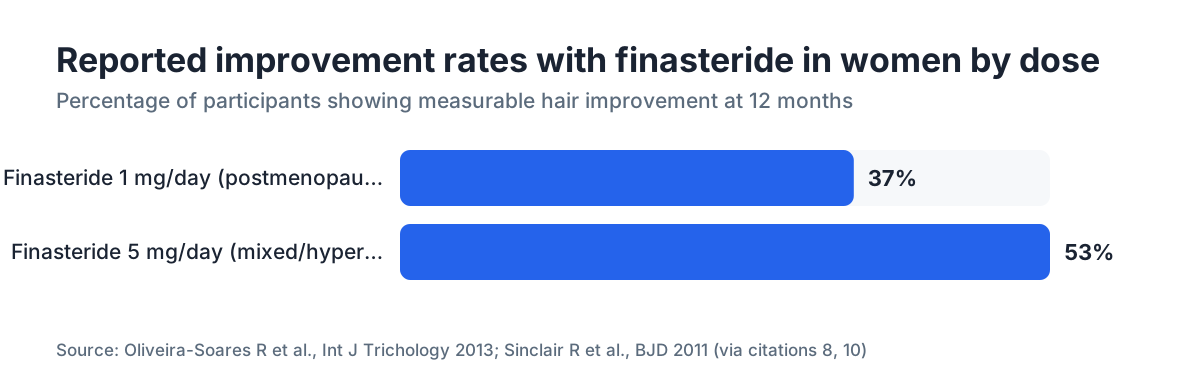
Higher doses tell a more interesting story. Several studies used 2.5 mg or 5 mg daily in women, and some showed better results than the 1 mg dose. One prospective study found that women taking 5 mg finasteride showed measurable improvement in 53% of participants after one year, compared with about 37% in the 1 mg group, though the sample sizes were small enough that you shouldn't treat those numbers as definitive [8].
For women with polycystic ovary syndrome (PCOS) or documented hyperandrogenism, the response tends to be better. That makes intuitive sense. If elevated DHT is actively causing the problem, blocking it should help more.
For women with normal androgen levels, finasteride's benefit is less predictable. It may still help because follicle sensitivity to DHT varies independent of serum androgen levels, but the evidence is thinner.
Here's the honest read: finasteride is not a home run for women the way it often is for men in early Norwood stages. It's one reasonable option in a limited toolkit, not a guarantee.
What are the risks of finasteride for women?
The risk that overshadows everything else is teratogenicity. Finasteride causes abnormal development of external genitalia in male fetuses. The FDA label warns against even handling crushed finasteride tablets while pregnant [2]. This is not a theoretical risk. It's the reason the drug was classified as FDA Pregnancy Category X (now replaced by the PRIS labeling system, but the contraindication is unchanged).
For postmenopausal women who cannot become pregnant, this risk drops out of the equation entirely. That's why they're the clearest candidates.
For premenopausal women, the drug is sometimes prescribed with mandatory contraception. If that sounds uncomfortable, it should. The margin for error is zero.
Beyond pregnancy, side effects reported in women include:
- Decreased libido (reported in a minority of users, frequency varies across studies)
- Irregular menstrual cycles in some premenopausal users
- Breast tenderness
- Headache
- Mood changes, though causality here is difficult to establish
The post-finasteride syndrome discussion, which involves persistent sexual and neurological side effects after stopping the drug, has been studied almost exclusively in men. Whether a comparable syndrome occurs in women is unknown. The data simply don't exist yet [5].
Liver function should be monitored in long-term users, since finasteride is metabolized by the liver, though clinically significant liver injury is rare.
If you're weighing finasteride against other options, the finasteride and minoxidil comparison is worth reading before you decide.
What dose of finasteride do doctors prescribe to women?
There's no officially established dose for women because there's no approved indication. In practice, dermatologists use a range.
| Dose | Common use case | Notes |
|---|---|---|
| 1 mg/day | Most common starting dose | Same as male Propecia dose; milder DHT suppression |
| 2.5 mg/day | Moderate FPHL, normal androgens | Used in several published trials |
| 5 mg/day | Hyperandrogenism, PCOS-related hair loss | Proscar tablet; more DHT suppression but more side effect potential |
Most dermatologists start at 1 mg and reassess at 6 to 12 months, stepping up if there's no response and the patient tolerates the drug. Some go straight to 2.5 mg or 5 mg for women with confirmed hyperandrogenism.
Blood work before starting is standard: a full androgen panel (total and free testosterone, DHEA-S, SHBG), thyroid, iron studies, and a pregnancy test for premenopausal women. This isn't box-checking. It tells you whether DHT is actually elevated and rules out other treatable causes of hair loss like telogen effluvium, which finasteride won't touch.
Results take time. Most clinicians want to see 12 months of consistent use before judging whether it's working. Hair cycling is slow.
How does finasteride compare to minoxidil for women?
Minoxidil is FDA-approved for women at 2% concentration (the 5% foam is labeled for men but used off-label by women regularly). It's the established first-line treatment for FPHL [11]. Finasteride is typically second-line or added on top.
The two drugs work completely differently. Minoxidil is a vasodilator that extends the anagen (growth) phase of the hair cycle. Finasteride lowers the androgen signal that triggers follicle miniaturization. They address different parts of the problem, which is why combining them is common and makes mechanistic sense.
Minoxidil's main drawbacks for women are facial hypertrichosis (unwanted facial hair growth), scalp irritation, and a temporary shedding phase when starting. See the minoxidil side effects breakdown for specifics. Neither drug is perfect. Both demand long-term commitment: stopping either one typically brings hair loss back within months.
If you're a premenopausal woman who can't use finasteride safely, minoxidil is the cleaner choice to start with. If you're postmenopausal or firmly committed to contraception, adding finasteride to minoxidil is a reasonable step up that most dermatologists would support.
Can premenopausal women take finasteride safely?
Yes, with significant caveats. The key requirement is reliable, consistent contraception. The AAD guideline specifies that finasteride can be considered in premenopausal women who are not pregnant and are using effective contraception [3].
In practice, many dermatologists are more cautious. Some won't prescribe it to premenopausal women at all. Others require an IUD or another highly effective long-term contraceptive before writing the prescription. A daily pill is generally considered insufficient because user-error failure rates are real.
Any premenopausal woman considering finasteride should have an honest conversation with her prescribing physician about exactly what contraception she's using and whether it's enough. This isn't negotiable.
There's also the question of what happens if a premenopausal woman wants to conceive later. Finasteride has a half-life of roughly 5 to 6 hours, and the drug clears the body relatively quickly. Most guidelines suggest stopping finasteride at least one month before trying to conceive, though some practitioners recommend longer. The drug does not accumulate in bone or tissue the way some other medications do [2].
For women whose hair loss isn't clearly androgen-driven, go back to basics first. The what causes hair loss article outlines the full differential, because treating androgenetic alopecia with finasteride when the real cause is nutritional deficiency or thyroid dysfunction wastes time and money.
What does a dermatologist evaluation look like before prescribing finasteride to a woman?
A good evaluation isn't quick. A dermatologist prescribing this thoughtfully will do several things before writing the script.
First, they'll confirm the diagnosis. FPHL has a characteristic pattern: diffuse thinning over the crown and central part with a relatively preserved frontal hairline (Ludwig pattern). A scalp biopsy or dermoscopy can help confirm miniaturization of follicles. A receding hairline in a woman, especially if the temples are involved, can point to androgenetic alopecia but also needs to be told apart from traction alopecia or frontal fibrosing alopecia, which finasteride won't help.
Second, they'll order bloodwork. The typical panel includes TSH (thyroid), ferritin (iron stores), CBC, and a full hormone panel. Elevated free testosterone, DHEA-S, or a low SHBG would support an androgen-driven mechanism and raise the odds that finasteride helps.
Third, for premenopausal women, a pregnancy test and contraception discussion.
Fourth, they'll set expectations. Hair loss treatments for women have real limits. Even in the best case, you're looking at stabilization of loss and modest regrowth, not a return to a pre-loss baseline.
If you want a starting point before that appointment, MyHairline's free AI hair scan (/scan) can help you map your current loss pattern and give you clearer language to use with your doctor.
Are there alternatives to finasteride for women with hair loss?
Yes, several, and some have better evidence or safety profiles for certain groups of women.
Spironolactone is the most commonly used alternative anti-androgen for women in the US. It's a potassium-sparing diuretic that also blocks androgen receptors. It's been used for decades for female hirsutism and acne and has a reasonably established track record for FPHL [7]. It also carries a pregnancy contraindication but works differently, at the receptor level rather than at DHT synthesis. Many dermatologists prefer it over finasteride for premenopausal women with signs of hyperandrogenism.
Dutasteride is a stronger 5-alpha-reductase inhibitor that blocks both type 1 and type 2 isoforms (finasteride blocks only type 2). Some studies show better efficacy than finasteride for hair loss in men, and limited data in women are emerging. It's not FDA-approved for hair loss in anyone, the half-life is much longer (about 5 weeks), and it stays in the system for months after stopping. That makes the safety math even more cautious for women who might become pregnant.
Oral minoxidil at low doses (0.25 to 1.25 mg/day) has growing evidence and is increasingly popular for women who don't tolerate topical formulations. Read the oral minoxidil breakdown for a thorough look at how it compares.
Low-level laser therapy (LLLT) has some supportive trial data for FPHL and no systemic side effects, though it's not a DHT-blocking mechanism and likely works best alongside other treatments.
For women who have already lost significant density, a hair transplant consultation is worth considering, though candidacy criteria differ meaningfully from men.
How long does finasteride take to work in women, and what should you expect?
Slower than you want. Hair follicles run on a cycle of 3 to 6 months from growth to shed. Finasteride works by changing the hormonal environment at the follicle, not by producing new hairs on demand. Most clinical trials in women measure outcomes at 12 to 24 months, which tells you something about the realistic timeline.
At 3 months: some women notice a drop in shedding. This is often the first sign the drug is doing something.
At 6 months: early density changes may show up on trichoscopy even if they aren't obvious in the mirror.
At 12 months: this is when most dermatologists do the first meaningful assessment. Photography or hair counts at this point give a real signal of whether the drug is working for you.
At 24 months: if the drug is going to produce meaningful regrowth, most of it will have appeared by now. Continued use is still needed to hold any gains.
Stop taking finasteride and the DHT-suppressing effect reverses within weeks. Hair loss typically resumes within 6 to 12 months, and you can expect to lose whatever ground the drug helped you gain. This is a long-term commitment, not a course of treatment.
Patience is genuinely required. Women who quit at 4 months because they haven't seen dramatic results often bail right before real change was starting.
What questions should you ask your doctor before starting finasteride?
Walking in prepared makes a real difference. Here are the questions worth asking:
- Is my hair loss pattern consistent with androgenetic alopecia, or could something else be driving it?
- Do my bloodwork results suggest elevated androgens? Would that change your recommendation?
- What dose do you recommend, and why?
- What does success look like at 12 months? How will we measure it?
- If I'm premenopausal, what contraception do you consider adequate?
- What side effects should make me call you immediately versus just monitor?
- Is spironolactone a better option for my specific situation?
- What happens if finasteride isn't working after a year? What's next?
- Are there any supplements or medications I'm currently taking that could interact?
The hair loss supplements article is worth reading before that appointment too, since some supplements can interact with androgen metabolism in ways that complicate the picture.
Sources
- National Library of Medicine, StatPearls: Androgenetic Alopecia
- FDA, Drugs section (Propecia and Proscar prescribing information)
- American Academy of Dermatology, Clinical Guidelines for Female Pattern Hair Loss
- Journal of the American Academy of Dermatology, 2020 review: Finasteride for female androgenetic alopecia
- National Institutes of Health, main site (research portfolio on finasteride)
- PubMed, Vañó-Galván S et al., Dermatology 2012: Spironolactone for female-pattern hair loss
- PubMed, Oliveira-Soares R et al., Int J Trichology 2013: Finasteride 5 mg/day for female androgenetic alopecia
- PubMed, Sinclair R et al., British Journal of Dermatology 2011: Finasteride 1 mg in postmenopausal women
- National Library of Medicine, Levy LL, Emer JJ, J Clin Aesthet Dermatol 2013: Female pattern alopecia review