
TL;DR: Finasteride is FDA-approved only for men, but dermatologists prescribe it off-label to women with androgenetic alopecia. Trials show hair density gains in postmenopausal women and in younger women using reliable contraception. It is absolutely contraindicated in pregnancy because it can cause genital birth defects in male fetuses. Women of childbearing age need strict contraception before starting.
What is finasteride and how does it work in women?
Finasteride is a 5-alpha reductase inhibitor. It blocks the enzyme that converts testosterone into dihydrotestosterone (DHT), the androgen most responsible for shrinking hair follicles in people genetically prone to androgenetic alopecia. In men, cutting scalp DHT slows miniaturization and, in many cases, partially reverses it. The same mechanism applies in women, because roughly 40% of women with female pattern hair loss show elevated androgenic activity or heightened follicle sensitivity to DHT, even when serum androgens look normal on a lab panel [1].
Women produce testosterone in the ovaries and adrenal glands, and type II 5-alpha reductase sits in scalp follicles in both sexes. That's the biological reason finasteride has any rationale in women at all. Pharmacologically it's not a stretch. The real question has always been whether the clinical effect is big enough to justify the risks, especially for women who can become pregnant.
For a deeper look at how DHT drives hair loss in both sexes, see DHT blocker.
Finasteride at 1 mg was approved by the FDA in 1997 for male androgenetic alopecia under the brand name Propecia [2]. The 5 mg dose (Proscar) is approved for benign prostatic hyperplasia in men. Neither dose has ever won FDA approval for use in women. Off-label prescribing is legal and common in dermatology, but it puts the informed-consent burden squarely on the prescribing physician.
Does finasteride actually work for women's hair loss?
It works for some women. The effect size runs from modest to meaningful depending on the population, and postmenopausal women tend to see the clearest benefit.
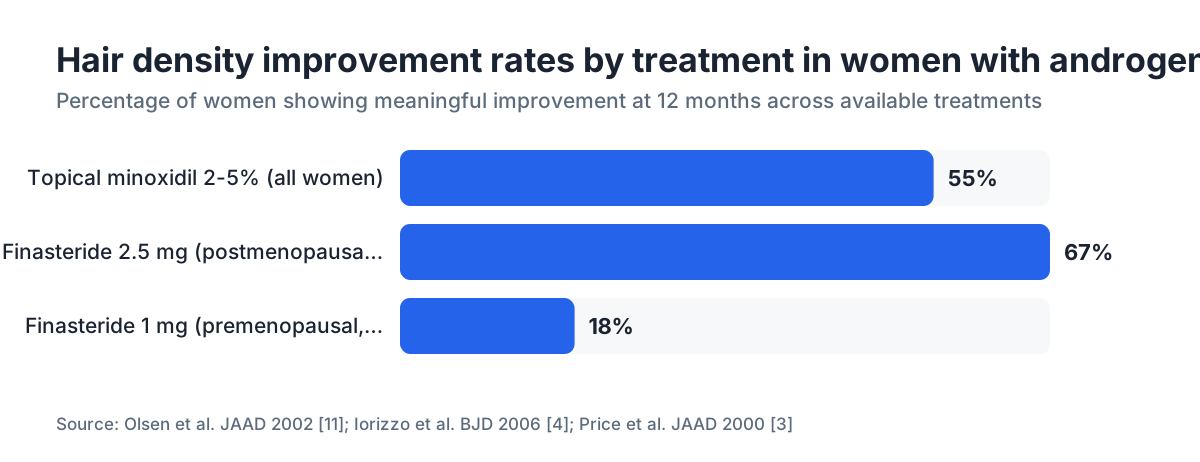
A randomized controlled trial published in the Journal of the American Academy of Dermatology in 2000 enrolled 137 premenopausal women with androgenetic alopecia. After 12 months on 1 mg finasteride, hair counts did not differ significantly from placebo in that group [3]. That trial is the one most often cited to dismiss finasteride in women, but it carries two caveats: it excluded women with elevated androgens, and 1 mg may have been too low for the hormonal setting of premenopausal women.
Postmenopausal data look better. A prospective study in the British Journal of Dermatology followed 33 postmenopausal women on 2.5 mg finasteride daily for 12 months. Investigators reported improved hair density scores in most participants, with no serious adverse events [4]. Several smaller case series and retrospective analyses, using 2.5 mg to 5 mg in both pre- and postmenopausal women, show density improvement in roughly 50% to 75% of treated subjects. That's lower-quality evidence, and worth reading as such.
The American Academy of Dermatology lists finasteride as a second-line option for female pattern hair loss, at a lower evidence level than topical minoxidil, which stays the first-line FDA-approved treatment for women [5].
Here's the practical read. If a woman has confirmed androgenetic alopecia, is postmenopausal or on reliable contraception, and hasn't responded well enough to minoxidil, finasteride is a reasonable next step. It is not a guaranteed fix. Give it 6 to 12 months before you judge it.
What does the FDA actually say about women using finasteride?
The FDA label for finasteride 1 mg (Propecia) is blunt. It states that "PROPECIA is not indicated for use in women" and that "Women should not handle crushed or broken PROPECIA tablets when they are pregnant or may potentially be pregnant because of the possibility of absorption of finasteride and the subsequent potential risk to a male fetus" [2].
That language reflects the drug's Pregnancy Category X status. Animal studies and human case reports show finasteride can interfere with normal development of male external genitalia when a pregnant woman is exposed. The risk targets male fetuses during the window of sexual differentiation, roughly weeks 6 to 12 of gestation.
So no FDA approval exists for women. Physicians can still prescribe it off-label. The FDA regulates drug marketing, not the practice of medicine. Off-label prescribing accounts for an estimated 20% of all prescriptions written in the U.S., and it's especially common in dermatology and oncology [6].
When a dermatologist prescribes finasteride to a postmenopausal woman, that's legitimate medicine. It's not a loophole or a gray area. It's standard off-label practice backed by a plausible mechanism and a growing body of clinical evidence, even if no manufacturer has filed for a new indication.
Is finasteride safe for women? What are the risks?
For women who cannot become pregnant, the safety profile looks reasonably clean in the available studies. Reported side effects in women include decreased libido, mood changes, and occasional menstrual irregularity, though trial rates are generally low and not always significantly different from placebo [3][4].
Longer-term observational data in men raise the question of persistent sexual dysfunction after stopping the drug, sometimes called post-finasteride syndrome. Whether a comparable syndrome exists in women is unknown. The female evidence base is much smaller, and no large prospective study has tracked persistent side effects after discontinuation in women. Nobody has good data on this in women yet.
Liver toxicity is rare but has been reported with 5-alpha reductase inhibitors. Breast tenderness or changes turn up anecdotally. Plenty of women report no side effects at all.
The one risk that isn't ambiguous is teratogenicity. Finasteride is absolutely contraindicated in pregnancy. Any woman of reproductive age considering it must use reliable contraception, understand the risk fully, and have a clear plan if that contraception fails. That is not a technicality. A male fetus exposed to finasteride during the first trimester can develop hypospadias or ambiguous genitalia [2].
For women past menopause, the teratogenic risk is moot. The safety conversation there is mostly about side effect monitoring and periodic blood work.
What dose of finasteride do dermatologists use in women?
There is no FDA-approved dose for women, so dermatologists lean on clinical judgment and the existing trial data. The 1 mg dose from the 2000 RCT barely moved the needle in premenopausal women [3]. Many prescribers use 2.5 mg or 5 mg daily instead, based on the postmenopausal studies and retrospective data pointing to better outcomes at higher doses [4].
A few physicians have tried 1 mg in women with hyperandrogenism (polycystic ovary syndrome with alopecia, for example) and seen results, presumably because higher baseline androgens give the drug more substrate to block. This is individualized practice, not a protocol.
One takeaway matters most here. If you and your dermatologist decide finasteride is worth trying, don't assume the 1 mg men's dose is right for you. Ask directly what evidence supports whatever dose gets chosen.
| Dose | Population studied | Evidence quality | Notes |
|---|---|---|---|
| 1 mg/day | Premenopausal women (no elevated androgens) | RCT (n=137) | No significant effect vs. placebo [3] |
| 2.5 mg/day | Postmenopausal women | Prospective cohort (n=33) | Majority showed improvement [4] |
| 5 mg/day | Mixed, including hyperandrogenism | Retrospective case series | Positive trend; higher side effect reports |
| 1 to 2.5 mg/day | Women with PCOS-related alopecia | Small case series | Mixed; often combined with OCP |
Who is a good candidate for finasteride as a woman?
Not every woman with hair loss should consider finasteride. The diagnosis decides everything. Finasteride has a theoretical basis only for androgenetic alopecia (female pattern hair loss), never for telogen effluvium, alopecia areata, traction alopecia, or scarring alopecias. Using it for the wrong diagnosis wastes months and adds risk for nothing.
The strongest candidates on current evidence break into three groups.
Postmenopausal women with confirmed androgenetic alopecia who saw an inadequate response to topical minoxidil after at least 6 months of consistent use. This is where the evidence is best and the pregnancy contraindication doesn't apply.
Premenopausal women with confirmed androgenetic alopecia who have elevated androgens (elevated free testosterone, DHEAS, or androstenedione on bloodwork), are not pregnant, and use highly reliable contraception such as an intrauterine device or sterilization. Some dermatologists also require a documented negative pregnancy test before starting and at regular intervals.
Women with PCOS-related hair loss sometimes benefit, though the evidence is thin. Spironolactone (another anti-androgen) usually goes first in this group because its pregnancy risk, while real, is less acute in terms of external genital malformation.
Women who are pregnant, trying to conceive, or not using contraception should not take finasteride. That's a firm line, not a judgment call.
Understanding what causes hair loss in your specific case comes before any treatment decision.
How does finasteride compare to other hair loss treatments for women?
Topical minoxidil (2% solution or 5% foam) is the only FDA-approved topical treatment for female pattern hair loss, and it stays the AAD's first-line recommendation [5]. It prolongs the anagen (growth) phase and improves blood flow to the follicle. It does not block DHT. Roughly 50% to 60% of women see meaningful improvement over 6 to 12 months [11]. The safety record is well established. The downsides: you use it indefinitely, and it can trigger a shed in the first 1 to 3 months that scares a lot of people into quitting too soon.
Oral minoxidil at low doses (0.25 mg to 1 mg daily) is prescribed off-label for women more and more. Systemic bioavailability beats topical, with stronger regrowth in some patients, but fluid retention, palpitations, and unwanted facial hair are on the table. See oral minoxidil for the full comparison.
Spironolactone (50 to 200 mg daily) is the most widely prescribed anti-androgen for women in the U.S. It blocks androgen receptors rather than reducing DHT production. It's off-label for hair loss but well-studied for androgenic conditions. It also carries a pregnancy contraindication and needs potassium monitoring. Many dermatologists reach for spironolactone before finasteride in premenopausal women because it has more women-specific safety data [9].
Finasteride plus minoxidil gets used in women the same way it does in men, with potentially additive benefit since the two work by different mechanisms. See finasteride and minoxidil for what the combination evidence actually shows.
Hair transplant surgery is an option for women with stable androgenetic alopecia and enough donor density, though the diffuse pattern of female hair loss makes candidacy tighter than in men. Hair transplant covers this in detail.
| Treatment | FDA status in women | First-line? | Pregnancy safe? | Typical onset |
|---|---|---|---|---|
| Topical minoxidil (2-5%) | Approved | Yes | Generally yes | 4-6 months |
| Oral minoxidil (0.25-1 mg) | Off-label | Second-line | No | 3-6 months |
| Finasteride (1-5 mg) | Off-label | Second/third-line | No (contraindicated) | 6-12 months |
| Spironolactone (50-200 mg) | Off-label | Second-line in premenopausal | No | 6-12 months |
| Hair transplant | Surgical procedure | Selected cases | Discuss with surgeon | 12-18 months |
Can women use topical finasteride instead of oral?
Topical finasteride is a genuinely interesting option for women and an active area of research. The idea is that a topical formula delivers the drug straight to scalp follicles with lower systemic absorption, cutting follicular DHT while sparing the rest of the body most of the hormonal disruption.
A 0.25% topical finasteride preparation, tested in a randomized trial in men, reduced scalp DHT to a degree comparable to oral 1 mg while lowering serum DHT far less, which points to reduced systemic exposure [7]. Whether that translates into a meaningfully safer profile for women hasn't been tested in a large trial.
The pregnancy risk does not vanish with topical use. Systemic absorption is lower, but it still happens. A pregnant woman or a woman trying to conceive should avoid topical finasteride exactly as she would the pills. For postmenopausal women or women with strictly managed contraception, though, a topical formula could in theory trim the systemic side effect burden.
Topical finasteride is not FDA-approved in any form. Specialty pharmacies compound it and prescribe it off-label. Compounded products skip the manufacturing controls of approved drugs, so potency and purity can drift. That's a real caveat, not a theoretical one.
What should women expect during the first year on finasteride?
Patience is the whole game. Finasteride works by changing the hormonal environment at the follicle, and follicle cycling runs on its own clock. Most dermatologists tell patients not to judge the drug until they've taken it consistently for 6 to 12 months.
The first few months can bring a shedding phase, much like minoxidil, as follicles shift cycle phases. It's temporary. It does not mean the drug is failing. It's disorienting, and plenty of people read it as harm when it's just biology catching up.
By month 6, women who respond tend to notice less shedding and maybe early regrowth in thinning areas. Full assessment usually lands at 12 months. Some women keep improving through month 18 to 24.
No response by 12 months? Most dermatologists will revisit the diagnosis, the dose, or whether a different drug makes more sense.
If finasteride is working, stopping it eventually reverses the benefit. Hair gained on finasteride is not permanent. This is the same reality men face. Plan for indefinite use if it works, with periodic check-ins with your prescribing physician.
If you want a baseline before starting anything, tools like the free AI hair scan at MyHairline can document your current density and pattern, so you have something concrete to compare against at 6 and 12 months.
Does finasteride affect hormones in women differently than in men?
Yes, and the difference matters. In men, the main hormonal effect is a drop in serum DHT of roughly 65% to 70% at 1 mg and around 70% at 5 mg [2]. Testosterone rises modestly as the conversion pathway gets blocked, and in men that bump is generally not a clinical problem.
In women the picture gets more complicated. Female hormonal systems are more tightly regulated and more sensitive to swings. Blocking 5-alpha reductase pushes testosterone back toward the ovaries and adrenal glands, which then have to route it through other pathways. In premenopausal women with a working hypothalamic-pituitary-ovarian axis, that can, in theory, set off compensatory adjustments. Whether it produces menstrual irregularity, mood changes, or libido effects varies from woman to woman.
Some women report better mood and libido on finasteride, possibly because DHT itself can drive anxiety through neurosteroid pathways. Others report the reverse. The endocrinology here is genuinely messy, and anyone who tells you the effect is simple and predictable is oversimplifying.
Postmenopausal women have lower baseline estrogen and progesterone and no cyclical feedback loop. Their hormonal response to finasteride tends to be less variable, which is part of why clinical outcomes stay more consistent in that group.
Bloodwork before starting (testosterone, free testosterone, SHBG, DHEAS, and in premenopausal women a standard cycle-day hormonal panel) gives your dermatologist a baseline and helps show whether elevated androgens are actually part of your hair loss picture.
What do dermatologists actually recommend for women with thinning hair?
The standard pathway at most academic dermatology programs runs like this: confirm the diagnosis with a scalp exam, possibly a biopsy or trichoscopy, and rule out correctable causes (thyroid disease, iron deficiency, nutritional deficiencies) before prescribing anything.
For confirmed androgenetic alopecia, the AAD guidelines put topical minoxidil first for women [5]. It has the most evidence, the widest safety margin, and the most predictable dosing. For minoxidil side effects, including the scalp irritation and early shed that trip people up, knowing what's coming makes a real difference in whether people stick with it.
Finasteride enters as a second or third option, usually when minoxidil alone isn't enough, when androgen involvement clearly drives the loss, or when the patient is postmenopausal and the risk-benefit math is cleanest.
Many dermatologists combine agents. Topical minoxidil plus finasteride (oral or topical) plus a low-androgen oral contraceptive in premenopausal women is a real combination in practice. Adding hair loss supplements like biotin or iron makes sense as an adjunct when a deficiency is documented, not as standalone treatment.
One thing dermatologists say over and over: early treatment matters. Follicles that have fully miniaturized into vellus hairs are not coming back with any current medication. Treatment preserves and partially restores. It does not regenerate scarred follicle beds. Getting evaluated and starting evidence-based treatment before advanced stages is almost always the better outcome.
How do women get a finasteride prescription and what does it cost?
Finasteride isn't FDA-approved for women, so you probably won't get it from a general practitioner who doesn't know the off-label literature. Your best path is a dermatologist, ideally one who specializes in hair disorders, or a physician at a hair loss clinic. Some telehealth platforms prescribe finasteride to women, though the quality of the evaluation varies a lot.
The prescription is for the same generic finasteride men take, and it's cheap. Generic finasteride 1 mg runs roughly $15 to $40 per month at major pharmacy chains. Generic 5 mg tablets split cleanly, and some patients prescribed 2.5 mg buy 5 mg tablets and cut them to lower cost further. Brand-name Propecia costs much more, and there's no clinical reason to pay for it over generic.
Compounded topical finasteride, if your dermatologist prescribes it, usually costs $40 to $100 per month from compounding pharmacies. Insurance almost never covers it, because compounded preparations aren't FDA-approved.
Insurance coverage for oral finasteride in women is inconsistent and often denied on off-label grounds. Some insurers cover it when it's prescribed for hyperandrogenism or PCOS rather than hair loss. A letter of medical necessity from your dermatologist sometimes helps.
The full finasteride guide covers the pharmacology, the men's evidence, cost, and generic options in far more depth if you want the complete picture before your appointment.
Sources
- Vañó-Galván S et al., Journal of the European Academy of Dermatology and Venereology, 2021, androgenetic alopecia in women: androgen sensitivity in follicles
- Price VH et al., Journal of the American Academy of Dermatology, 2000, finasteride in premenopausal women with androgenetic alopecia
- Iorizzo M et al., British Journal of Dermatology, 2006, finasteride treatment of female pattern hair loss in postmenopausal women
- American Academy of Dermatology, Hair loss: types (female pattern hair loss)
- U.S. FDA, Understanding Unapproved Use of Approved Drugs 'Off Label'
- Piraccini BM et al., International Journal of Dermatology / topical vs oral finasteride studies, scalp and serum DHT comparison
- Blumeyer A et al., Journal of the German Society of Dermatology (JDDG), 2011, evidence-based guidelines for androgenetic alopecia
- Sinclair R et al., British Journal of Dermatology, 2005, treatment of female pattern hair loss with oral antiandrogens
- Olsen EA et al., Journal of the American Academy of Dermatology, 2002, clinical trials of minoxidil in female alopecia
- U.S. FDA, Propecia (finasteride) prescribing information / drug label