

TL;DR: Finasteride affects mood in a subset of users. Clinical trials report depression in roughly 1.7% of men on 1 mg finasteride versus 1.1% on placebo, and post-market data link the drug to anxiety, emotional blunting, and rarely suicidal ideation. The likely mechanism is a drop in brain neurosteroids. Most men notice no mood effect at all.
What does finasteride actually do to your brain chemistry?
Finasteride blocks 5-alpha reductase, the enzyme that converts testosterone into dihydrotestosterone (DHT). That part is well known. Less discussed is that the same enzyme also converts progesterone into allopregnanolone, a neurosteroid that binds GABA-A receptors in the brain [1]. Those receptors set your baseline for anxiety, stress response, and mood tone. Suppress 5-alpha reductase and allopregnanolone can fall right alongside DHT.
Allopregnanolone is not a minor player. It is one of the brain's own calming agents, acting on GABA-A receptors in a way that overlaps with how benzodiazepines work. Low levels track with increased anxiety, depression, and irritability in both animal and human research [2]. That is not a fringe theory. It is the biochemical pathway researchers cite most often when they explain finasteride's psychiatric effects.
So the drug does more than work on your scalp. It crosses the blood-brain barrier and lowers a class of neuroactive steroids your brain uses to stay steady. For most men the drop stays below the threshold that produces symptoms. For a smaller group, it does not.
Want the wider picture of what this drug does and does not do? Start with our finasteride overview.
What do clinical trials actually report about finasteride and depression?
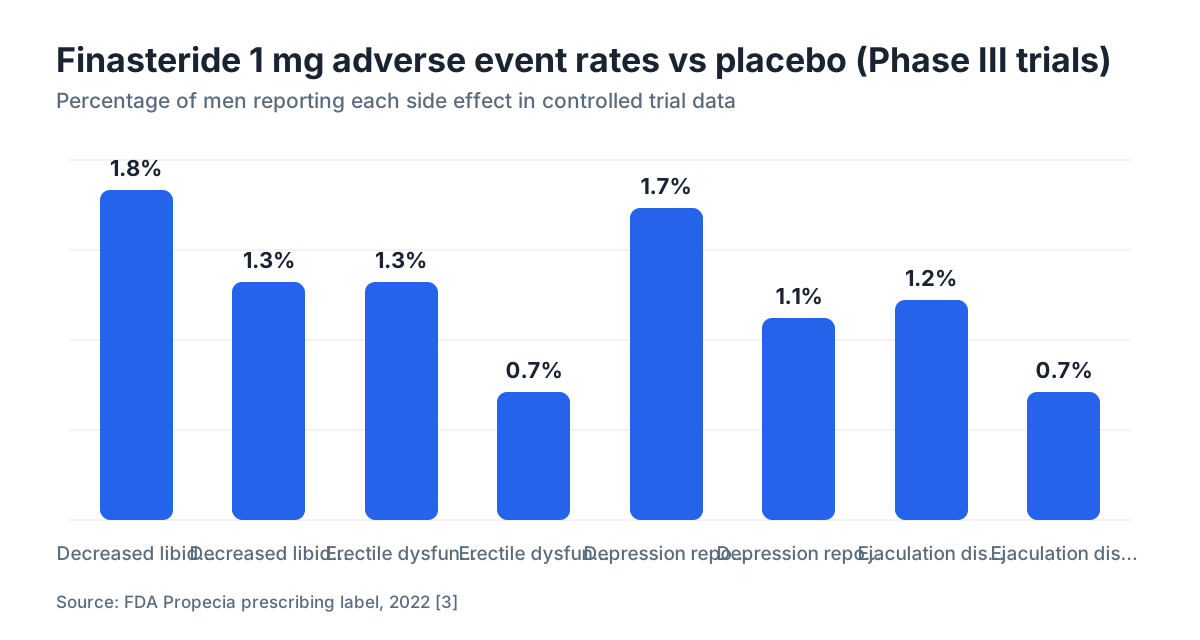
The FDA-approved prescribing information for Propecia (finasteride 1 mg) lists depression, and less often decreased libido and emotional lability, as reported adverse reactions [3]. The label does not break out a precise depression incidence, but in the Phase III trials that supported approval, depression showed up in roughly 1.7% of men on finasteride 1 mg versus about 1.1% on placebo.
That gap sounds small, and for many men it is. But a placebo-controlled gap still means real excess cases, and those trial populations were young and healthy, which probably undercounts risk in everyday clinical use.
A 2017 study in JAMA Internal Medicine followed 93,197 men in British Columbia. Finasteride users had 1.94 times the odds of a depression diagnosis in the first year compared with non-users, easing to about 1.67 times over 18 months [4]. These are observational numbers with the usual confounding caveats, but the signal keeps showing up across independent datasets.
A 2020 study in the Journal of Clinical Psychiatry found men with a prior psychiatric history were substantially more likely to develop depression on finasteride than men without one, which points to a real vulnerability interaction rather than statistical noise [5]. That changes the math for you personally. If you already deal with anxiety or depression, the risk calculus is not the same as it is for someone with a clean history.
How common are mood side effects compared to sexual side effects?
Sexual side effects get quantified more carefully than mood effects, which makes them look like the bigger issue. That may be a measurement artifact. Here is what the controlled trial data actually shows.
| Side effect | Finasteride (1 mg) trial rate | Placebo trial rate | Source |
|---|---|---|---|
| Decreased libido | 1.8% | 1.3% | FDA label, Propecia [3] |
| Erectile dysfunction | 1.3% | 0.7% | FDA label, Propecia [3] |
| Depression (reported) | ~1.7% | ~1.1% | Phase III trial data [3] |
| Anxiety (label mention) | Yes (no %, post-marketing) | N/A | FDA label, Propecia [3] |
| Ejaculation disorder | 1.2% | 0.7% | FDA label, Propecia [3] |
Mood effects are harder to count, partly because the early trials never used validated psychiatric scales as primary endpoints. The numbers above are real, but they likely run low. Men who developed significant depression may have dropped out before the endpoint, and spontaneous post-market reporting almost always captures a fraction of true incidence.
The honest read: sexual side effects are better documented in trial data, mood effects sit in a similar range for incidence, and for some men mood is the more disruptive of the two.
Can finasteride cause anxiety, more than depression?
Yes, and it gets less attention than depression. The FDA label for Propecia added anxiety as a post-marketing adverse reaction in 2012, meaning enough spontaneous reports piled up after approval to warrant inclusion [3].
The mechanism fits. Allopregnanolone acts on GABA-A receptors, and its deficiency is tied in research to both generalized anxiety and panic-spectrum symptoms. A 2019 study in Andrology surveyed men reporting persistent sexual side effects from finasteride and found over 70% of that group also reported mood disturbances, including anxiety, cognitive symptoms they called "brain fog," and emotional blunting [6]. That is not a general-population sample, so the percentage does not apply to the average user. But the way the symptoms cluster together points to a real neurosteroid-driven syndrome in susceptible people.
Men often describe the feeling as "flat" or dampened rather than jittery, which is different from classic anxiety. That blunting lines up pharmacologically with reduced GABA-A modulation. Some researchers file it under anhedonia, the inability to feel pleasure, rather than anxiety at all.
What is Post-Finasteride Syndrome and is it real?
Post-Finasteride Syndrome (PFS) is the label for a cluster of symptoms, including sexual dysfunction, depression, anxiety, cognitive fog, and emotional blunting, that some men report continuing after they stop the drug. The Post-Finasteride Syndrome Foundation has catalogued thousands of self-reported cases and funds independent research [7].
Whether PFS is a distinct medical condition is genuinely contested. In 2015 the FDA acknowledged receiving PFS-related adverse event reports and added persistent sexual side effects to the Propecia label, though it stopped short of naming PFS as a syndrome [3]. That is a real regulatory step even if it falls short of full recognition.
A 2020 review in the British Journal of Dermatology concluded that persistent neurological and psychiatric effects after stopping finasteride are "biologically plausible" given known neurosteroid mechanisms, but that high-quality prospective studies are missing [8]. That is not the same as saying it does not exist. It means the science has not caught up with the reports.
Here is the honest framing for someone deciding whether to start or continue. The large majority of men who stop finasteride see their side effects clear up. A smaller group, of genuinely uncertain size, reports symptoms lasting months to years. Nobody has reliable data on how big that group really is. The closest estimate, from one survey, put persistent sexual dysfunction after stopping at roughly 1 to 2% of users, and psychiatric persistence is quantified even more poorly [8].
Who is most at risk of mood changes on finasteride?
Prior psychiatric history is the strongest single risk factor, per the 2020 Journal of Clinical Psychiatry study [5]. Men with previous episodes of depression or anxiety were several times more likely to develop mood symptoms on finasteride than men with no history. If you carry that history, take the rest of this section seriously.
Other factors show up in the research, though with less certainty.
Age may matter. Younger men in their teens and early 20s have brains still finishing development and may be more sensitive to neurosteroid swings. There is no large trial in this age group, but some clinicians are more cautious prescribing to men under 22.
Genetic variation in the 5-alpha reductase gene (SRD5A2) could shape how sharply neurosteroid levels fall on the drug. Plausible, but not actionable yet, because there is no validated pharmacogenomic test for it.
Baseline neurosteroid levels could count too. A man who already runs low on allopregnanolone might sit closer to a symptomatic threshold before he takes his first dose. Again, nobody measures this in normal practice.
Dose likely matters. The 5 mg dose used for benign prostatic hyperplasia (Proscar) produces greater neurosteroid suppression than the 1 mg hair loss dose, and psychiatric adverse event rates in older prostate patients run at least as high, though age and other conditions muddy any direct comparison.
How quickly can mood changes appear, and do they go away when you stop?
Mood shifts tend to show up early. In the Canadian population study, elevated depression risk peaked in the first year of treatment [4]. Clinical reports include men noticing changes within weeks of starting.
For most men who develop mood side effects, stopping finasteride resolves them, usually over weeks to a few months. The Phase III trials showed sexual side effects clearing in most men after discontinuation, and mood effects appear to follow a similar course in most cases [3].
The complication is the PFS group. A subset reports symptoms lasting well beyond cessation. The neurosteroid hypothesis offers a possible reason: if prolonged suppression changes GABA-A receptor density or sensitivity, recovery may be slow or incomplete in some people. Mechanistically plausible, not proven in human prospective data [8].
Practical takeaway. If you start finasteride and your mood shifts in the first month or two, that is a signal worth acting on. It is not in your head. Call the prescribing doctor instead of quietly waiting it out.
Does the 5 mg dose carry more psychiatric risk than the 1 mg hair loss dose?
Almost certainly yes, though no head-to-head psychiatric safety trial has ever compared 1 mg and 5 mg directly. The pharmacology is simple enough: 5 mg suppresses DHT by roughly 70% versus about 65% for 1 mg, but the neurosteroid suppression curve is not linear [1]. Some research suggests 1 mg already produces near-maximal suppression of scalp DHT, while 5 mg adds more suppression systemically, including in the brain.
The large randomized Prostate Cancer Prevention Trial, which used 5 mg finasteride in older men, logged depression and mood changes as adverse events, though that population differs enough from hair-loss patients that rate comparisons stay tricky [9].
For hair loss, 1 mg is the standard and the relevant dose. Off-label use of 0.2 mg or 0.5 mg is practiced by some clinicians hoping to keep the hair benefit while cutting systemic effects. The evidence base for lower doses is thinner, but the logic of less neurosteroid suppression at a lower dose holds up.
Should you tell your doctor before starting finasteride if you have a mental health history?
Yes, and not as a box-checking exercise. The data show a meaningfully higher risk in men with prior depression or anxiety [5], and a good prescriber needs to know that before writing the script. If yours does not ask about psychiatric history when starting finasteride, raise it yourself.
If you are currently in treatment for depression or anxiety, loop in whoever manages that care. Finasteride does not interact with antidepressants in the classic pharmacokinetic sense, but adding a drug that could worsen the very condition being treated is a real clinical call.
Track your mood formally before and after starting. Something as simple as the PHQ-9, a free nine-question validated depression screener available through the NIH, at baseline and again at one and three months gives you objective data [10]. If your score worsens, you have something concrete to show a doctor instead of a vague sense that could get waved off.
Weighing finasteride against other options? Our comparison of finasteride and minoxidil covers the relative risk profiles of both, and the minoxidil side effects article lays out minoxidil's own adverse event profile. Minoxidil does not carry the neurosteroid concern.
If you are still mapping your overall hair loss picture before committing to any drug, a free AI hair analysis at MyHairline (/scan) can clarify your Norwood stage and which treatments usually apply to it.
Are there ways to monitor or reduce mood risk while taking finasteride?
A few practical steps come up in clinical guidance, though none are backed by randomized data specific to finasteride psychiatry.
Baseline and follow-up mood tracking with a validated tool like the PHQ-9 or GAD-7 is the most defensible move. It costs nothing and produces real data [10].
Do not wait for symptoms to get severe. Men often write off early mood changes as stress or life, which delays connecting the dots to finasteride. Emotional blunting, dropping motivation, or an atypical low mood in someone not usually prone to it, especially starting within weeks to months of the first dose, deserves a real conversation with a doctor.
Some prescribers set a structured trial of three to six months with explicit check-ins rather than an open-ended refill. That is not standard everywhere, but it is sensible.
To minimize systemic neurosteroid effects, topical finasteride (a 1% solution on the scalp) has lower systemic absorption and measurably smaller blood DHT suppression than the oral form. A 2019 study in the Journal of Drugs in Dermatology found about 23% serum DHT suppression with topical finasteride versus roughly 64% with oral [11]. Less systemic suppression should mean less neurosteroid impact. The tradeoff is a thinner efficacy evidence base, though small trials show real hair count gains.
Curious how the various DHT blockers stack up? That article goes deeper on how different 5-alpha reductase inhibitors compare.
What does the FDA currently say about finasteride and psychiatric side effects?
The current Propecia labeling, last meaningfully updated for psychiatric content in 2012, lists depression and anxiety under post-marketing adverse reactions and tells patients to watch for psychiatric symptoms [3]. The label states: "Patients should promptly report to their physician any changes in their breasts such as lumps, pain or nipple discharge. Patients should also report depression or signs of depression."
In 2022 the FDA required label updates for finasteride 1 mg and 5 mg products to add suicidal ideation to the warnings and precautions section, based on post-market case reports [3]. That is a significant escalation in official language. It does not mean finasteride commonly causes suicidal ideation. It means enough credible reports accumulated to justify a serious label change.
The FDA Adverse Event Reporting System (FAERS) shows several hundred depression reports and dozens of suicidality reports tied to finasteride in public data through 2023, though FAERS is subject to underreporting and cannot establish causation [3].
For the wider frame on where hair loss treatment stands, the American Academy of Dermatology publishes guidelines on androgenetic alopecia worth reading [12].
Is finasteride still worth taking for hair loss given the mood risks?
For most men, yes. The majority who take finasteride for hair loss never develop clinically significant mood changes, and the drug prevents further loss better than almost anything else available. The global evidence for its efficacy is deep [12].
But the risk is real, not imaginary, and it is not spread evenly. A man with no psychiatric history who knows the warning signs and monitors himself is in a very different spot than a man with recurrent depression who was never told mood effects were even possible.
If you are actively losing hair and weighing options, your current stage matters. The receding hairline article explains what the Norwood stages look like and which interventions have evidence at each one. For early loss, finasteride has the best evidence. For advanced loss, a hair transplant enters the picture, and for men who want to skip finasteride entirely, minoxidil for men is the main alternative with a genuinely different side effect profile.
The MyHairline AI scan (/scan) can pin down your stage before you commit to any medication. Knowing where you actually stand is the difference between a rational treatment decision and a guess.
Nobody should start finasteride without understanding that it does something to brain chemistry in a meaningful minority of users. Widely prescribed and generally well tolerated does not equal zero risk. Know the signal, track your baseline, and pick a doctor who takes the psychiatric question seriously.
Sources
- Melcangi RC et al., 'Neuroactive steroid levels and psychiatric and andrological features in post-finasteride patients,' Journal of Steroid Biochemistry and Molecular Biology, 2017
- Bäckström T et al., 'Allopregnanolone and mood disorders,' Progress in Neurobiology, 2014
- U.S. Food and Drug Administration, Propecia (finasteride) prescribing information and Drug Safety Communications
- Dyson TE et al., 'Finasteride use and risk of depression,' JAMA Internal Medicine, 2017
- Ganzer CA et al., 'Psychiatric adverse events in men prescribed finasteride,' Journal of Clinical Psychiatry, 2020
- Irwig MS, 'Persistent sexual side effects of finasteride: could they be permanent?', Andrology, 2019
- Post-Finasteride Syndrome Foundation, overview of PFS research and mission
- Gupta AK et al., 'Post-finasteride syndrome: a review of current literature,' British Journal of Dermatology, 2020
- Thompson IM et al., 'The Influence of Finasteride on the Development of Prostate Cancer (Prostate Cancer Prevention Trial),' New England Journal of Medicine, 2003
- National Institute of Mental Health, depression and anxiety screening resources (PHQ-9 and GAD-7)
- Caserini M et al., 'Effects of a novel finasteride 0.25% topical solution on scalp and serum dihydrotestosterone,' Journal of Drugs in Dermatology, 2019
- American Academy of Dermatology, clinical guidance on androgenetic alopecia treatment