
TL;DR: Yes. When inflammation around a hair follicle turns chronic, the body can swap the follicle's living tissue for scar tissue (fibrosis). A follicle fully replaced by fibrous cord cannot regrow hair. The upside: most common hair loss starts as reversible inflammation. Catching it before fibrosis locks in is what separates recoverable loss from permanent loss.
What actually happens to a follicle during inflammation?
A hair follicle is a small mini-organ with a lot going on. It sits in the dermis, wrapped in a connective tissue sheath, fed by blood vessels, ringed by immune cells that usually stay quiet. Trip those immune cells and they release inflammatory cytokines, including interleukins and tumor necrosis factor-alpha, and the tissue around the follicle turns inflamed.
Short term, that inflammation reverses. The follicle sheds its hair early, sits dormant in telogen, then restarts growth once the trigger clears. That is basically telogen effluvium: a stressor pushes follicles into a rest phase, the follicles stay structurally intact, and hair comes back.
The trouble starts when inflammation runs long or hits hard. Over months to years, persistent immune activity switches on fibroblasts, the cells that make collagen. Under repeated inflammatory signals they overproduce it, and that excess collagen wraps the follicle in a dense, disorganized matrix. That is perifollicular fibrosis [1].
Once fibrosis is well established, the follicle loses its blood supply, its stem cell niche in the bulge region gets wrecked, and the whole structure collapses into a fibrous cord. No current treatment regrows it. The skin in that spot goes smooth and follicle-free, for good.
Which types of hair loss actually cause fibrosis?
Not every kind of hair loss involves fibrosis, and the difference changes your entire treatment plan.
The scarring alopecias are where fibrosis is the whole story. Lichen planopilaris (LPP), frontal fibrosing alopecia (FFA), discoid lupus erythematosus (DLE), folliculitis decalvans, and central centrifugal cicatricial alopecia (CCCA) all destroy follicles through inflammation-driven fibrosis [2]. The American Academy of Dermatology groups these as primary cicatricial (scarring) alopecias. In these conditions, the follicle is the direct target of the immune attack.
Androgenetic alopecia (male and female pattern hair loss) is a different animal. It is technically non-scarring. But here is the part most people miss. Several studies found perifollicular lymphocytic infiltration and mild fibrosis in scalp biopsies from people with ordinary pattern hair loss, especially around the isthmus of the follicle [3]. A 1993 study in the Journal of the American Academy of Dermatology found that the degree of perifollicular fibrosis in androgenetic alopecia tracked with how well patients responded to treatment. More fibrosis, worse response [3].
So androgenetic alopecia miniaturizes hair mostly through DHT, but a secondary inflammatory component can speed things up and eventually lock the loss in. That is why early treatment matters, and why some researchers argue anti-inflammatory approaches alongside finasteride or minoxidil for men may add something.
Seborrheic dermatitis and chronic scalp folliculitis throw off low-grade inflammation too. Whether they cause fibrosis on their own, or only when severe and left alone for years, is still argued. The data is thin. The safe clinical move is to treat scalp inflammation early, before the question turns academic.
How do you know if fibrosis has already set in?
This is where a dermatologist earns the fee. You cannot call it from the mirror.
Signs that point to cicatricial (fibrosis-associated) loss instead of plain androgenetic loss: the follicular ostia disappear (those tiny pore openings vanish from the scalp surface), redness or scaling shows up around the hair margin, the active edges burn or itch, and the bare skin looks shiny or slightly sunken [2].
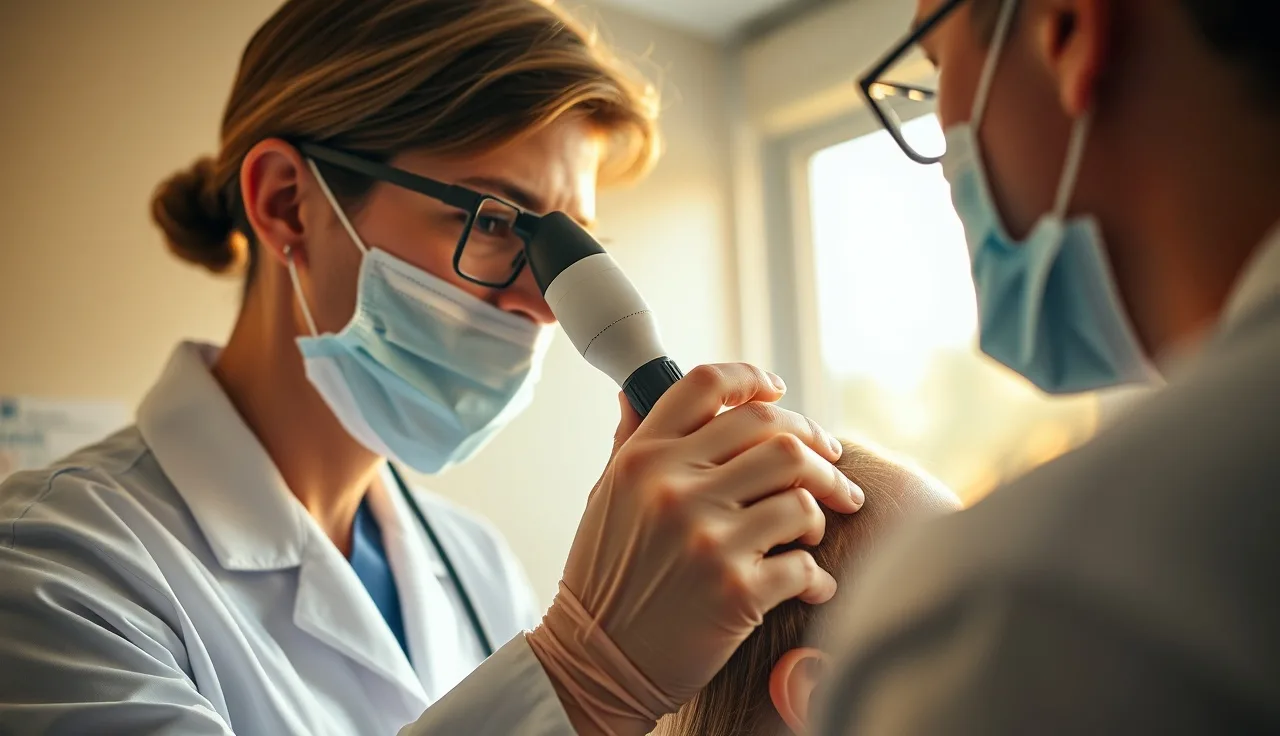
Dermoscopy, a magnified light exam of the scalp, lets a dermatologist read the follicular openings, perifollicular scale, and vessel patterns without cutting anything. Missing follicular ostia on dermoscopy is a strong scarring signal. A scalp biopsy settles it. A 4mm punch biopsy sent for horizontal sectioning shows the extent of fibrosis, the type of inflammatory cells, and whether any live follicles survive in the affected zone [2].
Get a biopsy if your loss does not match a standard androgenetic pattern, if you have symptoms (burning, tenderness, itch at the edge of loss), or if topical treatments have done nothing after six months. Waiting is the one thing fibrosis wants.
Can you reverse or stop fibrosis-driven hair loss?
Reversing established fibrosis is not possible with any approved treatment. Once a follicle becomes a fibrous cord, it is gone. Full stop.
What you can do is halt or slow active inflammation before it reaches that end. For the scarring alopecias, options include topical and intralesional corticosteroids, hydroxychloroquine (an antimalarial with anti-inflammatory effects used for LPP and DLE), oral tetracycline antibiotics for folliculitis decalvans, and JAK inhibitors now in clinical trials [4]. The goal of all of them is arrest, not reversal. Dermatologists count success as stabilization: no new loss for six to twelve months.
For androgenetic alopecia and its milder inflammatory streak, finasteride and minoxidil stay the first-line standard of care. Finasteride cuts DHT, which appears to quiet the inflammatory cytokine cascade that DHT partly drives at the follicle [5]. Minoxidil raises blood flow and stretches the anagen (growth) phase. Neither is specifically anti-fibrotic, but both slow the process that leads there.
For already-scarred areas, a hair transplant is on the table, but only after the active disease has stayed quiet (no new progression) for at least one to two years. Transplant into actively inflamed scalp and the grafts die.
How fast does fibrosis progress from inflammation?
It varies wildly between conditions and between people, and nobody has clean population-level data on exact timelines. Here is what the literature actually gives you.
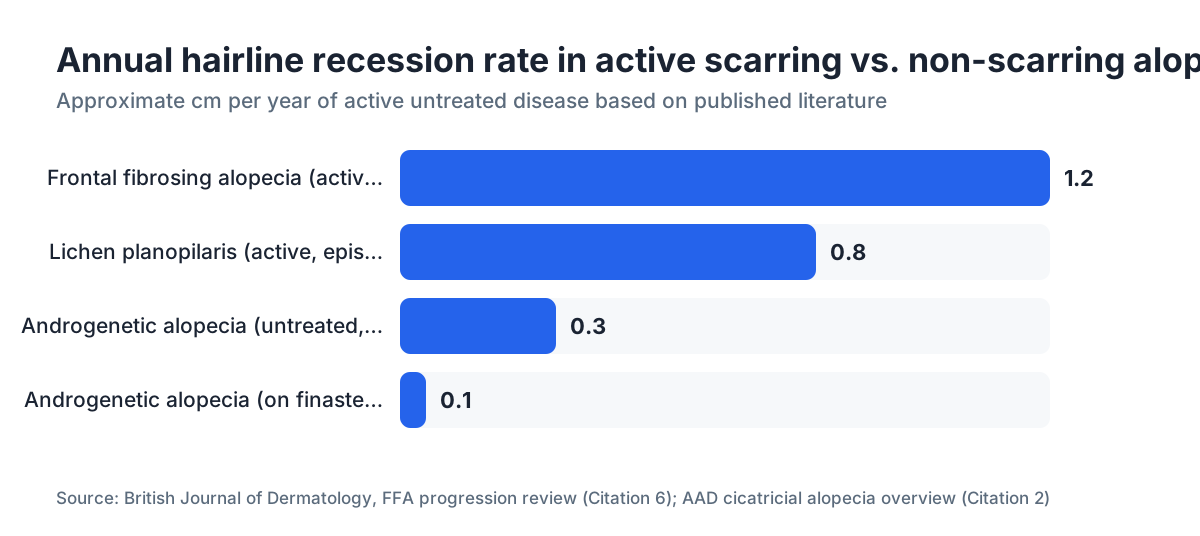
In frontal fibrosing alopecia, the hairline can retreat 0.5 to 2 centimeters per year during active disease [6]. That is a measurable rate. In lichen planopilaris, activity comes in episodes, flaring then quieting, which makes any timeline estimate shaky.
In androgenetic alopecia, the low-grade perifollicular fibrosis builds slowly. Long-running epidemiological work shows most men move through Norwood stages over years to decades, not months. The fibrotic piece in standard pattern loss is a late act, not the opening scene.
The honest answer: speed depends on which condition you have, how your immune system responds, and whether you are treating it. A dermatologist running serial dermoscopy or photography every three to six months can hand you a real answer for your case that no article can.
What does the research show about inflammation in male pattern baldness specifically?
The link between inflammation and androgenetic alopecia has been building in the literature for about thirty years. A frequently cited 1993 histological study found perifollicular lymphocytic infiltrates and concentric lamellar fibrosis in a meaningful share of androgenetic alopecia biopsies, even in early-stage loss [3].
Work from the Journal of Investigative Dermatology suggested DHT may raise prostaglandin D2 (PGD2) in the scalp, and PGD2 is both a hair growth inhibitor and a pro-inflammatory mediator. That casts DHT as more than a direct miniaturizing agent. It is also an inflammatory trigger [5]. That is one mechanistic reason DHT blockers may slow inflammation-linked fibrosis indirectly.
Studies examining scalp specimens from men with pattern hair loss have reported that perifollicular fibrosis runs greater in men with a longer duration of loss, pointing to cumulative damage over time [1]. That backs the case for early treatment: the inflammatory component compounds.
None of this makes male pattern baldness a scarring alopecia. It is not. But it does mean ignoring it for years, on the theory that you can start treatment whenever you feel like it, may let a small fibrotic component shrink how many follicles are still salvageable when you finally begin.
Does scalp itching or dandruff cause permanent follicle damage?
Scalp itch and flaking, usually from seborrheic dermatitis or scalp psoriasis, cause real inflammation. Whether that inflammation alone is enough to drive fibrosis depends on how severe it gets and how long it lasts.
Seborrheic dermatitis runs on a Malassezia yeast overgrowth that sets off an inflammatory response in the scalp skin. The inflammation is real and measurable. Several studies report correlations between seborrheic dermatitis severity and hair loss, though causation is harder to pin down [7]. At the usual mild-to-moderate level, seborrheic dermatitis is not a scarring condition. Treated early and kept in check with medicated shampoos (ketoconazole, zinc pyrithione, selenium sulfide), it is unlikely to cause fibrosis.
Let it run severe, untreated for years, and progress to folliculitis (direct follicle infection and inflammation), and the risk changes. Folliculitis decalvans, a scarring alopecia, likely starts as staph-related folliculitis that flips the immune system into a dysregulated response and eventual fibrosis [2].
So: ordinary dandruff, treated sensibly, probably not a fibrosis risk. Severe, chronic, untreated scalp disease, a different story. Treat your scalp. It is not hard.
Can you check whether your hair loss is inflammatory before seeing a dermatologist?
You can read some surface signals yourself, but a real answer needs a professional.
Self-check questions that lean toward an inflammatory or scarring process:
- Does the loss come with burning, tenderness, or itch right at the leading edge (more than random scalp itch)?
- Does the bare skin look smooth and shiny, almost poreless?
- Is the loss patchy rather than diffuse thinning or a receding hairline?
- Have you spotted redness or flaking specifically at the margin of loss?
- Are you losing hair in your 20s or 30s in a pattern that skips the standard Norwood progression?
Several yeses mean you should push for a dermatology referral instead of starting a receding hairline protocol on your own.
If you want a fast, low-barrier first look, the MyHairline AI scan at myhairline.ai/scan can read your hairline and flag patterns that look like something other than standard androgenetic loss, which may help you gauge how urgent a dermatologist visit is. It is a starting point, not a diagnosis.
For standard male or female pattern loss without those warning signs, the what causes hair loss framework holds: DHT sensitivity, genetics, and age are the main drivers, and the inflammation is a secondary process you handle by treating the primary cause early.
Does PRP, laser, or any cosmetic treatment help with fibrosis?
Platelet-rich plasma (PRP) and low-level laser therapy (LLLT) get marketed hard for hair loss. Their evidence for standard androgenetic alopecia is modest but real. Their evidence for fibrosis-driven loss specifically is much thinner.
PRP carries growth factors including platelet-derived growth factor (PDGF) and vascular endothelial growth factor (VEGF) that may support follicle survival and calm local inflammation. A few small studies in lichen planopilaris found PRP injections lowered disease activity scores and stabilized loss [4]. Small, uncontrolled studies. Not definitive. But the biology is plausible and the risk of PRP in scarring alopecia is low.
LLLT has no credible published evidence in scarring alopecias. The FDA has cleared it as a medical device for androgenetic alopecia [8], and that clearance does not stretch to cicatricial conditions.
There is ongoing research into treatments that might actually remodel scar tissue, including antifibrotic drugs used for organ fibrosis (like pirfenidone) applied topically. Experimental. None approved for hair loss as of 2026.
Short version: PRP is worth raising with a dermatologist for active scarring alopecia, as an adjunct to inflammation-suppressing drugs, not a solo fix. Laser devices for fibrosis have no evidence behind them. Neither does anything sold as a hair loss supplement for this mechanism.
Does minoxidil help or hurt when inflammation is the problem?
Minoxidil works mainly through vasodilation and stretching the anagen phase. It does not target inflammation or fibrosis directly. It also is not contraindicated in most inflammatory hair loss conditions.
For androgenetic alopecia with a secondary inflammatory component, minoxidil still fits. Keeping miniaturizing follicles in anagen may help them ride out ongoing low-grade inflammation, even if it does not touch the cause.
For the primary scarring alopecias, minoxidil is not the treatment. Dermatologists sometimes add it as support while the main anti-inflammatory drug does the work, trying to hold onto follicles at the margins of active disease. Not standard protocol, and the evidence is limited.
The minoxidil side effects picture does not include worsening inflammation. Contact dermatitis from the propylene glycol in some topical formulas can irritate an already touchy scalp, which is one reason some people do better on foam or oral minoxidil, which skips scalp application entirely.
If you have a diagnosed scarring alopecia, the minoxidil conversation belongs with your dermatologist, not a blog post or a pharmacy shelf.
What is the Norwood scale and where does fibrosis fit into hair loss staging?
The Norwood-Hamilton scale stages male pattern androgenetic alopecia from Type I (minimal recession) through Type VII (only a band of hair across the sides and back) [9]. It describes the pattern of loss, not the underlying pathology.
Fibrosis is not part of the Norwood classification. But the relationship matters clinically. A man at Norwood III untreated for fifteen years likely has more perifollicular fibrosis in his balding zones than a man at Norwood III who has been on finasteride for three years. The Norwood number reads the same. The biological state of the follicles does not.
That is one reason scalp biopsies matter when planning a hair transplant. The surgical team wants to know whether thinning areas still hold miniaturized follicles that might respond to medical treatment, or whether the tissue has gone largely fibrous and only transplantation can rebuild density.
| Norwood Stage | Pattern | Typical Follicle Status | Fibrosis Risk (AGA only) |
|---|---|---|---|
| I-II | Minimal recession | Mostly intact | Very low |
| III | Visible recession at temples | Mixed intact and miniaturized | Low-moderate |
| IV-V | Significant crown/top loss | Mostly miniaturized | Moderate |
| VI-VII | Near-complete top/crown loss | Largely miniaturized, some fibrosis | Higher with long duration |
When should you see a dermatologist about hair loss inflammation?
Urgently, if any of these fit: the loss is patchy rather than diffuse, the scalp burns or aches at areas of active loss, you see redness or perifollicular scaling at the border of loss, or you are losing hair in your teens or early twenties in an odd pattern.
Soon (within a few months), if: you have treated apparent androgenetic alopecia for six months or more with first-line options and seen nothing, you have a known autoimmune condition and are now losing scalp hair, or someone in your family has a diagnosed scarring alopecia.
A dermatologist who suspects scarring alopecia will usually order a scalp biopsy, sometimes with direct immunofluorescence to look for immunoglobulin deposits typical of lupus-related alopecia. Blood work may include ANA titers, thyroid panel, iron studies, and zinc levels depending on the picture.
Time matters here in a way it does not for most conditions. Every month of active scarring alopecia is follicles that will not come back. Waiting for a convenient appointment slot is fine. Waiting six months because you are not sure it is serious enough is a decision you may regret. The myhairline.ai/scan tool can help you judge urgency fast while you line up a clinical appointment.
For most people reading this, the news is better than the scary parts suggest. Standard androgenetic alopecia is not a scarring alopecia. Treat it early, stay consistent, use proven options, and you keep the low-grade inflammatory component from compounding into a bigger problem.
Sources
- British Journal of Dermatology (Oxford Academic), perifollicular fibrosis and duration of androgenetic alopecia
- American Academy of Dermatology, Cicatricial Alopecia overview
- Journal of the American Academy of Dermatology, Whiting 1993, histology of androgenetic alopecia
- Journal of the American Academy of Dermatology, scarring alopecia treatment review
- Journal of Investigative Dermatology, Garza et al. 2012, prostaglandin D2 inhibits hair follicle growth
- British Journal of Dermatology (Oxford Academic), frontal fibrosing alopecia progression review
- National Library of Medicine (PubMed/NCBI), seborrheic dermatitis and hair loss review
- U.S. FDA, 510(k) clearance of low-level laser therapy devices for androgenetic alopecia
- National Library of Medicine (NCBI), Norwood-Hamilton classification of male androgenetic alopecia
- Journal of the American Academy of Dermatology, central centrifugal cicatricial alopecia in Black women
- American Academy of Dermatology, androgenetic alopecia diagnosis and treatment guidance