TL;DR: Finasteride does raise total testosterone, typically by around 10 to 15%, because it blocks the enzyme that converts testosterone into dihydrotestosterone (DHT). Your body keeps making testosterone but converts less of it, so levels edge up slightly. That rise is real but modest and, for most men, has no noticeable effect on muscle, libido, or energy.
What does finasteride actually do to your hormones?
Finasteride is a 5-alpha-reductase inhibitor. That phrase sounds dense, but the mechanism is straightforward. Your body converts testosterone into a more potent androgen called dihydrotestosterone (DHT) through an enzyme called 5-alpha-reductase. Finasteride blocks that enzyme, so less testosterone gets converted into DHT.
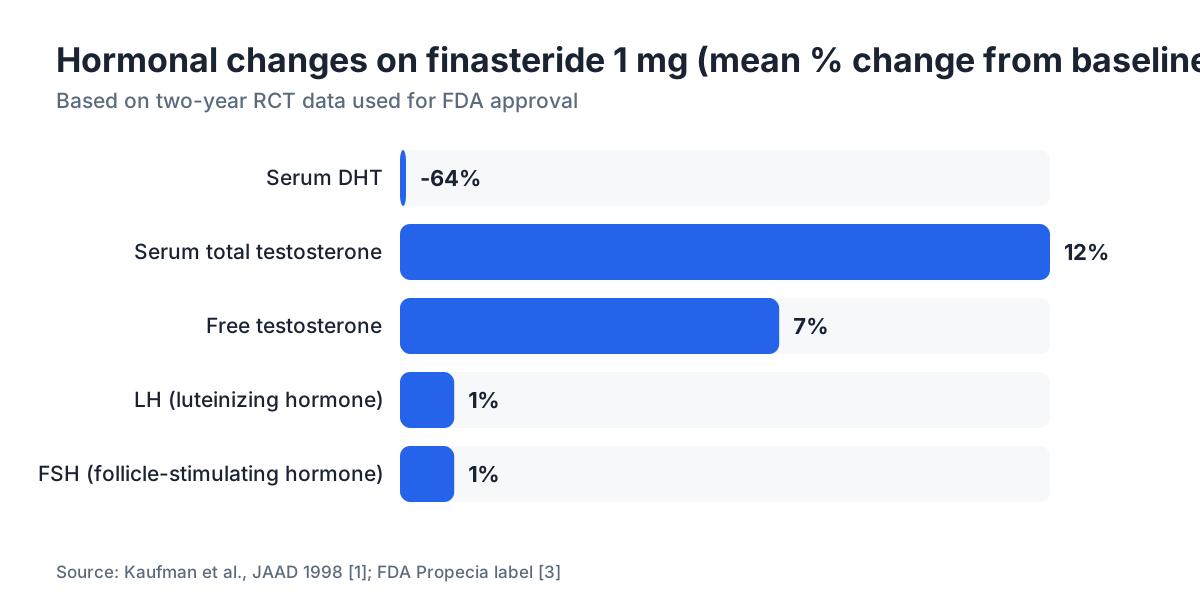
The downstream effect: testosterone accumulates slightly because the conversion pathway is partly closed off. The standard 1 mg daily dose used for androgenetic alopecia reduces serum DHT by roughly 60 to 70% and raises serum testosterone by roughly 10 to 15% [1]. The 5 mg dose used for benign prostatic hyperplasia suppresses DHT even more, around 70 to 75%, with a proportionally similar rise in testosterone [2].
Think of it like a one-way valve getting partially pinched. Testosterone is still produced at the same rate, but less of it exits through the DHT pathway, so more stays in the testosterone pool. The pituitary does not read the small rise as a problem worth correcting, so levels just sit a little higher than baseline.
This is not the same as taking exogenous testosterone. The rise is passive, not an injection. Most men never feel it.
How much does testosterone actually go up on finasteride?
The numbers matter, and they are modest. The randomized controlled trial published in the Journal of the American Academy of Dermatology, which was the basis for the FDA's 1997 approval of Propecia, found that men on 1 mg finasteride daily saw mean serum DHT fall from roughly 502 pg/mL to around 186 pg/mL, while serum testosterone rose from roughly 5.6 ng/mL to about 6.1 ng/mL [1]. That is roughly a 9 to 10% increase in total testosterone in that dataset.
Other pharmacokinetic studies have reported slightly higher rises, up to 15%, depending on baseline levels, age, and the measurement timing [2]. The FDA's approved label for Propecia notes that finasteride 1 mg decreased serum DHT by 64% on average across studies [3].
Normal total testosterone in adult men ranges from roughly 300 to 1,000 ng/dL depending on the assay and lab reference range [4]. A 10 to 15% rise from, say, 550 ng/dL gets you to around 605 to 630 ng/dL. You are still well within the normal range. Nobody is going from hypogonadal to supraphysiological here.
Free testosterone, the fraction not bound to proteins and considered the most biologically active form, also rises slightly, but the increase is similarly small and generally stays within normal range [2].
Why does DHT matter more than testosterone for hair loss?
Testosterone and DHT are both androgens, but DHT binds to the androgen receptor with about five times greater affinity than testosterone does [5]. In scalp hair follicles that carry a genetic sensitivity to androgens, DHT is the main driver of the miniaturization process that eventually kills the follicle. Reducing DHT directly addresses the mechanism behind male pattern baldness, also called androgenetic alopecia.
You can read more about how androgens drive follicle shrinkage in our overview of what causes hair loss and our closer look at DHT blockers.
Testosterone itself has a weaker effect on follicle miniaturization than DHT does. That is why the rise in testosterone from finasteride does not cancel out the drug's hair-preserving benefit. The whole point is to cut the more potent androgen while leaving a modest amount of testosterone essentially unchanged.
Does higher testosterone from finasteride actually change anything you feel?
For the vast majority of men, the answer is no. A 10 to 15% rise in testosterone from a baseline within normal range is not the kind of change you would notice in strength, libido, or mood. Clinical trials found no statistically significant difference in sexual function attributable to that testosterone rise [1].
Here is the counterintuitive part. Some men on finasteride report reduced libido and sexual side effects, not increased ones. That happens because DHT itself has functions in sexual physiology, including modulating mood, genital sensitivity, and erectile mechanisms. Reducing DHT can affect those functions in some men even though testosterone rises slightly. The FDA label acknowledges sexual side effects including decreased libido, erectile dysfunction, and ejaculation disorders, each occurring in 1 to 2% of trial participants [3].
A small number of men also report what has become known as post-finasteride syndrome, a persistent cluster of sexual, cognitive, and emotional symptoms after stopping the drug. The mechanism is not fully understood and the syndrome remains contested in the literature [6]. If you are seeing symptoms you attribute to finasteride, talk to a physician rather than just stopping abruptly.
Does finasteride affect testosterone differently in women?
Women also have DHT and 5-alpha-reductase activity, though at lower absolute levels than men. Off-label finasteride use in women with androgenetic alopecia does raise testosterone for the same mechanistic reason: less testosterone converts to DHT, so more stays in the testosterone pool [7].
The clinical concern in women is different from men. Finasteride is a Category X drug in pregnancy due to the risk of feminizing a male fetus. Women who are pregnant or could become pregnant should not handle crushed finasteride tablets [3]. For postmenopausal women with female pattern hair loss, some clinicians prescribe finasteride off-label and find it helpful, but the evidence base is thinner than in men.
The testosterone rise in women on finasteride follows a similar proportional pattern to men, but because women start from a much lower baseline, the absolute increase is small. Whether that rise has any clinical significance in women is not well studied.
Finasteride and testosterone: what does the comparison data look like?
The table below summarizes the key hormonal changes seen in the main clinical trials and pharmacokinetic studies cited in the literature.
| Measure | Baseline (approx.) | On finasteride 1 mg | Change |
|---|---|---|---|
| Serum DHT | ~500 pg/mL | ~180 to 200 pg/mL | Down ~60 to 64% |
| Serum total testosterone | ~5.5 to 6.0 ng/mL | ~6.0 to 6.8 ng/mL | Up ~9 to 15% |
| Serum free testosterone | Within normal range | Slight increase | Up ~5 to 10% |
| Luteinizing hormone (LH) | Normal | Minimal change | No significant shift |
| Follicle-stimulating hormone (FSH) | Normal | Minimal change | No significant shift |
Sources: Kaufman et al. JAAD 1998 [1]; Gormley et al. J Urol 1992 (5 mg data) [2]; FDA Propecia label [3].
The flat LH and FSH tell the real story. The hypothalamic-pituitary-gonadal axis is not reacting to the testosterone rise by turning down production. The body basically treats the new testosterone level as normal.
Can finasteride be used to boost testosterone intentionally?
Some men and clinicians have asked whether finasteride could act as a mild testosterone booster. The logic is superficially appealing: if it raises testosterone 10 to 15%, could it help someone with low-normal testosterone feel better?
The honest answer is no, and this is not what finasteride is for. A 10 to 15% rise from a mid-range baseline stays within the normal range and does not produce the clinical effects of testosterone replacement therapy. Men with true hypogonadism, who have low testosterone along with symptoms like fatigue, low libido, and mood disturbance, need a proper evaluation and potentially actual hormone replacement, not a DHT blocker.
Finasteride was approved by the FDA specifically for androgenetic alopecia (1 mg) and benign prostatic hyperplasia (5 mg) [3]. Using it as an informal testosterone strategy is not evidence-based, and the sexual side effect profile means it is not a risk-free experiment.
If you want to understand your hormone levels before starting finasteride, ask your doctor for a baseline testosterone and DHT panel. That way you have a real number to compare against.
Does finasteride interact with testosterone therapy or steroids?
This is a real-world question for men who use testosterone replacement therapy (TRT) or anabolic steroids. When you add exogenous testosterone, 5-alpha-reductase activity increases proportionally because there is more substrate to convert. DHT rises sharply, which can speed up androgenetic alopecia in genetically susceptible men. This is one reason some men on TRT develop or worsen hair loss.
Finasteride is sometimes used alongside TRT precisely to blunt the DHT rise that TRT causes. The combination is not FDA-approved for that purpose, but clinicians do prescribe it off-label in that context. The testosterone-elevating effect of finasteride becomes less meaningful here because the exogenous testosterone dose dominates total levels.
For men on anabolic steroids, the picture gets complicated because many synthetic androgens are not substrates for 5-alpha-reductase the way testosterone is. Nandrolone, for example, converts to a weaker androgen (5-alpha-dihydronandrolone) through 5-alpha-reductase, so finasteride could paradoxically worsen hair loss for someone using nandrolone rather than helping [8]. This is a niche but real issue.
How does finasteride compare to minoxidil on hormones?
Minoxidil works through a completely different mechanism and does not affect testosterone, DHT, or any hormone. It is a vasodilator that extends the anagen (growth) phase of the hair cycle and improves blood flow to follicles. There is no hormonal interaction [9].
That is why finasteride and minoxidil are often combined. They hit different parts of the problem. Finasteride reduces DHT-driven miniaturization; minoxidil stimulates growth independent of hormones. If you are weighing one against the other or thinking about combining them, the article on finasteride and minoxidil covers the evidence on combination use in detail.
For men worried specifically about hormone side effects, minoxidil has essentially none. Its side effects are mostly local: scalp irritation, unwanted facial hair in some users, and in rare cases, initial shedding [see our guide to minoxidil side effects]. If the hormonal changes from finasteride concern you, minoxidil sidesteps that issue entirely, though it also does not directly block DHT.
What should you monitor if you start finasteride?
If you are starting finasteride and want to track your hormones, the most informative baseline blood panel includes total testosterone, free testosterone, DHT, LH, FSH, and a basic metabolic panel. Most men on 1 mg finasteride do not need routine hormone monitoring because the changes are predictable and within normal ranges [3].
That said, some physicians do order a follow-up panel at three to six months to confirm DHT suppression and rule out unexpected responses. If you have pre-existing low testosterone or are already on TRT, monitoring becomes more important.
Symptoms matter more than numbers for most patients. If you develop persistent sexual side effects, mood changes, or fatigue after starting finasteride, that is worth discussing with a prescribing physician, more than a self-interpreted blood test. The relationship between finasteride and your hormones is more complex than a single testosterone number captures.
If you want a starting point for understanding your hair loss picture before committing to medication, our free AI hair analysis at MyHairline can help you map your current pattern and see whether the degree of loss is consistent with androgenetic alopecia, which is the specific condition finasteride is approved to treat.
For broader context on what drives hair loss and when finasteride makes sense, the finasteride overview covers dosing, efficacy, and the full side effect profile in depth.
Does finasteride affect testosterone long-term with continuous use?
Men who take finasteride for years, often for a decade or more to keep their hair, tend to hold the same modest testosterone elevation without meaningful tolerance or progressive hormonal drift [1]. The mechanism does not change over time: as long as you take the drug, 5-alpha-reductase stays inhibited, DHT stays suppressed, and testosterone stays slightly elevated.
When you stop finasteride, DHT rebounds to baseline levels within one to two weeks. Testosterone drops back proportionally. There is no lasting hormonal disruption from the drug in the vast majority of men [3]. Some men report a temporary hair shedding event after stopping, sometimes called a rebound shed, because the DHT-driven miniaturization resumes quickly.
The long-term safety data on finasteride 1 mg is fairly reassuring for hormonal outcomes specifically. FDA approval was based on two-year trials, but later observational follow-ups extending to five years showed consistent hormonal profiles without progressive changes [1]. The contested area remains the rare cases of persistent side effects after stopping, not long-term hormonal damage in men who tolerate the drug well.
Sources
- Kaufman KD et al., Journal of the American Academy of Dermatology, 1998, Finasteride 1 mg RCT (JAAD)
- Gormley GJ et al., Journal of Urology, 1992, Finasteride 5 mg pharmacokinetics
- FDA, Propecia (finasteride 1 mg) Prescribing Information
- Endocrine Society, Testosterone Therapy in Men Clinical Practice Guideline
- Imperato-McGinley J et al., New England Journal of Medicine, 1974, DHT androgen receptor affinity
- Irwig MS, Journal of Sexual Medicine, 2012, Post-finasteride syndrome
- Price VH et al., Journal of the American Academy of Dermatology, 2000, Finasteride in women with androgenetic alopecia
- Thiboutot D et al., American Academy of Dermatology, Androgen metabolism in skin
- FDA, Rogaine (minoxidil topical) Prescribing Information
- Thompson IM et al., New England Journal of Medicine, 2003, Prostate Cancer Prevention Trial (NIH/NCI funded)
- National Institutes of Health MedlinePlus, Finasteride drug information