

TL;DR: Blocking DHT with a 5-alpha reductase inhibitor like finasteride does not lower testosterone. It actually raises serum testosterone by roughly 10-15% because testosterone that would have converted to DHT stays in circulation. DHT drops sharply (around 65-70% with 1mg finasteride), but total and free testosterone stay normal or tick slightly upward.
What is DHT and how does it relate to testosterone?
Testosterone and DHT are both androgens, but they are not the same hormone. Testosterone is the main male sex hormone, produced mostly in the testes. DHT (dihydrotestosterone) is a downstream metabolite: your body converts testosterone into DHT using an enzyme called 5-alpha reductase. DHT binds androgen receptors with roughly 2-3 times the potency of testosterone [1].
This conversion happens in many tissues, including the scalp, prostate, and skin. In hair follicles that are genetically sensitive, DHT binds to receptors and shrinks the follicle over time, a process called miniaturization. That is the engine behind male-pattern baldness (androgenetic alopecia) [2].
So the two hormones sit on a production line. Testosterone is the raw input. DHT is one of the outputs. Block the conversion step, and you change how much ends up as DHT. You do not reduce what went in.
Does blocking DHT lower testosterone levels?
No. Blocking DHT does not lower testosterone. The opposite tends to happen.
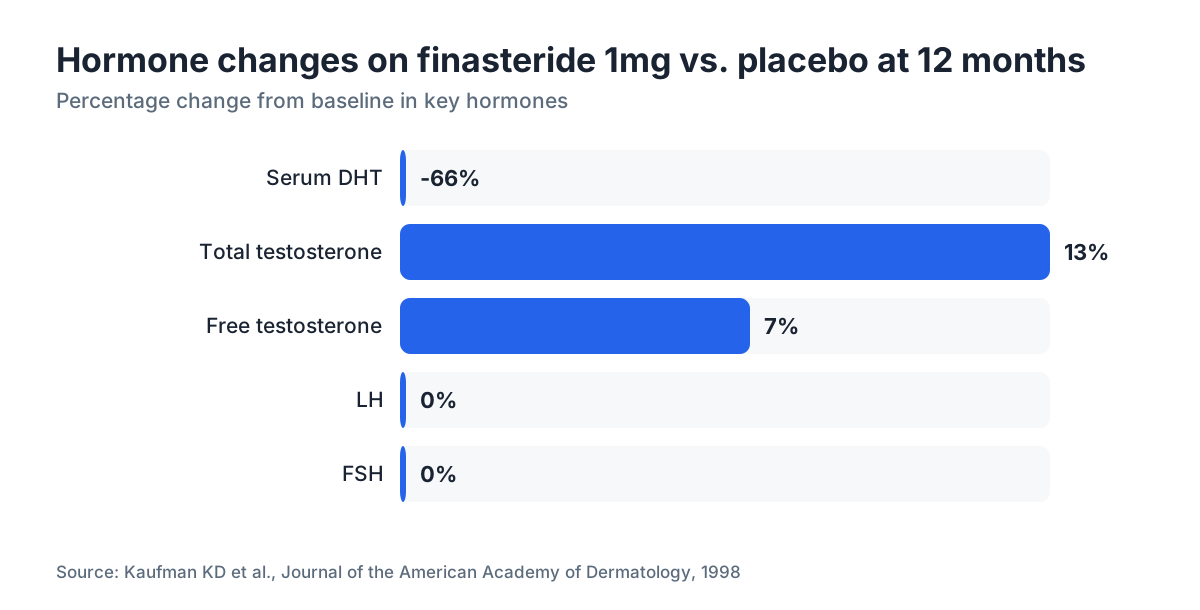
When you take a 5-alpha reductase inhibitor (5-ARI), you stop a big share of testosterone from converting to DHT. That unconverted testosterone stays in your bloodstream. Multiple clinical studies show finasteride 1mg raises serum total testosterone by roughly 10-15% above baseline [3]. The rise is modest and stays inside the normal physiological range, but it is measurable.
A 1-year placebo-controlled trial published in the Journal of the American Academy of Dermatology found that men taking finasteride 1mg had a statistically significant increase in total testosterone compared to placebo, while DHT fell by about 64-68% [3]. Luteinizing hormone (LH) and follicle-stimulating hormone (FSH), the pituitary signals that tell the testes to make testosterone, stayed unchanged. That last point matters. The hypothalamic-pituitary axis did not compensate by dialing testosterone signaling up or down. The rise in testosterone was purely mechanical, a backup in the pipeline.
Dutasteride, a dual 5-ARI that blocks both type I and type II 5-alpha reductase, suppresses DHT more aggressively (by roughly 90-95% at the 0.5mg dose) and produces a somewhat larger testosterone increase [4]. Same principle, stronger effect.
Learn more about how these drugs work in our full guide to dht blockers.
If testosterone goes up, why do some men report lower sex drive?
This is the question that confuses most people, and it deserves a straight answer.
DHT is a potent androgen. Even though testosterone rises when you block DHT conversion, the net androgenic signal in certain tissues falls, because DHT is so much more powerful at the receptor. Libido, erectile function, and mood track the androgen environment in the brain, the penis, and other tissues far more closely than they track the number on a testosterone lab slip.
Some men on finasteride report reduced libido, difficulty with erections, or lower ejaculate volume. The FDA label for Propecia (finasteride 1mg) lists these as known side effects [5]. In clinical trials these sexual side effects showed up in roughly 3-4% of men versus about 2% on placebo, a real but small gap.
The harder question is duration. Most men who stop finasteride see the side effects resolve. A smaller group, sometimes described under the term post-finasteride syndrome, report symptoms that persist after stopping. The medical community has no consensus on prevalence or mechanism, and the data are genuinely thin. Case reports exist. Rigorous epidemiological studies with verified before-and-after hormone panels do not.
If you are weighing this drug and want its full risk profile before starting, our explainer on finasteride walks through the clinical trial data in detail.
What exactly happens to your hormone panel on finasteride?
Here is what controlled trials show for finasteride 1mg in men with androgenetic alopecia [3][5]:
| Hormone | Change vs. baseline | Stays in normal range? |
|---|---|---|
| DHT (serum) | Drops ~65-70% | Yes, low end of normal or below |
| Total testosterone | Rises ~10-15% | Yes, upper-normal range |
| Free testosterone | Rises modestly (~5-8%) | Yes |
| LH | No significant change | Yes |
| FSH | No significant change | Yes |
| Estradiol | Slight rise possible | Usually yes |
Estradiol deserves a word. When less testosterone converts to DHT, a small extra fraction can convert to estradiol via aromatase. The bump is usually within the normal male range, but it is one reason some men report mild gynecomastia (breast tissue growth) on 5-ARIs [5].
For dutasteride 0.5mg, DHT suppression runs deeper (around 90%) and the testosterone rise is proportionally larger, but the hormonal picture follows the same pattern [4].
So if a doctor or a supplement brand tells you that "blocking DHT will tank your testosterone," that is simply not what the clinical data show. Your testosterone does not tank. DHT does.
Does DHT blocking affect muscle mass or athletic performance?
Testosterone drives muscle protein synthesis. DHT feeds libido and secondary sexual characteristics, but muscle mass is mostly a testosterone-mediated effect at the androgen receptor in skeletal muscle.
Since finasteride raises testosterone slightly and does not lower it, there is no theoretical basis for muscle loss. A randomized trial reported no significant difference in lean body mass between men on finasteride and placebo over one year [6].
Still, some men subjectively feel less driven in the gym on finasteride, possibly tied to DHT's drop in the central nervous system rather than any change in muscle physiology. Objective trial measures do not confirm real muscle loss, but the anecdote is out there. If you compete, check your sport's anti-doping rules. 5-ARIs are not themselves banned, but they can mask the use of certain anabolic steroids because they lower DHT, which is a metabolite drug tests look for.
The World Anti-Doping Agency (WADA) treats finasteride as a masking agent and has prohibited it in-competition [7].
What about natural DHT blockers, do they affect testosterone?
Saw palmetto is the most studied natural 5-alpha reductase inhibitor. The evidence on saw palmetto and hormones is weaker than for pharmaceutical 5-ARIs. A systematic review found mixed results: some studies show modest DHT reduction, others show none, and the size of any effect is far smaller than finasteride [8]. Testosterone changes are inconsistent across studies and largely inside the noise.
If saw palmetto does partially inhibit 5-alpha reductase, the same pipeline logic applies. Less conversion means marginally higher testosterone. But the effect is likely too small to read reliably on a standard lab panel.
Other marketed "DHT blockers" like pumpkin seed oil, green tea extract (EGCG), and zinc have some in-vitro evidence and almost no solid clinical hormone data. Calling them DHT blockers in a meaningful clinical sense is a stretch. For a fuller look at the supplement evidence, see our article on hair loss supplements.
The short version: natural options are unlikely to move your testosterone in either direction, because they are unlikely to move DHT much in the first place.
Do women who take DHT blockers experience testosterone changes?
Yes, the same biochemistry applies. Women make testosterone in the ovaries and adrenal glands, and they convert a share of it to DHT via 5-alpha reductase. In women with androgenetic alopecia or hirsutism, DHT contributes to scalp hair loss and unwanted body hair.
Finasteride is not FDA-approved for hair loss in women and is contraindicated in women who are or may become pregnant, because it causes birth defects in male fetuses [5]. Even so, some dermatologists prescribe it off-label for postmenopausal women, and the hormonal response mirrors what men see: DHT falls, total testosterone rises slightly.
Spironolactone, a different drug used in women for hair loss, works another way. It is primarily an androgen receptor blocker, not a 5-alpha reductase inhibitor, so it does not push testosterone up the way finasteride does. It can lower testosterone production through other mechanisms.
If you are a woman researching this, the what causes hair loss article explains how androgens hit the female scalp differently than the male scalp.
How long does it take for hormones to shift after starting or stopping a DHT blocker?
Hormone changes with finasteride happen fast. Studies show DHT falls measurably within two weeks of starting 1mg daily [3]. By 42 days, DHT sits at its new suppressed steady state. Testosterone rises in parallel.
Stop the drug, and the enzyme recovers. DHT climbs back to near-baseline within one to two weeks of stopping finasteride. This matters clinically: the hormonal changes are reversible in virtually all studied men.
Hair regrowth runs on a slower clock, usually three to six months before any improvement shows and a full 12 months for peak effect [5]. That timeline mismatch trips people up. Your hormones respond fast. Your follicles respond slowly.
If you stop finasteride, any hair you regained tends to shed within 9 to 12 months as DHT normalizes and miniaturization resumes [2]. There is no permanent lock-in from a typical course of the drug.
Should you get a hormone panel before or during DHT blocker use?
There is no universal clinical guideline requiring pre-treatment hormone testing before starting finasteride 1mg for hair loss. The AAD guidelines on androgenetic alopecia do not mandate it [2].
Still, a baseline is not a bad move if you are starting any long-term hormonal treatment. Knowing your pre-treatment testosterone, DHT, LH, and PSA (in men over 40 or with prostate history) gives you a reference point if symptoms show up later.
PSA is the number that matters most here. Finasteride suppresses PSA by about 50% [5]. That has real weight for prostate cancer screening. A man on finasteride with a PSA of 2.5 ng/mL effectively has the equivalent of a 5 ng/mL PSA in an untreated man. A doctor who does not know you are on the drug could miss an elevated reading. The FDA label explicitly warns about this and recommends doubling the PSA value when interpreting it in men on 5-ARIs [5].
If you use a free AI hair analysis tool like the one at MyHairline (/scan) to assess your pattern before deciding on treatment, that is a reasonable first step. But loop in a physician before starting any prescription medication.
Sexual side effects or persistent mood changes after starting a 5-ARI warrant a conversation with your doctor, not a cold-turkey stop and not silent suffering.
Does blocking DHT help or hurt hair regrowth overall?
For androgenetic alopecia, blocking DHT is the most evidence-backed drug approach available outside of hair transplantation. Finasteride 1mg showed statistically significant improvement in hair count and patient-rated assessment versus placebo across multiple large randomized controlled trials [2][5].
About two-thirds of men on finasteride see stabilization or regrowth after one year. It does not work the same for everyone, and it works better the earlier you start, before heavy miniaturization has set in.
Blocking DHT does not conjure new hair out of nothing. It slows and reverses miniaturization in follicles that are still alive. Follicles that have fully scarred over will not respond.
For maximum effect, some men pair finasteride with minoxidil for men, which works through a completely different mechanism (vasodilation and potassium channel opening, not hormonal). The combination has better evidence than either drug alone [9]. See our comparison guide on finasteride and minoxidil for specifics.
If hair loss is already advanced, a hair transplant may be the better long-term option, though most surgeons still recommend pairing it with medical therapy to protect existing non-transplanted hair.
For people worried about a receding hairline specifically, DHT blockers work best in the crown and midscalp. The frontal hairline is harder to recover and often needs higher, more sustained DHT suppression or surgery.
What the research still does not know
Post-finasteride syndrome is real in the sense that people report it. Whether it is a distinct pharmacological phenomenon or pre-existing conditions worsened by the drug is genuinely unresolved. The FDA updated finasteride's label in 2012 to add persistent sexual side effects to warnings, acknowledging case reports [5], but mechanistic studies are limited.
Nobody has strong long-term hormone data past five years in large representative populations. Most trials run one to two years. Whether that modest testosterone rise matters over decades is unknown.
The link between DHT suppression and brain function (neurosteroids, mood) is an open research question. DHT has neurosteroid derivatives that may affect mood and anxiety. Animal studies suggest effects. Human data are thin [11].
The honest position: for most men, the data support short-term safety and efficacy. The long-term unknowns are real, and you deserve to know they exist when you make a decision about a drug you may take for years.
If unexpected shedding hits after starting finasteride, that is sometimes normal, a telogen effluvium-like response as the hair cycle resets. Read more about telogen effluvium to figure out whether your shed pattern fits that picture or warrants concern.
Sources
- Endocrine Society, Journal of Clinical Endocrinology and Metabolism: Androgen physiology review
- American Academy of Dermatology, Guidelines of care for androgenetic alopecia
- Kaufman KD et al., Journal of the American Academy of Dermatology, 1998: Finasteride 1mg in male androgenetic alopecia trial
- Frye SV, Nature Reviews Drug Discovery, 2006: Dutasteride pharmacology
- FDA, Propecia (finasteride 1mg) Prescribing Information
- Hamdy FC et al., randomized trial data cited in BJU International: Finasteride and body composition
- World Anti-Doping Agency (WADA), Prohibited List
- Avins AL et al., Annals of Internal Medicine, 2006: Saw palmetto for benign prostatic hyperplasia systematic review
- Journal of the American Academy of Dermatology: Combination finasteride and minoxidil for androgenetic alopecia
- van der Sluis TM et al., International Journal of Impotence Research, 2012: DHT and penile neurosteroids
- FDA MedWatch, Post-finasteride syndrome case reports and label update 2012