TL;DR: Dutasteride 0.5 mg blocks roughly 98% of scalp DHT compared to finasteride's 70%, and two head-to-head trials found it grows meaningfully more hair at 24 weeks. The catch: dutasteride's half-life is about 5 weeks, so side effects linger for months if they show up. Finasteride is FDA-approved for hair loss. Dutasteride is off-label in most countries.
What are dutasteride and finasteride, and how do they differ?
Both drugs block an enzyme called 5-alpha reductase, which turns testosterone into dihydrotestosterone (DHT). DHT is the androgen behind androgenetic alopecia, the pattern loss that hits roughly 50% of men by age 50 and a large share of women too [1]. Less DHT means less follicle miniaturization.
The real difference is which version of the enzyme each drug hits. 5-alpha reductase comes in two main isoforms: type 1 (mostly in skin and liver) and type 2 (the dominant form in hair follicles and the prostate). Finasteride blocks type 2 only. Dutasteride blocks both [2].
That dual action is why dutasteride's DHT numbers run so much higher. Research published in the Journal of the American Academy of Dermatology found finasteride 1 mg cut serum DHT by about 68-71%, while dutasteride 0.5 mg cut it by roughly 90-95% in serum and up to 97-99% in scalp tissue [3]. More DHT blocked, in theory, means more follicle protection.
Work out what causes hair loss before you commit to either drug. Neither one touches non-androgenic causes like telogen effluvium, thyroid trouble, or a nutritional deficiency. If your loss is DHT-driven, though, the data on both drugs is genuinely good.
Is dutasteride actually FDA-approved for hair loss?
No. Finasteride 1 mg (branded Propecia) got FDA approval for male pattern hair loss in 1997 [4]. Dutasteride 0.5 mg (Avodart) is FDA-approved only for benign prostatic hyperplasia (BPH). When a US doctor prescribes dutasteride for hair loss, it's off-label. That's legal, but it means the FDA never formally reviewed the hair loss evidence.
South Korea is the exception. Its Ministry of Food and Drug Safety approved dutasteride 0.5 mg for androgenetic alopecia in men in 2009, the first country to do so [10]. Some other countries have since added approvals or formal guidance. This is also why the biggest head-to-head trials ran in Korea, not the US.
For women, neither drug is simple. Finasteride sees some off-label use in postmenopausal women with pattern loss. Dutasteride carries a strict pregnancy contraindication (formerly FDA category X, now described under the PLLR framework) because 5-alpha reductase inhibitors can feminize a male fetus [2]. Women who could become pregnant are generally not candidates.
Off-label doesn't mean fringe. Off-label prescribing is routine in dermatology, and the dutasteride evidence base has grown a lot since 2009.
What do head-to-head trials show about hair count and regrowth?
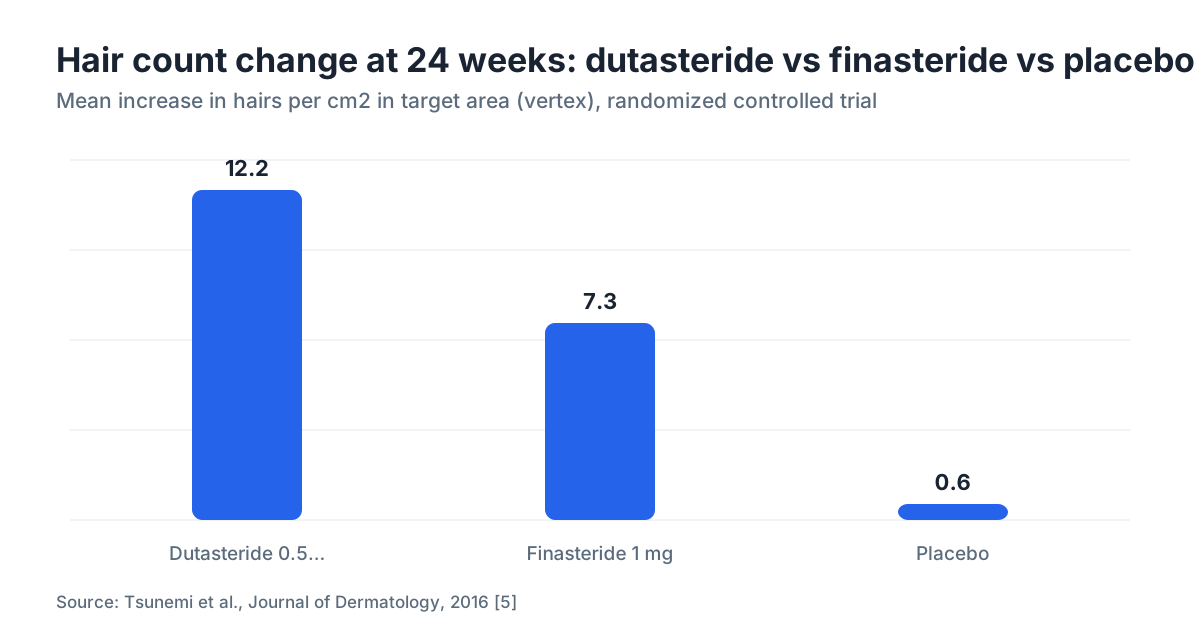
The most-cited comparison is a randomized, double-blind trial by Tsunemi et al. (2016) in the Journal of Dermatology. It ran 153 Japanese men through dutasteride 0.5 mg, finasteride 1 mg, or placebo over 24 weeks. Dutasteride grew a mean 12.2 hairs per cm2 in the target area, versus 7.3 for finasteride and 0.6 for placebo [5]. That's about 67% more hair from dutasteride over the same stretch.
A larger Korean RCT by Jung et al. (2014) enrolled 917 men and also ran 24 weeks. Dutasteride 0.5 mg beat finasteride 1 mg on hair counts and investigator ratings by a statistically significant margin [6]. Both drugs clearly beat placebo. Dutasteride's edge held across Norwood stages II through V.
A systematic review and meta-analysis by Mella et al. (2010) pooled the available data and concluded dutasteride 0.5 mg produced greater hair count gains than finasteride 1 mg at 24 weeks, with the standardized mean difference favoring dutasteride [7].
Here's the honest caveat. Most of these trials stop at 24 weeks. Long-term (5-year) comparative data basically doesn't exist. Finasteride's long-term efficacy is well documented from the original approval trials, which ran 5 years [4]. Dutasteride's long-term hair data is mostly extrapolated from its BPH trials and small open-label extensions.
If you want the category-level picture, our DHT blockers article explains why follicle miniaturization is reversible only up to a point. That matters for setting realistic expectations from either drug.
How much more DHT does dutasteride suppress than finasteride?
It depends on where you measure. In serum, finasteride 1 mg drops DHT by roughly 68-71% and dutasteride 0.5 mg by roughly 90-95% [3]. In scalp tissue the gap widens: dutasteride hits 97-99%, while finasteride's scalp numbers are harder to pin down but land around 70% in the studies that measured them.
Type 1 inhibition is the reason dutasteride wins so decisively in the scalp. Type 1 5-alpha reductase sits heavily in sebaceous glands and scalp skin. Finasteride misses type 1 entirely, so DHT made through that pathway stays up. Dutasteride shuts both pathways down [2].
Whether 97% suppression beats 70% for your particular follicles is a separate question. The trial data says yes, on average, it shows up as more measurable hair. But individual response swings hard. Plenty of men do great on finasteride alone. The trials report averages, not promises for any one head.
Are the side effects different or worse with dutasteride?
On paper the profiles look alike. Sexual side effects (lower libido, erectile dysfunction, less ejaculate volume) are the main worry for both, and reported rates in trials sit roughly in the 1-4% range for each [3][5].
The difference that matters is half-life. Finasteride's half-life is 6-8 hours, and it clears the body within days of stopping [8]. Dutasteride's half-life is about 5 weeks, so it can stay pharmacologically active for 3-6 months after your last dose [2]. That's the whole game if side effects show up. Stop finasteride today and problems often fade in days to weeks. Stop dutasteride today and you might wait months for DHT to climb back to baseline.
Post-finasteride syndrome (persistent sexual and neurological symptoms after stopping) is a reported phenomenon. Reports of persistent sexual dysfunction pushed the FDA to update finasteride's label [11]. Whether dutasteride carries the same risk is less studied, and there's no biological reason to assume it doesn't. The longer half-life could, in theory, make persistence more likely, though that's speculation right now.
For a full read on finasteride's documented risks and benefits, the finasteride article covers the persistence data in detail. And if you're thinking about adding minoxidil to either drug, read the minoxidil side effects page first.
Which Norwood stages respond best to dutasteride vs finasteride?
Both drugs do their best work early (Norwood II through IV), when enough miniaturized follicles are still alive to answer a drop in DHT. By Norwood V and beyond, many follicles have gone fibrotic and won't grow terminal hair no matter how much DHT you kill. Neither drug regrows hair from a scarred follicle.
The Jung et al. (2014) trial found dutasteride's advantage over finasteride held steady across stages II through V rather than clustering in one stage [6]. Absolute gains ran larger in earlier stages for both drugs, which fits the biology.
Men at Norwood V or VI with real scalp exposure are unlikely to get a cosmetically meaningful result from pills alone. That's the point where a hair transplant consult makes sense, ideally while staying on medication to protect the native hair you still have.
Women with Ludwig-scale pattern loss are mostly treated with off-label finasteride or topical minoxidil. Dutasteride in women is far less studied and carries the pregnancy risk already covered. A few small trials exist, but not enough to make confident comparative claims for women.
How long does it take to see results from dutasteride vs finasteride?
Neither drug is fast. Plan on 6-12 months for meaningful results, with peak effect somewhere around 12-24 months. Shedding can actually spike in the first 2-3 months as the hair cycle resets, which spooks people into quitting early.
In the 24-week trials, dutasteride's higher hair count was already measurable by week 24 [5][6]. Whether that edge shows up faster in the first few months isn't clear. The first 8-12 weeks on either drug often look identical, because DHT suppression has to build before follicles change their behavior.
People ask whether dutasteride's faster DHT suppression means faster hair results. It's plausible, but the trial timelines don't prove it. The 24-week data shows more hair, not necessarily an earlier start.
That early shed can look scary. The telogen effluvium article walks through the hair cycle mechanics behind medication shedding, so you know what's normal and what isn't.
What does dutasteride cost compared to finasteride?
Generic finasteride 1 mg is cheap. In the US, 30 tablets usually run $15-30 a month through generic pharmacies or telehealth, sometimes less with a discount card [4].
Generic dutasteride 0.5 mg costs more than generic finasteride but far less than the brand. Budget roughly $30-70 a month depending on pharmacy and insurance. Discount coupons pull it down further. Brand-name Avodart runs $200+ a month at many US pharmacies, but few people actually pay that.
Insurance often covers dutasteride for BPH. For hair loss (the off-label use), coverage is hit or miss. Finasteride for hair loss is similarly spotty, though many plans cover it for prostate conditions. Call your pharmacy about your specific plan before you assume either drug is out of reach.
Some men buy dutasteride BPH capsules and split the dose to cut cost, but that's not smart without medical guidance and barely saves anything given how cheap generics already are. Telehealth hair loss platforms tend to bundle either drug with periodic check-ins. Convenient, but it adds to the bill.
Can you take dutasteride and minoxidil together?
Yes, and the combination is common. Minoxidil works by a completely different route: it stretches out the anagen (growth) phase and improves blood flow to the follicle. It never touches DHT. Dutasteride handles DHT. The two mechanisms don't overlap, so stacking them makes pharmacological sense and happens all the time in practice.
A 2014 comparison in JAAD found finasteride plus topical minoxidil produced greater hair density gains than finasteride alone [3]. The same logic extends to dutasteride plus minoxidil, though a large, direct RCT of dutasteride-plus-minoxidil versus dutasteride alone is harder to find.
Want the details? Our oral minoxidil article explains how oral compares to topical (dose and side effects differ). For the combination angle with finasteride as the base, finasteride and minoxidil has the trial breakdown.
MyHairline's free AI scan can flag your pattern and stage before you decide between monotherapy and a combination, which is a useful first move before a dermatology appointment.
The triple stack (oral minoxidil plus a 5-ARI plus a topical) also shows up in practice, especially for more advanced loss, though formal RCT data on the triple is thin.
Is dutasteride ever prescribed for women with hair loss?
Sometimes, with real caveats. The evidence for dutasteride in women is much thinner than in men. A few small trials in postmenopausal women with androgenetic alopecia looked promising, but none have the power of the big male trials.
The hard stop is pregnancy. Dutasteride is absolutely contraindicated during pregnancy. Even skin contact with a leaking capsule poses a risk to a pregnant woman, which is why the drug ships as sealed gel capsules. For any woman who could get pregnant, dutasteride is off the table.
For postmenopausal women with confirmed androgenetic alopecia, some dermatologists do reach for off-label dutasteride after finasteride fails. It's not standard of care, and it isn't backed by the same depth of evidence. The American Academy of Dermatology's guidance on female pattern hair loss lists minoxidil as first-line and treats 5-alpha reductase inhibitors as options in postmenopausal women specifically [1].
If you're a woman still researching causes, the what causes hair loss and receding hairline articles cover the female presentation and why the pattern (usually diffuse thinning at the crown rather than temple recession) changes the treatment call.
Should you switch from finasteride to dutasteride if finasteride isn't working?
People bring this exact question to dermatologists constantly. The honest answer hinges on what "not working" means.
On finasteride less than 12 months? You probably haven't given it a fair shot. The drug takes a full year to show its real effect in many men. Switching early is a common mistake.
On finasteride 18-24 months and still watching active loss? Moving to dutasteride is a reasonable next step. The stronger DHT suppression may hold ground finasteride couldn't. Several dermatologists use this sequential approach, and there's a biological rationale even without a dedicated RCT on finasteride "failures" moving to dutasteride.
Quit finasteride over intolerable side effects? Dutasteride is unlikely to feel better and could feel worse or drag out longer, given its half-life.
One middle option: some men on finasteride 1 mg get slightly more DHT suppression by stepping up to finasteride 5 mg (the prostate dose), which pushes serum DHT reductions closer to 70-75% versus 68-71% at 1 mg. That's a smaller jump than dutasteride and keeps the same side effect profile. Some doctors use it as an intermediate move, though formal trial data on this specific strategy is sparse.
What's the honest bottom line: which drug should you choose?
Want the most DHT suppression with the strongest evidence behind it? Dutasteride wins on the numbers. Two randomized trials and a meta-analysis all say it grows more hair than finasteride at 6 months [5][6][7].
Want an FDA-approved treatment with 25-plus years of real-world safety data across millions of patients? Finasteride is the standard of care and the right starting point for most people.
My honest read: most men should start on finasteride. It's cheaper, it's approved, it's better studied for hair specifically, and it clears fast if it gives you trouble. If it hasn't moved the needle after 12-18 months of consistent use, dutasteride is a legitimate step up backed by real trial data. Going straight to dutasteride makes more sense only if you're at a stage where you need maximum effect quickly and you and your doctor have decided the payoff beats the longer side-effect window.
Still early in your research? Nail down your Norwood stage and pattern first. The free AI hair analysis at MyHairline gives you that before your first dermatologist visit, so you walk in with a starting point instead of a guess.
Neither drug is a cure. Both need continuous use. Stop, and DHT comes back and loss picks up again within months. That's the reality, and any plan you build should start from it.
Sources
- American Academy of Dermatology, Hair Loss: Who Gets and Causes
- MedlinePlus (NIH National Library of Medicine), Dutasteride
- Gubelin Harcha W et al., Journal of the American Academy of Dermatology, 2014, Dutasteride vs Finasteride DHT suppression comparison
- U.S. Food and Drug Administration, Drugs@FDA (Propecia/finasteride)
- Tsunemi Y et al., Journal of Dermatology, 2016, RCT dutasteride vs finasteride vs placebo in Japanese men
- Jung JY et al., Journal of the European Academy of Dermatology and Venereology, 2014, RCT 917 Korean men dutasteride vs finasteride
- Mella JM et al., Archives of Dermatology, 2010, Systematic review and meta-analysis of 5-ARIs for androgenetic alopecia
- MedlinePlus (NIH National Library of Medicine), Finasteride
- Olsen EA et al., Journal of the American Academy of Dermatology, 2006, Dutasteride dose-ranging trial for androgenetic alopecia
- Choi GS et al., dermatology review citing Korean Ministry of Food and Drug Safety approval of dutasteride for AGA (2009)
- Irwig MS, Journal of Clinical Psychiatry / JAMA Internal Medicine coverage, 2012, persistent sexual dysfunction after finasteride