TL;DR: Finasteride blocks roughly 70% of scalp DHT by inhibiting one enzyme (5-alpha reductase type II). Dutasteride blocks both type I and type II, cutting DHT by more than 90%. Head-to-head trials show dutasteride 0.5 mg beats finasteride 1 mg on hair count and patient-rated improvement. Neither is FDA-approved for hair loss in women, and both carry real sexual side-effect risks.
What does 'DHT-resistant hair loss' actually mean?
The phrase gets thrown around loosely, so let's pin it down. Androgenetic alopecia, the most common form of patterned hair loss, happens when dihydrotestosterone (DHT) binds to receptors in genetically sensitive follicles. Most men who start finasteride respond. A meaningful minority keep losing ground even with measurable DHT suppression, and that is what clinicians casually call a "poor responder" or, less precisely, a DHT-resistant case. [1]
Here's the twist: the resistance usually is not about DHT itself. It can come from follicles that are already too shrunken to recover. It can come from incomplete suppression, because finasteride reduces DHT rather than abolishing it. It can come from type I 5-alpha reductase activity in the scalp that finasteride barely touches. Or it can come from androgen-receptor sensitivity that varies genetically between men. [2] Which problem you actually have changes which fix makes sense.
If your hair kept thinning after 12 to 18 months of consistent finasteride, the question of switching to or adding dutasteride becomes fair to ask. That is what this article is about. See what causes hair loss for the wider picture of why DHT is only part of the story.
How do finasteride and dutasteride work differently?
Both are 5-alpha reductase inhibitors (5-ARIs). The enzyme 5-alpha reductase turns testosterone into DHT inside the follicle and in other tissues. Block the enzyme, less DHT reaches the receptor, less miniaturization.
The difference is selectivity. Finasteride inhibits only the type II isoform. Dutasteride inhibits both type I and type II. [3] That matters because the scalp carries both isoforms, and the sebaceous glands and follicles in the frontal and vertex regions have real type I activity that finasteride never reaches.
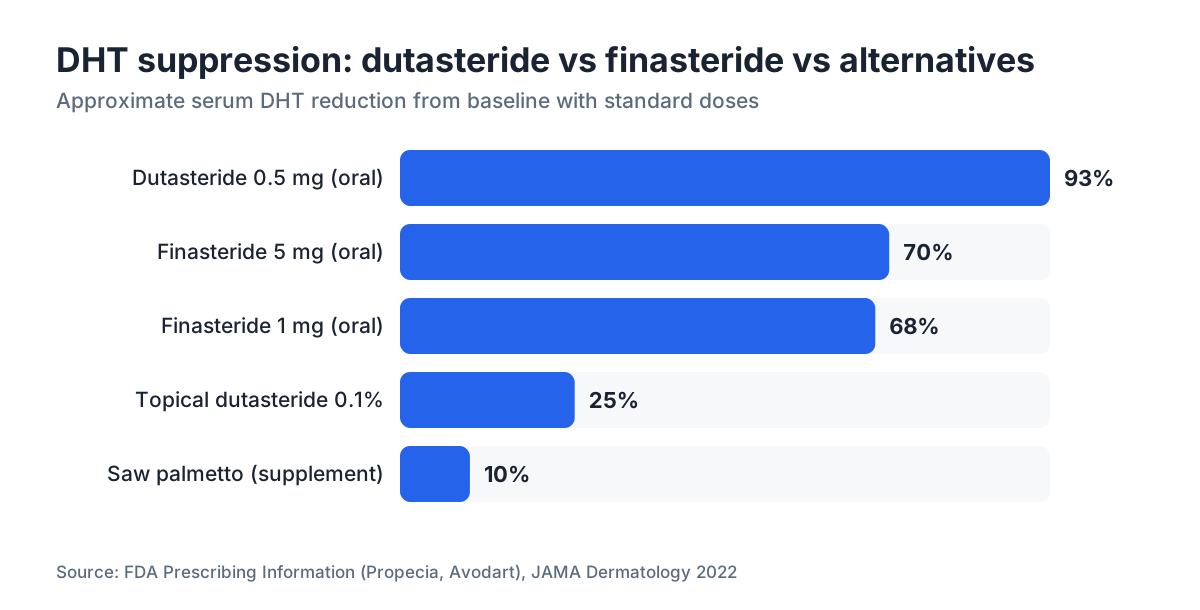
Finasteride 1 mg suppresses serum DHT by roughly 65 to 70%. [3] Dutasteride 0.5 mg suppresses serum DHT by more than 90% in most measured studies. [4] Scalp tissue DHT drops in a similar pattern, but measuring it needs a biopsy, so the exact figures move around between studies.
For how finasteride works on its own, see finasteride. If you already pair a 5-ARI with minoxidil, finasteride and minoxidil covers the combination data.
One more point on mechanism. Dutasteride has a much longer half-life, around 5 weeks versus finasteride's 6 to 8 hours. A missed dose barely registers with dutasteride. The flip side: any side effects also take weeks to clear rather than days.
What do the head-to-head trials actually show?
Dutasteride wins on efficacy in the direct comparisons we have. The clearest data comes from a 2014 Korean randomized controlled trial by Olsen and colleagues, published in the Journal of the American Academy of Dermatology, which put 917 men on either dutasteride 0.5 mg or finasteride 1 mg for 24 weeks. The dutasteride group gained more hair in both the vertex and frontal scalp, and the difference was statistically significant. [5]
Before that, a 2009 Japanese trial by Tsunemi and colleagues compared dutasteride at 0.5 mg, 2.5 mg, and 5 mg daily against finasteride 1 mg over 24 weeks. Hair counts and patient global assessment favored the 2.5 mg and 5 mg dutasteride doses over finasteride 1 mg. The 0.5 mg dose also came out ahead numerically, though the gap at that dose was smaller. [10]
Nobody has run a clean five-year randomized head-to-head in Western populations. Most trials last 24 to 52 weeks, which captures regrowth but not long-term maintenance. That is an honest limit worth stating out loud.
The table below pulls the key efficacy metrics from the available comparative data.
| Metric | Finasteride 1 mg | Dutasteride 0.5 mg |
|---|---|---|
| Serum DHT suppression | ~65-70% | ~90-95% |
| 5-AR isoforms blocked | Type II only | Type I + II |
| Hair count improvement (24 wk, vertex) | Moderate | Greater (statistically significant) [5] |
| FDA approval for AGA (men) | Yes (Propecia) [3] | No (off-label) |
| FDA approval for BPH | Yes (Proscar 5 mg) [3] | Yes (Avodart 0.5 mg) [4] |
| Half-life | 6-8 hours | ~5 weeks |
| Dose used in AGA | 1 mg/day | 0.5 mg/day |
Dutasteride 0.5 mg produced statistically significantly greater hair count gains than finasteride 1 mg in a 917-man randomized trial. The trade-off is regulatory status, cost, and deeper hormonal suppression.
Is dutasteride FDA-approved for hair loss?
No. Finasteride 1 mg (Propecia) got FDA approval for male pattern hair loss in 1997. [3] Dutasteride 0.5 mg (Avodart) is FDA-approved only for benign prostatic hyperplasia. [4] Prescribing dutasteride for hair loss is off-label, which is legal and common, but it means your prescriber is working from trial data rather than an approved label for this use.
South Korea is the exception. Regulators there approved dutasteride specifically for androgenetic alopecia in 2009, after the positive RCT data. That approval shaped prescribing habits worldwide even though the FDA never followed.
US prescribers can and do write dutasteride off-label for hair loss, and plenty of dermatologists treat it as a reasonable step up when finasteride falls short. Because it is off-label, insurance almost never covers it for hair loss, and compounding pharmacies fill a big share of these scripts.
If you're weighing a dht blocker and want the full regulatory and evidence picture before you talk to a prescriber, that article covers the broader category.
What are the side effects, and are they worse with dutasteride?
Both drugs share the same mechanism-based side effects: lower libido, erectile dysfunction, reduced ejaculate volume, and in some men, gynecomastia. These are class effects of 5-ARI use, listed in the FDA prescribing information for both drugs. [3][4]
Whether dutasteride causes more of them than finasteride is genuinely debated. Deeper DHT suppression sounds like it should mean more hormonal impact, but the trial data on side-effect rates does not show a clearly higher incidence with dutasteride 0.5 mg versus finasteride 1 mg. The 2014 JAAD RCT reported broadly similar rates in the two groups. [5]
What differs is how long problems stick around. Dutasteride's half-life is roughly five weeks, so side effects that emerge take much longer to fade after stopping. Men who react to finasteride usually recover within days to a few weeks. Men on dutasteride may wait 3 to 6 months for DHT to normalize.
Post-finasteride syndrome (PFS) is a contested and not fully characterized condition in which sexual and neurological symptoms persist after stopping the drug. It has been reported with both finasteride and dutasteride. The FDA added a label update on persistent sexual dysfunction in 2012. [3] The evidence here is messier than advocates on either side admit. Nobody has good large-scale data on true incidence.
The practical read: if finasteride gave you significant side effects, switching to dutasteride is unlikely to fix that, because the mechanism is the same. If you tolerated finasteride fine but keep losing ground, dutasteride is a legitimate next step. Have that talk with a prescriber who can weigh your personal risk factors.
Who is a good candidate to switch from finasteride to dutasteride?
The profile that fits: a man who has taken finasteride 1 mg consistently for at least 12 to 18 months, who actually took it (not scattered missed doses), who had no significant side effects, and whose loss kept progressing anyway. [6]
Rule out other causes first. Telogen effluvium from a stressor, a nutritional gap, thyroid trouble, or scalp inflammation can all cause shedding that looks like finasteride failure but is not. See telogen effluvium for how to tell them apart. Blood tests for ferritin, thyroid-stimulating hormone, and basic metabolic function make sense before escalating drugs.
Men already at advanced Norwood stages (V, VI, VII) with widespread miniaturization may not get meaningful regrowth from any medical therapy. In those cases the honest conversation turns toward hair transplant as the main move, with medication used to protect the remaining native hair.
Women are a separate story. Neither finasteride nor dutasteride is FDA-approved for hair loss in women. Both are category X in pregnancy (teratogenic) and carry serious fetal risk. Some dermatologists prescribe finasteride off-label to postmenopausal women, but dutasteride off-label in women with AGA is even less studied and carries the same virilization concerns. [6] Women exploring options should read receding hairline for female-pattern hair loss.
How long does it take to see results with dutasteride?
Same timeline as finasteride. Expect 3 to 6 months before you notice meaningful change, and the full picture often takes 12 months. Hair follicle cycling is slow, which is why finasteride trials used 12-month endpoints as their primary efficacy measure.
Because dutasteride's half-life is so long, it reaches steady-state tissue levels more slowly than finasteride. Some prescribers guess this pushes early results back a bit, but there is no strong trial evidence for a clinically meaningful difference in onset.
If you switch from finasteride to dutasteride, don't expect a fast turnaround. You may see some shedding in the first 2 to 3 months (a shed sometimes signals a new round of follicle activity). Stay patient. Photograph your hairline monthly, same angle, same light. That is still the most practical tracking method outside a dermatology clinic.
For a baseline before you start or switch, a free AI hair scan at MyHairline (myhairline.ai/scan) gives you a consistent reference point from your own photos.
What does dutasteride cost, and is it covered by insurance?
Generic dutasteride 0.5 mg runs about $30 to $80 per month out of pocket at US retail pharmacies, depending on the pharmacy and any discount card (GoodRx and the like). Branded Avodart costs far more and rarely comes up now that generics are everywhere.
Insurance coverage for hair loss medication is generally awful. Finasteride for AGA is almost never covered, and dutasteride off-label for AGA is the same. A BPH diagnosis can change coverage, but prescribing it for BPH when the real intent is hair loss is ethically and legally shaky.
Compounded dutasteride, usually oral capsules or topical solutions, comes from compounding pharmacies and can run $20 to $50 per month, sometimes less. Topical dutasteride is an active research area with a small but growing evidence base. A 2022 study in JAMA Dermatology found topical dutasteride 0.1% solution raised hair density with lower systemic DHT suppression than oral dutasteride, which could mean fewer systemic side effects, though the study was small. [7]
Finasteride 1 mg generics are much cheaper, often $10 to $20 per month, which is a real factor when you weigh the cost of moving up to dutasteride.
Can you combine dutasteride with minoxidil for better results?
Yes, and the logic holds up. Minoxidil works through a different pathway, extending the anagen (growth) phase and enlarging follicles through vasodilation and probable direct follicle effects. [8] It does not lower DHT at all. Pairing a DHT-blocking 5-ARI with minoxidil hits two separate mechanisms, which is why many clinicians treat combination therapy as the strongest medical approach to androgenetic alopecia.
The evidence for dutasteride specifically plus minoxidil is thinner than for finasteride plus minoxidil, mostly because finasteride has decades of study behind it and dutasteride for hair loss is newer and off-label. Mechanistically, there is no reason the combination logic would stop at dutasteride.
For men already on minoxidil and stuck, adding dutasteride (rather than finasteride) as the 5-ARI is a reasonable escalation. Some prescribers use oral minoxidil for this pairing. See oral minoxidil for how oral dosing compares to topical, and minoxidil for men for the general evidence on topical use.
One thing to know: minoxidil can trigger an early shed in the first 4 to 8 weeks as follicles shift phases. Start dutasteride and minoxidil together and any early shedding gets hard to read. Consider starting one at a time, a few months apart, so you can pin down what is doing what. minoxidil side effects covers what to expect.
What about topical dutasteride as an alternative to oral?
Topical dutasteride is not FDA-approved but is available through compounding pharmacies and is being studied. The appeal is plain: you want the DHT suppression in the scalp, not spread across your whole body. Cutting systemic absorption could lower the risk of sexual side effects while keeping the local effect.
The 2022 JAMA Dermatology study is the best data point here. [7] It found topical dutasteride 0.1% and 0.5% solutions applied to the scalp produced meaningful increases in hair count, with serum DHT suppression around 20 to 30% versus more than 90% with oral dosing. Whether 20 to 30% systemic suppression still carries meaningful sexual side-effect risk is not yet well characterized.
This is a genuinely thin, evolving area. If you're worried about systemic side effects but want stronger DHT blockade than finasteride gives, topical dutasteride is a plausible middle path worth raising with a dermatologist. It is not a proven swap for oral dutasteride yet.
Some compounding pharmacies offer topical finasteride too. On whether topical formulations match oral efficacy, the short answer from current evidence: probably somewhat less potent systemically, with an unclear trade-off on local scalp efficacy.
When should you consider a hair transplant instead?
Medication, dutasteride included, cannot bring back follicles that are already dead. If miniaturization has wiped out the follicles in a zone, no DHT blocker restores them. A hair transplant moves DHT-resistant follicles from the donor area (usually the back and sides) to the areas of loss.
The American Academy of Dermatology recommends medical therapy as first-line for androgenetic alopecia, with surgery for patients who do not respond well enough or who want to address established loss. [6]
Medication and transplant are not either-or. Most transplant surgeons will tell you to keep or start a 5-ARI after surgery to slow native loss and protect the result. Some prefer dutasteride over finasteride post-transplant given the stronger DHT suppression, though there is no specific RCT for post-transplant dutasteride outcomes.
At Norwood III or below with good donor density, medication first is usually the right call. At Norwood V and above, the conversation changes a lot. See hair transplant for what to actually expect from the procedure and costs.
To see your current stage before deciding anything, the free AI scan at MyHairline (myhairline.ai/scan) maps your pattern against Norwood staging from your own photos.
Are there non-prescription alternatives worth considering?
Honestly, not for stubborn DHT-resistant loss. The non-prescription options, mainly minoxidil and supplements sold as DHT blockers, have little head-to-head data against prescription 5-ARIs, and none comes close to the DHT suppression dutasteride delivers.
Saw palmetto is the most popular supplement marketed as a natural DHT blocker. The evidence is weak. A 2012 study in JAMA Dermatology compared saw palmetto to finasteride and found finasteride clearly superior. [9] Saw palmetto showed a modest effect versus placebo in a small subset of that trial's data, but it is no serious substitute for prescription therapy in a man already failing finasteride.
Ketoconazole shampoo (prescription 2% or OTC 1%) has some evidence as an add-on, working through a different route involving scalp inflammation and sebaceous activity. On its own it will not move the needle much, but it is low-risk and can earn a spot in a broader regimen.
Some men add biotin, zinc, iron, or other hair loss supplements on the theory that nutritional gaps are the cause. Worth checking with a blood test. Correcting a genuine iron deficiency (common in women, less so in men) can stop deficiency-driven shedding. But supplements do not replicate 5-ARI pharmacology.
Creatine has drawn interest as a possible DHT-raising factor. See does creatine cause hair loss for what the actual evidence shows.
Sources
- American Academy of Dermatology, Guidelines of Care for Androgenetic Alopecia
- National Institutes of Health, StatPearls: Androgenetic Alopecia
- FDA, Propecia (finasteride 1 mg) Prescribing Information
- FDA, Avodart (dutasteride 0.5 mg) Prescribing Information
- Journal of the American Academy of Dermatology, Olsen et al. 2014 RCT: Dutasteride vs Finasteride for AGA
- American Academy of Dermatology, Clinical Practice Guidelines: Hair Loss
- JAMA Dermatology, Topical Dutasteride Study 2022
- FDA, Rogaine (minoxidil topical) Prescribing Information
- JAMA Dermatology, Saw Palmetto vs Finasteride comparative study 2012
- NIH National Library of Medicine, PubMed: Tsunemi Y et al. 2009, dutasteride dose comparison vs finasteride in Japanese men with AGA
- FDA, Prostate Cancer Prevention Trial (PCPT) and REDUCE trial safety communications