TL;DR: Most men on finasteride stabilize within 6 months and see meaningful regrowth by 12-24 months. Clinical trials show about 83-87% of men halt further loss, and roughly 66% get measurable regrowth. Photos look subtler than marketing implies: expect thicker density and slower recession, not a full restoration. The catch is you have to take it forever.
What do finasteride before and after photos actually show?
The before-and-after photos you find online are almost always cherry-picked. That's not a conspiracy. It's marketing math. Companies post the best 5% of outcomes and skip the rest. Real results are quieter than that.
In the 5-year Merck trial that supported FDA approval, men taking 1 mg finasteride daily gained a mean of about 277 hairs per square inch above baseline at two years. [1] That's real, measurable growth. But 277 extra hairs in a defined counting area reads on a scalp photo as better density, not a full head of hair appearing out of nowhere.
What you actually see in honest before-and-afters:
- The vertex (crown) thickens visibly in many responders. Hair there goes from see-through to opaque.
- The hairline usually barely moves. Finasteride is better at holding and thickening existing hair than pushing a receded hairline forward. [1]
- Photos taken under the same light and angle at 12 months often look "good for what it is" rather than dramatic.
- Some men show no visible change but have clearly stopped losing ground, which counts as a win.
If you're evaluating photos, check for the same lighting, the same angle, the same hair length, and the same time of day. Scalp oils change how light reflects. A wet photo versus a dry one can fake a 30% swing in apparent density. If a company's photos don't control for those variables, treat them with suspicion.
How long does finasteride take to show results?
The timeline matters more than most people expect, because finasteride works through a slow hormonal mechanism, not a direct growth stimulant. It blocks the 5-alpha reductase enzyme that converts testosterone to dihydrotestosterone (DHT), and DHT is what miniaturizes hair follicles in androgenetic alopecia. [2] Lower the scalp DHT and follicles recover gradually, not overnight.
Here's what the evidence suggests month by month:
Months 1-3: Almost nothing visible. You might actually see a shed. This "finasteride shed" is real and documented. It happens because the drug pushes follicles from the resting (telogen) phase back into the growing (anagen) phase, temporarily shoving resting hairs out. [3] If you don't know to expect it, it's terrifying. It is not failure. See our explainer on telogen effluvium for why this shed happens.
Months 3-6: The shed resolves. In clinical data, hair counts start climbing above baseline. You may not see it in photos yet, but the trend has reversed.
Months 6-12: This is when most men notice something. Vertex density becomes visible. Some see hairline improvement, though it's less common and less dramatic than the crown.
Months 12-24: Peak photographic results for most responders. The Merck trial showed hair count improvements plateaued around year 2 and held from there. [1]
Year 2 and beyond: Maintenance mode. You're keeping what you rebuilt. Men who stop at this point lose most regrowth within 6-12 months and slide back onto the loss trajectory they were on before. [4]
Give it 12 months before deciding it isn't working. Judging at 3 months is almost always premature.
What percentage of men actually respond to finasteride?
This is where you have to read the fine print, because "response" gets defined differently depending on who's reporting it.
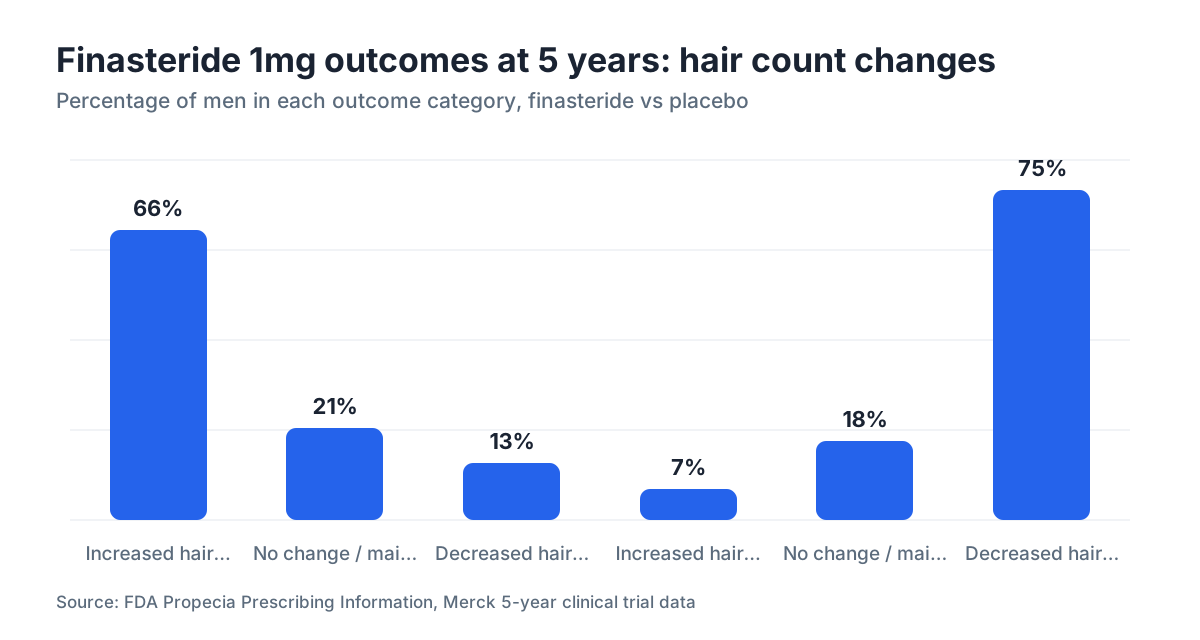
The FDA-approved prescribing information for Propecia (1 mg finasteride) states that in a 5-year study, 90% of men maintained or increased hair count versus baseline, compared to 75% of men on placebo who lost hair over the same period. Roughly 66% of men on finasteride showed some measurable increase in hair count. [1]
A separate number to hold onto: about 10-13% of men see no measurable benefit. Nobody fully understands why. Genetic variation in 5-alpha reductase isoforms, androgen receptor sensitivity, and baseline follicle health all probably feed into it.
Here's the breakdown in plain terms:
| Outcome | Finasteride 1mg | Placebo |
|---|---|---|
| Increased hair count | ~66% | ~7% |
| No change (maintained) | ~21% | ~18% |
| Decreased hair count | ~13% | ~75% |
Source: Merck/FDA Propecia prescribing information, 5-year data [1]
So "83-87% respond" means they either held the line or improved. That's the honest number to carry around. It does not mean two-thirds of men get a dramatic transformation.
For men whose response is weak, adding minoxidil for men is the most evidence-backed next step. The combination beats either drug alone in head-to-head trials. [5] Our finasteride and minoxidil breakdown covers the combination in detail.
Which areas respond best: hairline or crown?
The crown (vertex) responds better to finasteride than the hairline does. The reasons aren't fully clear, but the pattern shows up again and again across trials.
The leading theory: frontal hairline follicles tend to be more heavily miniaturized by the time most men start treatment, and heavily miniaturized follicles have less capacity to recover even after DHT drops. Vertex follicles, on average caught earlier in the process, keep more of their potential.
The Merck 5-year trial reported vertex and anterior mid-scalp results separately and consistently found stronger responses in the vertex. [1] That's why most credible before-and-after galleries lean on crown photos.
If your main concern is a receding hairline, finasteride can slow or stop the recession, but don't expect it to march your hairline forward. A realistic goal for someone with a Norwood 2-3 hairline: the recession slows or stops, and some density returns behind the hairline. For real hairline restoration, a hair transplant is worth considering once your loss is stable on medication.
This is also why the best candidates for finasteride are men who catch their loss early, at Norwood 1-3, while more follicles are still viable.
What does finasteride NOT do in before and after photos?
Be clear-eyed about what you will not see.
Finasteride does not regrow hair on a completely bald, slick scalp. If a follicle has been miniaturized for years and the skin looks shiny and smooth, that follicle is likely gone or too damaged to revive. The drug works on miniaturized follicles that are still producing some hair, however thin. [2]
It does not stop loss instantly either. You can be on finasteride and still lose ground in the first few months, especially if you started late or have a fast-progressing pattern.
It does not work for hair loss from other causes. Finasteride is specifically for androgenetic alopecia (male pattern baldness). Alopecia areata, telogen effluvium from a nutritional deficiency, thyroid problems, and other causes will not respond. Get the cause right before you start anything. See what causes hair loss for a full breakdown.
And it does not hold results once you quit. This is the most important "does not" on the list. Finasteride needs lifelong use to keep working. The hair you grew falls back out within roughly 6-12 months of stopping, and you return to the loss pattern you were on. [4] Plan for that before you start.
How do I take accurate before and after photos of my own hair?
If you want to track your own results honestly, you need a consistent photo protocol. Otherwise you'll gaslight yourself into thinking things are worse or better than they are.
Set these variables once and never touch them:
Light: Natural daylight from a north-facing window (no direct sun), or a fixed indoor setup with one overhead light. Direct sun throws harsh shadows that make hair look thinner. Overcast light shows density most accurately.
Angle: Three shots matter. Directly overhead (crown), 45 degrees from above-and-front (hairline and mid-scalp), and straight front at eye level (hairline). Use a mirror and a second person if you need to nail the overhead shot.
Hair state: Always the same. Dry, unwashed, same number of hours after washing. Freshly washed hair that isn't yet coated in sebum often looks thinner in photos.
Timing: Monthly photos on the same day of the month. Do not look at them weekly. The noise will drive you nuts.
Storage: Date-stamp them and keep a folder. At 6 months, compare month 1 to month 6 only. At 12 months, compare month 1 to month 12.
If you want an objective baseline before starting, the MyHairline AI scan can analyze your scalp and hairline from photos and give you a standardized reference point to compare against later. That kind of consistent baseline is genuinely hard to set by eye alone.
Does finasteride work differently depending on your Norwood stage?
Yes, and this shapes what your before-and-after comparison should even aim for.
Norwood 1-2 (minimal recession, no significant thinning): Best prognosis on finasteride. Most stabilize completely. Some see mild thickening. Their before-and-after photos look unimpressive precisely because the drug worked: the "after" just looks like a healthy head of hair. You might not even tell there was a problem.
Norwood 3-4 (moderate recession, some vertex thinning): The classic finasteride success story. Crown responds well. Hairline often stabilizes. Many men in this range see photos that are clearly, visibly better at 18-24 months.
Norwood 5-6 (extensive recession and vertex loss, starting to merge): Results get more modest. Some vertex improvement is possible, but the large bald zone means fewer viable follicles to work with. Stabilization is the main realistic outcome.
Norwood 6-7 (extensive frontal and crown loss): Finasteride can slow what remains, but photographic improvement is rare. Here the more realistic conversation is often whether a hair transplant makes sense once loss is stable, paired with continued finasteride to protect the non-transplanted hair.
You can learn more about what causes hair loss and the role DHT blockers play across Norwood stages.
What do real clinical photos show versus marketing photos?
The FDA approval studies used standardized macrophotography shot under identical conditions. Looking at those tells you more than any brand's website.
The Merck trial photos in peer-reviewed literature consistently show modest but real improvement in vertex density among most responders, almost no hairline advancement, and a small but visible minority who look essentially unchanged. [1] A 2002 study in the Journal of the American Academy of Dermatology examining 2-year data found that "global expert panels" rated 80% of finasteride patients as improved versus 28% of placebo patients, using standardized photography. [6]
That 80% "rated as improved" sounds great, and it is. But "improved" ran the full range, from "a little denser in one spot" to genuinely dramatic crown regrowth. The distribution is wide.
Marketing photos do several things clinical photos don't. They select outlier responders. They sometimes add styling product in the "after" shot. They may adjust lighting. And they often show men who were also on minoxidil without saying so.
Want the most honest look at what finasteride does? Search for published dermatology trial data and study the standardized photos, or read large community forums where users post their own unedited photos with dates and protocols. That distribution is a truer picture of outcomes than any brand gallery.
What are the side effects and do they affect whether you'll see results?
Side effects are a separate question from efficacy, but they matter for the decision to start and stay on the drug.
The FDA-approved prescribing information reports sexual side effects (lower libido, erectile dysfunction, reduced ejaculate volume) in about 1.8-3.8% of men in clinical trials, versus roughly 1.3-2.1% on placebo. [1] Post-marketing reports describe persistent sexual dysfunction in some men after stopping the drug, though causality is hard to pin down and it remains an active area of research.
Finasteride also carries an FDA label warning about an association with high-grade prostate cancer found in screening studies. The context: a large chemoprevention trial found finasteride cut overall prostate cancer incidence but showed a higher proportion of high-grade tumors among those who did develop cancer. [7] Discuss it with a physician before starting.
Does having side effects mean the drug is working or not working for your hair? No. The two aren't correlated. Men who get sexual side effects are not better or worse responders for hair growth.
For how DHT blockers work mechanically, that piece is worth reading before your first prescription conversation. If you're thinking about adding a topical growth agent, read the minoxidil side effects article too. The combination is common and the two side effect profiles barely overlap.
Can women use finasteride and what do their before and after results look like?
Women can use finasteride, but it's more complicated than it is for men.
Finasteride is not FDA-approved for women. It's used off-label, usually at 1 mg or sometimes 2.5 mg, for women with androgenetic alopecia. The evidence in women is weaker than in men. A 2012 randomized controlled trial in the British Journal of Dermatology found no statistically significant difference between finasteride 1 mg and placebo in postmenopausal women. [8] Other studies using higher doses or focusing on premenopausal women with elevated androgens have found modest benefit.
Women who are pregnant or may become pregnant must not take finasteride. The drug causes serious fetal harm, specifically genital abnormalities in male fetuses, and this is an FDA Category X warning. [1] Even handling crushed tablets is a listed risk.
For women with pattern hair loss, minoxidil has stronger evidence and FDA approval. The combination of spironolactone (an androgen blocker) and minoxidil is often the first-line prescription approach. Finasteride comes into the picture after those options, for premenopausal women on reliable contraception with confirmed androgenetic alopecia.
Before-and-after photos for women on finasteride follow the same pattern as men: crown and part-line density improvement is the most visible outcome, and it takes at least 12 months to judge fairly.
How does combining finasteride with minoxidil change the before and after results?
The combination produces better outcomes than either drug alone. That's not marketing. It's what the trials show.
A 2021 study in the Journal of the American Academy of Dermatology compared finasteride alone, minoxidil alone, and the combination in men with androgenetic alopecia. The combination arm showed significantly greater hair density and hair count improvements at 12 months than either monotherapy. [5]
Mechanically it makes sense. Finasteride goes after the hormonal cause (DHT-driven miniaturization). Minoxidil is a vasodilator that stretches out the anagen (growth) phase and enlarges follicles through a separate pathway. [9] They attack the problem from different angles, and the effects stack.
In before-and-after photos, men on the combination consistently show more visible improvement in both the crown and mid-scalp than men on finasteride alone. The hairline still lags the vertex, but even hairline density tends to improve more with combination therapy.
The tradeoff is managing two drugs, two side effect profiles, and two routines. Oral minoxidil is increasingly used instead of topical for convenience. See our breakdown of oral minoxidil and the full finasteride and minoxidil guide for dosing and what to watch for.
Deciding between one drug or both? Most dermatologists would say: if your loss is moderate to significant, start both. If it's early, finasteride alone is reasonable, and you add minoxidil if progress is slow at 6 months.
What should I realistically expect at 1 year on finasteride?
At 12 months, here is an honest spread of outcomes based on clinical data.
About two-thirds of men will have visibly more hair in the vertex than at baseline. Some of it is subtle. Some is dramatic. The dramatic cases are the ones that get posted online.
About one in five men will look roughly the same as before starting, but they won't have lost additional ground. Their rate of loss has slowed or stopped. That's a success, even if the photos are unremarkable.
About one in eight to ten men will have kept losing hair, either at a slower rate than they would have without the drug or, in some cases, the same rate. These are the non-responders and partial responders.
Most men at 12 months who started at Norwood 2-4 will tell you the same thing: the shedding they were seeing on the pillow and in the shower has mostly stopped or dropped off hard. That subjective experience often shows up before visible photographic improvement, and it's a meaningful early sign the drug is doing something.
At 12 months, if you've seen no change at all (no slower shed, no visual improvement, no subjective difference), that's a fair point to ask a dermatologist whether to continue, switch, or add another agent. But 12 months is the minimum evaluation window. Plenty of men who felt "nothing was happening" at 6 months had clearly measurable improvement at 12 months in standardized photos.
For deeper reading on how the drug works and how to use it, the finasteride hub article covers the full picture. If you want an objective record of your starting point before treatment, a standardized hair loss analysis through MyHairline gives you documented baseline data that makes your 12-month comparison far more reliable.
Sources
- FDA, Propecia (finasteride 1mg) Prescribing Information
- StatPearls (NCBI/NIH), Finasteride
- Journal of the American Academy of Dermatology, 2018, Telogen effluvium associated with finasteride
- Journal of the American Academy of Dermatology, 1996, Finasteride discontinuation study
- Journal of the American Academy of Dermatology, 2021, Combination finasteride plus minoxidil vs monotherapy in androgenetic alopecia
- Journal of the American Academy of Dermatology, 2002, Global photographic assessment, finasteride 2-year data
- New England Journal of Medicine, 2003, Prostate Cancer Prevention Trial (finasteride)
- British Journal of Dermatology, 2012, Finasteride in postmenopausal women with androgenetic alopecia
- StatPearls (NCBI/NIH), Minoxidil
- American Academy of Dermatology Association, Hair Loss: Diagnosis and Treatment