
TL;DR: Hair cloning and stem cell therapies for hair loss are real science, but none are FDA-approved or commercially available as of 2025. The most advanced trials sit in Phase 1-2. Realistic timelines for approval run 5 to 15 years out depending on the approach. Finasteride and minoxidil are still the only proven options right now.
What exactly is hair cloning and how is it different from a hair transplant?
Hair cloning is a loose term that covers several different ideas, so it's worth unpacking what people actually mean.
A traditional hair transplant moves existing follicles from a donor area (usually the back of your scalp) to a thinning area. You end up with the same number of follicles total. That's the hard limit. If you're severely bald, you simply run out of donor hair.
Hair cloning tries to break that limit. The core idea: take a small number of follicle cells from your scalp, multiply them in a lab, then inject or implant millions of new follicle-building cells back in. You'd be generating new follicles from scratch, more than redistributing existing ones. That's what makes it genuinely different and genuinely exciting.
The cells researchers target vary by approach. Some teams focus on dermal papilla cells, the signaling cells at the base of each follicle that tell it to grow. Others focus on hair follicle stem cells that sit in a region called the bulge. Still others are working with induced pluripotent stem cells (iPSCs), which are adult cells reprogrammed back to an embryonic-like state so they can become almost any tissue type.
The word "cloning" is a bit misleading here. Nobody is cloning whole humans or even whole follicles. They're cloning (meaning copying) specific cells and hoping those cells will self-organize into functional follicle structures when reintroduced to the scalp. That self-organization step is the hardest part, and it's where most approaches have stumbled so far.[1]
What stem cell hair loss treatments are actually in clinical trials right now?
Several approaches are in various stages of human testing, though "clinical trial" covers a huge range from a 10-person safety study to a 1,000-person Phase 3 efficacy trial.
Hair follicle neogenesis from dermal papilla cells has been the most actively pursued approach for years. A 2013 study by researchers at Columbia University showed that human dermal papilla cells, when cultured in a specific 3D aggregate format and then grafted into human skin, could generate new hair follicles [1]. That was a proof of concept in a very small model, but it confirmed the biology was possible.
RepliCel Life Sciences has been working on RCH-01, a therapy that uses hair follicle stem cells from the patient's own occipital (back-of-head) scalp. They completed a Phase 2 trial in Japan in partnership with Shiseido. Results published around 2020 showed modest but measurable increases in hair density in some patients, though the results weren't dramatic enough to push straight to market.[2]
Sanford Burnham Prebys researchers published work in 2022 on using iPSCs to generate hair follicle organoids (tiny self-organized follicle-like structures in a dish). They grew structures that showed classic follicle anatomy and even pigmentation. This was a lab result, not a human trial, but it's widely cited as a significant step toward a scalable approach.[3]
Tsuji Lab at RIKEN in Japan has been working on a whole "organ germ" method, growing complete follicle structures from stem cells in vitro and then implanting them. Their early mouse results were strong. Human trials have been slower to start than originally projected.
Exosome therapies are a related but distinct category. These inject tiny cell-signaling vesicles, often derived from stem cells, into the scalp to try to stimulate dormant follicles. Some clinics are already offering these, but as of 2025, the FDA has not approved any exosome therapy for any condition, and the agency has issued warnings about unapproved exosome products.[4]
PRP (platelet-rich plasma) often gets lumped into the stem cell conversation because it involves concentrating your own blood's growth factors. It has more clinical data than exosomes and some evidence of modest benefit, but it's not a stem cell therapy in any precise sense.
| Approach | Stage (as of 2025) | Key challenge |
|---|---|---|
| Dermal papilla cell cloning | Phase 1-2 human trials | Cells lose signaling ability in standard culture |
| RCH-01 (RepliCel/Shiseido) | Phase 2 complete, no Phase 3 announced | Modest efficacy data so far |
| iPSC-derived follicle organoids | Lab / pre-clinical | Scalability, tumor risk, implantation method |
| Tsuji Lab organ germ method | Pre-clinical / early human | Regulatory pathway, scalability |
| Exosome injections | No approved trials; clinics operating off-label | FDA has issued safety warnings |
| PRP | Phase 2-3 level data exists | Modest effect size, not truly regenerative |
Why has hair cloning taken so long? What are the main obstacles?
The biology of hair follicle growth is genuinely complicated in ways that took years to appreciate.
The first big wall is what's called dermal papilla cell "inductivity." Dermal papilla cells in a living follicle are powerful signal-senders that tell surrounding cells to form a follicle. But when you take those cells out of the body and grow them in a flat culture dish, they quickly lose that inductive ability. They survive and multiply, but they stop behaving like dermal papilla cells. Early attempts at hair cloning failed partly for this reason, they grew plenty of cells but the cells wouldn't actually do the job when reinjected.[1]
The 3D culture solution (growing cells in spheroid aggregates rather than flat dishes) partially restored inductivity in research settings, but scaling that process to produce enough cells for a commercial treatment is a different problem entirely.
The second wall is follicle architecture. A hair follicle isn't just one cell type. It's an organized structure of roughly 20 different cell types that form a precise spatial relationship. Getting injected cells to self-organize correctly in adult skin (which is already structured and scarred from prior follicle activity) is very different from how follicles form during fetal development.
Safety is the third wall, particularly for iPSC approaches. Reprogrammed stem cells carry a risk of forming teratomas (benign tumors made of mixed tissue types) if the reprogramming isn't complete. Regulators rightly require extensive safety data before any iPSC-derived therapy goes into humans.
Regulatory complexity is the fourth wall. The FDA classifies most of these approaches as biological drug products or combination products, meaning they face the full drug approval pathway, more than a device clearance. That means Phase 1, 2, and 3 trials, each taking years.
And finally there's the economics. Hair loss affects a lot of people but doesn't kill anyone, which means it competes for research funding with genuinely life-threatening conditions. Private investment from companies like Allergan (now AbbVie) and Shiseido has been significant, but the path to profitability is long enough that some programs have stalled or been deprioritized.[2]
What is the realistic timeline for hair cloning to become available?
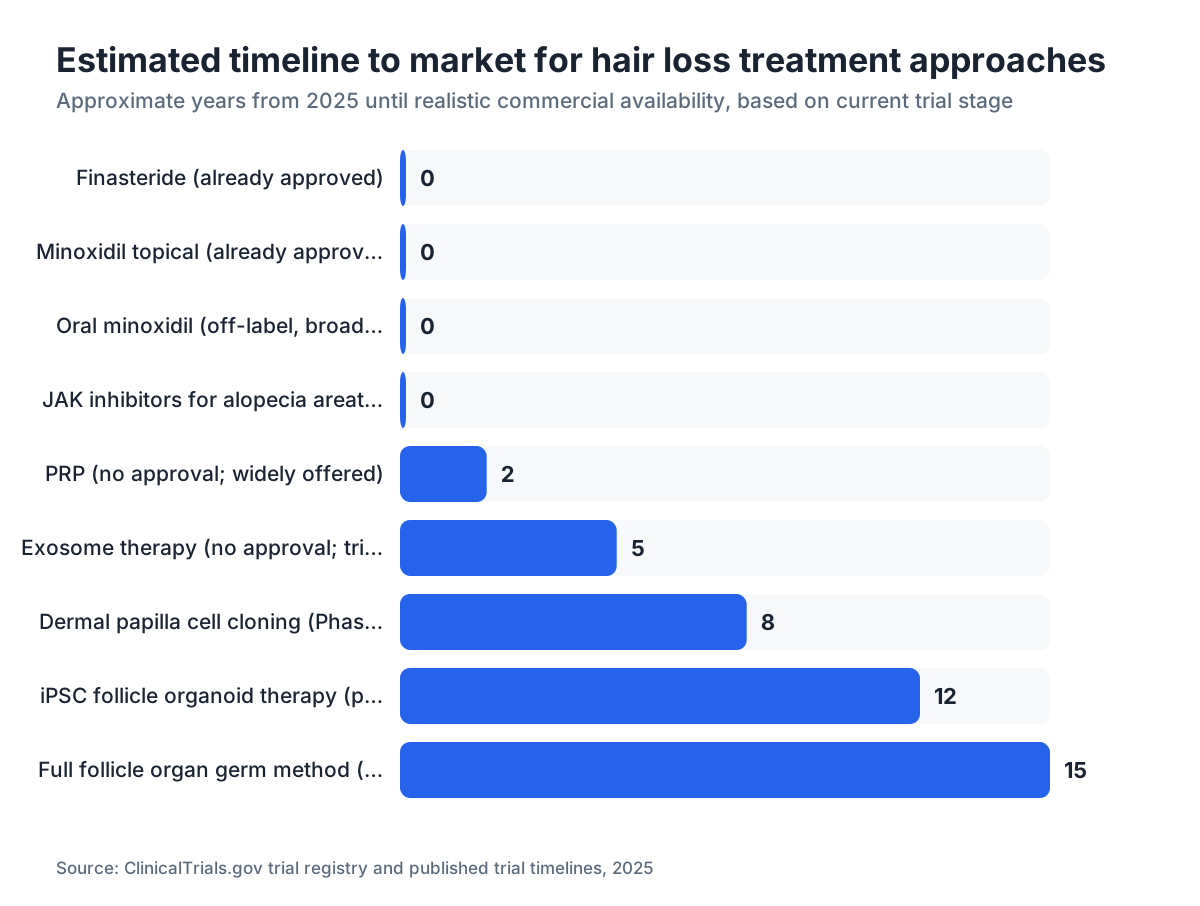
Honest answer: probably not before 2030 for any first-generation approved treatment, and 2035 is a more realistic target for something scalable and affordable. Here's why that estimate makes sense.
A therapy currently in Phase 2 trials typically takes 2 to 4 years to complete that phase, then 3 to 5 years in Phase 3 (efficacy and safety in hundreds of patients), then 1 to 2 years for FDA review. Add manufacturing scale-up time and you're looking at a minimum of 6 to 10 years from current Phase 2 work to approval, assuming no failures, which is a generous assumption. Most novel biologics fail somewhere in this process.
The closest candidates to market are probably Shiseido's program (if they resume clinical development) and any new entrant that builds on the iPSC organoid work from groups like Sanford Burnham Prebys. Neither has announced a Phase 3 trial as of 2025.
Japan has taken a more permissive regulatory approach to regenerative medicine through its Act on the Safety of Regenerative Medicine, which allows conditional early approval for some cell therapies.[11] Some researchers believe the first commercially available hair stem cell therapy may launch in Japan before anywhere else, possibly around 2027 to 2030 for a limited initial approval. But "available in Japan" and "proven effective at scale" are two different things.
Cost is also a realistic barrier even if approvals come. Early biologics are almost always expensive. If the first hair cloning treatment costs $20,000 to $50,000 per treatment and requires repeat sessions, it will be accessible to very few people at launch, similar to how early hair transplants were before FUSS and FUE became more routine and prices fell.
So the honest timeline looks like this:
| Timeframe | What's realistic |
|---|---|
| Now to 2026 | More Phase 2 data published; no approvals |
| 2027 to 2029 | Possible conditional approval in Japan for one approach; US still in trials |
| 2030 to 2033 | First plausible US FDA approval if Phase 3 launches soon and succeeds |
| 2034 to 2040 | Scale-up, competition, price reduction; treatment becomes more accessible |
| Post-2040 | If iPSC approaches succeed, potentially curative treatment for most hair loss types |
Does stem cell hair therapy work for any hair loss type better than others?
Most of the research so far has focused on androgenetic alopecia (pattern baldness), the most common type, driven by DHT's effect on genetically susceptible follicles. This is the target for hair cloning too, since these follicles miniaturize and eventually stop producing terminal hairs, but the follicle stem cells are actually still present in many cases, they're just not getting the right signals.[5]
That distinction matters. If the follicle stem cell reservoir is still intact (which it often is in earlier stages of androgenetic alopecia), then therapies that deliver signaling support (like exosomes or growth factor approaches) have something to work with. If the follicles are completely gone, which happens in scarring alopecias (cicatricial alopecias) and in very advanced androgenetic alopecia, you actually need to build new follicles from scratch.
Scarring alopecia is where true follicle neogenesis (growing entirely new follicles) would matter most, and also where it's hardest, because the scalp environment is hostile due to inflammation and fibrosis.
Telogen effluvium, the kind of diffuse shedding triggered by stress, illness, or nutrient deficiency, almost certainly doesn't need stem cell therapy. The follicles are still there and functioning; they just need the trigger to resolve. Stem cell approaches are overkill for this.
Alopecia areata (an autoimmune condition) is a different problem entirely. It's an immune attack on follicles, not a stem cell deficiency. JAK inhibitors, a totally separate drug class, have shown much more promise for alopecia areata, with FDA approvals of baricitinib and ritlecitinib in 2022 and 2023.[6]
What can I actually do right now while waiting for these therapies?
The honest situation is that two treatments have real, replicated evidence of working for androgenetic alopecia and are FDA-approved: minoxidil (topical and oral) and finasteride (and its close relative dutasteride, which is off-label in the US).
Minoxidil, used topically, has been shown across multiple trials to increase hair count and slow loss. It doesn't fix the underlying DHT blocker problem; it extends the growth phase of existing follicles. Minoxidil for men is available over the counter at 2% and 5% concentrations. Oral minoxidil at low doses (0.625 to 2.5 mg/day) has gained real clinical traction as an alternative, with some evidence of better adherence and comparable or better results than topical, though minoxidil side effects like fluid retention and unwanted facial hair become more relevant at higher doses.
Finasteride at 1 mg/day is the most effective single oral treatment for male pattern hair loss. A 5-year study found it maintained or increased hair count in 90% of men versus continued loss in placebo groups.[7] Combining finasteride and minoxidil produces better results than either alone.
If your loss is advanced enough and your donor hair is adequate, a hair transplant is still the only intervention that produces permanent cosmetic results today. FUE (follicular unit extraction) in particular has become quite refined. It doesn't grow new hair, but it redistributes existing hair very effectively.
Hair loss supplements like biotin, saw palmetto, and various formulations get a lot of marketing attention, but the evidence base is thin compared to minoxidil and finasteride. If you want to understand what causes hair loss in your case before spending money, that's the right starting point.
If you want a data-driven look at where you currently stand, tools like the free AI hair analysis at MyHairline can help you document your hairline over time and identify which Norwood stage you're at, which informs what treatments are actually relevant for you.
The point is simple. The wait for hair cloning could run 10 to 15 years. That's too long to do nothing if you're actively losing hair now.
Are any clinics offering stem cell hair treatments right now and should I try them?
Yes, many clinics are offering treatments marketed as "stem cell hair therapy" or "exosome hair treatment" right now. You should be skeptical.
Here's the regulatory reality in the US. The FDA has cleared very few cell-based therapies for any condition, and none specifically for hair loss. In 2019 and again in 2021, the FDA warned consumers and providers about unapproved stem cell and exosome therapies, noting that "the FDA has not approved any exosome product for any indication."[4] Serious adverse events including infections have been reported.
Some clinics operate under the argument that using a patient's own cells (autologous use) exempts them from FDA oversight. The FDA has clarified this exemption is narrow and doesn't cover many of the procedures being marketed, particularly those involving more than "minimal manipulation" of cells.
PRP (platelet-rich plasma) injections sit in a different position. The devices used to prepare PRP are FDA-cleared, and while there's no FDA approval of PRP as a treatment for hair loss specifically, there's a reasonable body of peer-reviewed evidence (mostly small trials) suggesting modest benefit in androgenetic alopecia. The American Academy of Dermatology acknowledges PRP as an option some dermatologists use, though it's not listed as a first-line standard of care.[8]
If a clinic is offering "stem cell hair regrowth" and charging $3,000 to $8,000 per session with promises of substantial regrowth, that's almost certainly not backed by anything close to Phase 3 level evidence. Ask them specifically: what cells, derived how, what published clinical trial supports this exact protocol, and what happens if it doesn't work. If they can't answer those questions clearly, walk away.
How does a receding hairline or early hair loss affect what treatments might work?
Where you are in the hair loss process matters a lot for both current and future treatments.
For a receding hairline at Norwood 2 or 3, the follicles are still present but miniaturizing. This is the best time to start finasteride or minoxidil because you're working with living follicles that still have some function. Evidence for both drugs is strongest in this range.
At Norwood 4 to 5, the crown and vertex are more significantly affected. Finasteride can still slow or halt progression, and minoxidil may still produce some density improvement. Hair transplants become more relevant if you want to restore coverage in areas already substantially thin.
At Norwood 6 to 7, medical treatments have limited cosmetic impact because so much follicle loss is already complete. A transplant may help but is limited by available donor hair. This is precisely where hair cloning would matter most, if it ever becomes available and if it can produce follicles in environments where native follicles are gone.
The practical takeaway: the earlier you address hair loss, the more options work, and the less you'll need to depend on technologies that don't exist yet. Don't wait for hair cloning if you're already at Norwood 3 and progressing.
What does the research say about the cost of stem cell hair treatments when they become available?
Nobody has reliable pricing data because no approved treatment exists yet. But you can get a realistic estimate by looking at analogues.
Current hair transplants run roughly $4,000 to $15,000 depending on graft count and surgeon, with no insurance coverage since it's cosmetic.[9] Early biologics for other conditions (like the first JAK inhibitors, the first PRP protocols) were priced at a significant premium before competition drove costs down.
If a hair cloning treatment requires cell extraction, a lab processing period, and a multi-session reimplantation protocol, estimates from researchers involved in these trials suggest initial pricing of $20,000 to $50,000 per treatment course is realistic for first-generation commercial products. That figure isn't from any company's pricing sheet (none exist yet), it's derived from the known cost structures of comparable cell therapy manufacturing.
Over 5 to 10 years post-approval, prices would likely fall as manufacturing scales and competitors enter. The pattern with hair transplants is instructive: costs dropped substantially from the 1980s to today as the technique improved and more providers offered it.
For now, minoxidil costs $10 to $30 per month over the counter. Finasteride, generic, runs $15 to $40 per month. That's the price reality of what's proven versus what's coming.
Could hair cloning eventually work for women's hair loss too?
Yes, the underlying biology doesn't exclude women. Female pattern hair loss (androgenetic alopecia in women) also involves follicle miniaturization driven partly by androgens, and the stem cell reservoir depletion pattern is similar.
Women's hair loss is more diffuse than men's, which actually might make follicle injection approaches more technically practical (you don't need to reconstruct a precise hairline, just improve diffuse density). Scarring alopecias affect women as often as men and would benefit from true follicle neogenesis if it works.
The clinical trials to date have enrolled both sexes in some cases, though male androgenetic alopecia dominates the trial populations because it's more severe and easier to measure on objective scales.
Women who are candidates for current treatments face their own limitations. Finasteride is not FDA-approved for women with pattern hair loss and is contraindicated in women who may become pregnant due to fetal risk.[7] Minoxidil (2% topical) is the only FDA-approved treatment for female pattern hair loss. Oral minoxidil is used off-label in women at doses of 0.25 to 1 mg/day with some clinical evidence behind it.
If stem cell therapies do clear clinical trials, women will likely be a major beneficiary. The unmet need is significant and the treatment options are currently more limited than for men.
Is there any risk that these treatments could make hair loss worse?
For treatments currently in regulated clinical trials, safety monitoring is rigorous and serious adverse events must be reported. The known risks in early trials have generally been manageable: scalp irritation, injection site reactions, minimal efficacy in some participants.
The bigger safety concern is with unregulated clinic offerings. The FDA's warnings about unapproved exosome and stem cell products mention real risks including "infections, blindness, and death" from improperly manufactured cell products.[4] An exosome product made in a facility without proper sterile manufacturing controls can cause serious infection.
For iPSC-based approaches in future trials, tumor formation is the theoretical safety concern that researchers take most seriously. Current iPSC differentiation protocols are designed to minimize undifferentiated cell contamination, and regulators will require extensive safety data before approving any iPSC-derived therapy.
Shedding (a temporary increase in hair loss) is a well-documented early side effect of both minoxidil and some growth factor treatments. It happens because resting follicles are pushed into an active growth phase, shedding the old hair first. It's temporary and not a sign of damage, but it alarms many people who don't expect it.
If you're considering any experimental treatment outside a registered clinical trial, check ClinicalTrials.gov to see whether a trial is actually registered. A registered trial has institutional review board oversight, an approved protocol, and safety monitoring. A clinic offering something similar without a registered trial has none of those protections.[10]
At MyHairline, the AI analysis tool can track hair density changes over time, which is useful if you're in a trial or considering a new protocol and want objective documentation of what's actually happening to your hair.
Sources
- PNAS, Christiano et al. 2013 - Human dermal papilla cell aggregates induce hair follicle neogenesis
- RepliCel Life Sciences - RCH-01 clinical program overview
- Nature, Sanford Burnham Prebys 2022 - iPSC-derived hair follicle organoids
- Journal of Investigative Dermatology - Cotsarelis et al., hair follicle stem cell depletion in androgenetic alopecia
- FDA - Approval of baricitinib (Olumiant) for alopecia areata 2022
- FDA - Propecia (finasteride 1 mg) prescribing information
- American Academy of Dermatology - Hair loss: diagnosis and treatment guidelines
- ISHRS (International Society of Hair Restoration Surgery) - Practice census and pricing data
- ClinicalTrials.gov - US National Library of Medicine federal trial registry
- Japan's Act on the Safety of Regenerative Medicine (Act No. 85 of 2013) - summary by Japanese Ministry of Health, Labour and Welfare
- FDA - Ritlecitinib (Litfulo) approval for alopecia areata 2023