
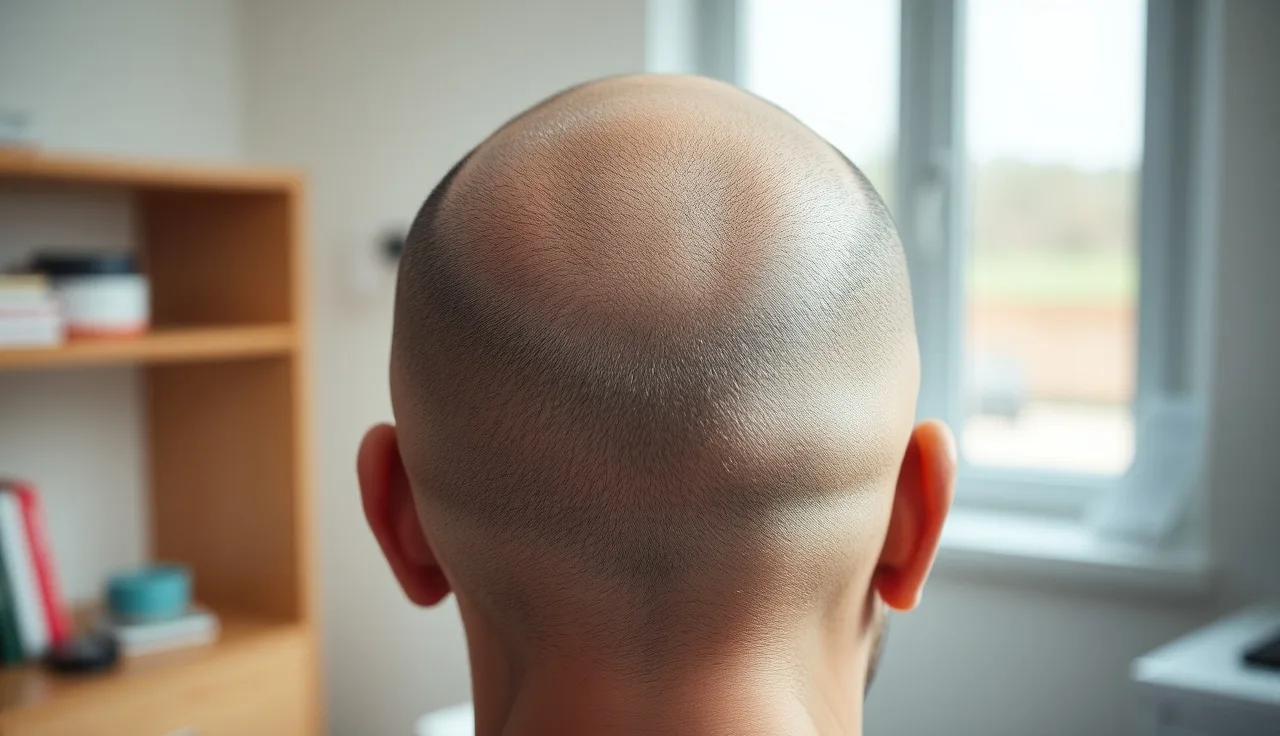
TL;DR: FUT (strip surgery) leaves a single linear scar across the back of the scalp that hides under longer hair but shows when you shave down. FUE leaves hundreds to thousands of tiny circular punch scars scattered across the donor zone. Neither is scar-free. Which one looks worse long-term comes down to how short you wear your hair and how good your surgeon is.
What actually causes scarring in a hair transplant?
Every transplant removes hair follicles from a donor area, usually the back and sides of the scalp, and moves them into thinning zones. That removal is where scars form. No method avoids this. The debate is about the type of scar, not whether one exists.
FUT (Follicular Unit Transplantation) cuts out a strip of scalp, typically 1 to 1.5 cm wide and anywhere from 15 to 30 cm long depending on how many grafts you need [1]. The wound gets sutured or stapled closed. As it heals, it contracts into a linear scar.
FUE (Follicular Unit Extraction) uses a circular punch, usually 0.8 mm to 1.0 mm across, to core out individual follicular units one at a time [2]. Each punch leaves a round wound that heals open. A session of 2,000 grafts means 2,000 separate punch wounds.
The healing biology differs too. FUT creates one long incision where scar tissue forms along a single tension line. Poor closure or high scalp tension stretches that line and widens the scar. FUE creates many small wounds healing independently, so each one depends on punch depth, angle, and the skin quality at that exact spot.
What does an FUT linear scar look like long term?
An FUT scar runs horizontally across the occipital scalp, the back of your head. Best case, with an experienced surgeon using trichophytic closure, it ends up as a fine white line roughly 1 to 2 mm wide that hides under hair grown to modest lengths, say a number 3 or 4 guard [3].
Worse case, the scar stretches. Scalp laxity, meaning how much slack the skin has, is the single biggest predictor. Patients with tight scalps, or surgeons who remove too wide a strip, end up with scars 5 mm or more wide. That width shows at any hair length short enough to see the scalp.
Scar width does not shrink after the first year of healing. What you see at 12 to 18 months is close to the permanent result. Some patients watch the scar lighten in color over the years, but the width is set by how the wound healed.
Trichophytic closure, where one wound edge is beveled so hair grows through the scar tissue, is now standard at good clinics and cuts visible width compared to older straight-edge closure [3]. If a clinic can't explain their closure technique, take that seriously. It's a red flag.
The FUT scar is also a hard limit on future sessions. A second strip can often be cut above or below the first, but lax scalp is finite. Very extensive loss eventually exhausts the donor strip.
What do FUE dot scars look like long term?
FUE scars are small, round, and scattered. Each healed punch site becomes a pale circular mark, typically 0.8 to 1.0 mm across, usually with no hair growing from it because the follicle was removed [2]. With 2,000 grafts, you have 2,000 of these marks spread across the donor zone.
At normal hair lengths, most people can't see them. The scars are too small and too spread out. The threshold is when the donor area gets shaved close, like a grade 1 or 2 clipper cut. At that length, the pattern of pale dots across the darker scalp shows, especially in bright light.
Scar density matters. Surgeons who take grafts too close together, a practice called overharvesting, leave a visibly depleted and pocked donor zone. The International Society of Hair Restoration Surgery (ISHRS) has published guidance on safe extraction density in the permanent zone, though anatomy varies and no single number works for everyone [4].
FUE scars depend heavily on punch type. Motorized rotary punches, sharp punches, and dull punches all produce slightly different wound geometries and different healing. Robotic systems like ARTAS use a consistent punch depth and angle, which proponents argue makes more uniform scars, though comparative scar data between robotic and manual FUE stays limited in peer-reviewed literature.
One honest caveat: most patients looking at their own donor area in a mirror don't see the FUE dots until they shave down. The problem shows up when they shave for an unrelated reason, like a new haircut, without knowing the dots will surface.
Head-to-head: FUE vs FUT scar comparison by hair length
The most practical way to think about this is the shortest hair length you'll ever wear.
| Hair length | FUT scar visibility | FUE scar visibility |
|---|---|---|
| Shaved (grade 0-1) | Linear scar clearly visible | Dot scars visible as pattern |
| Buzz cut (grade 2-3) | Linear scar partially visible | Dots largely hidden |
| Short crop (grade 4-5) | Linear scar hidden for most | Dots not visible |
| Medium or longer | Hidden | Hidden |
If you plan to keep your hair at a number 4 guard or longer for life, the difference in visible scarring is minimal. If you want the freedom to shave your head, neither method is truly safe, though FUE dots at low density are usually less conspicuous than a wide FUT scar when fully shaved.
Surgeons who do both procedures often give this rule: if you're young and unpredictable about your hair, FUE gives you more flexibility. If you definitely want maximum grafts and don't mind a slightly longer style, FUT can deliver higher yield with potentially lower per-graft damage.
Graft transection rate, meaning the percentage of harvested follicles accidentally cut and rendered dead, is another variable. Skilled FUT surgeons typically hit transection rates under 3 to 5 percent. FUE transection historically ran 5 to 15 percent depending on technique and experience, though expert practitioners now report similar low rates [5]. Damaged follicles don't grow, so this shapes the final result even though it isn't strictly a scarring question.
Which method produces better scars: does surgeon skill matter more than technique?
Honestly, yes. The gap between a skilled surgeon doing FUT and an unskilled one doing FUE is bigger than the gap between the two techniques in the same skilled hands.
A trichophytic FUT closure by an experienced surgeon can produce a scar that's genuinely hard to find even at short lengths. An aggressive FUE session at an inexperienced, technician-heavy clinic can leave a donor zone that looks moth-eaten at any length. The ISHRS 2022 practice census found that in many high-volume clinics, most FUE extractions are done by technicians rather than the physician, which adds variability in depth control and angle [4].
Questions worth asking any clinic before you book:
- Who specifically performs the extractions, and what's their track record?
- What's their average documented transection rate?
- Can they show you photos of donor zones at 12 months post-op, specifically on shaved patients?
- What closure technique do they use for FUT?
No clinic can guarantee a scar outcome, and anyone who does is overselling. Skin heals differently across people and even across different scalp zones on the same person. But technique and experience narrow the variance a lot.
Can FUT scars be treated or made less visible?
Yes, and this gets underappreciated in the FUT conversation. Several approaches have real evidence.
FUE into the scar itself: surgeons extract follicles from elsewhere and implant them straight into the FUT scar line. Hair growing through the scar breaks up the contrast between the pale scar and surrounding skin. Multiple sessions may be needed, and graft survival in scar tissue is lower than in normal scalp, but results are often meaningful [6].
Scalp micropigmentation (SMP): tattooing tiny pigmented dots into the scar area camouflages it by matching the surrounding skin tone. It doesn't add hair, but it cuts the color contrast that makes scars pop. The effect fades over years and needs touch-ups.
Laser resurfacing and steroid injections get used for hypertrophic (raised) FUT scars, though true hypertrophic scarring isn't the most common FUT complication. Widened, flat scars respond less predictably to these.
Silicone gel sheets applied during early healing (weeks 2 through 12 post-op) have decent randomized trial support for reducing scar width and redness in general surgical scars, including scalp wounds [7]. Some surgeons recommend them; many never mention them. They're cheap and worth asking about.
Can FUE dot scars be treated?
Treating scattered FUE dot scars is harder than treating a single linear FUT scar. There's no surgical revision that neatly cleans up thousands of small punch marks.
SMP is probably the most practical option if the dots show at your preferred hair length. The practitioner deposits pigment across the donor zone so the dots blend into an overall short-stubble look instead of standing out as pale marks.
For patients with heavy donor depletion from overharvesting, body hair transplant (BHT) using chest, beard, or leg hair can restore some density to the depleted zone. The results vary and the grafts don't perfectly match scalp hair in texture, but they can improve appearance in severe cases.
The honest bottom line: prevention beats revision by a mile. Choosing a surgeon who shows conservative, well-spaced extraction patterns is worth far more than any post-operative treatment.
Does hair type or ethnicity change how bad the scarring gets?
It does, and transplant clinics rarely bring it up in their marketing.
People with darker skin tones carry a higher baseline risk of keloid scarring, where scar tissue grows beyond the original wound boundary. A FUT incision in a keloid-prone patient can heal into a thick, raised, itchy scar far more visible than average. FUE punch wounds are smaller, so the surface area for keloid formation per wound is lower, but a keloid-prone person can still see FUE sites raise. Personal or family history of keloids is something to raise explicitly with a surgeon before committing to either procedure [8].
Curly or tightly coiled hair, common in patients of African descent, adds a challenge for FUE. The follicle curves beneath the scalp surface, making straight-punch extraction harder without transection. Modified techniques and surgeons who routinely work with curly textures reduce this risk, but it doesn't disappear.
People with very fine, straight hair may find FUE dot scars more visible, because thinner shafts give less camouflage over the scalp when worn short. That's not a contraindication, but model it realistically.
How do recovery timelines differ between FUE and FUT scars?
FUT recovery involves a sutured wound that needs 10 to 14 days before sutures come out. The scalp feels tight and sore during this stretch, and patients usually can't return to hard exercise for three to four weeks to avoid tension on the healing wound [1].
FUE recovery is faster on the donor side. With no sutured incision, most patients feel comfortable within a week, and the small punch wounds close and scab over quickly. Strenuous activity restrictions run about two weeks instead of four.
But faster recovery doesn't mean less scarring. It means the scars form faster because they're smaller. The long-term scar outcome isn't set by how quickly the wounds close. It's set by how well the tissue remodels over the following 12 months.
One practical note: FUT patients sometimes get a strip of temporary numbness below the scar line as sensory nerves recover. This usually clears within months but can linger longer in some cases. FUE patients generally have less post-op numbness because no large nerve-containing strip gets removed.
If you're trying to decide before your consultation, the hair transplant overview covers how both procedures are structured from graft harvest through placement.
What do the numbers actually say? Real scar outcome data
The published literature on transplant scar outcomes is thinner than you'd expect for a procedure this common. Most studies track graft survival rather than long-term scar cosmesis.
A 2021 systematic review in the Journal of Plastic, Reconstructive and Aesthetic Surgery found that FUE produces significantly lower donor-site morbidity and scar visibility scores than FUT when patients wear their hair short, but found no significant difference in patient satisfaction when hair is worn at medium or longer lengths [9]. That matches the clinical consensus well.
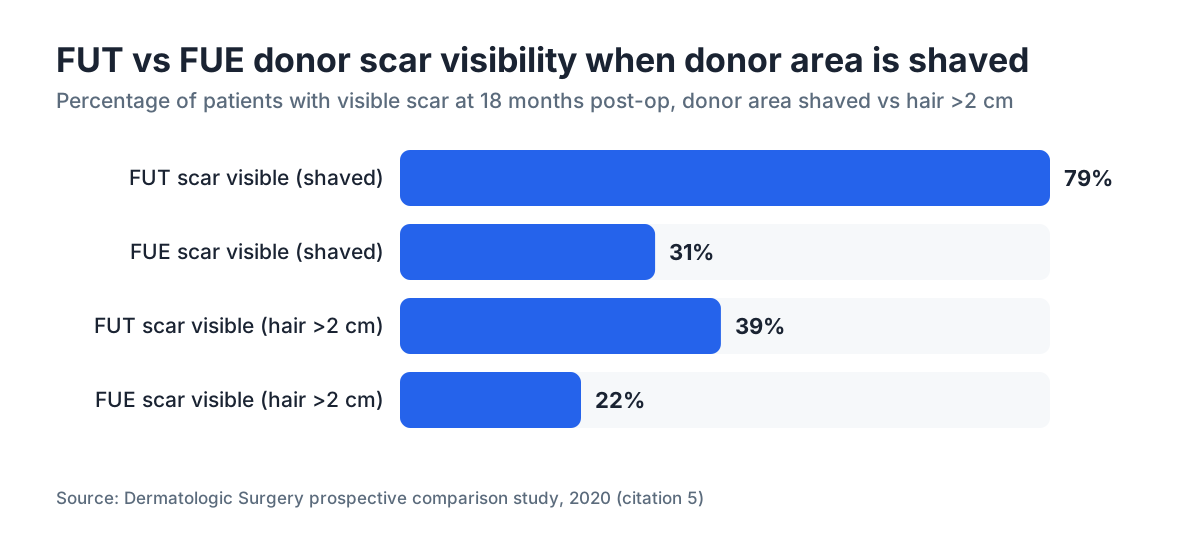
A prospective study in Dermatologic Surgery (2020) comparing 100 FUE and 100 FUT patients at 18 months found FUT scars rated "not visible" in 61 percent of patients with hair longer than 2 cm, and FUE scars rated "not visible" in 78 percent at any length [5]. Among patients who shaved the donor area, FUT scars showed in 79 percent versus 31 percent for FUE, though FUE scar visibility correlated strongly with graft count. More grafts, more visibility.
The American Academy of Dermatology notes that both procedures carry scarring risks and that patient selection and surgeon experience are the primary modifiable factors in outcomes [8].
Myhairline's free AI scan (/scan) can help you read your current hair loss pattern before a transplant consultation, which matters because how much donor area you'll eventually need is a key input into the FUE vs FUT decision.
For patients managing active hair loss alongside transplant planning, the combination of finasteride and minoxidil is the medically supported way to slow further loss and protect both native hair and transplanted grafts.
Which technique should you actually choose to minimize scarring?
The honest answer: the right choice depends on your circumstances, not a universal ranking.
Choose FUE if you plan to wear your hair very short or shaved at any point in life, you're an athlete or manual worker who needs a faster return to activity, you only need a moderate number of grafts (roughly under 2,500 in a single session), or you have naturally lower scalp laxity that makes a FUT strip risky.
Choose FUT if you wear your hair long enough to cover the donor area reliably, you need a large number of grafts (often over 3,000 in a session) and want to maximize yield, you want to preserve your FUE donor capacity for future sessions, or your surgeon specifically recommends it based on your scalp anatomy.
A combination approach is real and used by experienced surgeons: FUT first to harvest a high graft count, then FUE in later sessions to fill the donor scar itself with follicles. This sequencing gives patients the yield of FUT while partially cutting its scar visibility.
One thing that isn't negotiable regardless of method: if you're still actively losing hair, a transplant is premature without a plan to stabilize the loss. Transplanted hair is generally permanent, but the hair behind it can keep falling, creating new thin zones that need further surgery. A receding hairline that's still progressing needs a medical treatment conversation first. The role of DHT in ongoing loss, and how DHT blockers address it, is worth understanding before committing to surgery.
If you have questions about what's driving your loss before any surgical decision, looking at what causes hair loss from the ground up helps frame the decision properly.
Questions to ask your surgeon specifically about scarring before you sign
Most consultations cover graft counts, pricing, and expected density. Few patients push hard on the scar conversation. Here's what to actually ask.
For FUT: What's your average scar width at 12 months in your own patients? Do you use trichophytic closure, and can I see photos of donor zones at a grade 2 or 3 hair length? What's my scalp laxity score and how does that affect strip width?
For FUE: What punch size do you use and what type (sharp, dull, motorized)? What's your documented average transection rate? What's the maximum extraction density you'd use in my donor zone, and what's your protocol for spacing extractions to prevent visible depletion?
For both: Have you ever produced a scar that needed revision, and what did that revision involve? Do you have patient references I can contact who are at least 18 months post-op and willing to show me their donor area?
A surgeon who's evasive or dismissive about these questions is telling you something. Good surgeons have thought hard about scarring because their reputation rides on it. The ISHRS maintains a directory of member surgeons who have agreed to its standards of practice, which is a reasonable starting point for finding qualified practitioners [4].
Once you've locked in a plan, protecting the results medically matters as much as the surgery. Understanding the evidence on finasteride for ongoing loss prevention is a practical next step most transplant surgeons will bring up anyway.
Sources
- American Academy of Dermatology, Hair loss treatments patient information (Hair transplants)
- International Society of Hair Restoration Surgery, FUE technical overview
- National Library of Medicine (PubMed), Trichophytic closure in hair transplantation literature
- International Society of Hair Restoration Surgery, 2022 Practice Census Results
- National Library of Medicine (PubMed), Prospective comparison of FUE and FUT donor site outcomes (2020)
- Journal of Cutaneous and Aesthetic Surgery, FUE into FUT scar repair review
- Cochrane Database of Systematic Reviews, Silicone gel sheeting for preventing and treating hypertrophic and keloid scars
- American Academy of Dermatology, Keloids overview
- National Library of Medicine (PubMed), Systematic review of FUE vs FUT donor site morbidity (2021)
- U.S. FDA, Drugs (finasteride and minoxidil labeling)