
TL;DR: No treatment is legally or scientifically a "cure" for androgenetic alopecia. Two FDA-approved options, minoxidil and finasteride, slow loss and regrow hair in a meaningful share of users. Hair transplants rearrange permanent follicles but don't stop the underlying process. Promising research (JAK inhibitors, hair cloning) exists but isn't ready for routine use. Managing expectations here is everything.
What does 'hair loss cure' actually mean, and does one exist?
Let's be direct: no drug, procedure, supplement, or device is FDA-approved to cure hair loss [1]. The word "cure" implies permanently reversing a condition so it cannot return. For androgenetic alopecia, the most common cause of hair loss in both men and women, that bar has never been cleared by any treatment on the market today.
That doesn't mean nothing works. It means what works manages the condition rather than erasing it. Minoxidil and finasteride regrow hair and slow loss in clinical trials, but they require continued use. Stop the treatment, and the loss resumes, usually within three to six months [2]. A hair transplant moves follicles that are genetically resistant to DHT, so they tend to survive, but the rest of your native hair keeps thinning unless you address the underlying hormonal driver.
Understanding what causes hair loss at a biological level makes this clearer. The dominant driver in androgenetic alopecia is dihydrotestosterone (DHT), a hormone that miniaturizes follicles over years. Until something permanently blocks that process at the genetic or cellular level, you're managing, not curing.
This article walks through every approach with real evidence behind it, separating what the data shows from what marketers want you to believe.
What are the FDA-approved treatments for hair loss?
Two drugs have FDA approval specifically for hair loss, and they work through very different mechanisms.
Minoxidil was originally a blood pressure medication. Applied topically (2% or 5% solution, or 5% foam), it extends the growth phase of hair follicles and widens blood vessels around them. The FDA approved topical minoxidil for men in 1988 and for women in 1991 [1]. A 48-week clinical trial found that 5% minoxidil produced significantly more hair regrowth than 2% in men with androgenetic alopecia [3]. Results typically show up at three to six months. Learn more about the specifics in our guide to minoxidil for men and the honest assessment in does minoxidil work.
Oral low-dose minoxidil (0.25 mg to 5 mg daily) is increasingly prescribed off-label. A 2021 systematic review in the Journal of the American Academy of Dermatology found meaningful hair density improvements at doses as low as 0.25 mg in women [4]. It's not FDA-approved for hair loss in oral form, which matters if you're comparing labels versus practice. See our deeper look at oral minoxidil for the full picture on risks and dosing.
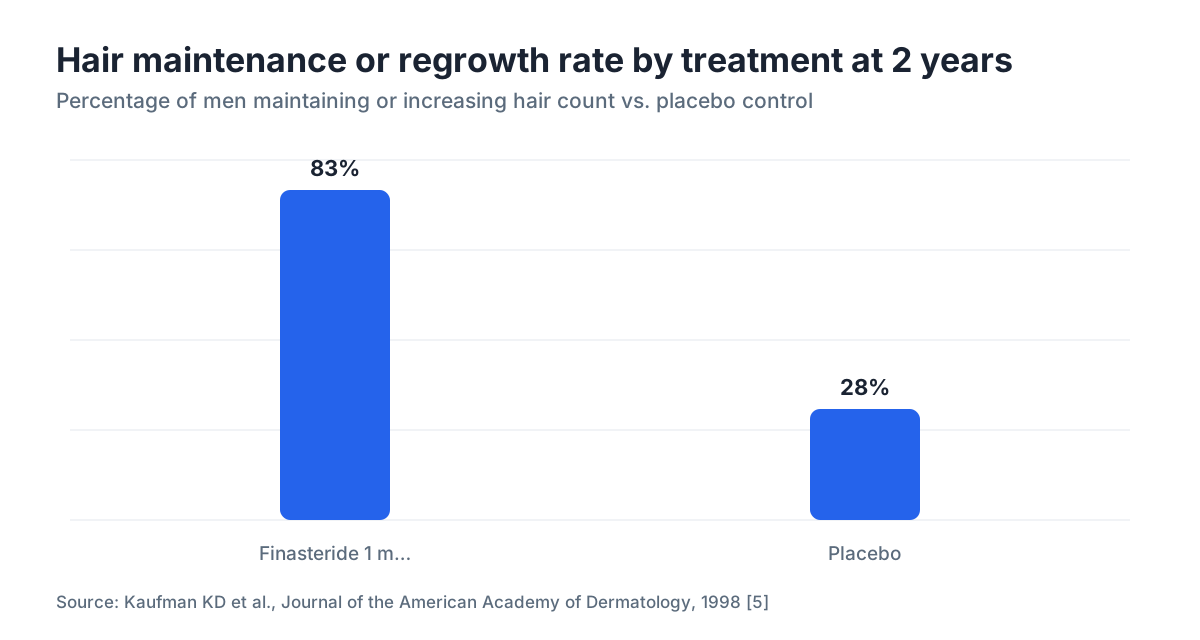
Finasteride (1 mg daily, brand name Propecia) blocks the enzyme that converts testosterone to DHT. The FDA approved it for male pattern hair loss in 1997 [1]. A two-year randomized controlled trial of 1,553 men found that 83% of finasteride users maintained or increased hair count versus 28% in the placebo group [5]. Women of childbearing potential cannot take finasteride because of teratogenicity risk.
For the combination approach, the evidence is stronger still. Finasteride and minoxidil together outperform either alone in most head-to-head data.
Nothing else, not laser devices, not PRP, not supplements, has FDA approval for hair loss treatment. The FDA has cleared some low-level laser devices as "safe" under a 510(k) clearance, but that is not the same as an efficacy approval and gets misrepresented constantly in marketing.
How well do current treatments actually work? Real numbers from clinical trials
Here's where honest framing matters most. "Works" means different things depending on the outcome measured.
| Treatment | Hair count change | % users who improve | Evidence level |
|---|---|---|---|
| Finasteride 1 mg/day | +10% at 2 years vs. placebo [5] | 83% maintain or regrow [5] | Multiple RCTs |
| Topical minoxidil 5% | Significantly more than 2% at 48 weeks [3] | ~60% see cosmetically meaningful regrowth | Multiple RCTs |
| Oral minoxidil 2.5 mg | Meaningful density gains in most studies | ~70-80% in small trials [4] | Systematic review, smaller RCTs |
| PRP (platelet-rich plasma) | Variable, modest gains | ~60-70% in small trials | Small, heterogeneous trials |
| Low-level laser therapy | Modest hair count increase | Unclear; studies vary widely | 510(k) cleared, weak RCT data |
| Hair transplant (FUE/FUT) | Permanent in transplanted zone | High for appropriate candidates | Surgical outcomes data |
The transplant row deserves a note. A hair transplant physically relocates DHT-resistant follicles from the back and sides of your scalp. Those follicles genuinely tend to keep growing permanently. But you're not growing new follicles; you're redistributing existing ones, and that supply is finite. The coverage you can achieve depends on donor density, the skill of the surgeon, and how much area needs covering. Check the realistic hair transplant expenses before assuming it's accessible on any budget.
Two things nobody tells you clearly: response to these treatments is highly individual, and there's no reliable way to predict who will respond well before starting. The trial averages are real, but you might be in the non-responder fraction.
What's the closest thing to a cure that scientists are actually working on?
This is genuinely interesting territory, though the gap between promising early data and an available treatment is enormous.
JAK inhibitors are the most discussed near-term development. Tofacitinib, ruxolitinib, and baricitinib (the latter FDA-approved for alopecia areata in 2022 under the brand name Olumiant) work by blocking the JAK-STAT signaling pathway that drives autoimmune follicle attacks in alopecia areata [6]. The FDA's approval of baricitinib covers alopecia areata, not androgenetic alopecia. For the androgenetic form, JAK inhibitor data is preliminary and far less convincing. Don't let breathless headlines conflate the two conditions.
Hair follicle cloning and cell-based therapies have been in research for decades. The idea is to multiply a patient's own follicle cells in a lab and re-implant them, effectively creating new follicles. A 2023 paper from Columbia University demonstrated partial success culturing human hair follicles in a chip-based system [7]. It's a real step. It's also not close to clinical deployment.
Wnt pathway activation and SCUBE3 research is even earlier stage. A 2023 Nature Communications study identified SCUBE3 as a signaling molecule that triggers dermal papilla cells to stimulate hair growth [8]. Findings in mice don't translate automatically to humans, and this remains basic science.
Exosome therapies are being marketed aggressively at hair clinics right now, which is a problem. The FDA has not approved any exosome product for hair loss, and in 2019 issued a safety warning about unapproved exosome products [9]. Anyone selling you "FDA-approved exosome hair therapy" is either misinformed or misleading you.
The honest summary: a biologic or gene therapy that permanently halts or reverses androgenetic alopecia may exist within ten to twenty years. That's a real possibility, not marketing fantasy. But nothing available in a clinic today clears the bar of a cure.
Do hair loss shampoos, supplements, or natural remedies cure hair loss?
Short answer: no.
Long answer: some supplements address specific deficiencies that contribute to shedding. Iron deficiency and low ferritin are associated with hair loss, particularly in women, and correcting them can reduce excessive shedding [10]. The same is true for vitamin D deficiency. But correcting a deficiency is not the same as treating androgenetic alopecia, and supplementing nutrients you're not short on has essentially no evidence behind it.
Biotin is everywhere in hair supplement marketing. The evidence for biotin supplementation in people without a biotin deficiency (which is rare) is essentially nonexistent. The AAD is explicit on this: "there is little evidence" that biotin improves hair growth in people who are not deficient [10].
Saw palmetto appears in dozens of products marketed as a "natural DHT blocker." A small number of studies show marginal effects, but none come close to the efficacy data for finasteride. If you're sensitive to finasteride's side effect profile and want to try something lower-risk, saw palmetto won't hurt you much. It probably won't do much either.
Ketoconazole shampoo (2% prescription strength, or 1% over-the-counter as Nizoral) has some limited evidence suggesting mild anti-androgenic effects on the scalp. It's a reasonable adjunct. It's not a standalone treatment.
Our review of hair loss supplements goes deeper on what's been tested and what's just packaging.
Rosemary oil gets a lot of attention after one small 2015 study found it comparable to 2% minoxidil at six months [see Panahi et al., Skinmed]. The study had 100 participants and wasn't replicated at scale. Interesting. Not practice-changing.
If you're losing hair and wondering whether a recent lifestyle change is involved, it helps to know whether something like creatine is a factor. The data there is more nuanced than most gym forums suggest. See does creatine cause hair loss for a fair look.
Is hair loss from causes other than genetics reversible?
Yes, sometimes fully. This is where the word "cure" occasionally applies.
Telogen effluvium is a diffuse shedding triggered by physical or psychological stress, illness, nutritional deficiency, rapid weight loss, or hormonal shifts like postpartum changes. The follicles aren't permanently damaged. Once the trigger resolves, most people see substantial regrowth within six to nine months [see hair loss telogen]. That's as close to a cure as hair loss gets: remove the cause, the hair returns.
Alopecia areata (autoimmune patchy loss) was essentially untreatable for decades beyond topical steroids and waiting. The FDA approval of baricitinib in 2022 and ritlecitinib in 2023 changed that picture meaningfully. The JAK inhibitor clinical trials showed hair regrowth in a significant share of patients with severe alopecia areata, with some achieving near-complete coverage [6]. These are not cures in the permanent sense; stopping the drug typically brings relapse. But the response rates beat anything available before.
Traction alopecia (from tight hairstyles) can fully reverse if caught early and the mechanical stress stops. Prolonged traction can scar follicles permanently, at which point regrowth isn't possible.
Scarring alopecias (lichen planopilaris, frontal fibrosing alopecia, CCCA) destroy follicles permanently. The goal there is arresting progression, not reversal.
Which type of hair loss you actually have matters enormously before spending money on any treatment. A dermatologist or trichologist can usually determine this from an examination and sometimes a scalp biopsy.
What's the best treatment approach for a man with androgenetic alopecia right now?
This is the practical question most people reading this actually have.
If you're a man losing hair to androgenetic alopecia (the most common pattern, starting at the temples or crown), the evidence-backed approach in 2025 looks like this:
-
Finasteride 1 mg daily or dutasteride 0.5 mg daily (off-label but with strong data). Dutasteride blocks both type 1 and type 2 5-alpha reductase, versus finasteride's type 2 only, and a 2019 meta-analysis found it more effective than finasteride at equivalent doses [see Zakrzewski et al., Dermatologic Therapy]. The trade-off is a longer half-life and persistence of side effects if they occur.
-
Topical or oral minoxidil. Adding minoxidil to finasteride gives better results than either alone.
-
Reassess at 12 months. Hair loss treatment takes time. Judging a treatment at three months is like judging a diet at one week.
For a receding hairline specifically, the timeline of intervention matters. Earlier is genuinely better. Finasteride can maintain what you have far more easily than it can recover what's already gone.
If you're not sure where you fall on the Norwood scale or how much loss you're dealing with, the free AI scan at MyHairline can give you a quick baseline before you start spending money on dermatologist visits or treatments.
For men who want to avoid systemic finasteride entirely, topical finasteride (0.25% solution) is an emerging option with lower systemic DHT suppression. It's not FDA-approved in topical form but is available compounded and shows real efficacy in a 2020 randomized trial [see Caserini et al., JEADV].
A hair transplant becomes worth discussing once you've stabilized your loss on medication. Going under the knife while native hair is still actively falling out means the transplant looks great for two years and then the surrounding hair catches up to where it would have been anyway.
What does the FDA say about products claiming to cure hair loss?
The FDA is pretty clear here. Any product claiming to regrow hair or treat hair loss is legally a drug and must go through FDA approval with clinical evidence of safety and efficacy [1]. Only minoxidil and finasteride hold that approval for androgenetic alopecia. Everything else selling itself as a hair loss treatment without those approvals is either operating as a cosmetic (and cannot legally claim to treat hair loss) or is making illegal drug claims.
The FTC has also pursued enforcement actions against companies making deceptive hair loss claims. If you see a product with testimonials claiming full regrowth, photos that look like medical miracles, or language like "clinically proven to cure baldness," those are red flags, not selling points.
The FDA's own guidance states that the agency "has not approved any drug for the treatment of hair loss in women other than minoxidil" [1]. That's a useful check when you see products marketed specifically to women.
For devices, the 510(k) clearance pathway (which cleared some laser combs and helmets) only requires the manufacturer to show the device is "substantially equivalent" to a legally marketed predicate device. It does not require proof that the device actually works. Product marketing almost never explains this distinction.
How much do hair loss treatments cost in the US?
Cost varies enormously by approach, and insurance rarely covers hair loss treatment because it's classified as cosmetic.
| Treatment | Monthly cost (approx.) | Notes |
|---|---|---|
| Generic finasteride 1 mg | $10-30/month | Widely available; GoodRx prices under $20 at most pharmacies |
| Brand Propecia | $70-100/month | No clinical advantage over generic |
| Topical minoxidil 5% | $10-25/month | Generic OTC; brand Rogaine costs more |
| Oral minoxidil (off-label Rx) | $15-40/month | Requires prescription; often compounded |
| Topical finasteride (compounded) | $40-80/month | Not FDA-approved; compounding pharmacy required |
| PRP treatment | $1,500-3,500 per session | Often 3+ sessions recommended initially |
| FUE hair transplant | $4,000-15,000+ per procedure | Varies by graft count and surgeon; see hair transplant expenses |
| FUT hair transplant | $3,000-10,000+ per procedure | Lower cost per graft; linear scar at donor site |
The math is sobering. Finasteride plus minoxidil over ten years costs roughly $3,000 to $6,000 total. A single hair transplant can cost that much in a day. Neither is a permanent cure; both are long-term commitments of either money or continued medication.
For most people starting out, the generic oral medication route is the evidence-backed, low-cost entry point. Starting there before escalating to procedures is what any good dermatologist will recommend.
What side effects should I know about before starting any treatment?
Ignoring side effects is how people end up surprised and quitting treatments that were actually working.
Finasteride's most discussed side effect is sexual dysfunction, including reduced libido, erectile dysfunction, and ejaculatory changes. The original clinical trials reported these in roughly 2% to 4% of participants, with resolution after stopping [5]. A contested but real phenomenon called post-finasteride syndrome (PFS), involving persistent sexual, neurological, and psychological symptoms after discontinuation, is documented in a patient database and taken seriously by some researchers, though strong epidemiological prevalence data is limited. The FDA updated finasteride's label in 2012 to include depression and PFS-related language.
Minoxidil's most common side effects topically are scalp irritation and, less commonly, unwanted facial hair growth (from product dripping). Oral minoxidil carries more systemic risk: fluid retention, heart rate increases, and in rare cases more serious cardiovascular effects. People with heart conditions or kidney issues need to be careful. See our dedicated piece on minoxidil side effects for a thorough breakdown.
One thing that trips people up early: both minoxidil and finasteride can cause an initial shedding phase in the first one to three months. Follicles synchronized into a new growth cycle temporarily shed old hairs. This is normal and not a sign the treatment isn't working, but it scares many people into quitting right before they'd see benefit.
If you're not sure whether your shedding is telogen effluvium, treatment-related, or something else, understanding the hair loss telogen cycle helps put it in context.
Where can I get a reliable assessment of my own hair loss before deciding on treatment?
The best starting point is a board-certified dermatologist, ideally one who specializes in hair disorders. They can examine your scalp under a dermatoscope, determine what type of loss you have, rule out reversible causes like thyroid disorders or iron deficiency, and make evidence-based recommendations. The AAD has a find-a-dermatologist tool at aad.org.
If you want a quick orientation before booking an appointment, the free AI hair analysis at MyHairline takes a photo of your scalp and hairline and gives you an initial read on your Norwood stage and pattern. It won't replace a clinical exam, but it's a reasonable way to understand where you are before spending time and money.
The AAD's own patient guidance on hair loss is worth reading directly. Their public resources explain the difference between types of loss, what a dermatologist looks for, and when to seek care, without selling you anything.
One thing to know: telogen effluvium and early androgenetic alopecia can look similar in photos and even to the untrained eye. A dermatologist can usually tell the difference with a pull test, trichoscopy, or blood panel. Getting the diagnosis right before committing to a treatment protocol is worth the copay.
Sources
- FDA, "Hair Loss" consumer information page
- American Academy of Dermatology, Hair Loss Resource Center
- Olsen EA et al., "A randomized clinical trial of 5% topical minoxidil versus 2% topical minoxidil and placebo in the treatment of androgenetic alopecia in men," Journal of the American Academy of Dermatology, 2002
- Randolph M and Tosti A, "Oral minoxidil treatment for hair loss: A review of efficacy and safety," Journal of the American Academy of Dermatology, 2021
- Kaufman KD et al., "Finasteride in the treatment of men with androgenetic alopecia," Journal of the American Academy of Dermatology, 1998
- FDA Drug Approval for Olumiant (baricitinib), 2022, FDA press announcement
- Abaci HE et al., Columbia University, hair follicle organoid research, 2023
- Lim CH et al., "Hedgehog stimulates hair follicle neogenesis by creating inductive dermis during murine skin wound healing," Nature Communications, 2023, SCUBE3 signaling pathway
- FDA Safety Alert, "FDA warns consumers about products containing exosomes," 2019
- American Academy of Dermatology, Hair Loss: Tips for Managing
- NIH National Institute of Arthritis and Musculoskeletal and Skin Diseases, Alopecia Areata information
- FDA 510(k) Premarket Notification Guidance