

TL;DR: Norwood stage 3 is the first degree of hair loss severe enough that surgeons take a transplant seriously. Most patients need 800 to 2,000 grafts, pay $4,000 to $10,000, and see final results by 12 months. Many Norwood 3 men do just as well pausing for medication first, since the stage is early enough that finasteride and minoxidil can slow or partly reverse it.
What does Norwood stage 3 actually look like?
The Norwood-Hamilton scale is the standard classification doctors use to describe male-pattern hair loss. It runs from stage 1 (no visible loss) to stage 7 (almost nothing left on top). Stage 3 is the first grade the original 1975 paper by O'Tar Norwood described as "minimal but definite" recession, with the frontotemporal angles receding past a line drawn across the scalp. [1]
In plain terms: your hairline has pulled back noticeably at the temples, forming a distinct M or U shape. The recession is deep enough that most people can see it in photos, but your crown is still intact and you still have workable density in the mid-scalp. That last detail matters a lot for transplant planning.
Stage 3 also has a substage called Norwood 3 vertex, where the crown starts thinning at the same time as the temples. That variant changes the math on a transplant a lot, because the surgeon now has to decide whether to address two zones or one.
The line between stage 2 and stage 3 is not always obvious in the mirror. A trained surgeon or dermatologist uses a density-measuring tool called a trichoscope to count hairs per square centimeter, which takes out the guesswork. If you want a rough self-assessment first, MyHairline's free AI scan can classify your Norwood stage from a photo before you book a clinic consultation.
Is Norwood 3 early enough to skip a transplant entirely?
Honestly, yes, for a lot of men. Stage 3 is the point where you have the most options and the least urgency.
The two FDA-approved treatments for androgenetic alopecia are topical minoxidil (approved 1988) and oral finasteride (approved 1997). [2][3] Both have the strongest evidence at early-to-mid stages, meaning Norwood 2 through 4, because there are still enough miniaturizing follicles alive to rescue. A 5-year finasteride trial published in the Journal of the American Academy of Dermatology found that 48% of men taking 1 mg finasteride daily showed visible improvement in vertex hair growth, and 42% showed improvement at the hairline at the 5-year mark, compared to continued loss in the placebo group. [4]
Minoxidil works through a different mechanism (vasodilation and a longer anagen phase) rather than blocking DHT. Combining both is the most evidence-backed non-surgical strategy. See finasteride and minoxidil for a head-to-head breakdown.
The honest case against skipping surgery: if your recession has been progressing for several years and your family history points toward Norwood 5 or 6 by your fifties, starting with medication alone may just delay the same decision by a decade. Neither drug stops loss permanently once you quit taking it. A transplant using your own follicles is permanent, but it does not stop further native hair loss around the transplanted zone.
So the real question is not transplant vs. medication. It's whether you start with medication, buy time, and transplant later, or transplant now and add medication to protect the hair you still have.
How many grafts does a Norwood 3 transplant typically require?
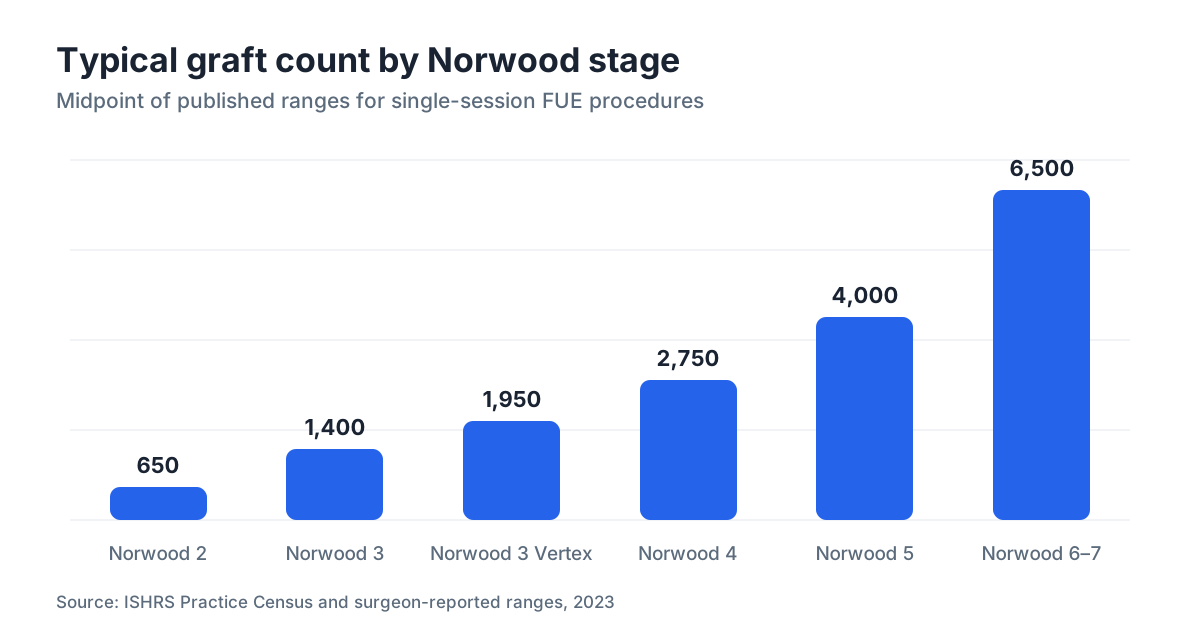
Graft counts at Norwood 3 are modest next to later stages. Most surgeons quote 800 to 2,000 grafts for a standard Norwood 3 recession, depending on how far the temples have pulled back, the density goal, and whether the vertex is involved. [5]
A "graft" is a naturally occurring group of 1 to 4 hairs (called a follicular unit). When clinics say 1,500 grafts, that usually translates to roughly 2,500 to 3,500 individual hairs, because most follicular units in the scalp contain 2 to 3 hairs. Clinics that advertise raw "hair" counts rather than graft counts are not being dishonest, but the numbers sound bigger, so ask specifically for graft counts when comparing quotes.
For a Norwood 3 vertex case, add another 400 to 700 grafts to cover the crown, bringing the total to 1,200 to 2,700 grafts. Doing both zones in one session is fine for most patients, but some surgeons prefer staged procedures to preserve donor density.
The donor area (the back and sides of the scalp) holds a finite number of grafts, typically 6,000 to 9,000 lifetime grafts for most men, though anatomy varies widely. Spending 1,500 grafts on a Norwood 3 hairline in your late twenties is a gamble if you end up at Norwood 6 by your forties. That is the single most-discussed risk in the transplant planning community, and it's worth taking seriously.
| Norwood Stage | Typical Graft Range | Approximate Hair Count |
|---|---|---|
| 2 | 400 to 900 | 800 to 1,800 |
| 3 | 800 to 2,000 | 1,600 to 4,000 |
| 3 Vertex | 1,200 to 2,700 | 2,400 to 5,400 |
| 4 | 2,000 to 3,500 | 4,000 to 7,000 |
| 5 | 3,000 to 5,000 | 6,000 to 10,000 |
| 6 to 7 | 5,000 to 8,000+ | 10,000 to 16,000+ |
What does a Norwood 3 hair transplant cost?
In the United States, hair transplants are priced per graft. The going rate at reputable clinics in 2024 to 2025 is roughly $3 to $8 per graft for FUE (follicular unit excision) and a bit less for FUT (follicular unit transplantation). [5] At 1,500 grafts, that puts a Norwood 3 procedure at $4,500 to $12,000.
Prices swing hard by geography. New York and Los Angeles clinics run higher. Clinics in Florida, Texas, and the Midwest often come in lower for the same technique. International destinations like Turkey, India, and Mexico offer packages from $1,500 to $4,000 all-in for equivalent graft counts, which is why medical tourism for hair transplants is so big. The quality range at overseas clinics is enormous, from excellent to genuinely harmful, so the price gap alone should not drive the decision.
Insurance does not cover hair transplants because they are classified as cosmetic. Some clinics offer financing through third-party lenders (CareCredit and similar). Interest rates on those plans are not always favorable, so compare the total cost of financing carefully.
The cost per graft breakdown:
| Technique | Cost per Graft (US) | Typical Norwood 3 Total |
|---|---|---|
| FUT (strip) | $2 to $5 | $3,000 to $10,000 |
| FUE (manual/robotic) | $3 to $8 | $4,500 to $16,000 |
| Overseas FUE (Turkey) | $0.80 to $2 | $1,200 to $4,000 |
A full breakdown of the hair transplant process, both techniques, and what to ask before signing a consent form is in hair transplant.
FUE vs. FUT: which technique is better for Norwood 3?
Both techniques move real follicular units from your donor area to the recipient zone. The difference is how the grafts get harvested.
FUT takes a strip of scalp from the back of the head, dissects it under magnification into individual follicular units, and closes the donor wound with sutures. It leaves a linear scar that hides under hair but shows if you ever shave down to a short buzz. Yield per session is high, and the grafts are generally undamaged by the harvesting.
FUE punches out individual follicular units one at a time using a small circular punch (0.7 to 1.0 mm). There is no linear scar, recovery is faster, and you can wear your hair very short afterward. The trade-off: transection rates (accidentally cutting a follicle during extraction) run higher with less-experienced technicians, and the per-graft cost is higher.
For a Norwood 3 patient in their twenties or thirties who wants the freedom to keep hair short, FUE is the obvious choice, assuming you find a surgeon with documented low transection rates. If you are older, comfortable with slightly longer hair, and want maximum graft yield at lower cost, FUT produces slightly denser results per session according to a 2020 review in the Journal of Cutaneous and Aesthetic Surgery. [6]
Some surgeons offer a combined approach: FUT first to harvest a strip, then FUE on top to squeeze out more grafts. That mostly matters for Norwood 5 to 7, not stage 3.
What is the recovery timeline for a Norwood 3 hair transplant?
Day 1 to 3: The scalp is red and swollen. Small scabs form around each graft site. Most patients take 2 to 3 days off work. Sleeping elevated (two to three pillows) cuts facial swelling.
Day 5 to 14: The scabs fall off. The transplanted hairs enter a resting (telogen) phase and most of them shed. This is transplant shock loss, or post-operative telogen effluvium, and it is normal. Seeing your hair shed at this stage does not mean the procedure failed. For a full explanation of why this happens, see telogen effluvium.
Month 1 to 3: Very little visible growth. The follicles are resting underground. Patient anxiety peaks here.
Month 4 to 6: New hairs start emerging. They are often thin and wavy at first. The hairline begins to show.
Month 8 to 12: Density and texture close in on final results. Most surgeons treat 12 months as the standard endpoint for judging the outcome.
Month 12 to 18: The last 10 to 20% of density arrives. Some patients keep improving up to 18 months post-procedure.
The number most surgeons cite: about 60% of final growth is visible by month 6, and 80% to 90% by month 9. [5] If you have a social event you care about, book the procedure at least 10 to 12 months ahead.
Native hair around the transplanted zone can also shed temporarily after surgery from the stress of the procedure. This is shock loss to existing hair. It usually passes, and it's more common in patients who did not start finasteride beforehand.
What are the real risks of a hair transplant at Norwood 3?
The risk that comes up most at Norwood 3 specifically is overharvesting the donor zone relative to your long-term loss trajectory. If you are 28 with a Norwood 3 pattern and a family history of Norwood 6, using 1,500 grafts now leaves you with roughly 4,500 to 7,500 grafts for future procedures. That may not cover everything that goes bald in the decades ahead.
General surgical risks apply to any transplant. The American Academy of Dermatology lists infection, scarring, folliculitis (small pimples around new grafts), and numbness as possible complications. [7] These are uncommon with board-certified surgeons but real at high-volume, low-oversight operations.
Unnatural hairline design is a cosmetic risk that hits young patients hardest. An aggressively low, straight hairline at 28 can look odd at 50 once the surrounding native hair has receded further. Good surgeons place hairlines conservatively and use single-hair grafts at the front edge to copy the irregular density of a real hairline.
Cobblestoning (a bumpy graft surface) and poor growth (graft survival below 70%) are signs of a low-quality procedure. Graft survival rates at experienced centers run 90% to 95%. [5]
A small group of patients get persistent numbness or altered scalp sensation in the donor area after FUT. This usually clears in weeks to months but can occasionally stick around. Bring it up with your surgeon before consenting.
Should you take finasteride or minoxidil before or after the transplant?
Most hair loss specialists recommend starting finasteride at least 6 to 12 months before a transplant if you plan to use it. The reasoning: finasteride stabilizes the native hair around the transplant zone, cuts the risk of shock loss to existing hairs, and shows you what your non-transplanted hair can recover before surgery. [4]
Finasteride works by inhibiting 5-alpha reductase type II, dropping DHT levels in the scalp by roughly 60 to 70%. [8] It does not touch the transplanted follicles themselves (donor-area follicles are genetically DHT-resistant), but it protects the miniaturizing follicles already in the recipient area. For a closer look at how it works and its side effect profile, see finasteride.
Minoxidil is commonly added after the procedure. The 5% topical foam twice daily or the 2% solution twice daily are both FDA-approved for men. [3] Some dermatologists now prefer low-dose oral minoxidil (2.5 to 5 mg daily) for convenience. The evidence on oral minoxidil for androgenetic alopecia is growing; see oral minoxidil for the current data. For side effects with the topical version, minoxidil side effects covers them in full.
The practical answer: if you are on nothing before surgery, start finasteride at least 6 months out if you can tolerate it, keep taking it afterward indefinitely, and add minoxidil post-op to speed growth and protect native hair. Stop finasteride after the transplant and its benefits on native hair typically reverse within 6 to 12 months.
If you want to understand DHT's role in miniaturization more broadly, dht blocker explains the mechanism without the surgical context.
How do you find a qualified surgeon for a Norwood 3 case?
Board certification is the starting point. In the US, the relevant boards are the American Board of Hair Restoration Surgery (ABHRS) and the International Society of Hair Restoration Surgery (ISHRS). Both keep searchable directories of credentialed surgeons. [9]
Credentials aside, ask specifically for before-and-after photos of Norwood 3 cases, not dramatic Norwood 6 results. Ask for the surgeon's graft survival rate and transection rate. Ask who actually does the procedure: at many high-volume clinics, the physician handles the design and initial incisions while trained technicians do the extraction and implantation. That is not inherently bad, but you should know what you are paying for.
Consult with at least two or three surgeons before committing. Any surgeon who pressures you to book on the spot, or who lowballs your future loss risk to sell a procedure, is a red flag. The consultation should include a trichoscopy read of donor density and a frank talk about your lifetime loss trajectory.
To start your research with an objective look at your current stage, the free AI hair analysis at MyHairline gives you a Norwood classification and a loss trajectory estimate from a photo, which you can bring to clinic consultations as a baseline.
What results can Norwood 3 patients realistically expect?
Norwood 3 is one of the most predictably satisfying stages to treat surgically, for a few reasons. The zone to fill is small. Donor supply is usually plentiful next to demand. The native hair on top is still largely intact, so the transplanted hairline blends in rather than standing alone on a bald scalp.
Patient satisfaction studies consistently show the highest satisfaction at earlier Norwood stages. A review published in Dermatologic Surgery found that 97% of patients who underwent FUE at stages 2 through 4 rated their results as satisfactory or better at 12 months. [10] Norwood 6 and 7 patients are harder to satisfy because the area needing coverage is bigger than what donor supply can realistically fill.
Realistic expectations for Norwood 3:
- A natural-looking hairline that no longer reads as receded in most lighting and social situations
- Density at the hairline of roughly 35 to 50 follicular units per square centimeter, against the 60 to 80 FU/cm2 of an unaffected scalp (transplanted hair rarely matches native density exactly)
- Results that are permanent at the transplanted sites (DHT-resistant donor follicles keep their genetic programming after transplantation)
- No change to the natural loss pattern of surrounding native hair over time, which means medical therapy is still needed to keep the temples from receding outside the transplanted zone
The most common disappointment is not bad graft growth. It's the steady loss of native hair next to the transplanted area that was never covered. That's why medical therapy is not optional if you care about long-term appearance.
What are the alternatives to a transplant for Norwood 3?
Three alternatives deserve honest evaluation.
Medical therapy alone (finasteride plus minoxidil) is the most evidence-backed non-surgical option and, for younger men with recent onset, often the right first move. [4][3] The downside: it takes indefinite daily use, and results plateau or reverse when you stop.
Scalp micropigmentation (SMP) is a tattooing technique that mimics the look of a closely-shaved head. It adds no real hair and it is a poor fit if you wear your hair longer, but for men who already shave their heads it can make a receding hairline nearly invisible. It lasts 3 to 5 years before fading and needing a touch-up.
Low-level laser therapy (LLLT) using FDA-cleared devices (combs, caps, and helmets) has modest evidence for slowing shedding. A 2009 randomized controlled trial in the American Journal of Clinical Dermatology found statistically significant hair count improvement versus a sham device. [11] Nobody has great data on how it stacks up head-to-head against finasteride or minoxidil, and the effect sizes are smaller. Calling it an alternative rather than a supplement is generous.
The honest hierarchy at Norwood 3: try medical therapy first if you're under 30 and your loss is recent. If you have been on effective therapy for 12 to 18 months, are stable or still slowly losing, and the hairline bothers you, a transplant is a reasonable next step. The two approaches are not mutually exclusive, and the best outcomes usually use both.
For more on what's driving the loss in the first place, what causes hair loss covers the full picture beyond DHT.
Sources
- O'Tar Norwood, Southern Medical Journal 1975, original Norwood-Hamilton classification paper
- FDA, Drug Approval History: Rogaine (minoxidil topical)
- FDA, Drug Approval for Propecia (finasteride 1 mg)
- Kaufman KD et al., Journal of the American Academy of Dermatology, 1998 and 5-year follow-up
- International Society of Hair Restoration Surgery (ISHRS), Practice Census and Patient Survey
- Gupta AK et al., Journal of Cutaneous and Aesthetic Surgery, 2020 review of FUT vs FUE outcomes
- American Academy of Dermatology, Hair Loss: Diagnosis and Treatment
- MedlinePlus (US National Library of Medicine), Finasteride drug information
- American Board of Hair Restoration Surgery (ABHRS) and ISHRS surgeon directories
- Garg AK, Garg S, Dermatologic Surgery, patient satisfaction in FUE at early Norwood stages
- Leavitt M et al., American Journal of Clinical Dermatology, 2009, randomized controlled trial of LLLT