
TL;DR: Modern hair transplants, done by a skilled surgeon using FUE or FUT, achieve graft survival rates of 85 to 95% in peer-reviewed studies. Most patients see real density gains. Failure happens, but it usually traces back to surgeon skill, poor candidate selection, or native hair loss that keeps going because nobody put the patient on medication afterward.
What is the success rate of a hair transplant?
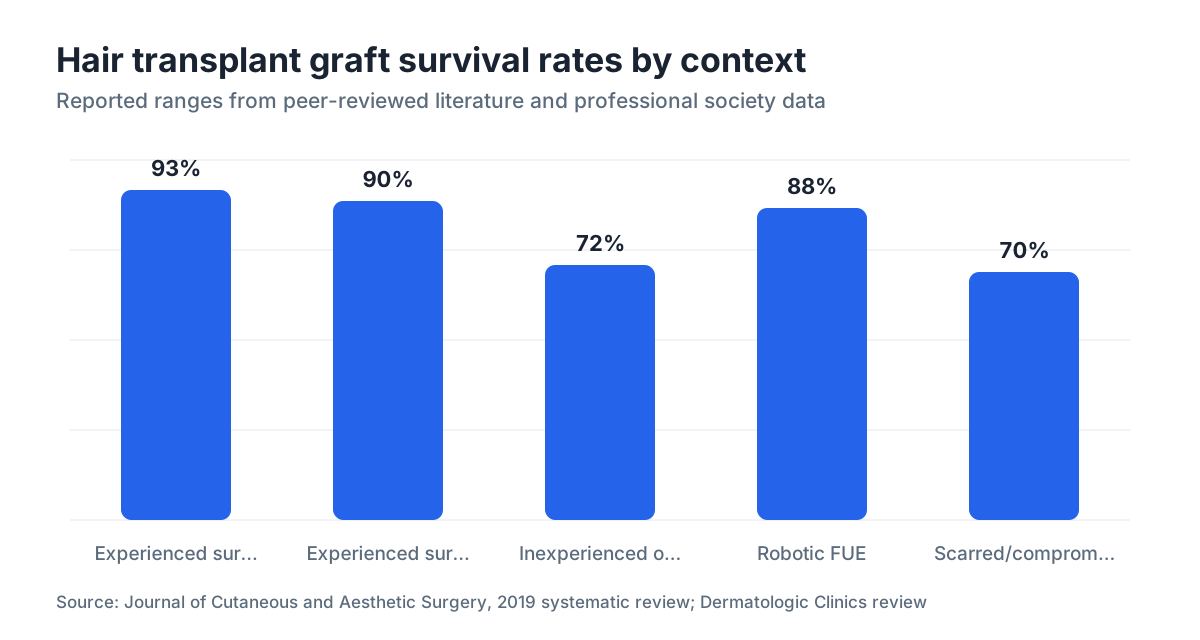
Here's the honest number: 85 to 95% graft survival. That range holds up across FUE and FUT when the surgeon is experienced and the patient is a reasonable candidate [1]. A 2019 systematic review in the Journal of Cutaneous and Aesthetic Surgery found graft survival consistently landed in that band across studies that met quality criteria [1].
That number needs unpacking, because "success" means different things to different people.
Graft survival is the technical measure: what percentage of transplanted follicular units are alive and growing hair at 12 months. Patient satisfaction is something else entirely. You can have 90% graft survival and still be miserable if your expectations were set wrong, if your native hair kept thinning around the transplanted patch, or if the hairline was designed to look fake.
The American Hair Loss Association estimates that roughly 95% of men with male pattern baldness will keep progressing over time [2]. So a transplant done at 28 without medication to slow ongoing loss can look like a completely different head at 38, no matter how many grafts survived. Graft survival is necessary. It is not enough.
How is success actually measured after a hair transplant?
Surgeons and researchers use several overlapping measures, and none of them captures the whole picture on its own.
Graft survival (the most cited number): Measured at 12 months, usually by counting visible hairs in a defined scalp area using a trichoscope or standardized photography. A graft counts as surviving if it produces at least one visible terminal hair. Most quality clinics call above 80% acceptable, with the best results above 90% [1].
Hair density (hairs per cm²): Measured by trichoscopy. A realistic target for transplanted zones is 40 to 60 hairs per cm², against a normal scalp's 100 to 150 hairs per cm². A transplant can post high graft survival and still miss target density if too few grafts went in.
Patient-reported satisfaction scores: Standardized tools like the DLQI (Dermatology Life Quality Index) and visual analogue scales put satisfaction in the 70 to 90% range across published series [3]. That lower bound is the part clinics don't advertise. In some series, 10 to 30% of patients report partial disappointment, usually about density rather than outright failure.
Naturalness of the result: Harder to quantify. Trained evaluators score hairline naturalness blind from photos. Poor graft angulation and unnatural linear placement are the two things they flag most, and both are surgeon-skill problems [4].
Success is multidimensional. When a clinic quotes you a 95% success rate, ask which metric they mean.
FUE vs. FUT: does the technique affect success rates?
Both techniques work. The literature doesn't show one beating the other on final graft survival when the surgeon is competent [1][4].
| Metric | FUE | FUT (strip) |
|---|---|---|
| Graft survival (reported range) | 85 to 95% | 90 to 95% |
| Max grafts in one session | ~2,000 to 3,000 | ~2,000 to 4,000 |
| Scarring | Scattered dot scars | Linear scar, easily hidden |
| Transection rate (damaged grafts) | Higher if tech is inexperienced | Lower, controlled excision |
| Recovery time | 7 to 10 days | 10 to 14 days |
| Cost | Higher | Slightly lower |
FUT has a modest edge in raw yield for big sessions because the strip gets dissected under microscope control, which cuts transection (accidental slicing of the follicle). FUE transection runs under 5% in expert hands and over 15% with inexperienced ones, and transected grafts don't grow [4]. That spread is the main reason FUE results ride so heavily on who's holding the punch.
Robotic FUE (systems like ARTAS) sells itself on consistent punch depth to reduce transection. A 2018 study in Dermatologic Surgery found robotic FUE transection rates of roughly 5 to 8%, on par with skilled manual FUE [5]. It's not magic. It's consistency at scale.
For most patients picking between the two, the technique matters far less than the surgeon.
What factors actually predict whether your transplant will succeed?
The research points to a fairly clear set of variables, and you can assess most of them before you ever book a date.
Surgeon experience and facility quality. This is the dominant factor. No licensing body in the US certifies hair transplant surgeons specifically, though the American Board of Hair Restoration Surgery (ABHRS) offers a credential that requires documented training and an exam [6]. A surgeon running 3 to 4 sessions a week for years builds pattern recognition and technique that genuinely move graft survival.
Donor density. Transplanted hair comes from the permanent zone, usually the sides and back of the scalp. Dense, coarse donor hair packs more grafts into a smaller area for higher yield. Fine, low-density donor areas give you a smaller supply and less impact per graft.
Recipient area characteristics. Scarred tissue (from burns, old strip surgeries, or traction alopecia) has reduced blood supply, which limits graft take. Surgeons usually aim for 30 to 40% lower density in these zones and may stage the work [4].
Age and progression stage. Operating on a 24-year-old with early loss is risky because you're designing around a scalp that will keep changing. The International Society of Hair Restoration Surgery (ISHRS) advises careful evaluation of Norwood trajectory before proceeding [7].
Post-op care. Grafts are fragile for the first 7 to 14 days. Direct trauma, picking, heavy exercise, or sun in that window can knock down survival. Most clinics report outcomes from patients who followed the rules. Real-world adherence varies.
Ongoing medical management. This one gets undersold. A transplant moves hair. It doesn't stop loss in the surrounding native follicles. Patients who stay on finasteride or minoxidil for men after surgery keep their existing hair and make the transplant look denser for longer. The ones who don't often need a second procedure within 5 to 8 years as native hair catches up with the loss.
What does a hair transplant failure look like and how common is it?
Complete failure, where essentially no grafts survive, is rare. In a well-run clinic with proper technique and candidate selection, it's below 1% [1]. Partial failure is where most of the real disappointment lives.
The common failure modes:
Shock loss: Many patients get telogen effluvium in the weeks after surgery, where native hairs around the recipient and donor areas drop into a resting phase and shed. It's temporary and usually reverses by 3 to 4 months, but it's terrifying if nobody warned you. You can read the mechanism in the telogen effluvium explainer on this site. Shock loss is not failure. It gets mistaken for failure constantly.
Inadequate density: The transplant grew but didn't hit the thickness the patient wanted. This usually comes from underestimating graft count, overpromising yield from a limited donor area, or spacing grafts too far apart. Some patients need a second pass to fill in.
Progression of native hair loss: The planted hair survives perfectly, but the surrounding native hair keeps thinning, leaving the transplanted zone stranded like an island. Not a failure of the transplant. Experienced as one.
Poor cosmetic outcome: Hairline set too low, grafts angled wrong, no single-hair grafts at the front edge. All preventable with good planning.
Infection or necrosis: Rare. Published infection rates run under 1% in clinic series [4]. Scalp necrosis from poor blood supply is rarer still and catastrophic when it hits, usually in patients with previous dense-packing attempts or smokers with vascular compromise.
Smoking gets its own paragraph. Nicotine narrows blood vessels. Most serious surgeons require patients to quit for at least 2 weeks before and after surgery, citing evidence of meaningfully reduced graft survival in smokers [4].
How long until you see hair transplant results?
This timeline blindsides most patients, and bad expectations here drive a lot of premature "it failed" panic.
Days 1 to 14: Grafts go in. A scab forms around each one. The scalp looks red, dotted, and swollen. Normal.
Weeks 2 to 6: Most transplanted hairs shed. The follicle is alive underneath. The shaft falls out because the follicle enters telogen before reconnecting with the blood supply. Patients routinely think the whole thing failed here. It didn't.
Months 2 to 4: The scalp looks thin. Maybe thinner than before surgery if shock loss hit the surrounding native hair. This is the hardest stretch psychologically.
Months 4 to 8: New growth shows up. Fine at first, then progressively pigmented and terminal. About 60 to 70% of the final result is visible by month 6 in most patients.
Months 9 to 14: The hair thickens in diameter and length. This is when final density assessments actually mean something. Most surgeons won't judge the outcome before 12 months [1][7].
A small share of patients are slow growers and reach full results closer to 18 months. Judge your result at 6 months and you're looking at half the picture.
Does your Norwood stage affect transplant outcomes?
Your Norwood stage at surgery matters, but not in a simple more-is-worse way. It comes down to the ratio of donor supply to the area you're trying to cover.
A Norwood 2 patient has a small deficit and a full donor area, so the math is easy. A Norwood 6 patient has a huge recipient zone and a limited donor supply, and the arithmetic turns brutal fast. The average scalp holds roughly 6,000 to 8,000 extractable grafts over a lifetime for FUE, fewer for patients with naturally low donor density [7]. A Norwood 6 pattern can need 3,000 to 4,000 grafts just for acceptable frontal and mid-scalp coverage, leaving almost nothing for future needs.
ISHRS guidelines tell surgeons to discuss the patient's likely lifetime trajectory, more than the current picture, before planning graft distribution [7].
Patients with a receding hairline at an early Norwood stage often make the best candidates. They need fewer grafts, hold a large donor reserve, and get high visual impact per graft. But operating too early, before the pattern settles, risks a hairline that looks wrong as loss continues around it.
This is a big reason medication before or after a transplant matters so much. Slowing further loss with a DHT blocker changes the math of how many grafts you'll need across your life.
How much does a hair transplant cost and is a cheaper procedure less likely to succeed?
In the US, FUE typically runs $4,000 to $15,000 depending on graft count, surgeon reputation, and clinic location. FUT is a bit cheaper at $3,000 to $10,000. Large sessions at high-volume centers can push past $20,000 [7].
Abroad, Turkey has become the highest-volume destination for hair transplant tourism. Prices there run $1,500 to $4,000 all-inclusive. The UK, Spain, and Eastern Europe land in between at $3,000 to $8,000.
Here's the uncomfortable part about cheap procedures: price tracks surgeon involvement. At many high-volume tourism clinics, the lead surgeon places the hairline while technicians do most of the extraction and implantation. Technician work isn't automatically worse, but training, supervision, and accountability swing wildly. The ISHRS has openly flagged the rise of "hair mills" as a patient safety concern [7].
Expensive doesn't buy a good result either. There are pricey US clinics with mediocre outcomes and skilled surgeons in Turkey doing excellent work. Price is a rough signal, not a reliable one. The better questions: Can you review before/after photos from patients with a similar baseline? Will the operating surgeon do extraction and recipient site creation, or will technicians? What happens if you're unhappy at 12 months?
If you're tallying the full cost of managing hair loss, a transplant plus long-term medication (finasteride runs roughly $20 to $50/month generic; minoxidil runs $15 to $40/month) adds up to a multi-thousand-dollar lifetime commitment.
Do hair transplants work for women?
Hair transplants for women have lower average satisfaction than for men in published series, mostly because the cause of female hair loss is more often diffuse and not pattern-based [3].
Women with female-pattern hair loss (androgenetic alopecia) thin diffusely rather than going bald in discrete zones. That makes surgical planning harder. You're trying to raise density across a wide, diffuse area instead of restoring a clearly marked patch, and the donor area itself may be caught up in the same diffuse process.
The best female candidates are women with:
- A well-defined recession at the temples or frontal hairline
- A stable donor area confirmed by biopsy or trichoscopy
- Normal or near-normal density at the back and sides
- Hair loss from traction alopecia, a stable scar, or frontal fibrosing alopecia in remission
For diffuse female pattern loss, medications like minoxidil for men (and women) and spironolactone (off-label) often beat surgery alone, with surgery held back for patients who've plateaued on medical therapy and still have defined areas of concern.
The ISHRS notes that female hair restoration needs a different diagnostic workup, specifically to rule out non-androgenetic causes like thyroid disease, iron deficiency, and autoimmune conditions before anyone operates [7]. Understanding what causes hair loss in your specific case comes before booking anything.
Should you take medication before or after a hair transplant?
The evidence for pairing surgery with medication is strong enough that most experienced hair restoration physicians treat it as standard care, not an optional add-on.
Finasteride (1 mg daily for men) cuts scalp DHT by roughly 60%, which slows or halts miniaturization of native follicles [8]. A 2019 study in Dermatologic Surgery showed men who stayed on finasteride after a transplant kept meaningfully more native hair density at 5 years than men who had the transplant alone [9]. The transplanted hair itself is DHT-resistant (that's the whole point of using donor hair). The hair around it is not.
Minoxidil speeds the resting-to-growing phase transition in follicles and is sometimes started 2 to 4 weeks post-op to shorten shock loss, though the evidence there is thinner. Some surgeons hold off on topical minoxidil until 4 weeks out to avoid disturbing grafts during application.
The finasteride and minoxidil combination is the most studied dual approach and the baseline for ongoing maintenance in most patients serious about protecting their money.
FDA labeling for finasteride (Propecia) states the drug "is not indicated for use in women" and carries a pregnancy warning [8]. Women who need ongoing medical management typically use topical minoxidil, spironolactone, or oral minoxidil, the last of which gets more coverage at oral minoxidil.
If you want to understand your current hair loss picture before deciding on anything, the free AI scan at MyHairline can map your pattern and help you think through which options are worth exploring.
How do you find a qualified hair transplant surgeon?
No single government-enforced certification exists for hair transplant surgery in the US. Any licensed physician can legally perform it, which is exactly why credential scrutiny matters.
The American Board of Hair Restoration Surgery (ABHRS) is the most recognized specialty credential. ABHRS diplomates must document surgical training and pass a written and oral exam [6]. The International Society of Hair Restoration Surgery (ISHRS) keeps a physician finder with verified members [7]. Membership doesn't guarantee quality, but it does put the surgeon inside an accountable professional community with published ethics guidelines.
The most reliable signals when you're vetting:
Case volume. Surgeons doing 200+ sessions a year have seen the edge cases, complications, and recovery weirdness that lower-volume providers haven't. Ask directly.
Consistent before/after photos. Look for photos at 12+ months, same lighting, from patients with a baseline like yours. Before photos with flash washing out hair and after photos in flattering dim light are a red flag.
Who physically does each step. In many practices the surgeon creates recipient sites (the cuts that set angle and density) while technicians handle extraction and implantation. That can produce good results if the techs are well trained. Ask exactly who does what on your day.
Consultation quality. A surgeon who hands you a graft count and price in the first 10 minutes without discussing your future loss trajectory, donor limits, or medication history isn't doing a real assessment.
Revision policy. Reputable clinics have a defined approach to dissatisfaction at 12 months, whether that's a complimentary touch-up for thin areas or a clear explanation of what's refundable.
Can a hair transplant fail completely and what happens then?
Complete graft failure, meaning essentially no regrowth at 12 months, is rare but real. When it happens, the cause usually sits in one of three buckets: out-of-body graft time too long (grafts dry out and die before implantation), severe infection wrecking the healing environment, or vascular insufficiency in heavily scarred recipient tissue.
Partial failure, as noted earlier, is more common. Patients landing at 50 to 70% graft survival in the literature are usually disappointed but not out of options.
When a transplant underperforms:
A second session can fill in, if donor supply holds. This is the most common fix. Some surgeons build a complimentary session into the original quote for patients with modest yield.
Scalp micropigmentation (SMP) adds the visual impression of density without more surgery. It doesn't create real hair, but done well it lays down a convincing shadow that makes thin areas look fuller in buzz-cut styles.
Medication optimization after a failure is worth revisiting. Patients who weren't on minoxidil or finasteride before a poor-outcome transplant sometimes find that adding medication changes the look of the result as native hair gets preserved.
For patients dealing with a botched procedure, visible scarring, or an unnatural hairline, corrective surgery is its own subspecialty. Surgeons who focus on repair exist, and the ISHRS directory lets you filter by that focus [7].
The psychological hit from a failed or disappointing transplant is real and documented. Setting realistic expectations up front, which means an honest conversation about what 85 to 95% graft survival actually looks like on your specific head, is the single best protection against ending up here.
Is a hair transplant worth it? What does the evidence actually show?
For the right candidate, a hair transplant is one of the few permanent hair restoration options that exists. The satisfaction evidence in appropriate candidates is solid. A 2020 study in the Journal of Cosmetic Dermatology found 85.3% of patients rated their outcome "good" or "excellent" at 18 months, with the strongest predictors being realistic pre-op expectations and surgeon experience [3].
For the wrong candidate, it's an expensive procedure that doesn't touch the underlying problem.
Most likely to be satisfied:
- Men with male-pattern baldness at Norwood 2 to 4 who have stabilized or are on medication
- Women with well-defined frontal recession or a traction alopecia scar
- Anyone with stable loss, realistic expectations, and adequate donor density
Most likely to be disappointed:
- Young men under 25 with rapidly progressing loss who skip a long-term medication plan
- Patients at Norwood 6 to 7 expecting full coverage from one session
- Anyone with diffuse unpatterned alopecia
- Patients expecting "normal" density rather than improved density
The cost-per-outcome math looks genuinely favorable against a lifetime of wigs or concealers. A $7,000 procedure producing a permanent, natural-looking result over 20+ years stacks up reasonably against $50/month on concealers for the same stretch ($12,000), and the transplant fixes the underlying look instead of hiding it.
If you want to map where your hair loss stands before committing to anything, MyHairline's free AI scan at myhairline.ai/scan gives you a baseline Norwood-stage estimate and helps frame the conversation with a surgeon.
For the wider picture of what the procedure involves, the hair transplant explainer on this site covers surgical mechanics, recovery, and candidacy in more depth.
Sources
- Journal of Cutaneous and Aesthetic Surgery, 2019 systematic review
- American Hair Loss Association, Men's Hair Loss Overview
- Journal of Cosmetic Dermatology, 2020 patient satisfaction study
- Dermatologic Clinics, Hair Transplant Surgery review, NCBI
- Dermatologic Surgery, robotic FUE transection study, NCBI
- American Board of Hair Restoration Surgery (ABHRS), Diplomate Certification
- International Society of Hair Restoration Surgery (ISHRS), Patient Resource Center
- FDA, Propecia (finasteride) prescribing information
- Dermatologic Surgery, finasteride post-transplant outcomes, NCBI