

TL;DR: A Norwood 5 patient usually needs 4,000 to 6,000+ grafts to cover the scalp well, but the donor area only safely yields about 6,000 to 8,000 grafts over a lifetime. That math leaves little room for future procedures. Real outcomes hinge on donor density, hair caliber, and whether you take finasteride to protect the hair you still have.
What does Norwood 5 actually look like?
The Norwood scale runs from 1 (full hair) to 7 (near-total loss). Norwood 5 sits in the serious middle. The frontal hairline and crown have both receded a lot, and the two bald zones are starting to merge, separated only by a narrowing band of hair across the top of the scalp. That band often looks sparse even on a good day.
In practical terms, the bald area at Norwood 5 covers roughly 150 to 200 square centimeters of scalp, depending on head size. Norwood 6 and 7 add another 50 to 100 cm² as that connecting bridge disappears. This distinction matters because every square centimeter you want to cover costs grafts, and grafts are a finite resource.
A lot of men diagnose themselves as Norwood 4 when they're genuinely a 5, which leads to underestimating what the surgery requires. If you're unsure where you fall, a hair transplant consultation with standardized photography will place you precisely. [1]
How many grafts does a Norwood 5 patient actually need?
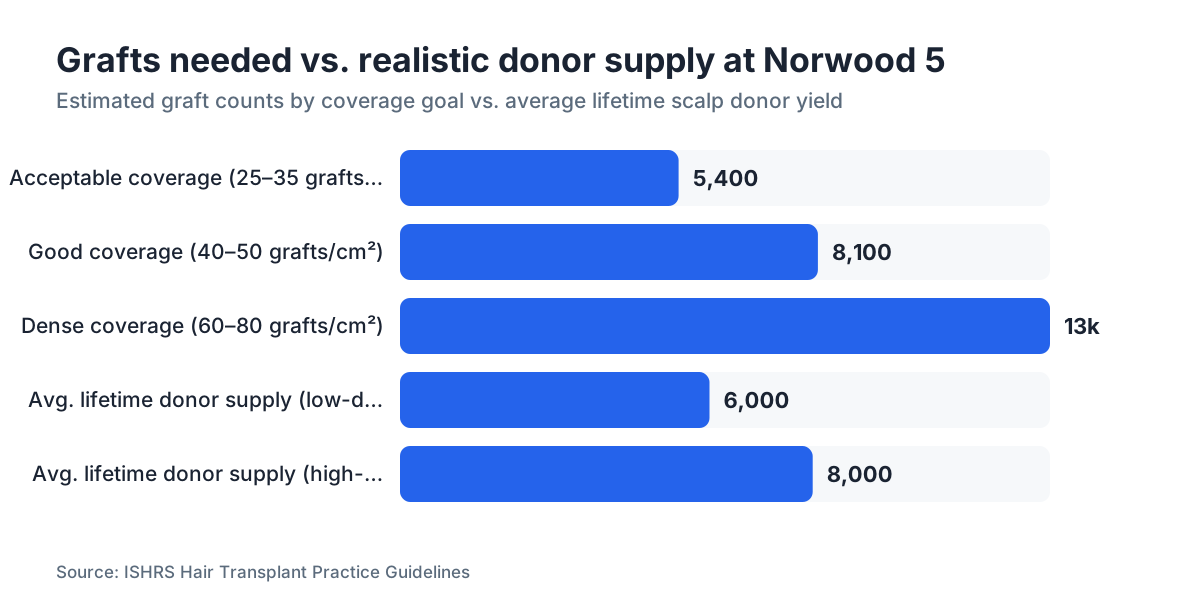
A natural-looking result needs roughly 40 to 50 follicular unit grafts per square centimeter. Something close to virgin density demands 60 to 80 grafts/cm², but that level is rarely achievable in a single session and often not achievable at all in advanced loss. Most Norwood 5 patients land in the "acceptable" range, not the "dense" one.
For a 180 cm² bald zone typical of Norwood 5, the math looks like this:
| Coverage goal | Grafts/cm² | Total grafts needed |
|---|---|---|
| Acceptable (thinner, wind-resistant) | 25 to 35 | 4,500 to 6,300 |
| Good (looks full in normal lighting) | 40 to 50 | 7,200 to 9,000 |
| Dense (close to natural density) | 60 to 80 | 10,800 to 14,400 |
Here's the uncomfortable part. Most people's donor areas cannot supply the graft counts in the bottom two rows. Surgeons commonly deliver 4,000 to 5,500 grafts at Norwood 5, which lands in the "acceptable" category. If a clinic quotes you 7,000+ grafts from the scalp donor area alone, ask them to show you their extraction density calculations under a trichoscope. Overharvesting leaves permanent visible scarring and thinning at the back of the head. [2]
What is the realistic donor supply for a Norwood 5?
The safe donor zone is the strip of permanent hair running from ear to ear around the back and sides of the scalp. It typically spans 150 to 200 cm² of harvestable area, and density there averages 70 to 100 follicular units per cm² in healthy, untouched scalp.
Multiply that out and you get a theoretical maximum of around 10,500 to 20,000 grafts. But "theoretical maximum" and "safely extractable" are different numbers. Surgeon consensus, reflected in the ISHRS (International Society of Hair Restoration Surgery) practice guidelines, is that extraction should not exceed about 50% of the donor area density, because going past that creates visible thinning in the donor zone itself. That cuts the real yield to roughly 5,250 to 10,000 grafts over a lifetime across all procedures combined. [3]
For the average Norwood 5 patient with average donor density, lifetime graft availability from the scalp is commonly estimated at 6,000 to 8,000 grafts. Men with exceptionally dense donor areas or very fine hair (finer hair has less visual contrast with scalp) can stretch that further. Men with sparse, coarse, or tightly curled donor hair get less.
The key word is "lifetime." Every graft you transplant now is a graft you cannot use if your loss progresses later. Because Norwood 5 can progress to Norwood 6 or 7, holding supply in reserve matters enormously.
Why does future hair loss progression change the whole calculation?
Hair loss doesn't stop when you get a transplant. The transplanted grafts, taken from the genetically resistant donor zone, are permanent. The native hair already on your scalp is not. If you're 28 and currently a Norwood 5, there's a real chance you'll progress to Norwood 6 or 7 without treatment. When that happens, transplanted islands of hair can look strange surrounded by new bald patches.
This is why most experienced surgeons strongly recommend you take finasteride or another DHT blocker before and after surgery. Finasteride 1 mg daily produced meaningful hair count increases versus placebo over two years in men with androgenetic alopecia, per trial data summarized in the drug's FDA prescribing information. The FDA approved finasteride 1 mg (Propecia) for male pattern hair loss in 1997, and its label states the drug inhibits Type II 5-alpha reductase, reducing scalp and serum DHT. [4][5]
Without medication, you're drawing a picture on a canvas that keeps shrinking. With it, you slow the shrinkage and preserve the native hair that fills gaps around transplanted grafts. A well-planned transplant plus medical maintenance is standard of care. One without the other leaves patients disappointed.
If you want the mechanics of why follicles miniaturize in the first place, the what causes hair loss article covers the androgen pathway in detail.
FUT versus FUE for Norwood 5: which gets you more grafts?
Follicular Unit Transplantation (FUT, the strip method) and Follicular Unit Extraction (FUE) each have real tradeoffs at Norwood 5, because graft yield is the binding constraint. Neither method wins for everyone.
FUT removes a strip of scalp from the donor zone, which the surgical team dissects into individual follicular units under microscopes. A well-executed FUT can yield 3,000 to 4,500 grafts in one session from a relatively narrow strip, and it leaves most of the donor area intact for future FUE. The tradeoff is a linear scar. With proper closure and a competent surgeon, that scar is usually a few millimeters wide and hidden under even moderate hair length.
FUE extracts follicular units one at a time using a small punch, leaving tiny circular scars spread across the donor zone. It's popular because there's no linear scar and recovery is slightly faster. At Norwood 5, though, FUE's limit shows up fast. Each extraction removes a small cylinder of scalp including the follicle and some surrounding tissue, and you can only take so many before the donor area looks thinned out. FUE can hit large sessions (3,000 to 4,000+ grafts), but usually by harvesting from a wider area, which eats into future supply faster.
For advanced loss, many surgeons recommend a combined approach: FUT first to maximize yield from the strip while preserving the upper donor zone, then FUE from the sides and remaining back area in a later procedure. Staged this way, you can extract more grafts over a lifetime than aggressive single-session FUE. The right choice depends on your donor density, scalp laxity, and future planning.
Body hair (beard, chest) can supplement scalp donor supply via FUE, and some surgeons use it to add texture or fill. Results with body hair are less predictable and it often grows at a different rate and caliber, so treat it as a supplement, not a substitute. [3][6]
What does a good result at Norwood 5 actually look like?
A good Norwood 5 result gives you a natural-looking hairline in front, coverage across the top that looks full in normal indoor lighting when styled, and reasonable coverage in the crown. It won't match a Norwood 1. But most people around you won't know it's transplanted.
Here's what a good result does not include: the density you had at 18, a scalp that looks great from every angle under direct overhead fluorescent light, or guaranteed crown coverage. The crown is the last priority in a resource-limited case because it eats the most grafts for the least visual payoff (the crown stays hidden unless someone is taller than you or standing behind you), and because dumping grafts there often leaves the front hairline too sparse.
Planning for Norwood 5 should go frontal third first, mid-scalp second, crown third. Surgeons who promise full crown restoration to a Norwood 5 patient in one session are either planning to overharvest the donor area or overpromising the result.
One more reality: at 3 months, most patients look worse than before surgery because the transplanted hairs shed (this is shock loss, a form of telogen effluvium, and the telogen effluvium article explains the mechanism). Final results aren't assessable until 12 to 18 months out. Patience is mandatory.
How do hair characteristics affect coverage at Norwood 5?
Two men with identical graft counts can look completely different. The reasons are hair caliber and color contrast.
Shaft diameter matters enormously. Coarse hair (diameter above 80 microns) gives roughly twice the visual coverage per graft as fine hair (below 60 microns). A patient with naturally coarse, wavy, or curly hair can reach an acceptable result with 4,000 grafts where a fine, straight-haired patient would need 6,000.
Color contrast between hair and scalp is the other variable. Dark hair on light skin shows every gap. Light hair on a similar skin tone blends forgivingly. High-contrast patients (black hair, fair skin) need higher density for the same visual result as someone with low contrast. That's not a reason to skip surgery. It's a reason to calibrate expectations before signing a consent form.
Curliness helps too. Curly hair coils and covers more scalp surface per follicle than straight hair lying flat. It's one reason patients with Afro-textured hair sometimes get good visual coverage at lower densities, though the technique demands specialized surgical skill.
Want a rough estimate before your consultation? Multiply your planned graft count by a coverage factor: 1.0 for fine straight hair, 1.3 to 1.5 for medium wavy hair, and up to 2.0 for coarse curly hair. Then divide that into your bald area size to see the density you'd land on. [7]
How much does a Norwood 5 hair transplant cost?
Cost varies by method, clinic location, and graft count. In the United States, FUE typically runs $5 to $12 per graft and FUT runs $4 to $8 per graft at reputable clinics. A 4,500-graft FUE session therefore costs $22,500 to $54,000. A 4,500-graft FUT session costs $18,000 to $36,000. These ranges are wide because price swings hard with surgeon experience and geography.
Turkey and other medical tourism destinations advertise flat-rate packages of $2,000 to $5,000 for large sessions. Some of these clinics produce excellent results. Others use technicians rather than surgeons to perform extraction and implantation, which directly affects graft survival. If you're considering surgery abroad, verify that a board-certified or ISHRS-member physician will personally perform the procedure, more than supervise it. [3]
Hair transplants are not covered by insurance in the United States because they're classified as cosmetic. Some patients tap health savings accounts (HSAs) or flexible spending accounts (FSAs) if they have a documented medical condition, but standard androgenetic alopecia usually doesn't qualify. Financing through medical credit lines (CareCredit, Alphaeon) is common.
For a Norwood 5, budget for two sessions. First session plus a likely second plus ongoing medical therapy (finasteride runs $20 to $60 a month depending on brand versus generic, and minoxidil for men runs $10 to $30 a month) puts the realistic multi-year total at $30,000 to $70,000 in the US. Surgery abroad cuts the surgical cost sharply while the medication cost stays the same.
Should you use minoxidil or finasteride before and after surgery?
Yes. Most serious transplant surgeons will tell you the same thing.
Finasteride protects the native hair you still have, slowing or halting the progression that would otherwise expand the bald zone after surgery. The ISHRS and the American Academy of Dermatology both include finasteride in their standard treatment guidance for male androgenetic alopecia. It doesn't regrow dramatically thinned hair in most men, but it stabilizes what's there. For a Norwood 5, that remaining hair is part of your overall look, filling between transplanted grafts. [4][5]
Topical minoxidil (2% or 5%) can increase the size and caliber of miniaturizing follicles in the non-transplanted areas. The FDA approved topical minoxidil for hair loss, and it's one of two FDA-approved treatments for androgenetic alopecia (finasteride is the other for men). Used after a transplant, minoxidil may reduce shock loss severity and support early graft cycling. There's some evidence for low-dose oral minoxidil (0.625 to 2.5 mg) as an alternative, though the oral minoxidil evidence base is still growing. [8]
The protocol most surgeons recommend: start finasteride at least 6 to 12 months before surgery if you tolerate it, and continue it indefinitely afterward. Add topical or oral minoxidil about 2 weeks post-procedure, once the scalp has settled. Stop either drug later and the hair it was protecting typically sheds within 3 to 12 months.
Side effects are real. Finasteride carries a risk of sexual side effects in roughly 3 to 5% of men in clinical trials; finasteride and minoxidil used together has its own considerations worth reading first. Minoxidil's main side effects are scalp irritation and, rarely, systemic effects at higher doses; the minoxidil side effects article covers these in detail.
What questions should you ask a surgeon before agreeing to a Norwood 5 transplant?
Picking the wrong surgeon at Norwood 5 costs you money, time, and permanently depleted donor supply. Here's what to actually ask:
-
What is your plan if my hair loss progresses to Norwood 6 or 7? Good surgeons design for future loss, more than your current bald area.
-
How many grafts will you leave in the donor zone for future procedures? They should give you an estimated lifetime graft budget and show what percentage this session uses.
-
Who physically performs the extraction and implantation? In many large-volume clinics, technicians do most of the actual work. This matters for graft survival.
-
Can I see before-and-after photos of Norwood 5 patients specifically, at 12 to 18 months post-op, rather than best-case results?
-
What density can I realistically expect, and in which zones, given my donor characteristics? Ask them to write a number down. "Good coverage" is not an answer.
-
Do you recommend combining FUT and FUE or a single method, and why for my case?
-
What's your policy if I need a second session? Some clinics charge full price again. Others offer discounts or include touch-up sessions.
Myhairline.ai's free AI scan (/scan) gives you a starting read on your Norwood stage and donor zone before your in-person consultations, so you walk in with a baseline instead of relying entirely on what a sales-driven clinic tells you.
Is a Norwood 5 hair transplant worth it?
For most men who go in with accurate expectations, yes. For men expecting to look like they never lost hair, no.
The honest version: a well-executed transplant at Norwood 5 with ongoing medical therapy can look natural, change your appearance a lot, and hold up for decades. The transplanted hair is genetically permanent. Patients who pair surgery with finasteride and keep density expectations realistic report high satisfaction in longer-term follow-up.
The men who regret it almost always fall into one of three camps. They didn't know they were heading toward Norwood 6 or 7 and the transplanted hair now sits like an island. Or they had crown-focused surgery that left the hairline too sparse. Or they used a low-quality provider and got poor graft survival (some discount providers see survival rates of 60 to 70% rather than the 90 to 95% at experienced clinics).
The receding hairline article covers hairline design specifically, which is its own decision inside a transplant plan.
So: if you're a Norwood 5 who has been on finasteride for at least 6 to 12 months with stable loss, has realistic density goals (not "full coverage"), and picks a surgeon with documented Norwood 5 results, the procedure has a reasonable track record. If any of those conditions aren't met, get more evaluation first. [2][6]
Sources
- American Academy of Dermatology, Hair loss types: androgenetic alopecia overview
- International Society of Hair Restoration Surgery, Hair Transplant Practice Guidelines
- International Society of Hair Restoration Surgery, Donor Area Harvesting and Graft Survival
- DailyMed (NIH), Propecia (finasteride) prescribing information
- National Institutes of Health, MedlinePlus: Finasteride drug information
- Journal of the American Academy of Dermatology (jaad.org)
- Journal of Cutaneous and Aesthetic Surgery, hair shaft caliber and coverage density in transplant planning
- DailyMed (NIH), minoxidil topical solution labeling
- National Institutes of Health, MedlinePlus: hair loss overview
- Plastic and Reconstructive Surgery journal (journals.lww.com)