TL;DR: Estrogen keeps hair in the growth phase longer and suppresses the androgen DHT that shrinks follicles. At menopause, estradiol levels fall by up to 90%, shifting the hormonal balance sharply toward androgens. The result: up to 50% of postmenopausal women experience noticeable hair thinning, most often as diffuse loss across the crown rather than a receding hairline.
What does estrogen actually do for hair follicles?
Estrogen protects hair in two direct ways. It lengthens the anagen (active growth) phase of the hair cycle, and it competes with androgens at the level of the follicle and the scalp's androgen-converting enzymes.
Hair follicles go through three phases. Anagen is growth, lasting two to seven years. Catagen is a brief transition. Telogen is rest and shedding, lasting roughly three months. Estrogen, specifically estradiol, keeps follicles in anagen longer. A 2006 study in Experimental Dermatology showed that estradiol prolongs anagen in cultured human scalp hair follicles in a dose-dependent way [1]. That extra time in growth is why women in high estrogen states, most famously during pregnancy, often have the thickest hair of their lives.
The second mechanism involves DHT (dihydrotestosterone), the androgen most responsible for follicle miniaturization in androgenetic alopecia. The enzyme 5-alpha reductase converts testosterone into DHT inside and around the follicle. Estrogen suppresses 5-alpha reductase activity in scalp tissue, which keeps DHT lower. Estrogen also raises sex hormone-binding globulin (SHBG), a protein that binds free testosterone in the bloodstream and makes it less available for conversion to DHT [2]. So estrogen acts as a kind of indirect dht blocker by cutting the raw material DHT is made from.
Follicles carry estrogen receptors too, mainly estrogen receptor beta (ER-beta), found in the outer root sheath and dermal papilla. When estradiol binds these receptors, it promotes follicle survival and may reduce the inflammatory signals that damage follicles over time [1].
How much does estrogen drop at menopause, and how fast?
The decline is steep and fast. In the years before the final menstrual period, the perimenopausal phase that usually starts in a woman's mid-to-late 40s, estradiol swings wildly but trends downward. After the final period, estradiol can fall from premenopausal levels averaging roughly 100 to 400 pg/mL down to postmenopausal levels of about 10 to 20 pg/mL. That is a drop of 80 to 90 percent [3].
Progesterone essentially disappears at the same time. Progesterone inhibits 5-alpha reductase too, so its loss compounds the DHT problem on its own. Testosterone, meanwhile, falls gradually across the lifespan and does not drop sharply at menopause. The net effect is a hormonal environment that looks meaningfully more androgenic, even though total androgen levels have not gone up.
The North American Menopause Society puts the average age of natural menopause in the United States at 51, with a normal range of 45 to 55 [3]. Surgical menopause from bilateral oophorectomy can happen at any age and causes an immediate, abrupt drop rather than the gradual perimenopausal slide. That is why postsurgical hair loss tends to feel more sudden and severe.
How common is hair loss after menopause?
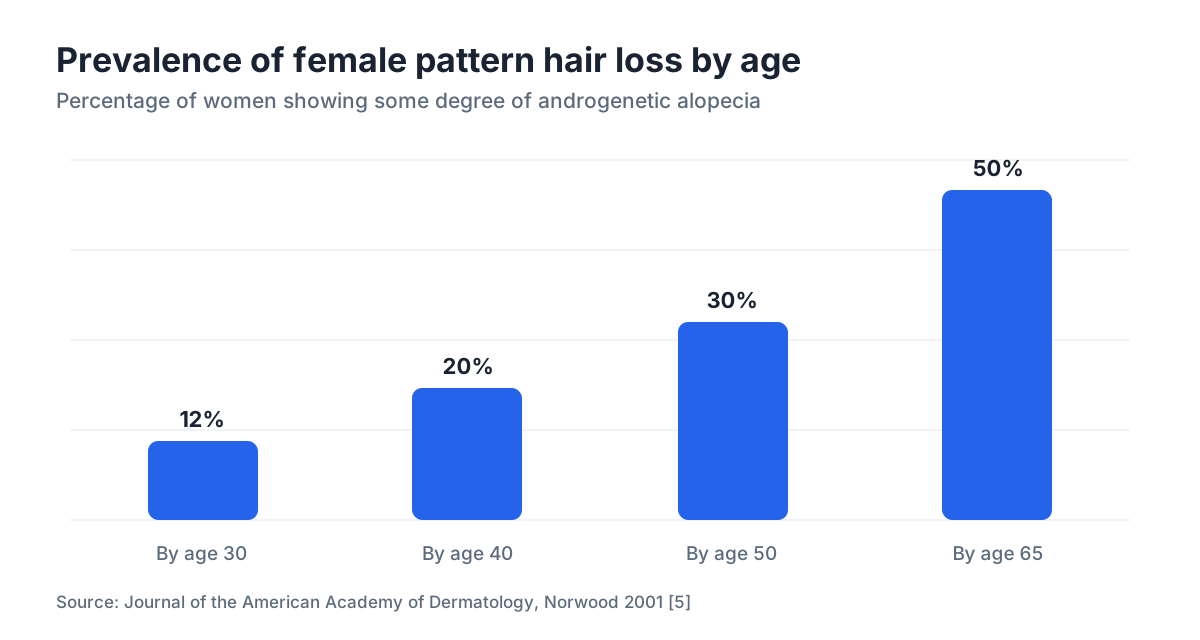
Very common. The American Academy of Dermatology (AAD) calls female pattern hair loss the most common cause of hair loss in women, and prevalence climbs sharply with age [4]. Roughly 30% of women show some degree of female pattern hair loss by age 50, and that figure rises to close to 50% by age 65 [5].
The pattern differs from what most people picture. Women rarely develop a fully receding hairline like the classic receding hairline seen in men. Instead the hair thins diffusely across the top and crown, widening the part. The frontal hairline usually stays intact. This is graded using the Ludwig Classification, which has three stages from mild (I) to severe (III), though the Sinclair scale is also common in clinical settings.
Menopause also raises the risk of telogen effluvium, a diffuse shedding triggered by the hormonal shift itself, by the stress of the transition, or by nutritional changes. Telogen effluvium is usually temporary, but it can overlap with and unmask underlying female pattern hair loss, making the total picture look worse than either condition alone.
Pinpointing how much of any woman's hair loss is hormonal versus androgenetic versus nutritional versus thyroid-related is genuinely hard. A dermatologist can sort it out with bloodwork and a scalp exam. Thyroid disorders, which become more common around menopause, are especially important to rule out early because that hair loss reverses once the thyroid problem is treated.
What is the difference between female pattern hair loss and menopausal hair loss?
They are often the same condition viewed at different stages. Female pattern hair loss (also called androgenetic alopecia) has a genetic component that expresses itself partly in response to androgens. Estrogen suppresses that expression for years. When estrogen falls at menopause, the genetic program that was kept quiet can start to run.
Many women carry the predisposition their whole lives but only notice thinning in their 50s. Menopause is not creating the problem from scratch. It is removing the hormonal protection that was masking it.
A smaller group of women loses hair earlier, in their 20s or 30s, when androgen levels are relatively high even under normal circumstances. In those cases, the loss is not waiting for menopause to start. Understanding what causes hair loss in your specific case matters before picking a treatment, because the solutions are not identical across these subtypes.
Does hormone replacement therapy (HRT) prevent or reverse hair loss?
This is where the evidence gets complicated and where honesty beats a clean answer.
HRT replaces the estrogen (and sometimes progesterone) that menopause removes, and there is reasonable mechanistic logic that it should protect hair. Some observational data suggests women on HRT have lower rates of female pattern hair loss progression. But randomized controlled trial data specifically on hair outcomes from HRT is thin.
The type of HRT matters a lot. Estrogen plus a synthetic progestin called norethisterone (norethindrone) actually has androgenic activity and can worsen hair loss or trigger it. Micronized progesterone (Prometrium) has anti-androgenic properties instead. Estrogen-only HRT for women who have had a hysterectomy avoids the progestin problem entirely. Women asking their doctor about HRT for hair should specifically ask about the androgenicity of the progestin component. This is a real clinical nuance that gets missed.
The FDA-approved hair loss treatments for women are topical minoxidil (2% or 5%, with 5% off-label but widely used), and some clinicians now prescribe low-dose oral minoxidil off-label [6]. The FDA has not approved finasteride for women, and it is contraindicated in women who could become pregnant due to the risk of fetal harm [7]. Postmenopausal women are sometimes prescribed finasteride off-label, and some small trials show benefit, but this is not the standard first line. The finasteride evidence in postmenopausal women is much weaker than in men.
If you are trying to understand your pattern before spending money on treatments, the free AI hair analysis at MyHairline can help you map the distribution of thinning, which is useful information to bring to a dermatology appointment.
Is minoxidil effective for menopausal hair loss in women?
Yes, and it is the most evidence-backed option available over the counter. Minoxidil is FDA-approved for women at 2%, and the 5% foam is also FDA-cleared for women [6]. Multiple randomized trials show 2% and 5% topical minoxidil raise hair count and density in women with androgenetic alopecia. A 2004 study in the Journal of the American Academy of Dermatology found 5% minoxidil statistically superior to 2% for regrowth in women [8].
Minoxidil works by prolonging anagen and widening the follicle, which produces a thicker hair shaft. It does not touch the hormonal driver, which means it treats the symptom, not the estrogen deficiency itself. Even so, for many postmenopausal women it produces meaningful visible improvement.
Give it at least four to six months of consistent daily use before you judge it, and the benefit reverses if you stop. That is the main thing people struggle with. The minoxidil side effects to watch for in women include initial shedding in the first few weeks (normal, and temporary), scalp irritation, and, less often, unwanted facial hair from contact transfer. Oral minoxidil at low doses (0.25 to 1.25 mg/day) is increasingly used off-label for women who find topical formulations messy, though the evidence base for that route is still building.
Does the perimenopause transition cause a different kind of shedding than postmenopause?
Yes, and telling them apart changes treatment decisions.
During perimenopause, estrogen does not simply decline. It swings unpredictably, sometimes surging above normal premenopausal levels before crashing. Those swings, combined with the psychological and physical stress of the transition, can trigger telogen effluvium: a diffuse shedding where many follicles shift from growth to rest at once. Telogen effluvium from a single trigger typically peaks around three months after the triggering event and resolves within six to nine months. The problem is that perimenopausal hormonal swings are not a single trigger. They repeat, so the shedding can look chronic.
Postmenopause is a different state. Estrogen is now stably low rather than swinging. The hair loss at this stage tends to be slower, steadier, and more patterned, driven by the chronic androgenic environment rather than acute shedding episodes. Women often describe a perimenopausal phase that feels like dramatic shedding, followed by a postmenopausal phase where the hair feels thinner overall but stops falling out in handfuls.
If you are in perimenopause with heavy shedding, get thyroid function (TSH, free T3, free T4), ferritin, vitamin D, and a full hormonal panel checked before starting any hair loss treatment. Low ferritin in particular, common as periods turn heavier and irregular before they stop, is a reversible cause of telogen effluvium that gets missed constantly.
Can nutrition or supplements compensate for losing estrogen's hair protection?
Partly, and only for specific deficiencies. No supplement replaces estrogen. But some nutritional factors become more relevant at menopause.
Ferritin is the big one. Hair follicles are among the most metabolically active cells in the body and are sensitive to iron storage levels. Some dermatologists aim for a ferritin level above 40 ng/mL for hair, though the optimal threshold is debated. If ferritin is low, iron supplementation can meaningfully cut shedding.
Vitamin D receptors sit inside follicles, and some data links low vitamin D to hair loss, though the evidence is correlational rather than causal. Postmenopausal women run a higher risk of vitamin D deficiency anyway, so getting levels up (serum 25-hydroxyvitamin D above 30 ng/mL is the standard threshold) is sensible regardless.
Biotin is heavily marketed for hair, and the evidence for supplementing people who are not biotin-deficient is essentially absent. Actual biotin deficiency is rare. The FDA has also warned that high-dose biotin can interfere with lab tests, including thyroid and cardiac tests [9]. Spending money on biotin is probably a waste unless you have a confirmed deficiency.
For a broader look at what actually has evidence, the hair loss supplements guide breaks down which ingredients have real trial data and which are mostly marketing.
How do doctors diagnose hormone-related hair loss in women?
The diagnosis is primarily clinical, meaning it rests on pattern, history, and ruling out other causes. A dermatologist looks at where the thinning sits, how the hairline is affected, whether the miniaturization matches androgenetic alopecia, and does a pull test.
Bloodwork rules out contributors and sometimes reveals reversible causes. Standard labs for a woman with hair loss include TSH and free thyroid hormones, ferritin and complete blood count, total and free testosterone, DHEA-sulfate, prolactin, and sometimes sex hormone-binding globulin. In perimenopausal women, FSH and estradiol help confirm menopausal status. FSH above 40 IU/L on two measurements at least a month apart is the standard threshold for confirming menopause [3].
Dermoscopy (a magnified view of the scalp) is increasingly used to assess follicle miniaturization directly, which can catch androgenetic alopecia before it is visually obvious. A scalp biopsy is rarely needed but can separate scarring from non-scarring alopecias when the diagnosis is genuinely unclear.
If a dermatologist visit is a few weeks away, mapping your current thinning pattern with the free scan at MyHairline gives you a baseline to track from. Pattern documentation over time is genuinely useful clinical information.
Are there non-drug options that help after menopause?
Some, though none match the evidence level of minoxidil.
Low-level laser therapy (LLLT) devices, including FDA-cleared combs and caps, have moderate evidence for female pattern hair loss. A 2014 randomized controlled trial in the American Journal of Clinical Dermatology found a statistically significant increase in hair density with an LLLT device versus sham in women with androgenetic alopecia [10]. The effect is real but modest. These devices work best as add-ons to medical therapy, not replacements.
Platelet-rich plasma (PRP) injections have a growing evidence base in women, including postmenopausal women. The mechanism involves growth factors from platelets that may stimulate dormant follicles. The evidence is still mixed and the optimal protocol is not standardized, but a 2019 systematic review in Dermatologic Surgery found significant improvements in hair density in most included studies [11]. Cost is a real barrier. PRP typically runs $500 to $1,500 per session, with three to six sessions recommended initially.
Hair transplants stay an option for women with stable, well-defined androgenetic alopecia and enough donor density. The tricky part is that female pattern hair loss often thins diffusely, which makes donor area selection harder than in men. A consultation with a fellowship-trained hair restoration surgeon is needed to assess whether someone is a good candidate. See the hair transplant overview for what the procedure involves and what realistic outcomes look like.
What is the role of androgens in female hair loss, and does menopause make this worse?
Androgens are the primary biological driver of follicle miniaturization in androgenetic alopecia in both sexes. In women, the main androgens involved are testosterone, DHEA-S (produced by the adrenal glands), and especially DHT.
Premenopausal women have lower androgen levels than men and, critically, have estrogen to counterbalance them. At menopause, that estrogen counterbalance largely disappears. Androgen levels in postmenopausal women do fall somewhat compared to the premenopausal peak, but nowhere near as much as estrogen falls. The ratio shifts toward a more androgenic environment, even though absolute androgen levels are lower than in a young woman.
The adrenal glands keep producing DHEA-S throughout life, and some of it converts to testosterone and DHT in peripheral tissues including the scalp. This adrenal androgen production becomes a more relevant driver of hair loss after menopause precisely because the ovarian estrogen that was buffering it is gone.
For women with clearly elevated androgens (high total or free testosterone, elevated DHEA-S), addressing the androgen source directly is the right approach. That sometimes means treating underlying conditions like polycystic ovary syndrome, adrenal tumors, or certain medications. Spironolactone, an androgen receptor blocker, is commonly prescribed off-label for female pattern hair loss in this context and has reasonable evidence in premenopausal women. The data in postmenopausal women is weaker.
Sources
- Experimental Dermatology, Ohnemus et al. 2006, 'Estrogen receptor beta in hair follicle cells'
- Endocrine Reviews, Vermeulen et al. 1999, 'Estrogens in male gender'
- North American Menopause Society, Menopause 101
- American Academy of Dermatology, Hair Loss
- Journal of the American Academy of Dermatology, Norwood 2001, 'Incidence of female androgenetic alopecia'
- FDA, Drug label for Rogaine Women's 5% Minoxidil Foam
- FDA, Finasteride (Propecia) prescribing information
- Journal of the American Academy of Dermatology, Olsen et al. 2002, '5% vs 2% minoxidil in women'
- FDA, Biotin (Vitamin B7) may interfere with lab tests safety communication
- American Journal of Clinical Dermatology, Lanzafame et al. 2014, 'Low-level laser therapy for female androgenetic alopecia'
- Dermatologic Surgery, Giordano et al. 2019, 'Platelet-rich plasma for hair loss systematic review'
- NIH National Institute on Aging, Menopause