TL;DR: DHT blockers like finasteride and dutasteride reduce dihydrotestosterone by 70-90%. Current evidence shows modest effects on muscle fiber size and strength in some men, but most gym-goers on standard hair-loss doses report no meaningful performance change. The risk is real but smaller than the internet claims, and individual response varies considerably.
What is DHT and why does it matter for muscle?
Dihydrotestosterone is a potent androgen made when the enzyme 5-alpha reductase converts testosterone into DHT. [1] In scalp follicles, DHT shrinks the follicle over time, which is why blocking it slows male-pattern hair loss. In muscle tissue, the story gets messier.
DHT binds to the same androgen receptor as testosterone, but it grips harder, roughly three to five times stronger by affinity. [1] That sounds alarming if you lift. But muscle growth runs mostly on testosterone, not DHT, and your body carries far more testosterone than DHT at baseline. Serum testosterone in adult men typically runs 300 to 1000 ng/dL. Free DHT runs roughly 30 to 85 pg/mL in the same men. [2]
Animal studies point to a specific role for DHT in fast-twitch (type II) muscle fiber development. Those are the fibers behind explosive strength and power. The mechanism is real. But translating rodent data straight to a man swallowing a once-daily 1 mg finasteride pill is a bigger leap than most gym forums admit.
If you want the full background on how androgens interact with hair follicles, the DHT blocker overview walks through the mechanism.
How much does finasteride or dutasteride actually lower DHT?
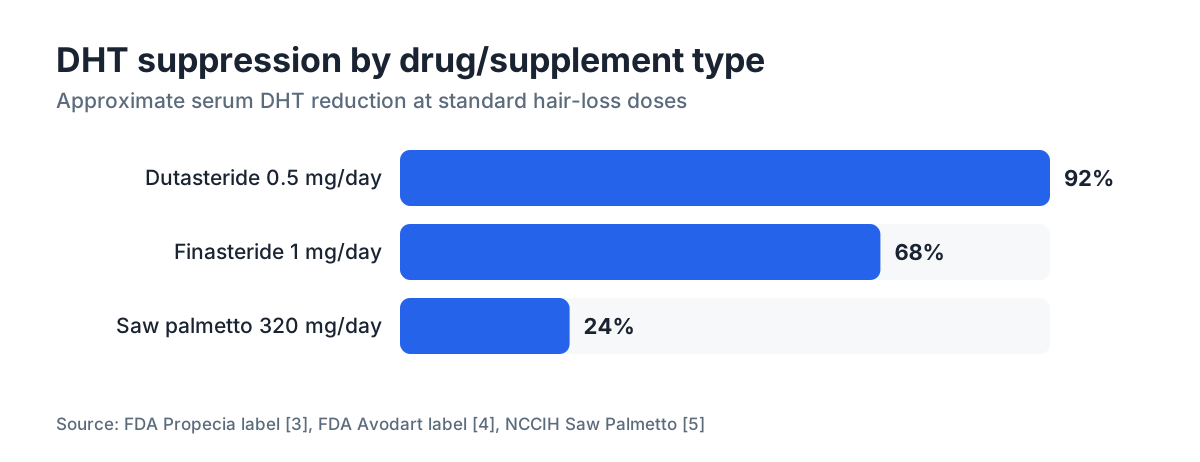
Finasteride at 1 mg (the standard Propecia dose for hair loss) cuts serum DHT by roughly 65-70% in most men. [3] Dutasteride at 0.5 mg blocks both type I and type II 5-alpha reductase isoenzymes and drops serum DHT by about 90-95%. [4] Those numbers come from the FDA-approved labeling and the registration trials.
Testosterone does not fall. It may tick up slightly, because testosterone that would have become DHT now stays as testosterone. A 2002 pharmacokinetic study found finasteride 1 mg left serum testosterone essentially unchanged. [3]
The gap between the two drugs matters here. If you take dutasteride for hair loss and you also care seriously about strength, you are wiping out a far bigger slice of your DHT than someone on finasteride. That distinction rarely shows up in gym-forum threads.
| Drug | Typical hair-loss dose | DHT reduction (serum) | Effect on testosterone |
|---|---|---|---|
| Finasteride | 1 mg/day | ~65-70% | Minimal change [3] |
| Dutasteride | 0.5 mg/day | ~90-95% | Slight increase [4] |
| Saw palmetto | Varies (320 mg typical) | ~15-32% in some trials | Not well established [5] |
Does DHT affect muscle mass and strength in humans?
Here the evidence gets more honest than what you find on forums, and the honest version has more shrugs in it.
A 2003 study by Sinha-Hikim et al. in the Journal of Clinical Endocrinology and Metabolism suppressed endogenous androgens in healthy young men with a GnRH agonist, then gave back graded doses of testosterone. Co-administering finasteride blocked the DHT conversion without blocking testosterone's direct action on muscle. Testosterone still increased muscle mass dose-dependently even with DHT suppressed. [6] That is probably the clearest human signal that DHT is not the main driver of testosterone-induced muscle growth.
Then there is the other side. A 2010 study by Page et al., also in JCEM, looked at muscle fiber composition in older men and found DHT may contribute to type II muscle fiber size. [7] Older men have more to lose here, since their baseline testosterone already sits lower.
For younger, healthy men lifting weights, the honest summary is short: current evidence does not show clinically significant muscle loss from finasteride 1 mg taken for hair loss. But the evidence base is thin. Nobody has run a large, well-powered RCT of finasteride versus placebo in competitive athletes or serious recreational lifters.
Bodybuilders and powerlifters sitting near their genetic ceiling may feel effects a casual gym-goer never would. There is no clean data on that subgroup. Anyone who tells you otherwise is guessing.
What do the clinical trials actually show about strength?
The straight answer: no large randomized controlled trial has used one-rep max, force output, or a validated strength test as a primary endpoint in men taking finasteride for hair loss. That study does not exist.
What exists is indirect. The registration trials for finasteride 1 mg (Propecia) tracked adverse events like sexual side effects and mood, not strength or body composition. [3] The prostate studies using finasteride 5 mg are bigger, but that dose is five times the hair-loss dose, and participants are usually 50-plus with already declining testosterone.
The Page et al. 2010 study [7] is the closest thing to direct evidence. In older men (mean age around 62), those with lower DHT had smaller type II muscle fiber cross-sectional area. The paper's stated conclusion: "DHT may regulate type II muscle fiber size in older men." [7] That finding is worth taking seriously if you're over 50 and eyeing dutasteride.
For men under 40 on finasteride 1 mg, the available evidence puts any strength effect within normal measurement noise. That does not mean zero. It means we cannot reliably measure it at that dose yet.
Are there gym performance side effects you should actually watch for?
Sexual side effects are the best-documented, and they hit gym performance indirectly. Finasteride carries FDA label warnings for decreased libido, erectile dysfunction, and decreased ejaculate volume. [3] Post-finasteride reports (sometimes called post-finasteride syndrome) include persistent fatigue and mood changes in a subset of men, though the incidence and mechanism are still argued over in the literature. [8]
Fatigue affects training. If finasteride drains your motivation or energy, that alone can shrink your training volume over months without you losing a single gram of muscle to the drug directly. That is probably the most underrated real-world gym effect.
One more mechanism worth knowing: neurosteroids. DHT is a precursor to 3-alpha-androstanediol and other neurosteroids that act on GABA-A receptors in the brain. Suppressing DHT shifts those neurosteroid levels, which may affect mood and anxiety in susceptible men. [8] The AAD lists this as an area still under investigation. [9]
Start a DHT blocker, notice real fatigue, reduced drive in the gym, or mood shifts? Track it and talk to your prescriber. Stopping finasteride returns DHT toward baseline within about two weeks in most men. [3]
Does blocking DHT affect body fat or body composition?
Fair question, and there isn't enough good data to answer it cleanly. Androgens in general, DHT included, influence fat distribution and fat cell differentiation. [1] Some animal data suggests DHT curbs fat cell proliferation.
The finasteride and dutasteride trials did not systematically track body composition. So the honest answer is plain: we have no reliable human trial data showing finasteride 1 mg causes meaningful fat gain at hair-loss doses.
There is a theoretical case that very heavy DHT suppression (dutasteride-level, 90-plus percent) could nudge fat distribution over years. Whether that ever becomes visible in a 30-year-old man eating well and training consistently is a separate question, and one nobody has answered with a controlled trial.
If body composition matters a lot to you, dutasteride deserves more caution than finasteride. See the finasteride deep-read for the side-effect comparison at each dose.
What about natural or OTC DHT blockers like saw palmetto?
Saw palmetto is the supplement most often sold as a natural DHT blocker. [5] It weakly inhibits 5-alpha reductase. NCCIH notes the evidence for saw palmetto's effect on prostate symptoms is modest at best, and its DHT reduction in human serum is far less reliable than finasteride's. [5]
For muscle, that weak suppression (some trials show 15 to 32% reduction in prostate tissue, with murkier serum effects) means saw palmetto is unlikely to cause the strength or body composition changes that might theoretically worry someone on dutasteride. The gym risk from saw palmetto is close to negligible on current evidence.
Other supplements sold as DHT blockers, including zinc, pumpkin seed oil, and biotin-heavy formulas, have even thinner mechanistic evidence. None have shown meaningful serum DHT reduction in peer-reviewed human trials at the doses found in standard supplements. The hair loss supplements article breaks down what works and what doesn't.
So here is the point. If you're worried about DHT blockers hurting your gym numbers, supplements are barely in the conversation. The concern is legitimate, if small, only for prescription finasteride and especially dutasteride.
Should competitive or serious lifters think differently about DHT blockers?
If you're a recreational gym-goer trying to stay in shape and keep your hair, the balance of evidence favors trying finasteride without much fear about strength loss. Most men at that level will not notice a performance difference they can pin on the drug.
Competition changes the math. If you compete in natural powerlifting, Olympic lifting, or any tested sport, three things shift. Your performance gets measured in kilograms, not feelings, so even a 1-2% change in max strength counts. If you already train near your ceiling, small hormonal changes weigh more. And drug-tested competition usually screens for exogenous androgens, not DHT blocker use, so finasteride itself is not a banned substance in most sports. Check your specific federation.
Athletes in this bracket who want hair loss treatment might reasonably try finasteride for 6-12 months and track real data: log your maxes, log body weight, and get a DEXA scan if you can afford one. That beats gym-forum anecdotes every time.
If you're also using creatine and wondering about your hair, the does creatine cause hair loss article covers the one trial people keep citing.
And if you want an objective read on how much hair you've actually lost before deciding on any treatment, MyHairline's free AI scan at myhairline.ai gives you a Norwood stage assessment in under two minutes. It helps you judge whether the tradeoff even makes sense for your situation.
What is the actual risk-benefit picture for someone weighing hair loss treatment against gym goals?
Put the evidence together and it lines up like this.
Finasteride 1 mg stops or slows hair loss in about 87% of men [3], a well-documented efficacy rate. The likely cost in gym performance for most men under 40 is small and possibly undetectable in normal training. The real, documented risks are sexual: libido changes, erectile issues, and a smaller subset with symptoms that persist after stopping.
Dutasteride does more for hair, but it suppresses DHT harder. The theoretical gym concern scales up with it. Dutasteride is not FDA-approved for hair loss in the US (it is approved for BPH at 0.5 mg), though it gets used off-label and is approved for androgenetic alopecia in some other countries.
Minoxidil, the other major hair-loss drug, is not a DHT blocker at all. It works on a different mechanism (opening potassium channels, boosting blood flow to follicles). It has no known effect on DHT, testosterone, or muscle. If gym performance is your main worry, combining finasteride and minoxidil lets you add the most effective topical treatment without piling on androgenic suppression.
For men who want hair restoration and refuse any DHT blocker on principle, hair transplants are the surgical route, though they treat the result of hair loss, not the ongoing mechanism.
Honestly, the internet wildly overstates the gym risk of finasteride at 1 mg. The sexual side effects are real and worth knowing. The muscle effects stay theoretical for most men at that dose. Make this call with a doctor who knows your training history, not a forum.
What should you actually monitor if you start a DHT blocker while training?
Tracking beats worrying. If you start finasteride or dutasteride, log these at baseline and every three months:
Strength: a few working max sets across your main lifts. Skip the weekly 1RM test. Just trend consistent rep maxes.
Body weight and how your clothes fit. You won't get a precise fat/muscle split without DEXA, but big composition changes tend to show.
Energy and motivation during sessions. A persistent, unexplained dip in drive is worth writing down.
Libido and sexual function, since these are the best-documented effects and they hit both quality of life and, indirectly, training motivation.
If nothing shifts noticeably after three to six months, you now have real individual data, which beats any population average. If strength trends down consistently with no other explanation (no change in sleep, calories, or training volume), take that to whoever prescribed the drug.
Blood tests are optional unless your doctor recommends them. But a baseline serum testosterone is a smart move before starting a long-term androgen-pathway medication, mostly so you have a reference point later.
Sources
- National Library of Medicine, StatPearls: Dihydrotestosterone
- NIH National Institute of Diabetes and Digestive and Kidney Diseases, Endotext: Androgens
- NCCIH, National Institutes of Health: Saw Palmetto
- Sinha-Hikim et al., Journal of Clinical Endocrinology & Metabolism, 2003: Testosterone dose-dependently increases muscle fiber CSA even with DHT suppressed by finasteride
- Page et al., Journal of Clinical Endocrinology & Metabolism, 2010: DHT regulates type II muscle fiber size in older men
- Melcangi et al., Journal of Steroid Biochemistry and Molecular Biology, 2017: Post-finasteride syndrome and neurosteroid changes
- American Academy of Dermatology, Hair Loss: Diagnosis and Treatment
- van der Sluis et al., Journal of Pediatric Urology, 2010: Androgen effects on muscle fiber composition
- Wicks et al., British Journal of Sports Medicine (Creatine and DHT), 2009 via PubMed