

TL;DR: A follicular unit is a natural bundle of 1 to 4 hairs. Surgeons count grafts, meaning the bundles, not individual hairs. A 2,000-graft session might deliver 4,000 to 5,000 hairs. That difference moves your quoted cost by thousands of dollars, resets your coverage expectations, and tells you whether a clinic's offer is fair or a red flag.
What exactly is a follicular unit, and why do surgeons use it instead of counting hairs?
A follicular unit is a natural cluster of 1 to 4 hairs that grows from the scalp as one bundle. Skin does not grow hairs one at a time. Under a microscope, hairs emerge in tight groups, each wrapped in a shared capsule of connective tissue, sebaceous glands, a small muscle, and nerve endings. Two-hair groupings are the most common across ethnicities [1].
Surgeons move the entire unit intact. Splitting it up destroys the sebaceous gland and disrupts blood supply, which lowers survival. The graft is the unit. So when a surgeon quotes you "2,000 grafts," they mean 2,000 follicular units carried from donor to recipient, each holding however many hairs it naturally contains.
This is not a technicality. It is the measurement the entire industry runs on, and misreading it is the single most common reason patients feel misled after surgery.
How do surgeons actually count grafts before and during surgery?
Reputable clinics count grafts twice: once before harvesting to estimate what your donor can give, and again during the procedure as a running tally. The two numbers check each other.
Pre-harvest estimation comes first. Before any cutting starts, the surgeon or a trained technician examines the donor zone, usually the back and sides of the scalp, under a densitometer or trichoscope. They measure follicular unit density in units per square centimeter, then multiply by the harvestable area to estimate how many grafts are available without over-thinning the donor [2].
Then comes direct counting during extraction. In Follicular Unit Extraction (FUE), each punch produces one graft, and a technician counts them into holding solution. In Follicular Unit Transplantation (FUT, the strip method), the strip is dissected under stereomicroscopes and technicians count units as they cut. Both should produce a number written in your surgical report.
After placement, a quality-conscious clinic tallies recipient site incisions too, because sites should match grafts placed. If a clinic can't tell you exactly how they counted, push on that before you sign anything.
What is the difference between grafts, hairs, and follicular units, and why does the distinction change your quote?
Grafts, hairs, and follicular units sound interchangeable and represent three different numbers. A graft is one follicular unit. A follicular unit holds 1 to 4 hairs. So a single graft can carry four times the hair of another.
| Term | What it means | Typical range |
|---|---|---|
| Follicular unit | The natural bundle as it exists in the scalp | 1-4 hairs per unit |
| Graft | One follicular unit as harvested and placed | Same as follicular unit |
| Hair | Individual strand | 1 per follicle |
Run the math. A person with average donor characteristics (roughly 2.2 hairs per graft) [1] who gets 2,500 grafts receives about 5,500 hairs. A person with fine, mostly single-hair units gets closer to 2,700 hairs from the same graft count.
Pricing usually runs per graft, not per hair. In the United States, per-graft pricing generally falls between $3 and $10, with a realistic average around $5 to $7 depending on location, technique, and surgeon experience [3]. "2,000 grafts at $5 each" is $10,000. If a clinic quietly counts individual hairs as grafts (an old bait-and-switch), the real graft count could sit near 900, nowhere close to enough for a Norwood 4 or higher.
Ask one question, every time: is this a graft count or a hair count? Get the answer in writing.
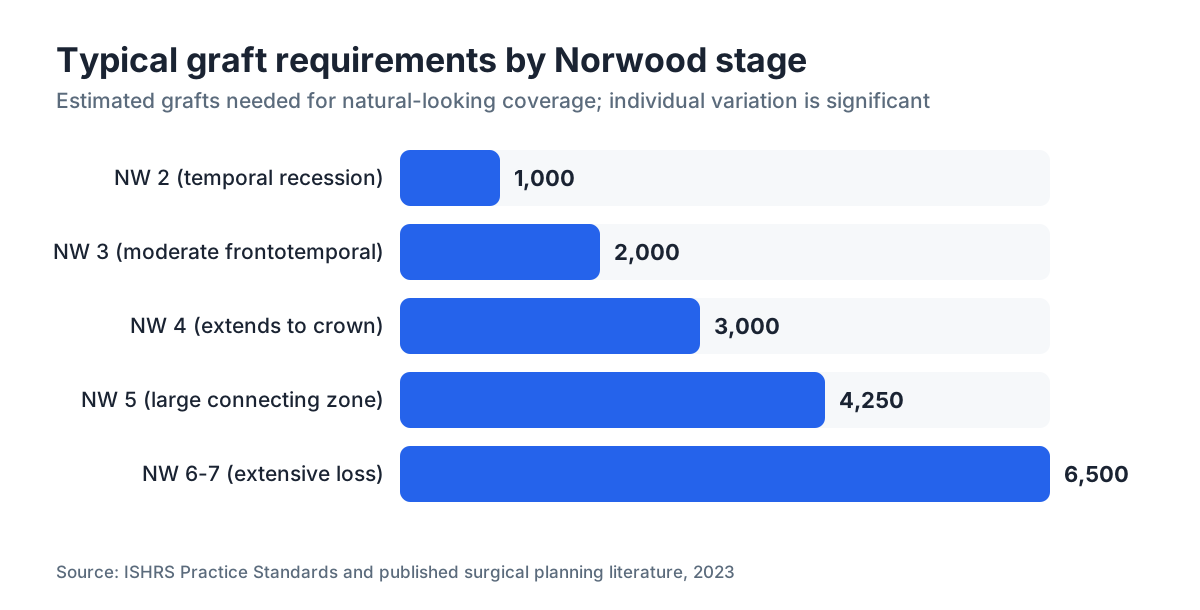
How many grafts do different Norwood stages typically require?
Graft counts scale with the area you need to cover, not with how far you've receded on paper. Surgeons estimate the recipient area in square centimeters, then calculate how many grafts hit a target density, usually 35 to 50 follicular units per square centimeter for a natural look [2].
The numbers below are widely cited clinical estimates. Real needs vary a lot based on hair caliber, scalp laxity, donor density, and the look you want.
| Norwood Stage | Area needing coverage (approx.) | Grafts typically needed |
|---|---|---|
| NW 2 | Temporal recession only | 500-1,500 |
| NW 3 | Moderate frontotemporal recession | 1,500-2,500 |
| NW 4 | Loss extends to crown | 2,500-3,500 |
| NW 5 | Large connecting bald zone | 3,500-5,000 |
| NW 6-7 | Extensive loss, limited donor | 5,000-8,000+ (often staged) |
These assume no prior surgery and a healthy donor. Anyone with a donor area compromised by previous FUE sessions, radiation, or scarring has fewer grafts to work with, which is why donor preservation matters so much. If you're deciding whether you're even a candidate, pinning down your receding hairline stage is the logical first step.
For Norwood 6 and 7, some surgeons supplement scalp hair with beard or chest hair, but survival rates for body hair grafts are lower and the evidence is thin [4].
What is graft density, and how does it determine whether results look natural?
Density is grafts per square centimeter in the recipient area. Native, unthinned scalp carries 65 to 85 follicular units per square centimeter [1]. A transplant cannot rebuild that. The goal is the look of fullness, not literal restoration of your original density.
Most surgeons target 35 to 50 grafts per square centimeter in the hairline, and slightly lower, 25 to 40, in the midscalp and crown [2]. The hairline gets more because it frames the face, the eye lands there first, and there's no coverage behind it.
Packing more than 50 grafts per square centimeter in one session risks graft compression: the new grafts crowd existing follicles and choke off blood supply, dropping survival for old and new grafts alike. Some surgeons split a big restoration into two sessions 12 to 18 months apart just to avoid this.
Hair caliber matters as much as count. Coarse, curly hair covers more surface per strand. A patient with African-textured hair can get good coverage with fewer grafts than a patient with fine, straight Asian hair, even when the raw graft count runs the other way [4].
The takeaway is simple. A surgeon who promises "ultra-high density in one session" deserves your skepticism. The biology does not back it up.
How do FUE and FUT differ in how grafts are counted and harvested?
FUE and FUT count grafts the same way, but they harvest differently, and harvesting affects how many grafts survive intact. That changes the usable count even when the quoted number matches.
In FUT, the surgeon removes a horizontal strip of scalp, usually 1 to 1.5 centimeters wide and 20 to 30 centimeters long, then closes the incision with sutures or staples (leaving a linear scar). Technicians dissect the strip under stereomicroscopes, cutting units apart with razor blades. The high magnification allows precise work. Transection rates, meaning follicles accidentally cut through, can stay below 5% in experienced hands [5].
In FUE, a small circular punch (0.7mm to 1.0mm across) cores around each follicular unit and pulls it whole. The main variable is again the transection rate. Skilled manual FUE runs 5% to 10%. Robotic FUE systems like ARTAS advertise lower rates, but published comparison data is mixed [5].
Here's what that means for you. If a clinic quotes 2,000 grafts via FUE at a 10% transection rate, roughly 200 grafts are damaged or unusable. A good clinic builds that into the quote. A careless one doesn't. Ask your surgeon two things: what is your average transection rate, and is the quoted number before or after transected grafts?
For the full procedure walk-through, see our hair transplant guide.
Why does graft survival rate matter more than the number placed?
Placing 3,000 grafts means nothing if only 1,800 survive. Survival is the number that actually shows up on your head, and it depends on factors the surgeon controls and factors you control.
On the surgeon's side, out-of-body time is the biggest lever. Grafts stored in saline at room temperature start losing viability after 2 to 4 hours. Better clinics use hypothermosol or ATP-enriched solutions that stretch viability to 8 hours or more [6]. Operating room temperature, how gently technicians handle grafts, and how fast recipient sites are made all move survival too.
On your side, smoking cuts capillary blood flow to the scalp and drags survival down [4]. Most surgeons want patients to quit at least 2 weeks before and 2 weeks after. Blood thinners (regular aspirin, high-dose fish oil, NSAIDs) increase bleeding, which can dislodge freshly placed grafts.
The first 7 to 10 days are fragile. Patients who rub, scratch, or blast grafts with high-pressure water in that window sabotage their own results.
A well-run clinic talks graft counts and expected survival in the same breath. If your consultation covered numbers but never touched survival, the consultation was incomplete.
What should a written surgical quote include so you can compare clinics honestly?
A complete written quote should name the graft count as follicular units, your estimated hair yield, the technique, the planned density by zone, the recipient area in square centimeters, the policy if fewer grafts turn up on surgery day, and whether follow-ups are included. Anything less and you can't compare clinics fairly.
Hair transplant tourism, especially to clinics in Turkey and Eastern Europe, has turned into a race to quote big graft numbers at low per-graft prices. The only way to judge competing offers is to standardize what you're comparing. Here's the full checklist:
- Total graft count, defined as follicular units (not hairs).
- Estimated hair yield, based on your specific donor characteristics.
- Technique (FUE, FUT, robotic, manual).
- Planned density in grafts per square centimeter, by zone.
- Estimated recipient area in square centimeters.
- What happens if fewer grafts are available on surgery day (refund policy, price adjustment).
- Whether the price includes follow-up visits, and how many.
When two clinics quote different graft numbers for the same patient, the higher number is not automatically better. A clinic quoting 4,500 grafts when a realistic assessment says 2,800 are available is either planning to over-harvest (permanent donor damage) or padding the number to close the sale.
The International Society of Hair Restoration Surgery (ISHRS) publishes practice standards covering graft counting and patient disclosure [7]. Asking whether your surgeon is an ISHRS member is a fair baseline question.
While you're vetting clinics, sort out how medical treatments like finasteride or minoxidil for men fit in, because the best transplant results usually depend on protecting your remaining native hair afterward.
How do clinics determine how many grafts your donor zone can safely provide?
The donor zone is the band of hair at the back and sides of the scalp that is genetically resistant to DHT, the hormone behind androgenetic alopecia [8]. That resistance is why transplanted hair keeps growing in bald areas. But the donor zone has a hard ceiling, and a good surgeon respects it.
Surgeons estimate donor capacity three ways:
- Densitometry readings (follicular units per cm2, measured with a handheld device or trichoscope). Normal donor density runs 65 to 90 follicular units per cm2 in untreated scalp [1].
- Safe donor zone area. The safe zone is the region statistically unlikely to bald over time. Harvest outside it and you transplant follicles that may later fall out in their new location, which wastes grafts.
- Scalp laxity (for FUT), which sets strip width. Tight scalps allow only smaller strips.
Over-harvesting leaves visible thinning at the back and sides, which can look worse than the original loss. Responsible surgeons tell you when you've hit the limit. A surgeon who happily agrees to whatever graft count you name, regardless of your donor, is a warning sign.
If you're wondering whether medications can slow progression and stretch your donor over time, the combination of finasteride and minoxidil is the most studied pairing in the literature.
How do hair characteristics like caliber and curl affect the effective yield from a given graft count?
Raw graft count is where planning starts, not where it ends. The visual result leans hard on three traits: caliber (thickness), color contrast with your skin, and natural curl or wave. Two people with identical graft counts can walk away with very different coverage.
Hair caliber is measured in micrometers. Asian hair averages 70 to 80 micrometers across. Caucasian hair runs 55 to 70. African hair, despite lower scalp density, has higher caliber and pronounced curl that creates real optical coverage per hair [4]. A patient with coarse, wavy hair can hit the same cosmetic result with 20 to 30% fewer grafts than a patient with fine, straight hair.
Color contrast is the other big lever. Dark hair on light skin shows every gap. Those patients often need higher actual density to match the coverage someone with low contrast gets (gray or blonde hair on light skin, or dark hair on dark skin).
A good surgeon tunes the graft count and density targets to your actual hair, not a generic formula. If your consultation involved a surgeon glancing at your head for five minutes and naming a standard package, that isn't a plan.
Myhairline.ai's free AI scan gives you a starting read on your loss pattern and hair characteristics before your first clinic visit, so you walk in with context instead of a blank page.
What are the red flags in how a clinic presents graft counts?
The biggest red flags are quoting hairs as grafts, offering unlimited-graft packages, refusing a written surgical plan, swapping surgeons on the day, and pressuring you to decide now. Graft counting is where bad actors hide, so read every one of these carefully.
Quoting hairs as grafts. Some clinics advertise "5,000 hairs" when they mean 2,300 grafts. The number looks bigger, the price per unit looks lower, and the result falls short. Clarify in writing whether the quoted unit is grafts (follicular units) or individual hairs.
Unlimited graft packages. "As many grafts as you need" for a flat fee sounds generous. It builds a bad incentive: the clinic maximizes volume and speed at the cost of graft quality and survival. More grafts, worse results.
No written surgical plan. If you can't get a document with the planned graft count, target density per zone, technique, and surgeon's name before you pay a deposit, walk.
Switching surgeons on the day. At some high-volume clinics, especially abroad, the named surgeon designs the recipient sites and then leaves while technicians handle extraction and placement. This isn't automatically bad, since technicians can be skilled, but you should know it beforehand, not discover it on the table.
Pressure to decide immediately. Any clinic dangling a discount that expires in 24 hours is not behaving like a medical practice.
To understand what's driving your loss in the first place, what causes hair loss covers the mechanisms that decide who makes a good transplant candidate.
Sources
- Headington JT, Journal of the American Academy of Dermatology, 1984 - Transverse microscopic anatomy of the human scalp
- International Society of Hair Restoration Surgery (ISHRS) - Practice Standards and Guidelines
- American Society of Plastic Surgeons - Hair Transplant Cost Statistics
- Bernstein RM, Rassman WR - Follicular Unit Transplantation, Dermatologic Clinics, 2004
- Garg AK, Journal of Cutaneous and Aesthetic Surgery - Comparison of FUE and FUT transection rates
- Cooley JE, Hair Transplant Forum International - Graft storage and survival: importance of holding solutions
- International Society of Hair Restoration Surgery - Patient Bill of Rights and Ethical Guidelines
- National Institutes of Health, MedlinePlus - Androgenetic Alopecia
- FDA - Finasteride label (Propecia), approved drug information
- Norwood OT, Journal of Dermatological Surgery - Male pattern baldness: classification and incidence, 1975