
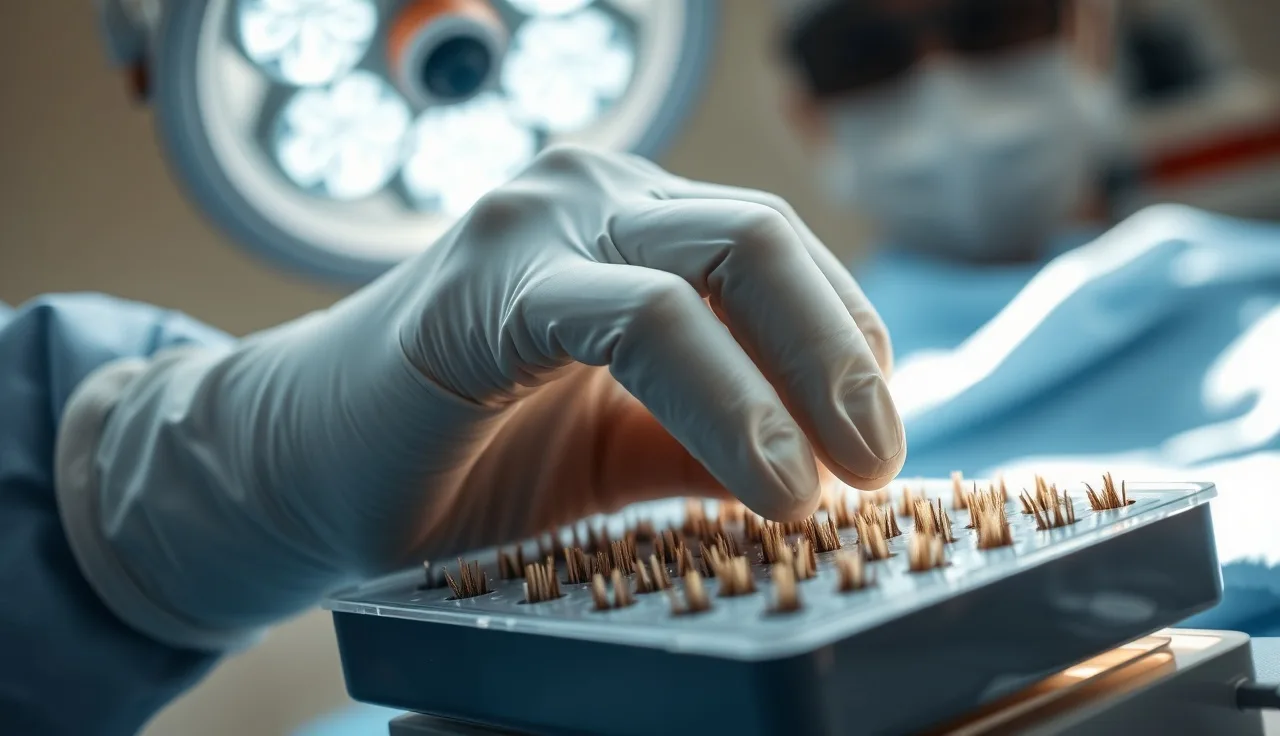
TL;DR: FUE (follicular unit extraction) harvests individual hair follicles with a small punch tool, leaving tiny dot scars. FUT (follicular unit transplantation) cuts a strip of scalp and stitches it closed, leaving a thin linear scar. Both transplant the same grafts into thinning areas. FUE suits short haircuts. FUT often yields more grafts per session and costs less per graft.
What is a hair transplant, and why does the harvesting method matter?
A hair transplant moves living follicles from a part of your scalp that keeps growing (usually the back and sides, called the donor zone) to wherever you're thinning. Those follicles are genetically resistant to DHT, the hormone behind male and female pattern hair loss, so they keep growing in their new spot for life. [1]
The grafts are identical no matter which method you choose. What differs between FUE and FUT is how the follicles come out of the donor zone. That single step changes how long surgery takes, what kind of scar you get, how many grafts a surgeon can safely harvest, and your total bill. Everything after harvesting (the implantation, the recipient-area healing, the final density) runs the same for both.
This distinction matters because clinics and their marketing often frame FUE as a totally different kind of treatment. It isn't. Both methods move follicular units. The whole debate is about one step in a procedure that runs several hours. If you're researching a hair transplant, start here.
What exactly is FUT (follicular unit transplantation)?
FUT, also called the strip method, has been done since the early 1990s. The surgeon removes a thin horizontal strip of scalp from the back of the head, then closes the wound with sutures or staples. A technician dissects that strip under a microscope into individual follicular units, each holding one to four hairs, and those units go into the recipient area. [2]
The linear scar runs across the back of the head. In most patients it heals to a fine white line, maybe 1 to 2 mm wide, hidden by surrounding hair at a length of about a centimeter or more. Buzz your head to a number two or shorter and the scar shows. That's the main cosmetic trade-off.
FUT lets a skilled team take a lot of grafts in one sitting, sometimes 3,000 to 4,000 or more, because the strip can be long and dissection is fast. The follicles also spend less time out of the body, which some surgeons say helps graft survival. The head-to-head survival evidence between FUT and FUE is mixed and leans heavily on clinic technique. A full session usually takes four to eight hours depending on size.
What exactly is FUE (follicular unit extraction)?
FUE, popularized in the early 2000s, removes follicles one at a time with a small circular punch, usually 0.6 to 1.0 mm across. [3] The surgeon (or in some clinics a robotic system like the ARTAS) punches around each follicular unit, lifts it out, and drops it into a holding solution before implantation.
Instead of one line, you get tiny round scars scattered across the donor area. Once healed, each is about the size of a freckle. Keep your hair at a grade two or three buzz and most people can't spot them. Shave completely bald and a careful look in bright light may show the pattern.
FUE runs slower per graft. Pulling follicles one by one takes longer than dissecting a strip, which is why large FUE sessions (over 2,500 grafts) often split across two days. It also demands more skill to avoid transection, where the punch cuts through the follicle and kills it. Published transection rates run from around 2% in expert hands to over 15% in less experienced clinics. [4]
FUE can also harvest body hair grafts (beard, chest, back) in patients with limited scalp donor supply. FUT can't do that.
FUE vs FUT: how do they compare side by side?
| Factor | FUT (strip) | FUE (punch) |
|---|---|---|
| Scar type | Linear, 1-2 mm wide | Scattered dot scars, 0.6-1.0 mm each |
| Scar visibility (buzz cut) | Visible at grade 1-2 | Less visible at grade 2-3 |
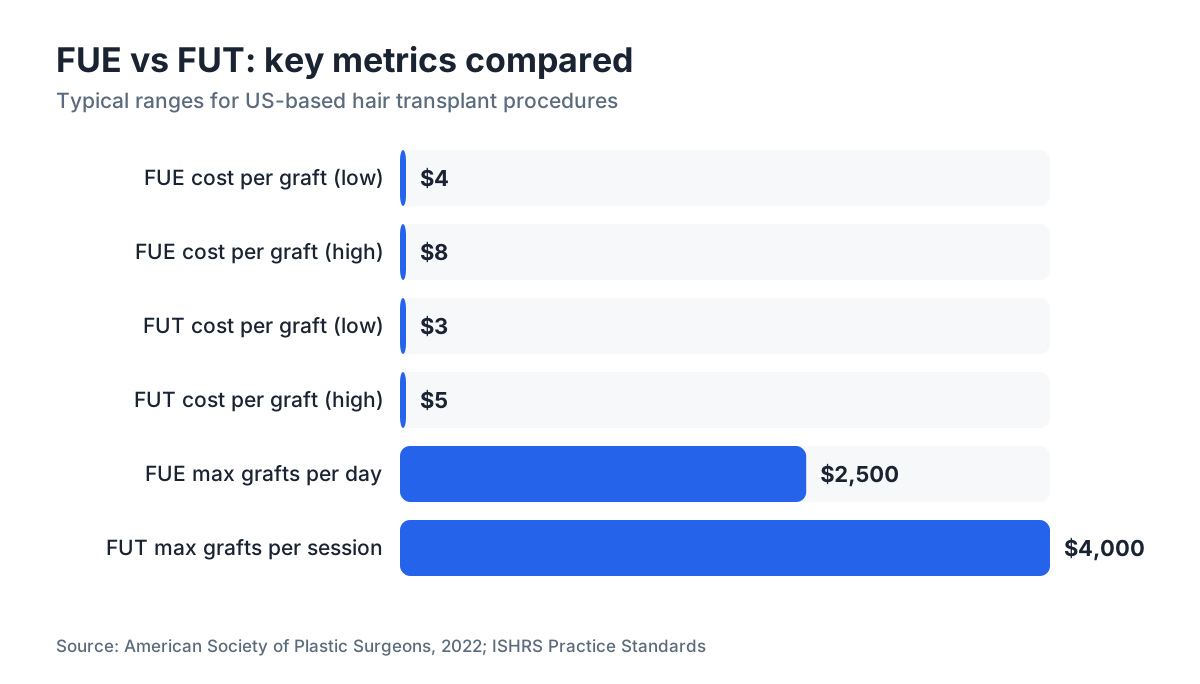
| Grafts per session | Up to 3,000-4,000+ | Up to 2,000-2,500 per day |
| Time in surgery | 4-8 hours | 6-10+ hours for large sessions |
| Recovery (donor area) | 10-14 days, sutures removed | 5-7 days, no sutures |
| Transection risk | Low (under microscope) | Higher if surgeon lacks experience |
| Cost per graft (US) | $3-$5 | $4-$8 |
| Body hair harvest | No | Yes |
| Best for | Larger coverage needs, patients who won't buzz | Patients who wear hair short, smaller sessions |
A 2020 systematic review in the Journal of Plastic, Reconstructive and Aesthetic Surgery found no statistically significant difference in overall graft survival or final hair density between FUE and FUT when experienced surgeons did the work. [5] Technique and surgeon skill drive outcomes far more than the method label.
Cost is real money either way. The American Society of Plastic Surgeons put the average hair transplant surgeon fee in 2022 at roughly $4,400, though total costs (facility and anesthesia included) for sessions of 2,000 or more grafts commonly run $10,000 to $25,000 depending on graft count and location. [6]
Which method leaves a worse scar?
This is the question most people actually care about. The honest answer hinges on your haircut, not on which method is objectively worse.
FUT leaves one scar. Healed well, it's a thin horizontal line sitting under your existing hair. For anyone keeping the sides at an inch or longer, that line never shows. Want to crop the sides very short or shave down entirely? Then it becomes something to weigh.
FUE leaves dozens to hundreds of tiny scars across the donor zone. No single one is dramatic. But at very short lengths, the pile-up of white dots can catch the light, and if you've had several FUE sessions pulling from overlapping donor zones, the thinned donor area itself can start to show.
Some clinics sell FUE as "scarless." The American Academy of Dermatology's patient guidance describes no hair transplant method as scarless, because every method creates a wound. [7] A clinic that promises zero scarring is a red flag.
Worried about the linear scar after FUT? An experienced surgeon using trichophytic closure (a technique that lets hair grow through the scar line) can cut its visibility substantially. [12] Ask to see the surgeon's own patient photos at 12 months, not six-week post-op shots.
Does one method give better results or more hair growth?
In the hands of a skilled surgeon with a well-trained team, outcomes match up. The follicles going in are the same biological units either way.
What actually predicts your result is mostly independent of FUE vs FUT. Donor density matters enormously: thick, wavy, or dark hair against the skin gives better cosmetic coverage per graft than fine, straight, or light hair. So does how much you've lost, since a Norwood 6 or 7 pattern leaves less donor hair to work with no matter the method. [1]
Graft handling time out of the body does affect survival. Follicles kept out too long or stored badly show lower viability. FUT's microscope dissection can be faster for the removal step, and FUE's one-by-one extraction is slower, but a clinic using hypothermic holding solutions can close that gap. The 2020 review found no significant density difference once these variables were controlled. [5]
What reliably wrecks outcomes: high transection rates (ask for the clinic's audited number), implantation left to undertrained technicians, and operating on hair loss that's still actively progressing with no medical treatment alongside. Adding finasteride or minoxidil for men after a transplant is standard at reputable clinics precisely because untreated DHT keeps shrinking your native hair while the transplants stay put.
How much does FUE cost compared to FUT in the US?
FUE costs more per graft almost everywhere. Individual punch extraction takes longer per follicle, needs more specialized tools, and in robotic cases runs on expensive equipment. Expect roughly $4 to $8 per graft for FUE against $3 to $5 per graft for FUT at established US clinics, though both ranges swing hard by geography, surgeon reputation, and graft count. [6]
For a 2,000-graft session, that gap works out to roughly $2,000 to $6,000 more for FUE in absolute dollars. For a 3,500-graft session, it widens.
Clinic tourism (traveling to Turkey, India, or Eastern Europe) has taken off because prices can drop to $1,500 to $3,000 all-in for large FUE sessions. The savings are real. So is the difficulty of follow-up care if something goes wrong, and the inconsistent surgeon training standards abroad. That's a personal risk calculation, not a clean yes or no. Nobody has published a rigorous head-to-head outcome study comparing US clinics to specific international ones; the closest data is case series from individual practices.
Hair transplants are generally not covered by insurance in the US because most plans classify them as cosmetic. [6]
Who is a good candidate for FUE vs FUT?
FUE tends to fit better if you keep the sides or back short, want to harvest body hair grafts on top of scalp hair, have a tight scalp (which makes strip removal riskier), or need a smaller session under 1,500 grafts.
FUT tends to fit better if you want maximum grafts in one session, have looser scalp laxity (which makes strip closure easier), prefer a lower cost per graft, or plan to keep at least moderate length on the back and sides for the long haul.
Neither works well if your loss is still moving fast and you haven't touched the underlying cause. A transplant relocates existing hair. It does nothing to stop the loss of what's still on your head. Men with receding hairline at Norwood 2 or 3 who transplant early often need a second procedure years later as loss marches on behind the restored hairline. Getting your pattern and stability evaluated first, and understanding what causes hair loss in your case, matters more than picking FUE or FUT.
Patients with certain scarring alopecia conditions, active scalp infections, or unrealistic density expectations about a finite donor supply may not be candidates for either method.
What is robotic FUE, and is it better than manual FUE?
Robotic FUE, best known through the ARTAS system (FDA-cleared in 2011 for harvesting), uses image-guided robotics to score and extract follicular units. The machine reduces surgeon fatigue during long sessions and holds a consistent punch depth, which supporters say cuts transection. [8]
The evidence comparing robotic to manual FUE is thin. A 2018 review in Dermatologic Surgery found no direct head-to-head randomized comparison published at the time and concluded that robotic-assisted FUE looks safe and feasible but lacks evidence of superiority over skilled manual FUE. [11] The robot adds cost, often $1,000 to $3,000 more per session, and it can't harvest from beard or body donor areas the way manual FUE can.
Manual FUE in expert hands is still the bar robotic systems get measured against. The robot doesn't implant the grafts; a human does that. So if you're paying extra for robotic extraction, the implantation team's quality is still what limits your result.
How long is recovery after FUE vs FUT?
The timelines split mainly in the donor area. The recipient area (where the grafts land) heals on roughly the same schedule for both: small scabs form over each site, shed by 10 to 14 days, and the transplanted hairs shed by about six weeks. That's normal. New growth starts around three to four months, with full results usually visible at 12 to 18 months. [2]
For the donor area, FUT needs suture or staple removal at about 10 to 14 days and brings more early tightness and soreness from the linear wound. Most patients get back to desk work within a week but should skip heavy lifting and hard cardio for two to three weeks.
FUE donors heal faster with no sutures to pull. The small punch sites close on their own in five to seven days. Patients usually return to light activity sooner, though surgeons still say avoid direct sun and sweating for at least a week.
Both methods carry risk: infection, folliculitis, temporary numbness, and rarely poor graft survival. Go over all of it with your surgeon before you commit.
Should I use finasteride or minoxidil alongside a hair transplant?
Most hair restoration physicians want you to continue or start medical treatment for androgenetic alopecia alongside a transplant. The transplanted hairs are DHT-resistant. Your existing native hairs aren't, if you have pattern loss. Without treatment those native hairs keep shrinking, and your result can look worse over time as the untransplanted zones thin further.
Finasteride (1 mg daily, FDA-approved for male pattern hair loss) drops scalp DHT by roughly 60% in clinical trials and slows or halts progression in most men who take it. [9] Minoxidil works differently, stretching the growth phase of follicles, and comes over the counter in 2% and 5% topical forms plus prescription oral minoxidil. [10]
The finasteride and minoxidil combination is the most evidence-backed medical duo for holding onto existing hair around a transplant zone. Both carry side effect profiles worth knowing first. Read up on minoxidil side effects and ask a dermatologist about DHT blockers specifically.
Not sure how much hair you've actually lost or where it's heading? MyHairline's free AI hair scan (/scan) gives you a Norwood stage estimate to bring to that conversation.
What questions should I ask a hair transplant surgeon before deciding?
Before you commit to either method, get clear answers to these.
What is your transection rate, and how do you measure it? A reputable clinic can tell you. Rates above 10% are a real concern.
How many grafts can my donor zone safely supply over my lifetime? This matters because Norwood 5 or 6 loss may need multiple sessions, and you have to budget your donor supply.
Who performs the implantation? In some clinics the named surgeon does the extraction and hands off implantation to technicians. Both steps shape the outcome.
Can I see 12-month photos of patients with my hair type and loss pattern? Before-and-afters from immediately post-op or at six months don't tell the real story.
What do you recommend for medical management alongside surgery? A surgeon who never mentions finasteride or minoxidil for a patient with progressive androgenetic alopecia is missing a key piece.
Do you recommend FUE or FUT for my case, and why? The answer should track your donor density, scalp laxity, desired haircut, and loss pattern, not a blanket "we only do FUE" policy driven by marketing.
Sources
- American Academy of Dermatology, Hair loss: Who gets and causes
- American Academy of Dermatology, Hair loss diagnosis and treatment
- International Society of Hair Restoration Surgery, ISHRS Practice Standards
- Dermatologic Surgery journal (Wolters Kluwer / Lippincott), FUE transection rate literature
- Journal of Plastic, Reconstructive and Aesthetic Surgery, Systematic review FUE vs FUT outcomes (2020)
- American Society of Plastic Surgeons, 2022 Plastic Surgery Statistics Report
- American Academy of Dermatology, Hair loss treatment overview
- U.S. Food and Drug Administration, Devices and 510(k) Premarket Notification program
- U.S. National Library of Medicine, DailyMed finasteride labeling
- U.S. National Library of Medicine, MedlinePlus minoxidil topical
- Dermatologic Surgery journal (Wolters Kluwer / Lippincott), robotic-assisted FUE review (2018)
- National Library of Medicine, StatPearls: Hair Transplantation