
TL;DR: Most people can safely run two or three hair loss treatments at once. The best-studied stack is minoxidil plus finasteride, and it beats either drug alone. Adding low-level laser therapy or microneedling on top stays low-risk. Past three treatments, overlapping side effects and cost outrun the evidence. Clear any combination with your prescribing doctor first.
Why do people stack hair loss treatments in the first place?
Hair loss rarely has one cause and one fix. Androgenetic alopecia, the pattern baldness affecting roughly 50 million men and 30 million women in the United States, involves DHT-driven miniaturization of follicles, scalp inflammation, poor microcirculation, and sometimes nutritional gaps all at once [1]. No single treatment touches all of those pathways. That's the real reason people stack.
The second reason is math. Finasteride slows DHT at the follicle. Minoxidil opens blood vessels and stretches out the growth phase. Those mechanisms barely overlap, so combining them gives you additive benefit instead of redundancy. The logic falls apart the moment you pile on three treatments that all hit the same target, or when side effect profiles start stacking on top of each other.
So the real question isn't "can you?" It's "am I adding a genuinely different mechanism, or just doubling up on the same pathway and the same risks?" Keep that filter in your head and every stacking decision gets simpler.
What does the research actually say about combining treatments?
The most-studied combination in androgenetic alopecia is finasteride plus minoxidil for men. A 2021 randomized controlled trial in JAMA Dermatology followed men with pattern baldness for 24 weeks and found the combination group gained significantly more hair than either drug on its own [2]. That's about as clean as evidence gets in hair loss research, a field not exactly drowning in rigorous RCTs.
Low-level laser therapy (LLLT) devices cleared by the FDA have modest but real support. A 2013 trial in the American Journal of Clinical Dermatology found a statistically significant increase in hair density with a laser comb over 26 weeks versus a sham device [3]. Stack it with minoxidil and small studies show additive benefit with no meaningful interaction, because the mechanisms sit in completely separate lanes.
Platelet-rich plasma (PRP) stacked with minoxidil or finasteride has positive pilot data, but the evidence is thin and clinic protocols swing all over the place. Nobody has good standardized data on the best PRP-plus-medication stack. The closest systematic review found inconsistent results largely because PRP preparation techniques differ so much between labs [4].
Microneedling is a different story, and a better one. A 2013 trial in the International Journal of Trichology found that minoxidil plus microneedling beat minoxidil alone by a wide margin in men with androgenetic alopecia [5]. The proposed mechanism is that micro-injuries trigger wound-healing growth factors and boost how much minoxidil the scalp absorbs. That's a genuinely separate pathway, and the safety record for 0.5 mm to 1.5 mm dermal rollers used at home is good when people follow the rules.
Here's the short version of the literature: two-treatment stacks have real RCT-level support, three-treatment stacks have smaller or messier evidence, and anything past three is personal experimentation.
Which combinations are proven safe and effective?
| Stack | Evidence Level | Notes |
|---|---|---|
| Topical minoxidil + finasteride | Strong (RCT) [2] | The best-supported combination; different mechanisms, well-tolerated |
| Minoxidil + microneedling (dermal roller) | Moderate (RCT) [5] | Space sessions at least 24 hours apart; boosts absorption |
| Minoxidil + LLLT device | Moderate (small RCTs) [3] | No interaction risk; separate mechanisms |
| Finasteride + DHT-blocking shampoo | Low-moderate | Shampoo effect is minor; adds no real side-effect burden |
| Topical finasteride + topical minoxidil | Moderate | Common in Hims/Keeps products; similar to oral/topical combo |
| Oral minoxidil + topical minoxidil | Not recommended | Doubles the same drug; higher hypotension and fluid-retention risk |
| Finasteride + dutasteride | Not recommended | Both block 5-alpha reductase; not additive, more side effects |
| Minoxidil + biotin supplements | No interaction | Biotin has no proven hair effect in people who aren't deficient |
The combinations in the top half of that table are ones most dermatologists sign off on without hesitation. The bottom two are cases where you're pairing treatments that hit the same target, which adds risk and almost nothing else.
If a doctor has you on oral minoxidil, stacking topical minoxidil on top is a bad idea. Oral minoxidil is already systemic. Layering topical over it doesn't feed your scalp more useful drug, but it can push your total systemic dose higher and worsen blood pressure effects.
How many treatments can you safely stack at once?
Two is the sweet spot for most people. Three works if you're deliberate about it. Four or more turns your hair plan into a side-effect management project.
The reason is troubleshooting. Every treatment you add is one more variable to isolate when something goes wrong or stops working. With two treatments and scalp irritation, you can drop one and see. With five running at once, figuring out the culprit is nearly hopeless, and you also lose any read on what's actually driving the improvement you see.
A practical three-treatment stack with decent evidence and low combined risk: finasteride (oral or topical), topical minoxidil, and microneedling every week or two. Three distinct mechanisms, side-effect profiles that don't pile up, and peer-reviewed support behind each. That's roughly the ceiling most dermatologists would nod at.
Adding a fourth piece like an FDA-cleared LLLT device isn't dangerous. The marginal gain over the three-treatment stack is just probably small, so you're spending more time and money for uncertain payoff. That's a personal call, not a medical one.
Anything that pairs two drugs hitting the same biochemical pathway, two 5-alpha reductase inhibitors or two forms of minoxidil, should not happen unless a physician has explicitly worked out the dosing rationale.
What are the real risks when you stack treatments?
The risks split into two buckets: drug interactions and cumulative side effects from overlapping mechanisms.
Finasteride and dutasteride both block 5-alpha reductase, the enzyme that turns testosterone into DHT. Stacking them doesn't drop your DHT lower than dutasteride alone, because dutasteride already blocks both type 1 and type 2. What you do get is more strain on the same hormonal pathway, which can amplify sexual side effects like decreased libido, erectile dysfunction, and ejaculatory changes [6]. The FDA label for finasteride lists these plainly [7].
Combining oral minoxidil with any other blood-pressure drug, including certain heart medications, diuretics, or high-dose supplements sold for blood pressure, raises the risk of hypotension. The FDA label for oral minoxidil tablets notes that "Minoxidil must be used in conjunction with a beta-adrenergic blocking agent" when the drug is used for its original hypertension indication, because reflex tachycardia is a genuine concern at cardiovascular doses [8]. Hair loss doses (0.625 mg to 5 mg daily) sit far below hypertension doses, but the blood pressure caution still holds, and it compounds if you add other agents.
Topical minoxidil side effects, scalp irritation, contact dermatitis, and unwanted facial hair, can worsen if you microneedle without leaving enough time between sessions. Microneedling opens up the scalp barrier significantly. Applying minoxidil right after rolling can spike systemic absorption and trigger lightheadedness or a racing heart. The standard trichologist recommendation is to wait at least 24 hours after microneedling before you apply minoxidil [5]. More on those effects at minoxidil side effects.
Supplement stacks marketed for hair often contain saw palmetto, which has mild DHT-blocking activity. If you're already on finasteride, saw palmetto adds little, and its risk profile in combination with prescription 5-alpha reductase inhibitors isn't well quantified. More on what supplements actually do at hair loss supplements.
The most underrated risk is missing a different diagnosis entirely. If your hair loss comes from telogen effluvium driven by iron deficiency or a thyroid problem, no combination of androgenetic alopecia treatments will fix it. Stacking without a diagnosis can push the right treatment back by months or years.
Does adding finasteride to minoxidil actually work better than either alone?
Yes. This is the one combination where the evidence is strong enough to say that flatly.
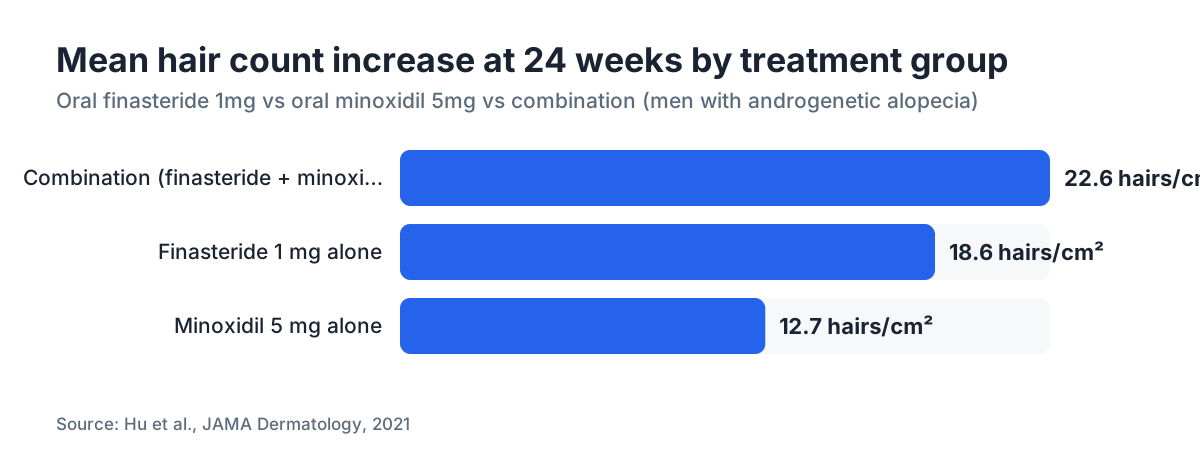
The JAMA Dermatology 2021 trial by Hu and colleagues randomized men with androgenetic alopecia to oral minoxidil 5 mg, oral finasteride 1 mg, or the combination. At 24 weeks the combination group gained a mean of 22.6 hairs per cm², versus 12.7 for minoxidil alone and 18.6 for finasteride alone [2]. The combination didn't rack up meaningfully more adverse events than either drug by itself.
The finasteride and minoxidil combination works because the drugs hit genuinely different targets. Finasteride quiets the DHT signal telling follicles to shrink. Minoxidil improves blood flow to the follicle and directly lengthens the anagen (growth) phase. Those effects add up in a way that two minoxidil products or two 5-alpha reductase inhibitors never do.
If you're doing one thing for androgenetic alopecia and you're eligible for finasteride (typically men, and post-menopausal women under physician guidance), moving to the combination is probably the single highest-value change you can make.
Is microneedling safe to add to a minoxidil or finasteride regimen?
Microneedling with a 0.5 mm to 1.5 mm dermal roller is generally safe to stack with both topical minoxidil and finasteride, and there's evidence it lifts results rather than just adding noise.
The 2013 International Journal of Trichology RCT found that men who combined weekly microneedling with daily topical 5% minoxidil showed a 40-count hair increase at 12 weeks, versus a 4.7-count increase in the minoxidil-only group [5]. That's a striking gap for a home roller that costs under $30.
The practical rules are short. Use a clean roller. Replace it every four to eight weeks. Limit sessions to once a week. Never apply minoxidil within 24 hours of rolling. A freshly needled scalp drives far more drug into the bloodstream than normal, which can cause headache, palpitations, or dizziness in some people. Timing is the whole game here.
Microneedling on an already inflamed or irritated scalp is a bad idea. Scalp psoriasis, active seborrheic dermatitis, or any open lesions mean you hold off.
Finasteride, oral or topical, has no timing interaction with microneedling. Keep your normal finasteride schedule regardless of when you roll.
What about hair transplants combined with medications?
A hair transplant doesn't compete with medications. It works next to them. Transplanted grafts come from DHT-resistant donor zones at the back and sides of the scalp, so finasteride and minoxidil don't affect them the way they affect native follicles. But the native follicles around the transplant keep losing ground to androgenetic hair loss if you stop your medications.
Most surgeons want you on finasteride before and after surgery to protect the existing native hair. Stopping finasteride after a transplant won't harm the grafts, but it can let the surrounding non-transplanted hair keep miniaturizing, which makes the result look patchy over time.
Minoxidil usually pauses two weeks before surgery to lower bleeding risk, then restarts two weeks post-op once the grafts start to anchor. Exact timing shifts by surgeon and technique, so follow your surgeon's protocol.
Pairing a transplant with ongoing finasteride and minoxidil is arguably the strongest multi-modal approach for advanced androgenetic alopecia. The transplant restores density in bald zones. The medications defend what's left. It isn't stacking in any risky sense; it's solving different problems with different tools.
Are there treatments you should never combine?
A handful of combinations are genuinely a bad call.
Finasteride plus dutasteride is the clearest one. Both are 5-alpha reductase inhibitors. Dutasteride blocks type 1 and type 2; finasteride blocks only type 2. Together they don't get your DHT lower than dutasteride alone, but they do concentrate the hormonal side effect risk. There's no approved reason to run both at once [6].
Oral minoxidil plus topical minoxidil is another to skip unless a physician has specifically calculated the combined dose. Oral minoxidil at even 2.5 mg already has systemic effects. Adding topical raises absorption unpredictably, especially if you're also microneedling.
Two different topical finasteride products from different brands is a dose-stacking trap people rarely think about. Topical finasteride has real systemic absorption, enough that serum DHT suppression shows up in studies. If one compounded spray delivers 0.1% finasteride and you add a second product, you can quietly exceed the dose you think you're on.
Ketoconazole shampoos (1% or 2%) used alongside other antifungals, particularly oral antifungals prescribed for something else, can carry liver interaction risks. That one is more a drug-drug interaction than a hair-specific issue, but it's worth knowing.
And if you're reaching for another treatment because one isn't working, the honest move is to first figure out why. A receding hairline from androgenetic alopecia responds to finasteride and minoxidil. One driven by traction from tight hairstyles won't. Stacking treatments on the wrong diagnosis just means spending more money on the wrong things. Start by understanding what causes hair loss at the root.
How do you know if your stack is actually working?
Hair responds slowly. Really slowly. Give any combination at least four to six months of consistent use before you judge it. The American Academy of Dermatology recommends waiting at least six months before drawing conclusions about a hair loss treatment [9].
Photo tracking is the most practical tool you have. Take standardized photos in the same lighting, from the same angles, every four weeks. Part your hair in the same spot each time. Smartphone apps handle this, but a consistent bathroom mirror setup works fine too.
Shedding often jumps in the first four to eight weeks after starting minoxidil. This is well-documented and temporary, and it happens because minoxidil pushes follicles out of telogen (rest) into a new growth cycle. Start two treatments at the exact same time and shed more than expected, and you'll have no idea which one did it. Starting treatments one at a time, spaced four weeks apart, lets you isolate the effect.
Want an objective baseline before starting a stack? A dermatologist-performed trichoscopy or a phototrichogram can document follicle density. If you just want a quick read on your current pattern before building a plan, the free AI hair analysis at MyHairline assesses your hairline and flags your likely Norwood stage, which narrows down which treatments even apply to your level of loss.
If after six months of a well-run two or three-treatment stack you see no stabilization and continued shedding, the next step is a dermatologist visit with bloodwork, not a fourth treatment.
What does a safe, evidence-based treatment stack actually look like?
For men with androgenetic alopecia at Norwood stages 2 through 4, a reasonable progression runs like this.
Start with the two-drug combination: oral finasteride 1 mg daily plus topical 5% minoxidil twice daily (or a topical finasteride/minoxidil combo if you want lower systemic finasteride exposure). Evaluate at six months.
If results plateau, add biweekly microneedling with a 1.0 mm roller, timed to dodge the 24-hour window before minoxidil. Give it another four to six months.
An FDA-cleared LLLT device used three times a week can go on at minimal risk at any stage, as long as you understand the evidence for LLLT is real but modest. It won't transform your outcome, but it adds a separate mechanism with no meaningful interaction risk.
Women have a more complicated path. Finasteride is contraindicated in women who are pregnant or may become pregnant, because of teratogenic risk to a male fetus [7], and minoxidil 2% is the labeled dose for women, though some doctors prescribe 5% off-label. The combination idea holds, but the specific drugs and doses differ. Women should get a DHT blocker assessment from a physician before starting any hormonal treatment.
Whatever the stage, review the stack with a dermatologist or trichologist once a year. Hair loss isn't static, and a regimen that fits Norwood 2 may need adjusting at Norwood 4. Don't set a prescription-drug routine and forget it.
What's a realistic monthly cost for a two or three-treatment stack?
Generic finasteride runs about $15 to $30 a month from most pharmacies and telehealth platforms. Generic topical minoxidil 5% solution costs $10 to $20 a month. A 1.0 mm dermal roller is a one-time $20 to $40 buy, replaced every couple of months. An FDA-cleared LLLT device (helmet or comb style) runs $200 to $800 up front, with the pricier helmet-style devices carrying broader evidence [3].
So a two-drug stack lands at $25 to $50 a month. Microneedling adds almost nothing ongoing. LLLT adds a real upfront cost but no monthly expense after.
Hair transplants play in a different league: $4,000 to $15,000 or more depending on graft count and location, and almost never covered by insurance because the procedure counts as cosmetic.
PRP sessions, if you go that route, typically cost $500 to $1,500 each, with three or more sessions recommended up front, then quarterly maintenance. The cost-to-evidence ratio for PRP is poor next to the medications.
The point worth remembering: the best-supported stack (finasteride plus minoxidil) is also among the cheapest. Spending more doesn't buy more results in this space.
Sources
- Hu R et al., JAMA Dermatology 2021, Combination minoxidil and finasteride RCT
- Lanzafame RJ et al., American Journal of Clinical Dermatology 2013, LLLT laser comb RCT
- Gupta AK et al., Journal of Cutaneous and Aesthetic Surgery, PRP systematic review
- Dhurat R et al., International Journal of Trichology 2013, Microneedling plus minoxidil RCT
- U.S. National Library of Medicine, MedlinePlus, Dutasteride drug information
- FDA Drug Label, Propecia (finasteride 1 mg)
- FDA Drug Label, Loniten (minoxidil tablets), oral minoxidil prescribing information
- American Academy of Dermatology, Hair Loss Treatment Guidance