

TL;DR: Most adults shed 50 to 100 hairs a day. That's the normal range from the American Academy of Dermatology. Losing more than 150 hairs daily for several weeks, watching your part widen, or finding bald patches means it's time to look closer. Autumn shedding spikes are real and temporary. Anything past the normal range deserves attention, not panic.
What is actually considered normal hair loss per day?
Fifty to 100 hairs a day. That's the number the American Academy of Dermatology gives, and it covers what falls out during washing, brushing, and just living your life [1]. So many hairs shed daily because your scalp cycles through three phases: anagen (active growth, 2 to 6 years), catagen (a short transition of a few weeks), and telogen (resting, about 3 months before the hair drops). At any moment, roughly 10 to 15 percent of your scalp's 100,000 or so follicles sit in telogen, ready to shed [2].
Losing a few dozen hairs in the shower isn't a crisis. It's biology.
The number worth watching is closer to 150 to 200 hairs a day, sustained for more than a few weeks. That crosses into telogen effluvium, a diffuse shedding condition usually kicked off by a physical or emotional stressor [3]. Even then, the outlook is often good. Most telogen effluvium clears up on its own once the trigger is gone.
One honest caveat. The 50 to 100 figure is a population average. People with longer or thicker hair lose more by weight. People who wash less often see bigger clumps when they finally do, because the shed hairs had nowhere to go. That drain clump isn't more hair, just several days delivered at once.
How do I know if I'm losing too much hair?
Counting individual hairs is impractical. But a few honest home tests get you close.
The pull test is what clinics use most. Grasp about 40 to 60 hairs between your thumb and forefinger, hold gently but firmly, and slide from root to tip. More than 6 hairs coming loose counts as a positive result, meaning shedding is elevated right now [4]. Dermatologists use it for a quick read on whether loss is active.
The part width test is simpler. Photograph your part from directly above, same lighting, every few months. A widening part over time, especially in women, is one of the earliest visible signs of androgenetic alopecia (the clinical name for genetic hair loss). You want the trend, not a single snapshot.
Then the scalp check. Bald patches, a distinct receding line at the temples, or spots where scalp shows through hair that used to be dense all point past normal shedding. Normal shedding stays diffuse and leaves no visible gaps.
Want a faster read without booking an appointment? MyHairline's free AI hair scan reads a photo of your scalp and hairline and gives you a preliminary sense of where you stand before you decide on a doctor.
Here's the honest part. Most people who worry they're losing too much hair aren't. The ones who genuinely are tend to rationalize it far too long. If the anxiety is real, book a dermatologist or trichologist. They can run a scalp biopsy or dermoscopy when the pull test isn't conclusive.
What does normal hair shedding look like versus actual hair loss?
People confuse these two constantly, and the difference decides everything about what you do next.
Shedding is hair falling from the root while the follicle stays healthy and keeps producing new hair. You can usually spot a shed hair by the small white bulb at the base. That bulb is the root, and the follicle underneath is intact.
Hair loss, in the clinical sense, is the follicle itself giving up: it stops producing hair or makes progressively thinner, shorter strands (a process called miniaturization). In androgenetic alopecia, DHT (dihydrotestosterone) shrinks follicles over years until they produce only fine vellus hair or nothing [5]. That process doesn't reverse the way telogen effluvium does. The follicle is genuinely damaged.
The practical difference is stark. Shed 150 hairs a day after surgery, a high fever, or a stretch of severe stress, and your hair almost certainly grows back fully in 3 to 6 months, because the follicles are fine. Watch your hairline retreat slowly for 5 years until the temples are bare, and the follicles in those zones may be permanently miniaturized. Two situations, two completely different conversations.
For men noticing temples and crown thinning together, that's the classic pattern of androgenetic alopecia tied to a receding hairline. For women it usually shows as a widening part with the frontal hairline intact, the typical look of female pattern hair loss.
Does hair loss increase with age, and by how much?
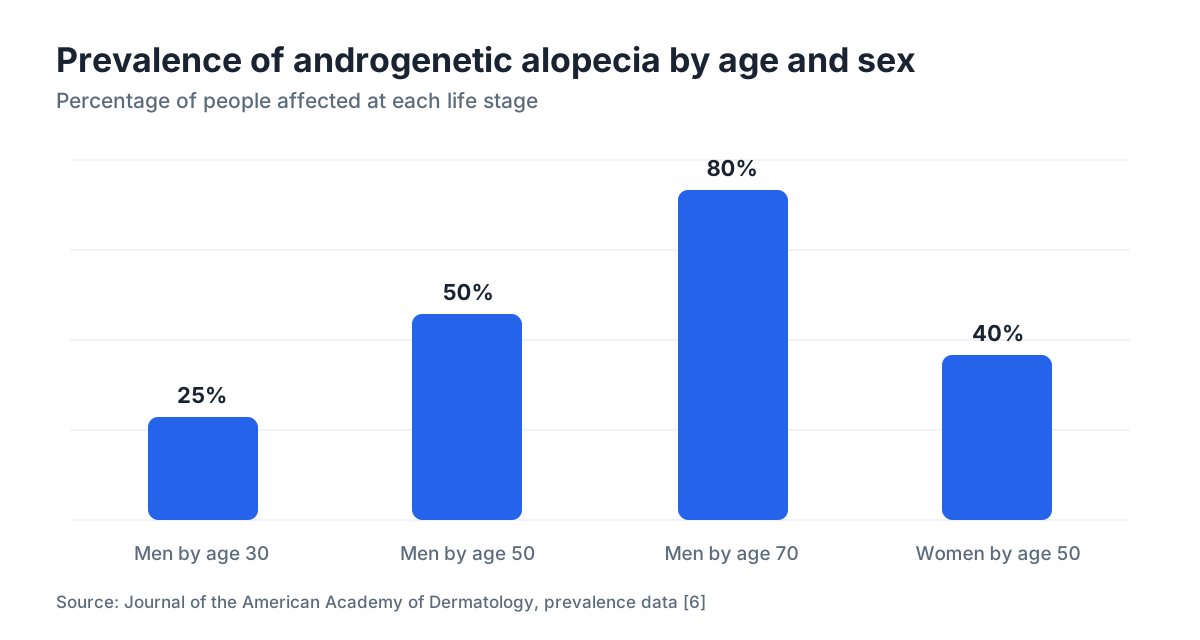
Yes, and by a lot. Androgenetic alopecia affects roughly 50 percent of men by age 50 and up to 80 percent by age 70, per prevalence data in the Journal of the American Academy of Dermatology [6]. For women the numbers run lower but aren't small: around 40 percent show visible hair loss by age 50.
The Norwood-Hamilton scale grades male pattern loss from I (minimal recession) to VII (only a horseshoe rim remains). Most men who go on to lose significant hair see the first signs in their 20s or early 30s, though the pace swings wildly with genetics.
Age changes hair beyond pattern loss too. After menopause, women often thin diffusely as estrogen's protective effect on follicles drops. Thyroid disease, more common with age, adds another cause. And simply getting older shortens the anagen phase, so hairs don't grow as long before cycling out.
Some rise in shedding or drop in density as you age is normal and expected. What isn't: dramatic loss in your teens or early 20s, loss in odd patterns (patchy circles can signal alopecia areata), or loss alongside scalp scaling, redness, or pain.
Is seasonal hair loss real, and how much extra shedding is normal in autumn?
It's real. A 2009 study in the British Journal of Dermatology tracked 823 healthy women over 6 years and found the share of hairs in telogen peaked in July, with the shedding surge peaking in October [7]. The lag makes sense: telogen lasts about 3 months, so follicles pushed into rest during summer let go in autumn.
How much extra? The study found roughly 10 percent more scalp hairs in telogen during summer than in spring. That means a noticeable but temporary bump in shedding, not the opening act of a permanent condition.
More hair in your brush in September and October is almost certainly seasonal. Shedding that stays high past December with no sign of slowing is worth investigating.
What causes hair loss beyond normal shedding?
The causes fall into a few buckets, and knowing which one is yours changes how you respond.
Androgenetic alopecia is the most common by far. It's genetic, driven by DHT binding to follicle receptors and triggering progressive miniaturization. It follows predictable patterns (Norwood for men, Ludwig for women). This is what finasteride and minoxidil are mainly approved to treat [8]. For the full breakdown, see our guide to what causes hair loss.
Telogen effluvium comes next. Any big physical stressor can shove a large batch of follicles into telogen at once: childbirth, major surgery, crash dieting, high fever, COVID-19 infection, or severe psychological stress. Shedding usually starts 2 to 3 months after the trigger and clears within 6 months once the trigger is gone.
Alopecia areata is autoimmune. The immune system attacks follicles, causing patchy, unpredictable loss. It affects about 2 percent of people at some point in their lives [9]. It isn't treated like androgenetic alopecia.
Nutritional deficiencies, especially iron-deficiency anemia and low ferritin, are underdiagnosed causes of shedding, particularly in women with heavy periods. Thyroid dysfunction in either direction (hypo or hyper) causes diffuse shedding too.
Medications get overlooked a lot. Beta-blockers, anticoagulants, lithium, some antidepressants, retinoids, and chemotherapy agents all list hair loss as a documented side effect. If your shedding started within 3 months of a new medication, raise that connection with your prescribing doctor.
Wondering about a specific supplement or habit? Our piece on does creatine cause hair loss works through one common worry in detail.
How much hair loss is normal after washing or brushing?
After a wash, most people see 50 to 150 hairs, and the high end is normal if you haven't washed in several days. Hairs that finished their cycle and detached from the follicle stay loosely in place until water and the scrub of washing free them.
Wash daily and you'll land at the low end. Wash every 3 or 4 days and the clump that looks alarming is usually just accumulated shedding arriving all at once.
After brushing, 10 to 30 hairs on the brush is unremarkable. More than 50 after a single session is worth noting, especially if it repeats.
One thing trips people up. After a long stretch of not brushing (some people with textured or curly hair co-wash and rarely brush), the first brush-out can look catastrophic. It's mostly hairs that detached long ago and stayed trapped by curl pattern or product. Not a week of accelerated loss. Just accumulated sheds finally set free.
If you honestly can't tell whether your shower shedding is normal, photos tracked over 4 to 6 weeks tell you far more than a single panicked count.
When should I see a doctor about hair loss?
See a dermatologist if any of these are true.
You're losing visibly more hair than usual for over 3 months with no obvious trigger (no recent surgery, illness, or major stress). Your part is widening or scalp shows in areas it didn't before. You have patchy loss, circular bald spots, or loss at the eyebrows and lashes along with the scalp. Your scalp is itchy, scaly, red, or painful. You're a teenager or in your early 20s with significant loss. Or you're postpartum and the shedding hasn't slowed by 6 months after delivery.
For loss that follows the classic male or female pattern and has crept along slowly, a dermatologist visit still earns its keep. It confirms the diagnosis and gets you talking about evidence-based treatments before the window of reversibility closes. The follicles that respond to finasteride or minoxidil for men are the ones thinning but not yet gone. Wait years and you're left with fewer options.
A good dermatologist usually orders blood work: complete blood count, ferritin, thyroid-stimulating hormone, and sometimes testosterone and DHEA-S. Those rule out the common reversible causes before settling on a diagnosis of androgenetic alopecia.
Primary care doctors can run the same workup. But a board-certified dermatologist focused on hair disorders (called a trichologist outside the US) is the specialist for pattern loss.
What treatments actually work for hair loss that goes beyond normal?
The list of treatments with real FDA approval or strong evidence is short. It isn't empty.
Minoxidil is the most accessible. It's over the counter as a 2% or 5% topical solution or foam, and the FDA has approved it for androgenetic alopecia in both men and women [8]. It stretches the anagen phase and improves blood supply to the follicle. It works for about 40 to 60 percent of consistent users, with results at 3 to 6 months. Stop using it and the benefit reverses. For the risks, see our article on minoxidil side effects. Oral minoxidil is an off-label alternative some dermatologists now prefer, mostly for adherence.
Finasteride (1 mg daily, oral) is FDA-approved for male pattern hair loss and blocks the conversion of testosterone to DHT. Trials show it stops progression in about 83 to 90 percent of men and regrows hair in about 66 percent over 2 years [10]. It's prescription-only and not FDA-approved for women of childbearing potential because of fetal risk. Some doctors prescribe it off-label for postmenopausal women. Pairing it with minoxidil beats either drug alone, as our guide to finasteride and minoxidil lays out.
DHT blockers in supplement form (saw palmetto, say) have some small-scale evidence, nothing near the volume behind finasteride.
Hair transplants are the surgical route, for people with stable pattern loss and enough donor hair. Results in the transplanted area are permanent, but the procedure does nothing to stop ongoing loss elsewhere. Our hair transplant overview covers cost through recovery.
Low-level laser therapy (LLLT) devices like helmets and combs are FDA-cleared (cleared, not approved, a lower bar) and carry modest evidence for slowing loss. Not a first-line pick, but possibly worth discussing as an add-on.
Early in thinning, an FDA-approved topical plus regular scalp monitoring with a tool like MyHairline's AI scan helps you see whether your approach is working before you spend on anything more aggressive.
Can diet and lifestyle affect how much hair you lose?
Yes, though how much depends on the cause.
Protein deficiency genuinely causes diffuse shedding. Hair is mostly keratin, a protein, and severe caloric or protein restriction pushes follicles into telogen. Crash dieting is a documented telogen effluvium trigger. Getting enough protein (at least 0.8 grams per kilogram of body weight, and some evidence suggests more for people under physical stress) is basic maintenance.
Iron has the strongest link to shedding. Ferritin (stored iron) below 30 ng/mL is associated with increased shedding in premenopausal women, even without frank anemia [12]. Some dermatologists aim for a higher treatment target (above 70 ng/mL), though the evidence for that cutoff is less settled.
Vitamin D deficiency has been tied to alopecia areata in some studies, and deficiency is common in northern latitudes. Biotin deficiency causes hair loss, but true biotin deficiency is rare outside specific genetic conditions or diets heavy in raw egg whites. The biotin supplement industry has run with that rare condition to sell products to people who almost certainly aren't deficient. Spending $30 a month on biotin while your ferritin sits at 15 is exactly backwards.
For a grounded look at what actually has evidence, our piece on hair loss supplements sorts the worthwhile from the waste of money.
Stress counts too. Chronic psychological stress raises cortisol, which disrupts the hair cycle. That said, the evidence sits mostly on acute, severe stress rather than the low-grade daily kind most people carry. Sleep, exercise, and handling major life stressors matter more than any single supplement.
Normal hair loss by age: what to expect at 20, 30, 40, and 50
Your 20s are when androgenetic alopecia often shows itself for the first time in men. The temples pull back a little. Most people notice and then talk themselves out of it. The daily shed is still 50 to 100, but follicle miniaturization has probably already started in susceptible men. This is the decade when preventive treatment does the most.
Your 30s often bring the first truly noticeable crown thinning in men. Women in their 30s may start seeing more scalp at the part, especially after a pregnancy. Postpartum shedding peaks at 3 to 4 months after delivery and usually clears fully by 12 months [11].
By your 40s, androgenetic alopecia is present in nearly half of men (50 percent by age 50 [6]) and a meaningful share of women. Perimenopause brings hormonal shifts that can speed thinning. This is often when people first seek treatment, though earlier would have worked better.
Your 50s and beyond: loss is common but not universal. Men who reach 50 without significant loss are less likely to develop severe pattern loss, though some progression continues. Postmenopausal women often see diffuse thinning pick up as estrogen drops. Scalp sensitivity and slower cycling are normal parts of aging, separate from pattern loss.
One rule holds at every stage. More than 100 to 150 hairs shed daily over a sustained stretch warrants attention. Gradual, patterned density loss is common but treatable if caught early. Sudden, dramatic loss is always worth investigating, whatever your age.
Sources
- American Academy of Dermatology (AAD), Hair loss: Who gets and causes
- StatPearls (NCBI Bookshelf), Hair Follicle Anatomy and Physiology
- DermNet NZ, Telogen effluvium
- American Academy of Dermatology (AAD), Hair loss: Diagnosis and treatment
- JAMA Dermatology
- Journal of the American Academy of Dermatology, Prevalence of androgenetic alopecia
- British Journal of Dermatology, Seasonal changes in human hair growth (2009)
- U.S. FDA, Drugs@FDA database (minoxidil topical labels)
- National Institute of Arthritis and Musculoskeletal and Skin Diseases (NIAMS), Alopecia areata
- New England Journal of Medicine, Finasteride in the treatment of men with androgenetic alopecia (1998)
- American Academy of Dermatology (AAD), Hair loss: Who gets and causes (postpartum shedding)
- Journal of the American Academy of Dermatology, Ferritin and hair loss in women