TL;DR: Yes, minoxidil is the only FDA-approved topical treatment for female hair loss and it can partly reverse diffuse thinning in women. Clinical trials show meaningful regrowth in roughly 40-60% of users after 8-12 months. It slows loss and regrows some hair, but it rarely restores full density and you have to keep using it or shedding returns.
What exactly is diffuse thinning in women?
Diffuse thinning means hair density drops across the whole scalp rather than receding from one spot. You notice a wider part, less volume at the crown, and a scalp that shows through where it never used to. It is different from the temples-first recession pattern more common in men.
The most common cause is female-pattern hair loss (FPHL), also called androgenetic alopecia. Hormones are involved, specifically dihydrotestosterone (DHT) sensitivity in follicles, but FPHL in women is more complicated than in men because androgen levels are often normal even when follicles are responding poorly. [1]
Other causes can look identical: thyroid disease, iron deficiency, crash dieting, and telogen effluvium from physical or emotional stress all produce diffuse shedding. This matters a lot before you buy anything, because minoxidil works on FPHL but does almost nothing if your thinning has an underlying nutritional or medical cause that is still active. A blood panel (TSH, ferritin, CBC) before starting treatment is genuinely useful, more than a doctor covering their bases.
See what causes hair loss for a full breakdown if you are still unsure which type you have.
How does minoxidil work on thinning hair?
Minoxidil was originally an oral blood pressure drug. Excess hair growth (hypertrichosis) showed up as a side effect, researchers noticed, and topical formulations followed. The exact mechanism is still not completely pinned down, but the leading explanation is that it opens ATP-sensitive potassium channels in follicle cells, improving blood flow and extending the anagen (active growth) phase of the hair cycle. [2]
For diffuse thinning specifically, those miniaturized follicles that have been producing finer, shorter hairs can get pulled back toward producing thicker terminal hairs. Minoxidil does not create new follicles. It works with what you still have.
One under-discussed point: minoxidil causes an initial shedding phase in roughly the first 4-8 weeks. Follicles in the resting (telogen) phase get pushed out early so new anagen hairs can replace them. This is normal and not a sign it is failing. Many women stop at week six precisely when the drug is working as intended.
What does FDA approval actually mean for women?
The FDA approved 2% topical minoxidil solution for women in 1991 under the brand Rogaine Women's, and later approved a 5% foam formulation as well. The agency's approval is specifically for androgenetic alopecia (female-pattern hair loss) and is not a blanket approval for all types of thinning. [3]
The FDA label for Women's Rogaine states the product is for "hair regrowth treatment for women" and that it "may not work for everyone." That hedged language reflects the trial data, which showed statistically significant but moderate regrowth rather than dramatic transformation.
The 5% foam carries a label note that it was studied in premenopausal women. Postmenopausal women were not the primary trial population, which is relevant because FPHL presentation can differ after menopause. Off-label use of 5% foam in postmenopausal women is common in dermatology practice, but the direct trial evidence is thinner for that group.
Oral minoxidil is a separate story. It is not FDA-approved for hair loss in any form, meaning every prescription for oral minoxidil is off-label, though it is increasingly used by dermatologists for cases where topical application is impractical or insufficient.
What do the clinical trials actually show for women?
The registration trials for 2% minoxidil in women ran for 32 weeks. In the largest study, investigators used a standardized hair count in a 1 cm² target zone. Women using 2% minoxidil had an average increase of 23 hairs in the target zone versus 11 hairs with placebo, a statistically significant but modest gain. [4]
For the 5% foam, a 24-week randomized controlled trial compared it to placebo in 113 women. The 5% foam group showed greater mean change in hair count from baseline than the 2% solution group in some analyses, and the FDA approved it partly on this basis. [3]
A useful 2019 review in the Journal of the American Academy of Dermatology summarized the evidence this way: minoxidil produces "clinically relevant" but not "dramatic" regrowth in FPHL, and the authors concluded it remains the first-line treatment for most women partly because no approved alternative exists for topical use. [1]
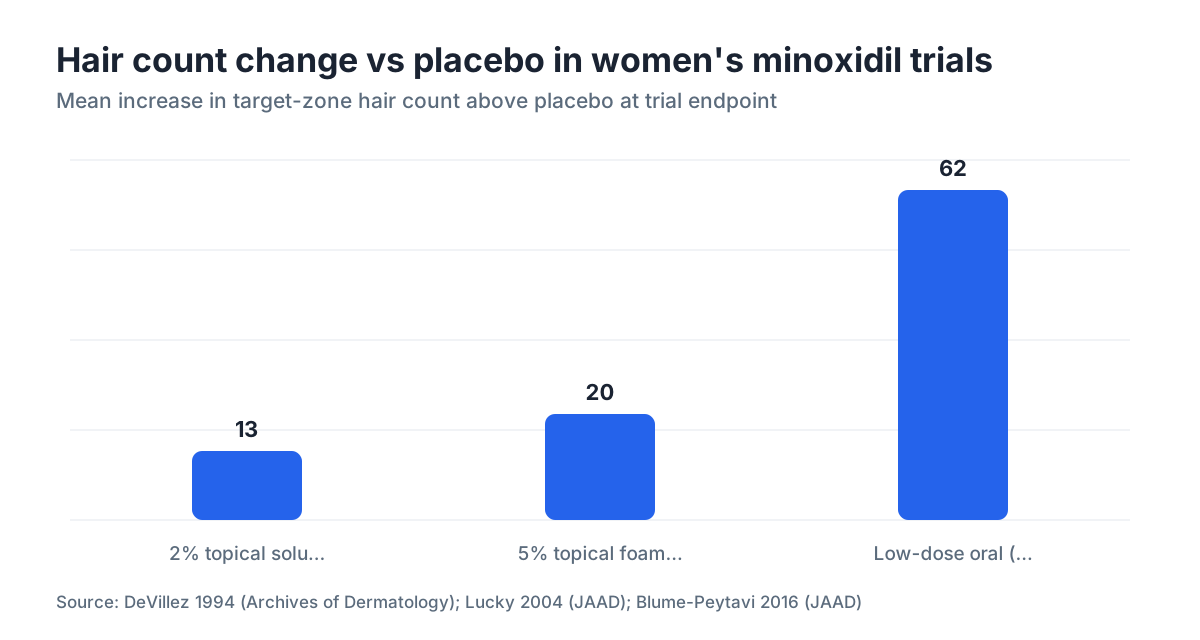
Here is what the major outcome measures look like across the main published trials:
| Study / Formulation | Duration | % Reporting Regrowth | Mean hair count change vs placebo |
|---|---|---|---|
| DeVillez 1994 (2% solution) | 32 weeks | ~40% "minimal" to "moderate" | +13 hairs/cm² |
| Olsen 2004 (5% solution vs 2%) | 48 weeks | 5% outperformed 2% | not directly reported |
| Lucky 2004 (5% foam vs placebo) | 24 weeks | higher in 5% foam arm | statistically significant |
| Blume-Peytavi 2016 (low-dose oral) | 24 weeks | ~62% improved | subjective global assessment |
None of those numbers mean full restoration. They mean the treatment moves the needle in the right direction for a meaningful share of users. [4][5]
Does 2% or 5% minoxidil work better for women?
5% delivers more minoxidil to the follicle and the trial data suggests modestly better efficacy than 2% for women. The tradeoff is a higher rate of facial hair growth (hypertrichosis), which showed up in about 3-5% of women using 5% solution in early trials. [3]
The 5% foam formulation largely solved this problem. Foam goes on a dry scalp and dries quickly before it can run onto the face. The hypertrichosis rate in foam trials was much lower, closer to 1-2%, making 5% foam the most commonly recommended starting point by dermatologists today.
Practically: if you have a sensitive scalp or find foam hard to apply to long hair, the 2% solution (with a dropper) is easier to distribute evenly. Some women do better with the solution simply because they can target their part line more precisely.
For a direct comparison of how women's regimens differ from men's, see minoxidil for men.
How long does it take to see results?
Real regrowth takes time. Most dermatologists tell patients to commit to 12 months before judging whether minoxidil is working. Here is the rough timeline based on trial data and clinical experience:
Months 1-2: Possible increase in shedding. This is normal. Resist stopping. Months 3-4: Shedding slows. Some women notice baby hairs (vellus hairs transitioning to terminal). Months 6-8: The clearest indicator window. Most of whatever response you will get is visible by month 8. Hair counts and global photography assessments in trials typically measured at 24-32 weeks for this reason. Months 9-12: Further gradual thickening in responders. Plateau in some.
After 12 months with consistent twice-daily application and no visible improvement, the evidence for continuing is weak. Switching formulations (from solution to foam, or adding oral minoxidil) or adding a DHT blocker are logical next steps to discuss with a dermatologist at that point.
One realistic expectation to set: even in responders, the goal is arrest of progression plus partial regrowth, not restoration to pre-thinning density. That is a meaningful outcome, just not a complete one.
What happens if you stop using minoxidil?
This is the single most important thing to understand before you start. Minoxidil does not fix the underlying cause of FPHL. It shifts follicles into a longer growth phase while you use it. Stop, and those follicles revert within 3-6 months, sometimes faster. [2]
The hair you regained is not permanent. You will not end up worse than if you had never started, but you will return roughly to where you would have been without treatment. For a condition that also progresses with age, that means the net result of stopping is a noticeable drop in density.
This reality changes the cost calculation. Two applications per day, every day, indefinitely. If that does not fit your life, think it through before you invest time and money in a several-month trial.
Are there women who should not use minoxidil?
Yes. The FDA label specifically says minoxidil should not be used during pregnancy. Animal studies showed fetal harm at high doses, and though topical absorption is low (estimated at roughly 1-2% of applied dose systemically), no adequate human pregnancy studies exist. [3] Women who are pregnant, trying to conceive, or nursing should not use minoxidil without a direct conversation with an OB and dermatologist.
Women with scalp conditions like psoriasis, eczema, or seborrheic dermatitis should know that minoxidil solutions contain propylene glycol, which can irritate compromised skin. The foam formulation avoids propylene glycol entirely, which is one more reason it is often preferred.
Kidney disease warrants caution with oral minoxidil specifically, since the oral form does carry meaningful systemic effects including fluid retention and reflex tachycardia at higher doses. Topical minoxidil at label doses is generally well tolerated. See minoxidil side effects for a thorough look at what to watch for.
If your thinning is patchy (not diffuse), get evaluated before starting minoxidil. Alopecia areata looks nothing like FPHL on a biopsy but can present similarly to a casual observer, and the treatment paths are completely different.
Can minoxidil be combined with other treatments for better results?
Yes, and for women with significant FPHL, combination therapy is increasingly standard practice.
The most studied combination in women is minoxidil plus an antiandrogen. Spironolactone is prescribed off-label in the U.S. for FPHL and has a reasonable evidence base. A 2017 retrospective study found 75% of women treated with spironolactone alone or in combination reported stabilization or improvement. [6] It is not FDA-approved for hair loss specifically, but it is one of the more commonly used dermatology adjuncts for premenopausal women.
Finasteride is FDA-approved for men only and is generally not recommended for premenopausal women because of fetal risk (category X for pregnancy). Some postmenopausal women use it off-label. The evidence is mixed. The AAD guidelines note the data is insufficient to recommend it routinely for women. [1] See finasteride for the full picture on how it works.
For women wanting to explore both options together, finasteride and minoxidil covers what the combination data looks like (mostly in men, but with emerging female data).
Platelet-rich plasma (PRP) injections are another combination partner some dermatologists use alongside minoxidil. The evidence is preliminary and the cost is high (typically $1,500-$3,500 for an initial series with no guarantee of benefit), but small randomized trials are showing positive signals. The data is not strong enough to call it standard of care yet.
At some point, if medical treatment has been exhausted, a hair transplant consultation becomes relevant. Women with FPHL are generally considered poorer transplant candidates than men because the diffuse pattern means even donor areas may be thinning, but selected cases do well.
How do you use minoxidil correctly to maximize results?
Application technique matters more than most product inserts suggest.
For topical solution: apply 1 mL twice daily to a dry scalp. Part the hair and apply directly to the scalp surface, not the hair shaft. The dropper lets you target the part line and crown directly.
For 5% foam: dispense half a capful, apply to affected areas on dry scalp, spread with fingertips, and let it air dry before styling. Do not wash the scalp for at least 4 hours after application. The manufacturer recommends applying at least twice daily.
Consistency matters far more than any particular brand. Generic minoxidil is bioequivalent and costs significantly less. The active ingredient is identical. A 3-month supply of generic 5% foam runs roughly $15-30 at most pharmacies compared to $50-70 for brand-name Rogaine. The branded premium is entirely marketing.
Space the second application about 12 hours after the first (morning and before bed). That roughly matches minoxidil's 8-12 hour activity window in follicle tissue based on pharmacokinetic data, though the studies were not designed to test specific timing intervals definitively.
If you are unsure how your particular pattern of thinning compares to FPHL norms, a tool like the free AI scan at MyHairline can help you characterize what you are seeing before committing to a treatment plan.
What does success look like and what are realistic expectations?
A realistic successful outcome for a woman with FPHL using minoxidil: thinning stops progressing, the part looks a bit narrower after 6-12 months, and hair feels slightly thicker. Global photography at 12 months shows stable or improved density compared to baseline. This is a real win.
A realistic unsuccessful outcome: no visible change after 12 months of consistent use. This happens to roughly 40-60% of users depending on the trial and how response is defined. [4] Genetics, duration of thinning before treatment, age, and the health of remaining follicles all influence response.
The earlier you start, the better. Follicles that have been producing miniaturized hairs for decades are less likely to recover than follicles that recently began thinning. This is one of the clearest messages from the FPHL literature and a strong argument for not waiting.
Photograph your scalp at baseline under consistent lighting before you start any treatment. Almost no one does this and everyone should. It is the only way to objectively assess what a year of treatment has actually done.
Are there any natural or supplement alternatives worth considering?
Honestly, the evidence gap between minoxidil and most supplement alternatives is large. Minoxidil has decades of randomized controlled trials and FDA approval. Most supplements have small, short studies with industry funding and no FDA oversight.
Nutritional deficiencies that cause thinning (iron, ferritin below roughly 40 ng/mL, vitamin D, zinc) are worth correcting because fixing an actual deficiency can stop shedding. But supplementing a nutrient you are not deficient in has no demonstrated benefit for hair. [7]
Biotin is the classic example of overselling: it matters for hair if you are genuinely biotin-deficient (rare) but clinical studies in women without deficiency show no regrowth benefit. A 2017 systematic review found all cases of biotin supplementation for hair in the literature involved a pre-existing deficiency. [7]
Ketoconazole shampoo (1% OTC or 2% prescription) has small trial data suggesting mild benefit for FPHL when used alongside minoxidil, thought to work through anti-inflammatory and mild anti-androgen mechanisms at the scalp. It is cheap, low-risk, and reasonable to add.
For a broader look at what supplements have real evidence, see hair loss supplements.
If you think stress or a shock event triggered your thinning rather than FPHL, read about telogen effluvium first, because that condition often resolves on its own within 6-12 months and may not require minoxidil at all.
Where do you get minoxidil and how much does it cost?
Topical minoxidil is available over the counter at pharmacies, big-box stores, and online retailers in the U.S. without a prescription. Generic 2% solution and 5% foam are both available OTC.
Oral minoxidil requires a prescription and is almost always used off-label for hair loss. Dermatologists typically prescribe 0.25 mg to 1.25 mg daily for women, far below cardiovascular doses. Cost varies but generic oral minoxidil tablets (2.5 mg, split) can run under $10/month at compounding pharmacies or with GoodRx at standard pharmacies.
The American Academy of Dermatology's current FPHL guidelines list topical minoxidil as a grade A recommendation (strong evidence, multiple trials) and the only FDA-approved topical for this indication. [1]
If you are spending money on treatments beyond minoxidil before confirming a diagnosis and trying the first-line option for 12 months, you are likely wasting money. That is a direct opinion, not a hedge. The basic treatment is cheap, proven, and easy to get. Try it first.
For women who want an AI-assisted look at their thinning pattern before seeing a dermatologist, MyHairline's free scan can help frame the conversation.
Sources
- American Academy of Dermatology, Hair Loss in Women guidelines
- Randomski & Shapiro, Minoxidil pharmacology review, Journal of Investigative Dermatology Symposium Proceedings 2003
- FDA, Rogaine Women's (minoxidil 2%) and 5% foam labeling
- DeVillez RL et al., Androgenetic alopecia in the female, Archives of Dermatology 1994
- Lucky AW et al., A randomized, placebo-controlled trial of 5% and 2% topical minoxidil solutions in the treatment of female pattern hair loss, Journal of the American Academy of Dermatology 2004
- Sinclair R et al., Spironolactone for female pattern hair loss retrospective study, International Journal of Dermatology / Australasian Journal of Dermatology
- Patel DP et al., A systematic review of the use of biotin for hair loss, Skin Appendage Disorders 2017
- Blume-Peytavi U et al., A randomized double-blind placebo-controlled pilot study to assess the efficacy of a 24-week low-dose oral minoxidil treatment in patients with androgenetic alopecia, Journal of the American Academy of Dermatology 2016
- NIH MedlinePlus, Minoxidil topical
- Olsen EA et al., A multicenter, randomized, placebo-controlled, double-blind clinical trial of a novel formulation of 5% minoxidil topical foam versus placebo in the treatment of androgenetic alopecia in men, Journal of the American Academy of Dermatology 2007 (foam vehicle data applicable to women's foam registration)