TL;DR: Minoxidil can regrow some hair at the temples, but results are modest and slower than at the crown. Most studies show measurable regrowth at 16-24 weeks, with peak results around 12 months. The temples are an androgen-sensitive zone, so minoxidil works best when hair loss there is early or ongoing, not long-established. Finasteride combined with minoxidil tends to outperform either drug alone.
Why the temples are harder to regrow than the crown
The temples are where male-pattern hair loss usually starts. That makes them the most emotionally loaded area for most men, and also, frustratingly, the area where minoxidil works worst.
The reason comes down to androgen sensitivity. Hair follicles at the temples carry more androgen receptors and respond more aggressively to dihydrotestosterone (DHT) than follicles at the crown or vertex. Once a follicle miniaturizes below a certain threshold, it enters a permanent resting state and stops cycling. Minoxidil can't reverse that. What it can do is extend the growth phase (anagen) in follicles that are still cycling but thinning. So timing matters enormously: early intervention, when follicles are miniaturizing but still alive, gives you a real shot. A completely smooth temple that has been bare for years is a different, much harder problem [1].
There's also a structural issue. The scalp at the temples is thinner and has different blood-vessel density than the vertex. Some researchers believe this affects how well topical minoxidil penetrates and reaches the follicle base, though direct comparative data on absorption by scalp region are limited [2].
What does minoxidil actually do to hair follicles?
Minoxidil is a potassium-channel opener. It dilates blood vessels, which is why it was originally developed as an oral blood-pressure drug in the 1970s. Researchers noticed an obvious side effect: hypertrichosis, meaning hair grew in unusual places. That led to topical formulations for the scalp [12].
At the follicle level, minoxidil does two things: it shortens the resting phase (telogen) and prolongs the active growth phase (anagen). More follicles spend more time actively growing, and the hairs that grow tend to be thicker in diameter. It does not lower DHT. That's the key limitation for temple hair loss, which is primarily DHT-driven. Minoxidil works around the cause rather than addressing it [3].
The FDA has approved 2% and 5% topical minoxidil for androgenetic alopecia. The agency's approval language specifies regrowth at the vertex scalp, not the temples, because the registration trials were built around the crown. Temples were never a primary endpoint in those studies [3]. That doesn't mean minoxidil does nothing at the temples. It means the evidence is weaker and the effect size is smaller.
How long does minoxidil take to regrow temple hair?
This is the question everyone wants a clean answer to, and the honest answer is messier than most websites admit.
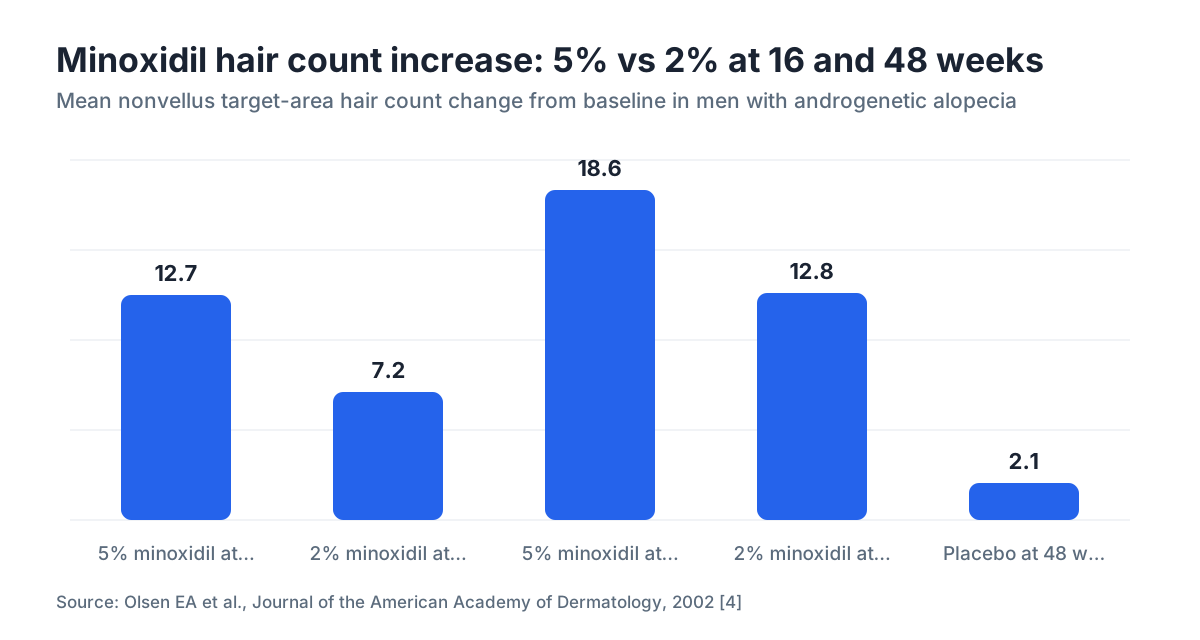
For the crown, the most-cited trials show statistically significant hair count increases at 16 weeks, with peak benefit somewhere between 48 and 52 weeks [4]. For the temples specifically, there is no large randomized controlled trial that used temple regrowth as a primary endpoint. The data we have come from smaller studies, case series, and extrapolation from broader hairline trials.
A 2021 Dermatologic Therapy systematic review of frontal hairline and temple studies found meaningful regrowth responses took longer at the hairline than at the vertex, with most responders showing visible improvement between 24 and 48 weeks [5]. The 6-month mark is roughly when you can make an honest assessment of whether you are responding. Before that, you may see shedding (more on that below), not yet any new growth.
Here's a realistic timeline:
| Time on minoxidil | What to expect at temples |
|---|---|
| 0-6 weeks | Possible shedding as resting hairs are pushed out |
| 6-16 weeks | Shedding slows; fine vellus hairs may appear |
| 16-24 weeks | First visible regrowth in responders |
| 6-12 months | Continued thickening; peak density not yet reached |
| 12-18 months | Closest to maximum response for most users |
If you see zero change by month 9 or 10, you are likely a non-responder at that site.
Will you shed hair first before it grows back?
Almost certainly, yes. The initial shedding phase is so common it has a name: minoxidil-induced telogen effluvium. When you start minoxidil, follicles in a prolonged resting phase are pushed prematurely into the next growth cycle, which first means shedding the old hair before the new one grows in. This is actually a sign the drug is doing something.
The shed usually peaks around weeks 4 to 8 and resolves by week 12 to 16. It can feel alarming. Some men stop the drug during this window, which is exactly the wrong call. If the shed continues past 4 months without any new growth following it, that warrants a conversation with a dermatologist, because prolonged shedding can have other causes [6].
See our deeper look at telogen effluvium if you want to understand the shed-regrowth cycle in more detail.
Does 5% minoxidil work better than 2% for temples?
For most men, yes, 5% outperforms 2%. The Olsen et al. trial published in the Journal of the American Academy of Dermatology in 2002 compared 5% and 2% minoxidil in men with androgenetic alopecia and found the 5% group had statistically more nonvellus hair counts at week 16 and week 48 [4]. The gap was roughly 45% greater hair count increase at 48 weeks for 5% versus 2%.
For women, the picture is different. The FDA-approved concentration for women is 2%, and 5% carries a higher risk of facial hypertrichosis (unwanted face and forehead hair) in women. For men without that concern, 5% is generally the better starting point.
Foam formulations are also often better tolerated than solution at the temples because the solution's propylene glycol base can irritate thinner scalp skin, and the foam dries faster, reducing forehead drip [2].
For a full breakdown of dosing and formulation options for men, see our guide on minoxidil for men.
What about oral minoxidil for temple regrowth?
Oral minoxidil at low doses (0.25 mg to 5 mg daily) has attracted real clinical attention since around 2019. A 2021 review in the Journal of the American Academy of Dermatology by Randolph and Tosti found low-dose oral minoxidil (1-5 mg) produced significant hair density improvement in both men and women with androgenetic alopecia, including at the frontal hairline [7]. Dermatologists are increasingly prescribing it off-label for hairline and temple cases where topical application is inconvenient or poorly tolerated.
Oral minoxidil has some real advantages for temples. You don't have to apply it directly to an area that is hard to reach without getting it on your forehead. Systemic delivery means blood-level exposure doesn't depend on where you rub the liquid. The tradeoffs are cardiovascular side effects (fluid retention, heart rate changes) and the hypertrichosis risk elsewhere on the body.
Oral minoxidil is a prescription-only drug in the United States. You need a physician evaluation before starting. Our article on oral minoxidil covers dosing, risks, and the off-label prescribing context in detail.
Does adding finasteride make temple regrowth more likely?
Yes, and this combination is probably the most important thing in this article.
Minoxidil stimulates growth. Finasteride removes the cause by blocking the 5-alpha-reductase enzyme that converts testosterone to DHT, cutting scalp DHT levels by roughly 60% at the 1 mg daily dose [8]. Since DHT-driven miniaturization is why temples recede in the first place, stopping that process lets minoxidil's pro-growth effects work on follicles that aren't simultaneously being damaged.
A 2004 study in Dermatologic Surgery by Arca and colleagues compared finasteride alone, minoxidil alone, and the combination in men with androgenetic alopecia and found the combination group had the highest hair count increases at 12 months. The study was small (n=68), but it pointed the same direction as the clinical consensus that has solidified since [9].
For men with actively receding temples, most dermatologists today will recommend the combination if you have no contraindications to finasteride. See our full article on finasteride and minoxidil for the evidence behind combining them.
Finasteride does carry its own risk profile, including the well-documented possibility of sexual side effects in a minority of men. Read our finasteride article before starting.
How do you apply minoxidil specifically to the temple area?
Application technique matters more at the temples than at the crown because the area is small, and it's easy to get the product on your hairline or forehead, where it can cause unwanted hair growth.
For topical 5% foam: dispense about half a capful, let it dissolve into your fingertips (not your palms, because palm temperature melts it too fast), then press gently into the temple zone. Part the hair if any remains in that area. Let it dry fully before touching your face.
For topical solution with a dropper: use the smallest dose needed to cover the temple zone, roughly 0.5 to 1 ml per side. Apply with the dropper tip as close to the scalp as possible. Tilt your head slightly forward so solution doesn't run down your forehead.
Apply twice daily, roughly 12 hours apart. FDA labeling specifies this schedule for a reason: minoxidil's vasodilatory effect has a finite duration, and once-daily application appears less effective [3]. Wash your hands immediately after application. Don't apply to irritated, cut, or sunburned skin.
Don't lie down within 30 minutes of application. Pillow contact transfers the drug and can cause facial hypertrichosis.
What results are realistic, and what should you not expect?
Honest answer: for most men with Norwood 2-3 hairlines, meaning early to moderate temple recession, minoxidil can produce visible, meaningful regrowth. It won't restore the hairline of a 16-year-old, but it can push it back from Norwood 3 toward Norwood 2, thicken up thinning areas, and slow future loss if you keep using it.
For Norwood 4 and above, with large bald patches, minoxidil's realistic contribution at the temples is modest. The follicles most responsible for that area are likely dead or too miniaturized to respond. In those cases, hair transplant surgery is usually the most reliable path to meaningful temple reconstruction.
Regrowth is also reversible. Stop minoxidil and most of what you gained is gone within 3 to 6 months, because the underlying DHT-driven miniaturization resumes. This is a maintenance drug, not a cure.
Nobody has good long-term data on exactly what percentage of temple-specific applications result in visible regrowth versus stabilization versus continued loss. The honest range from available studies is somewhere between 30-60% of men see meaningful improvement at the hairline/temple with topical minoxidil, with the rest seeing stabilization or no response [5]. Responders skew younger, have shorter duration of loss, and start treatment sooner after recession begins.
To understand your specific Norwood stage and what treatments make sense, you can use the free AI hair loss scan at MyHairline, which maps your current pattern before you commit to any treatment.
What else affects whether your temples respond to minoxidil?
Age is a factor. Men in their 20s and early 30s with recently receding temples respond better than men in their 50s with long-established recession. The older you are, the more follicles are likely past the point of activation.
Genetics influences both your underlying loss pattern and whether your follicles have the enzyme pathways minoxidil relies on. Minoxidil is a prodrug: it converts to minoxidil sulfate in the scalp via an enzyme called sulfotransferase. Low sulfotransferase activity, which is genetic, correlates with poor response. There is a commercially available hair follicle test (from companies like TrichoTest) that claims to predict sulfotransferase activity and therefore minoxidil response likelihood, though it's not yet standard of care [2].
Smoking reduces scalp microcirculation and is associated with worse minoxidil outcomes. Scalp inflammation, seborrheic dermatitis, or chronic dandruff creates a hostile environment for follicle recovery and should be treated alongside minoxidil if present. Addressing what causes hair loss from a broader perspective often reveals treatable contributors people miss.
DHT is the dominant driver of temple recession in men. So if you're using minoxidil alone and not blocking DHT via a DHT blocker, you are treating the symptom without addressing the cause. Finasteride or dutasteride does the DHT blocking; minoxidil does the growth stimulation. The combination is more than additive for many men.
Are there alternatives if minoxidil doesn't work on your temples?
Yes, several, and they vary a lot in evidence quality and cost.
Finasteride or dutasteride alone can slow or stop temple recession and, in some men, produce modest regrowth. They're not as pro-growth as minoxidil, but they address the cause rather than the symptom.
Low-level laser therapy (LLLT), available in combs, helmets, and caps cleared by the FDA as devices (not drugs), has some evidence for vertex regrowth. Temple evidence is thinner. A 2013 trial in the American Journal of Clinical Dermatology found statistically significant hair density improvement with LLLT versus sham in men and women with androgenetic alopecia, but it wasn't temple-specific [10].
Platelet-rich plasma (PRP) injections directly into the scalp have a growing evidence base, particularly for hairline and temple areas. A 2019 meta-analysis in Dermatologic Surgery found PRP increased hair density and thickness, with some hairline-specific subgroup data [11]. It's not cheap, typically $500-$2,500 per session, and requires multiple sessions.
Hair transplant surgery, specifically Follicular Unit Excision (FUE), is the most reliable way to physically restore temple hair when medical therapy has failed or is unlikely to work. The temples are technically demanding to transplant because natural temple hair grows at extreme angles, but an experienced surgeon can recreate a realistic hairline. Our hair transplant article covers costs, techniques, and what to ask a surgeon.
If you are exploring multiple options, it's worth looking at hair loss supplements and understanding receding hairline patterns to know which interventions are appropriate at your current stage.
Sources
- American Academy of Dermatology, Hair loss: Who gets and causes
- Gupta AK et al., Dermatologic Therapy, 2021, Minoxidil: a review of clinical evidence for scalp hair loss
- FDA, Minoxidil Topical Solution and Foam prescribing information and OTC labeling
- Olsen EA et al., Journal of the American Academy of Dermatology, 2002, A randomized clinical trial of 5% topical minoxidil versus 2% topical minoxidil and placebo in the treatment of androgenetic alopecia in men
- Gupta AK & Talukder M, Dermatologic Therapy, 2021, Systematic review of treatments for frontal fibrosing alopecia and hairline loss including minoxidil
- American Academy of Dermatology, Telogen effluvium: diagnosis and management
- Randolph M & Tosti A, Journal of the American Academy of Dermatology, 2021, Oral minoxidil treatment for hair loss: a review of efficacy and safety
- Kaufman KD et al., Journal of the American Academy of Dermatology, 1998, Finasteride 1 mg is safe and effective in the treatment of male pattern hair loss
- Arca E et al., Dermatologic Surgery, 2004, An open, randomized, comparative study of oral finasteride and 5% topical minoxidil in male androgenetic alopecia
- Lanzafame RJ et al., American Journal of Clinical Dermatology, 2013, The growth of human scalp hair mediated by visible red light laser and LED sources in males
- Gupta AK et al., Dermatologic Surgery, 2019, Platelet-rich plasma as a treatment for androgenetic alopecia: systematic review
- NIH MedlinePlus, Minoxidil topical