

TL;DR: Transplanted follicles are genetically resistant to DHT and don't depend on minoxidil to survive. You can stop minoxidil without losing your transplanted hair. What you risk losing is the native, non-transplanted hair around it. Most surgeons recommend continuing minoxidil to protect that surrounding hair and hold onto your overall density.
What actually happens to transplanted hair if you stop minoxidil?
Nothing happens to the transplanted hair itself. That's the short answer, and it's worth understanding why.
Hair transplants work by moving follicles from a donor zone, almost always the back and sides of the scalp, to a thinning area. Those donor follicles are selected specifically because they are genetically programmed to resist dihydrotestosterone (DHT), the hormone responsible for androgenetic alopecia [1]. That resistance moves with the follicle. Once the graft survives and establishes a blood supply in its new location, it behaves like donor hair for life. Minoxidil had nothing to do with getting it there, and stopping minoxidil does not trigger its loss.
Minoxidil is a vasodilator. It widens blood vessels near the scalp and appears to extend the anagen (growth) phase of the hair cycle [2]. For miniaturized, DHT-sensitive follicles, that extension can be the difference between producing a visible hair and shedding. But a healthy, DHT-resistant transplanted follicle is not miniaturizing in the first place. It does not need the anagen extension the same way.
So the fear that stopping minoxidil will cause your grafts to fall out isn't supported by how transplant biology works. Your surgeon didn't warn you about it because it isn't a real risk for the transplanted hair.
Why do so many surgeons still tell you to keep using minoxidil after a transplant?
Because the transplanted hair is only part of your scalp.
Most people who get a hair transplant still have some native hair in and around the recipient area. That native hair is still DHT-sensitive. It was thinning before surgery, and it will keep thinning after surgery unless something slows the process down. Minoxidil is one of the two FDA-approved treatments for that ongoing loss [2].
If you stop minoxidil after a transplant, the transplanted hair stays. The native hair between grafts continues to thin and eventually shed. The visual result is that your overall density drops over the coming years, even though your surgical result is technically intact. You might end up needing a second procedure sooner than you would have otherwise.
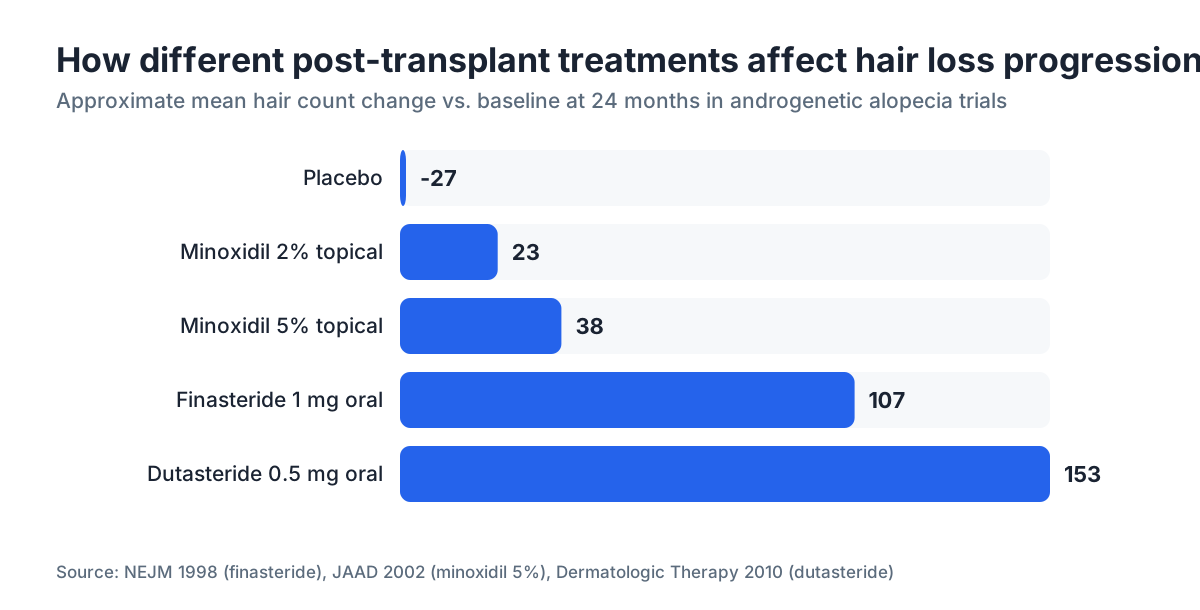
Surgeons also sometimes recommend minoxidil in the first few months post-transplant to help the grafts establish, though the evidence for that specific benefit is thinner than the evidence for its general efficacy in androgenetic alopecia. A 2002 study in the Journal of the American Academy of Dermatology found that 5% topical minoxidil produced hair count increases of roughly 15 to 17 hairs per cm² over placebo in men with androgenetic alopecia [3]. Whether that same effect applies to post-transplant grafts specifically is much less studied.
Here's the practical read: surgeons recommend continuing minoxidil not to protect your grafts but to protect everything else on your head.
What is the shedding people notice when they stop minoxidil?
When you stop minoxidil after using it for a while, you often see a shed within weeks to a couple of months. This is real, and it can look alarming.
What's happening is a rebound effect. Minoxidil was artificially holding hairs in the anagen (growth) phase. When you withdraw it, those hairs enter telogen (resting) and then shed. The hair that falls out is native hair the drug was propping up. It's essentially the hair loss you would have experienced if you had never started minoxidil, catching up with you. This kind of abrupt shed is a form of telogen effluvium [4].
This shedding applies to native, DHT-sensitive hair. It does not apply to healthy transplanted grafts, which run their own growth cycle independent of the drug.
The shed does not mean the follicles are permanently dead. In many cases, the miniaturized native hairs that were sustained by minoxidil will settle into whatever state they would have reached anyway without treatment. Some people restart minoxidil after seeing the shed and partially recover. Others accept the loss and don't restart. But in neither case do the transplanted grafts join that shed in any meaningful way.
If you want to stop minoxidil cleanly, the safest approach is to taper rather than quit abruptly, and to time it well after your transplant is fully settled (most surgeons consider the graft fully integrated at 12 to 18 months post-op).
Does the type of transplant (FUE vs. FUT) change whether you can stop minoxidil?
No. The underlying biology is the same regardless of technique.
Follicular unit excision (FUE) and follicular unit transplantation (FUT, also called strip surgery) both harvest follicles from the DHT-resistant donor zone. The extraction method differs but the follicle's genetic resistance does not. Once those follicles are grafted and healed, their survival does not depend on minoxidil regardless of which technique placed them there.
What does matter is graft survival in the immediate post-operative period, and that's about blood supply, trauma, and surgical skill, not about minoxidil use. Most surgeons actually ask patients not to apply topical minoxidil for at least two weeks after surgery to avoid irritating fragile newly placed grafts [5]. So the drug gets paused right at the most delicate moment for graft survival, and the grafts survive just fine.
After that initial healing window, surgeons may recommend restarting minoxidil, but again, that recommendation is about protecting native hair, not grafts.
If you're trying to decide whether to pursue a hair transplant and are worried about being locked into minoxidil forever afterward, the answer is you're not. You can stop it. The cost is potential acceleration of native hair loss, not loss of your surgical investment.
How long after a transplant can you safely stop minoxidil?
From the perspective of protecting your grafts, you could technically stop anytime after the initial post-operative healing window, which is roughly two to four weeks. The grafts will not fall out.
From the perspective of your overall hair, the question is different. Most dermatologists would put it this way: if you were on minoxidil for androgenetic alopecia before the transplant, stopping it after the transplant means your underlying condition is now unmanaged. There's no magic moment when it becomes safe to stop managing a progressive condition.
If you want a practical framework: the grafts are fully integrated and growing normally by 12 to 18 months post-surgery [5]. At that point, if you decide to stop minoxidil, you can read your baseline density clearly and make an informed choice about what you're willing to risk in native hair loss.
Some people stop minoxidil here and stay satisfied with their transplant result even as some native hair continues to thin. Others continue minoxidil or add finasteride to better address the root cause of ongoing DHT-driven loss. Finasteride (1 mg daily, the prescription dose for hair loss) reduces scalp DHT levels by roughly 60 to 70% and produced statistically significant improvements in hair count at two years compared to placebo [6]. It works at a different level than minoxidil does.
The combination of finasteride and minoxidil together, covered in more depth at finasteride and minoxidil, is what many hair loss specialists consider the strongest non-surgical maintenance regimen.
What happens to native hair if you stop minoxidil permanently after a transplant?
The native hair that was being sustained by minoxidil will likely thin and shed over the following months. How fast and how much depends on where you were in the progression of your androgenetic alopecia, your age, and your genetics.
For men, the underlying pattern tends to follow the Norwood scale. If you're a Norwood III or IV before surgery, you may have substantial native hair in the recipient zone that minoxidil was helping maintain. Stopping minoxidil removes that support and the natural progression continues.
This is not a catastrophic outcome for everyone. Some people have already lost most of their vulnerable native hair by the time they get a transplant, so there's relatively little left to lose. Others, particularly younger patients who get a transplant earlier in their hair loss progression, have more native hair at stake.
Here's the honest read. Stopping minoxidil after a hair transplant is a legitimate choice, but it's a trade-off. You keep the transplanted hair. You accept that the native hair will follow its natural course. If the cosmetic result is still acceptable without that native hair, stopping makes sense. If you need that native hair to look dense, continuing minoxidil (or switching to an alternative like oral minoxidil, which some patients find easier to stick with) is the smarter move.
For a broader picture of what drives hair loss in the first place, what causes hair loss covers the mechanisms in detail.
Is minoxidil required after a hair transplant, or is it optional?
Optional. Full stop.
No hair transplant clinic can require you to take any medication, and minoxidil is not a prerequisite for graft survival. Your transplanted hair will grow without it.
What surgeons do, appropriately, is advise it. The distinction matters. Advice is based on what optimizes your long-term result. The recommendation to continue minoxidil is about protecting native hair and holding density, not about keeping your grafts alive.
If you have contraindications to minoxidil, or if the minoxidil side effects are genuinely wrecking your quality of life, stopping is a reasonable decision. Common side effects from topical minoxidil include scalp irritation, dryness, and for some people, initial increased shedding in the first few weeks of use. Oral minoxidil carries a different, more systemic side effect profile including fluid retention and unwanted facial hair growth in some patients [7].
If you're stopping because you find the treatment inconvenient rather than because it's causing harm, reconsider. Minoxidil for men is one of the most cost-effective hair loss interventions available, usually $10 to $30 per month for the generic topical form. That's a small cost to hold native hair density around a surgical result you may have paid $5,000 to $15,000 for.
But ultimately it's your call, and the fear of losing transplanted hair should not be the thing keeping you on it.
What does the research say about minoxidil and transplant outcomes?
The direct research on minoxidil specifically in post-transplant patients is limited. Most of the big minoxidil efficacy trials studied men with androgenetic alopecia who had never had a transplant.
A frequently cited study published in the Journal of the American Academy of Dermatology found that 5% topical minoxidil was superior to 2% in men, with patients showing significantly greater hair count and hair weight increases at the higher concentration [3]. That tells us about efficacy in native androgenetic alopecia, not about post-transplant graft survival.
What we do have is a strong mechanistic argument. Transplanted hair's DHT resistance is a physical, genetic property of the follicle, not something a vasodilator switches on or off. There is no published study showing that transplanted, DHT-resistant follicles shed when minoxidil is discontinued. The absence of evidence here fits the biology.
There is some early evidence that minoxidil may speed up early graft growth when applied shortly after surgery, but even this isn't universally accepted in the surgical literature, and the risk of dislodging fragile new grafts means most surgeons prefer to wait before reintroducing it [5].
The American Academy of Dermatology lists both minoxidil and finasteride as first-line treatments for androgenetic alopecia [8], but makes no specific statement requiring their use post-transplant.
Nobody has good long-term randomized data specifically on stopping minoxidil post-transplant. What we have is biology, mechanism, and clinical consensus from experienced surgeons, which together point clearly in one direction: grafts are safe, native hair is the variable.
Are there alternatives to minoxidil for protecting hair after a transplant?
Yes, and for many people they're better options.
Finasteride is the most evidence-backed alternative. It works by inhibiting 5-alpha reductase, the enzyme that converts testosterone to DHT. Lower DHT means slower progression of androgenetic alopecia in DHT-sensitive follicles [6]. This addresses the cause of ongoing loss rather than just the symptom. The FDA approved finasteride 1 mg (Propecia) for male pattern hair loss in 1997 [9]. It's prescription-only and not approved for premenopausal women of childbearing age because of the risk of fetal harm.
Dutasteride is a related 5-alpha reductase inhibitor that blocks both type I and type II enzymes, compared to finasteride's type II blockade only. Some evidence suggests it reduces DHT more effectively and may produce better hair count outcomes, but it's not FDA-approved for hair loss (it's approved for benign prostatic hyperplasia) and gets used off-label [10]. It's covered more in the dht blocker overview.
Oral minoxidil is an option for people who find topical application inconvenient or irritating. Low-dose oral minoxidil (0.625 mg to 2.5 mg daily for women, 2.5 mg to 5 mg for men in most off-label protocols) has growing clinical support and skips scalp application entirely. Side effect profiles differ from topical; fluid retention and hypertrichosis (excess hair growth on the face and body) are the most commonly reported concerns [7].
Platelet-rich plasma (PRP) injections are sometimes offered at transplant clinics as an add-on. The evidence base is less consistent than for minoxidil or finasteride, and costs run substantially higher. It's not a substitute for established medical therapy in terms of evidence quality.
The combination you choose, or whether you choose any, should be a conversation with a board-certified dermatologist who knows your specific case. If you want a baseline sense of where your hairline and density stand before that conversation, a tool like MyHairline's free AI scan (/scan) can map your current pattern and give you something concrete to discuss.
How do you decide whether to stop or continue minoxidil after your transplant?
Think about it in two questions.
First: how much native hair do you still have in and around the transplanted area, and how much does that hair add to your current density? If you still have meaningful native coverage, minoxidil is doing real work for you. Stopping it means accepting those hairs are on their own. If most of the hair in the transplanted area is grafted hair and the native hair there was already mostly gone, stopping minoxidil has a much smaller cosmetic impact.
Second: what's your long-term plan for managing hair loss progression? A hair transplant moves existing hair. It doesn't stop DHT from acting on the hair you still have. If you're in your thirties and likely to progress further up the Norwood scale, ongoing medical therapy protects both your native hair and the overall density of your result. If you're older and your pattern looks stable, the calculus is different.
The practical move for most people who want to stop minoxidil is to taper the frequency rather than quit cold (to soften the rebound shed), wait until you're at least 12 months post-transplant so your result is fully mature, and photograph your scalp monthly for three to six months after stopping to track any change in native hair. If you see significant thinning in areas you care about, you can restart.
For ongoing monitoring, the free AI hair analysis at MyHairline (/scan) can track changes in density and pattern over time, giving you a visual record of what's actually happening instead of guessing.
And if you've never tried finasteride alongside your transplant plan, that conversation with a dermatologist is worth having. It addresses a different mechanism and for many people does more to preserve long-term density than minoxidil alone.
Sources
- National Library of Medicine, StatPearls: Hair Transplantation
- MedlinePlus (National Library of Medicine), Minoxidil Topical drug information
- Journal of the American Academy of Dermatology, Olsen et al. 2002: 5% vs 2% topical minoxidil in men
- American Academy of Dermatology, Hair loss types overview
- International Society of Hair Restoration Surgery, Patient Information
- New England Journal of Medicine, Kaufman et al. 1998: Finasteride in male pattern hair loss
- Journal of the American Academy of Dermatology, Randolph & Tosti 2021: Oral minoxidil review
- American Academy of Dermatology, Androgenetic alopecia (male and female pattern) treatment information
- FDA, Drugs@FDA database (Propecia finasteride 1 mg approval)
- Dermatologic Therapy, Eun et al. 2010: Dutasteride vs finasteride for male androgenetic alopecia